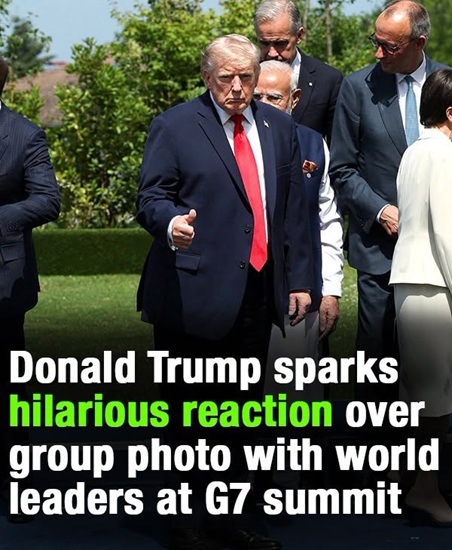
A brief moment involving Donald Trump during a recent G7 summit attracted widespread attention online after video footage began circulating across social media platforms. The short clip, which was viewed and shared by large numbers of people, appeared to show Trump stepping away from a group of international leaders as they prepared for an official photograph. Although the moment lasted only a few seconds, it quickly became the subject of discussion, analysis, and debate among viewers worldwide.
The G7 summit brought together leaders from several of the world’s largest economies to address important international topics, including economic cooperation, security concerns, trade relations, and ongoing geopolitical developments. These annual meetings are closely followed by governments, journalists, and members of the public because they often provide insight into how world leaders approach major global challenges. In addition to policy discussions, public appearances and official photographs frequently draw significant media attention.
As leaders gathered for one of the event’s traditional group photos, cameras captured a variety of interactions among participants. During that process, video footage appeared to show Trump moving away from the group before later returning to the designated area. Because the clip was brief and did not include extensive context, viewers interpreted the moment in different ways, leading to a variety of reactions across social media platforms.
The video spread rapidly online, where users examined the footage and shared their own opinions about what had taken place. Some critics suggested that the scene appeared awkward and questioned why Trump had stepped away from the group. Others viewed the incident as an ordinary occurrence that was receiving more attention than it deserved. The differing reactions demonstrated how a short video clip can generate multiple interpretations depending on the perspective of the audience.
Supporters of Trump strongly challenged many of the negative conclusions circulating online. They argued that isolated clips often fail to show the full context of an event and pointed out that official photo sessions involving numerous world leaders frequently require repositioning and movement. From their perspective, the moment did not indicate confusion or concern but was instead a routine part of a busy diplomatic gathering.
The discussion surrounding the footage also reflected the growing influence of social media in modern political coverage. Today, even a brief moment captured on camera can reach millions of people within hours. Public figures often find themselves at the center of widespread conversations triggered by short clips that may not fully represent everything happening during a larger event. As a result, online discussions can sometimes focus more on visual moments than on broader policy matters.
Despite the attention generated by the video, the primary purpose of the summit remained focused on diplomacy and international cooperation. Leaders spent much of their time discussing global economic conditions, regional security concerns, and strategies for addressing ongoing international challenges. Such gatherings provide opportunities for participating countries to coordinate policies and strengthen relationships with key allies.
Among the topics discussed at the summit were developments involving Iran and broader issues affecting stability in the Middle East. Leaders emphasized the importance of diplomatic engagement and international cooperation when addressing complex geopolitical situations. Security concerns, economic partnerships, and efforts to reduce tensions in various regions were among the subjects receiving significant attention during official meetings.
The summit also included conversations about economic growth, trade opportunities, and international cooperation on long-term challenges. Participating nations sought to identify areas where collaboration could help address shared concerns while supporting stability and prosperity. These discussions formed a major part of the event, even though they received less public attention than some of the viral moments captured by cameras.
Political observers often note that major international gatherings tend to generate two parallel narratives. One centers on the policy discussions and agreements taking place behind closed doors, while the other focuses on photographs, videos, and public interactions that capture attention online. In many cases, visual moments become the most widely shared aspects of an event, even when they are unrelated to the primary issues being discussed.
The viral reaction to the footage highlighted how quickly public attention can shift from complex diplomatic topics to a brief interaction caught on camera. While leaders were engaged in conversations about international cooperation, security, and economic policy, much of the online conversation focused on a single moment during a photo opportunity. This contrast illustrates the powerful role digital media plays in shaping public conversations around political events.
As discussions about the summit continued, opinions regarding the video remained divided. Some viewers believed the footage was significant, while others considered it a routine moment that had been amplified by social media. Regardless of individual interpretations, the clip became one of the most discussed visual moments associated with the gathering and continued to attract attention long after it was first shared.
Ultimately, the incident serves as another example of how modern political events unfold in an era of constant media coverage. Every gesture, movement, and interaction can be recorded, distributed, and analyzed within minutes. While the summit itself focused on major international issues affecting millions of people, a brief moment during an official photograph unexpectedly became one of the most widely discussed aspects of the event, demonstrating the lasting influence of digital media on public discourse.
