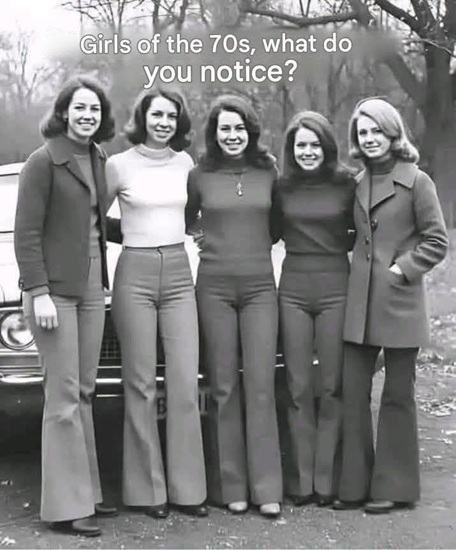
A vintage photograph showing young women during the 1970s can contain far more historical information than viewers initially expect. The first things that attract attention are often the clothing, hairstyles, facial expressions, or the way people are positioned around one another. Looking more carefully may reveal furniture, accessories, household objects, vehicles, or photographic characteristics associated with the period. These details can help modern viewers understand aspects of everyday life that are sometimes missing from traditional historical accounts.
At the same time, one photograph should never be treated as evidence of how every young woman or every family lived during the decade. Experiences differed considerably according to location, culture, family circumstances, income, age, and individual preference. Fashion is usually one of the most recognizable features of photographs from the era. Bell-bottoms and flared trousers became strongly associated with parts of 1970s fashion, while denim, patterned shirts, dresses, skirts, platform shoes, jackets, and colorful fabrics also appeared in different settings.
Trends changed throughout the decade, and not everyone followed the same styles at the same time. Clothing choices depended on what was available locally, what people could afford, what was considered appropriate for a particular occasion, and what individuals simply preferred to wear. Consequently, an ordinary photograph can document both larger fashion trends and highly personal choices. That combination makes everyday snapshots particularly valuable as visual records.
Hairstyles provide another noticeable connection with the period. Long hair, curls, waves, layered cuts, feathered styles, Afros, and many other looks could be seen during different parts of the 1970s and among different communities. No single hairstyle accurately represents every young woman from the decade. Hair could reflect fashion, cultural identity, practicality, personal taste, or inspiration from entertainers and other public figures. A style that appears unmistakably “1970s” to a modern viewer may have felt completely ordinary to the person wearing it. This difference between contemporary experience and later interpretation is an important part of understanding vintage photographs.
Accessories can provide additional clues without necessarily giving a photograph an exact date. Belts, scarves, handbags, necklaces, earrings, watches, sunglasses, and other objects frequently reflected changing tastes in fashion. However, people continued wearing clothes and accessories after particular trends had passed their peak. Fashion also spread at different speeds between cities, regions, countries, and social groups. For these reasons, identifying an entire photograph from a single garment or accessory can be unreliable. The strongest historical interpretation usually comes from considering several details together rather than relying on one visual clue.
The photographic process itself is one of the biggest differences between a 1970s snapshot and a photograph taken today. Consumer photography during the decade relied primarily on film. Instead of immediately appearing on a digital screen, an exposed image remained on the film until it was processed. Photographers therefore could not normally check every picture seconds after taking it and immediately decide whether another version was needed. Closed eyes, unexpected movements, imperfect framing, or unusual expressions might only become apparent after development. Many of the imperfections that now make vintage photographs seem spontaneous were connected to the practical realities of film photography.
Film also meant that photographers worked with a limited number of exposures before changing or replacing the film. The number depended on the camera and film format, so there was no universal number that applied to everyone. Film and processing also involved costs, which could influence how frequently photographs were taken in some households. This did not mean that people never took multiple photographs of the same subject or carefully planned a picture. They certainly did. The important distinction is that photography operated under physical and technological limitations very different from those of modern smartphones and digital cameras.
Seeing the finished photograph also required patience. Film usually needed to be processed before the images could be viewed in their final form. Depending on the type of film and available services, people might take it to a photo laboratory, store, or another processing service. The finished photographs could arrive considerably later than the moment when they were originally taken. Today, people can capture an image, inspect it, edit it, and distribute it almost immediately. Comparing these two processes helps explain why photography played a different role in everyday social interaction during the 1970s.
Color photography was already widely established, although black-and-white photography continued to be used as well. Many surviving color photographs from the period now show fading, shifts in color, scratches, dust, reduced contrast, or other signs of aging. These characteristics are often interpreted as part of the classic vintage appearance. However, some of them developed gradually after the photograph was created. Storage conditions, photographic materials, exposure to light, and the passage of time can all affect a print. The image seen today may therefore look different from the same photograph when it was newly developed decades ago.
The background of a photograph can sometimes reveal as much as the people in the foreground. Furniture, wallpaper, lamps, curtains, carpets, televisions, telephones, kitchen equipment, and decorative objects can provide useful clues about domestic environments. Something that seemed completely ordinary to the original photographer may become fascinating to viewers several decades later. A lamp or sofa that received no attention when the photograph was taken can eventually become an example of changing design preferences. Ordinary photographs unintentionally preserve this material culture. That makes them useful records of everyday environments rather than merely portraits of individuals.
Communication provides another major contrast between the 1970s and the present. Fixed landline telephones were an important form of personal communication, while smartphones and modern internet messaging did not exist. In many households, telephone access was shared among family members rather than being attached to one individual wherever that person traveled. Calling a friend could therefore mean contacting the household first. A parent, sibling, or another person might answer before the intended recipient came to the telephone. This created communication routines that can feel unfamiliar to people accustomed to private mobile devices.
Written correspondence also remained an established part of communication. Letters, postcards, greeting cards, and short written notes could connect friends and relatives across distance. Sending and receiving a letter naturally required more time than sending an electronic message. The sender could not expect an instant delivery notification or immediate response. That slower process influenced the rhythm of communication without necessarily making relationships better or worse. It was simply a different technological environment, and surviving letters now provide valuable physical records of everyday life.
Planning social activities also involved different practical limitations. Friends could arrange a place and time to meet, but changing those arrangements after everyone had left home was not as easy as sending a group message. Public telephones and other options could sometimes help, but constant personal connectivity was unavailable. It would be inaccurate to conclude from this that everyone was automatically more punctual, independent, or socially connected. Human behavior varied just as it does today. What can be established is that people coordinated their activities without the permanent mobile communication that later became normal.
Music was another central element of popular culture during the decade. The 1970s included rock, soul, funk, disco, country, reggae, punk, singer-songwriter music, and many other styles across different countries and communities. Vinyl records remained an important recorded-music format, while cassette tapes became increasingly significant and radio continued to connect audiences with new and familiar songs. Different listeners naturally had different musical experiences. Geography, age, local culture, personal taste, and access to recordings all affected what people heard. For this reason, there was never one universal soundtrack that represented every person’s experience of the decade.
Radio played an especially important role in music discovery. Listeners could hear songs selected by stations and broadcasters rather than choosing every track themselves. Local stations could develop recognizable personalities and introduce audiences to particular performers or musical styles. Hearing a favorite song could involve waiting for it to return to the broadcast schedule. Recorded music offered more control, but radio remained an important part of popular entertainment. Compared with today’s on-demand streaming environment, the relationship between listeners and music distribution was substantially different.
Television also helped shape popular culture. Programming structures varied significantly between countries and regions, and the number of available channels depended on location and technology. Viewers generally had fewer immediate choices than audiences using modern streaming platforms. Programs were commonly tied to schedules, which meant viewers needed to watch at particular times if they wanted to see a broadcast. Popular programs could become widely discussed cultural reference points. However, it would still be misleading to suggest that every household watched the same programs or shared identical opinions about them.
Printed magazines and newspapers provided another route through which fashion, entertainment, celebrities, and cultural trends reached audiences. Young readers could encounter photographs of musicians, actors, models, and other public figures through publications that arrived weekly or monthly rather than through feeds updated continuously throughout the day. Posters and magazine pages could remain on bedroom walls for long periods. Celebrity culture therefore existed long before social media, although the relationship between public figures and audiences worked through different communication channels. Understanding this difference provides a more accurate picture than assuming media influence began with the internet.
The circulation of personal photographs was also far more limited. A family snapshot might be stored in an album, placed in a frame, kept inside a box, mailed to a relative, or shown to friends during a visit. Additional prints could be produced, but distributing an ordinary photograph to thousands or millions of strangers required circumstances very different from today’s social networks. Most personal images remained within relatively small circles. This difference is significant because modern photographs are often created with potential online audiences in mind. Many ordinary film photographs were created primarily as private records.
As a result, countless everyday moments were never visually documented. Cameras certainly existed and photography was popular, but people did not carry smartphones capable of taking virtually unlimited photographs throughout the day. Cameras might appear at birthdays, vacations, graduations, holidays, family gatherings, school activities, and other occasions considered worth recording. Meanwhile, many routine conversations, walks, meals, and informal gatherings disappeared without leaving photographic evidence. The photographs that survived are therefore fragments rather than complete visual histories. They show what happened in front of the camera, not everything that occurred around it.
This selective record is important when interpreting the social atmosphere visible in vintage photographs. A group of young women laughing outdoors may create an impression of freedom and spontaneity, but a single image cannot establish what their lives were like outside that moment. They may have faced responsibilities, restrictions, challenges, or circumstances that the photograph does not reveal. A cheerful photograph documents a cheerful-looking instant, not an entire biography. Historical accuracy requires maintaining that distinction. Viewers can appreciate the emotion of an image without inventing unsupported stories about the people appearing in it.
Public spaces nevertheless played important roles in social life. Parks, streets, shopping districts, schools, cinemas, sports facilities, clubs, restaurants, and friends’ homes could all provide places where young people spent time together. Experiences differed greatly depending on whether someone lived in a large city, suburb, small town, or rural community. Family rules and economic circumstances also affected opportunities. The absence of smartphones meant that these activities occurred without today’s constant stream of mobile notifications. That technological difference changed the mechanics of communication even though it did not determine the quality of people’s relationships.
The lack of smartphones also affected photography in public spaces. Today, almost anyone nearby can potentially take a photograph or video with a device already in a pocket. During the 1970s, recording an event generally required someone to have a camera available and enough film to use it. Consequently, many ordinary interactions were experienced without an expectation that they would immediately become digital content. This observation should not be transformed into the exaggerated claim that privacy was complete or that cameras were rare everywhere. Cameras were widely used, but their availability and capabilities were fundamentally different from modern networked smartphones.
Transportation can provide another historical clue in old photographs. Cars from the 1970s often display recognizable design characteristics, although vehicles varied substantially across national markets and manufacturers. Automotive technology and consumer preferences changed throughout the decade. Economic conditions and energy concerns also influenced transportation debates. The oil crises of the 1970s had major economic consequences and contributed to increased attention to energy consumption and fuel efficiency in many places. A car appearing unintentionally in the background of a photograph can therefore connect a personal moment with much broader technological and economic history.
The same applies to architecture and streetscapes. Buildings, signs, storefronts, road markings, advertisements, streetlights, and public infrastructure can help researchers understand when and where an image may have been created. However, visual identification should be supported by reliable evidence whenever specific claims are made. Similar architectural styles can appear in multiple locations, and businesses or signs can change over time. An old photograph should not automatically be assigned to a particular city simply because its surroundings resemble that location. When the original location is unknown, acknowledging uncertainty is more accurate than guessing.
The decade itself should also not be romanticized into a universally carefree period. The 1970s included major political conflicts, wars, economic instability, inflation, energy crises, social movements, technological developments, and debates over rights and equality. These events affected countries and communities differently. At the same time, ordinary life continued alongside larger historical developments. People attended school, worked, formed friendships, listened to music, celebrated important occasions, and spent time with relatives. A personal photograph can therefore capture happiness during a historically difficult period without contradicting the broader historical record.
Women’s lives were undergoing important changes in many societies as well. Movements advocating women’s rights had histories extending far beyond the 1970s, but activism during the decade continued around employment, education, discrimination, legal rights, reproductive issues, and social expectations. Laws and opportunities differed significantly between jurisdictions, and change did not happen uniformly. A photograph of young women should not be used to assign political beliefs to its subjects. Their clothing or hairstyles cannot reliably reveal their opinions. What the photograph can do is place individual lives within a period when important social debates were taking place.
This is a useful reminder about the limits of visual interpretation. Clothing does not automatically reveal someone’s political views. Facial expressions do not provide complete information about personality. Standing close to another person does not prove the exact nature of a relationship. A hairstyle does not necessarily reveal why it was chosen. Photographs contain evidence, but that evidence has boundaries. Responsible historical storytelling respects those boundaries rather than filling unknown spaces with dramatic assumptions.
The distinction becomes particularly important when vintage images circulate online. An old photograph can be copied thousands of times while losing information about its photographer, date, location, or original subjects. A new caption may eventually become attached to it even when that caption was not part of the original record. Repetition can make an unsupported story appear established, but repeated claims do not become facts simply because many accounts reproduce them. Whenever the origin of an image cannot be verified, it is more accurate to describe what is visible and clearly identify what remains unknown.
Digital platforms have made historical photographs easier to discover while also creating new challenges for verification. Images can be cropped, recolored, edited, reposted, or separated from their original context. Sometimes an image from one decade is mistakenly described as belonging to another. In other cases, photographs of unidentified people acquire invented names and biographies. Checking reliable archives, original publications, museum collections, libraries, or documented provenance can help when those sources are available. If verification is impossible, uncertainty should be preserved instead of replaced with speculation.
Nostalgia adds another layer to the way these photographs are understood. A viewer who lived during the 1970s may recognize a piece of furniture, a hairstyle, a particular kind of telephone, or clothing similar to something worn by a relative. Those details can produce powerful memories. Another viewer born much later may see exactly the same objects as unfamiliar historical artifacts. Neither reaction automatically explains the original photograph. Personal memory influences interpretation, which is why different viewers can notice entirely different details in the same image.
For younger audiences, everyday objects from the period can provide useful introductions to technological history. A record player, cassette recorder, film camera, typewriter, or landline telephone was not created to become a nostalgic decoration. Each was a functional technology used for specific purposes. Understanding how those devices operated makes an old photograph more informative. It also prevents historical objects from being reduced to visual stereotypes. The past becomes easier to understand when objects are considered according to how people actually used them.
Education provides another example of technological change. Students during the 1970s did not have access to modern web search engines, smartphones, or today’s online research databases. Libraries, textbooks, encyclopedias, newspapers, magazines, teachers, and printed reference materials played important roles in finding information. Schools used different technologies according to their resources and location. Chalkboards, paper notebooks, overhead projectors, maps, typewriters, and printed worksheets were common in many educational environments. These tools were ordinary at the time but can now make classroom photographs instantly recognizable as belonging to an earlier technological period.
Libraries were especially valuable for research. Information that can now be located through a digital search might once have required consulting catalogs, indexes, reference books, newspapers, or specialized publications. This process could take considerably more time. However, slower access did not guarantee more accurate information. Printed sources could contain mistakes, bias, outdated information, or incomplete accounts just as digital sources can today. The need to compare evidence and evaluate reliability is not a new problem. What has changed most dramatically is the speed and volume at which information can be accessed.
Old photographs should therefore be approached with the same critical thinking used for written historical sources. A photograph records a real visual moment, but it is still shaped by choices. Someone selected the camera position, timing, subject, framing, and often the photograph that was ultimately preserved. Objects outside the frame remain invisible. Events immediately before or after the exposure are unknown unless other evidence survives. Photography can be powerful historical evidence without providing a complete account. Understanding those limitations makes the image more useful, not less valuable.
The informal expressions found in many family snapshots are particularly appealing today. Someone may be looking away, adjusting clothing, laughing unexpectedly, or standing in a position that would probably be corrected in a carefully staged modern photograph. Yet posed photography was certainly common in the 1970s as well. School portraits, wedding photographs, advertising, fashion photography, studio portraits, and family pictures could be highly organized. The difference is therefore not that people once avoided posing. Instead, different photographic situations produced different levels of preparation, exactly as they do today.
Family albums are especially valuable because they preserve images that were rarely intended for public audiences. Pages might contain handwritten dates, names, locations, or brief descriptions that provide information unavailable from the photograph alone. Unfortunately, these details can disappear when a picture is removed from its album and shared independently online. The original caption may be more historically significant than a later viral description. Preserving provenance is therefore an important part of preserving photographic history. Context can transform an attractive vintage image into a documented record.
The physical condition of an album can also reveal its history. Bent corners, faded pages, adhesive marks, handwritten notes, and damaged prints show that photographs were handled and stored as objects. Digital images can be duplicated without visibly wearing out the original file, but physical photographs accumulate evidence of use. A fingerprint, crease, or handwritten date may have no connection with the scene inside the image, yet it forms part of the
