
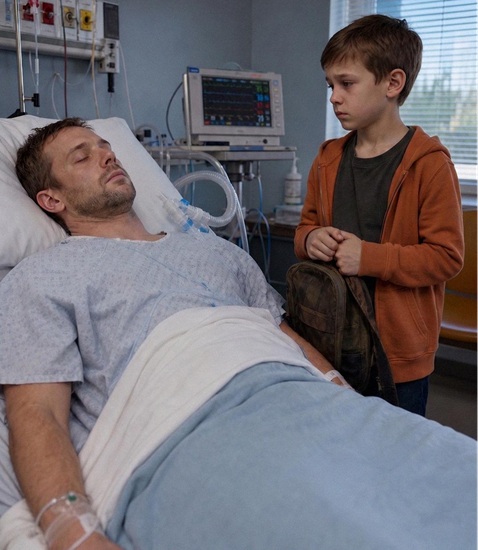
For fourteen long days, the hospital room felt like a suspended world where time had lost its meaning. The only constant sound was the steady rhythm of the ventilator, marking each breath for my husband Mark, who lay motionless in the bed. His condition had not changed since the accident, and every passing day deepened the silence that surrounded him. I often found myself watching the machines more than anything else, as if they held the only answers left.
I stayed by his side as much as I could, holding his hand and speaking to him even when there was no response. “Come back to me,” I would whisper, leaning closer as if my voice could bridge the distance between consciousness and silence. “Please, just open your eyes.” But nothing changed. The monitors continued their steady patterns, while Mark remained still, trapped in a condition that no one could fully predict. Our eight-year-old son, Leo, spent most of his time sitting quietly in the corner of the room.
He held his small blue backpack tightly, as though it was something he needed to protect. He rarely spoke, and when he did, his voice was soft and uncertain. I assumed he was processing everything in his own way, trying to understand a situation far too heavy for a child his age. Mark’s mother, Diane, visited frequently. She filled the silence with constant words—sometimes hopeful, sometimes uncertain. She spoke about miracles, about strength, and sometimes about acceptance. Her emotions shifted daily, reflecting the difficult reality we were all facing.
The room often felt like it was carrying too many emotions at once, none of them easy to bear. One day, the neurologist asked to speak with me privately. I followed him into a small, quiet room where the atmosphere immediately felt heavier. His expression told me what I feared before he even spoke. He explained that there was no meaningful brain activity and that the damage was severe. Despite all efforts, there was little expectation of recovery.
He spoke gently but clearly, suggesting that it might be time to consider letting Mark go. The words were difficult to process. I remember asking if there was still any chance, any possibility of change, but his answer remained unchanged. Continuing support, he explained, would likely only prolong what appeared to be an irreversible condition.
When I returned to the room, Diane noticed immediately that something had changed. When I told her, she placed her hand over mine and said that I needed to think about Leo. She reminded me that Mark would not want his son to remember him this way. Her words were meant to comfort me, but instead they added to the emotional weight I was already carrying.
That evening, I sat beside Mark’s bed while Leo moved closer to him. He leaned in and whispered something quietly that I barely heard at first. “Daddy… don’t worry. I still haven’t told Mommy the secret.” The words startled me. I looked at him immediately, unsure of what he meant.
“What secret, Leo?” I asked gently.
He pulled back quickly, his expression changing. “Nothing,” he said, gripping his backpack tighter. His reaction felt unusual, almost protective, as if he was holding something he was not ready to share. But I was too emotionally drained to press further. Everything around me already felt overwhelming.
The night nurse, Caleb, entered the room shortly afterward. He had been caring for Mark for several shifts and always appeared calm and attentive. He treated Leo with kindness, unlike others who seemed unsure how to interact with a child in such a serious environment. Before leaving, he checked the monitors and ensured everything was stable.
The next morning, the medical team handed me a DNR form. My hands trembled as I held it. The doctor explained that Mark was unlikely to survive much longer. Signing that document felt like one of the most difficult decisions I had ever faced. After a long pause, I finally signed it, feeling the emotional weight of the moment settle heavily over me.
As preparations began for what was expected to be a final goodbye, the room became quieter than ever. Family members gathered, and the staff moved with careful, respectful urgency. I knelt beside Leo and told him it was time to say goodbye to his father. He nodded silently, though his eyes reflected emotions he could not express in words.
When the doctor approached the machines, Leo suddenly stepped forward and shouted, “No!” His voice surprised everyone in the room. He moved quickly to Mark’s bedside, holding tightly onto his backpack. “I know what to do,” he said, his voice shaking but determined.
Before anyone could stop him, he opened the backpack and pulled out a small recorder. I had never seen it before. My confusion deepened instantly. Leo looked at me and said that someone had told him it would wake his father up. The atmosphere in the room changed immediately, shifting from grief to uncertainty.
Caleb then spoke up, explaining that he had noticed subtle changes in Mark’s vital signs whenever Leo spoke to him. These changes were small but consistent enough to raise questions. He suggested that before any final steps were taken, we should listen to what was on the recorder.
After a moment of hesitation, Leo pressed play.
At first, there was only static. Then Mark’s voice filled the room. It was clear, familiar, and real. Hearing him speak again after so many days of silence was overwhelming. My breath caught immediately as I recognized him. The recording was not random—it was personal, emotional, and directed to me.
Mark spoke about family, love, and memories we had shared. He mentioned plans he had made and things he wanted to do together in the future. His voice carried warmth and emotion that made the moment feel almost unreal. Leo stood beside the bed quietly, tears streaming down his face as he listened.
When the recording ended, something in the room changed. The monitors showed a subtle shift. Then Mark’s fingers moved slightly. At first, it was barely noticeable, but it was real. A small reaction, a physical response that had not been seen in days.
The doctor immediately stopped the withdrawal process and ordered further evaluation. The atmosphere shifted quickly from resignation to urgent reassessment. I stood there holding Leo’s hand, unable to fully process what had just happened.
I looked at my son, realizing that he had been carrying this secret all along. He had believed in something none of us fully understood. And somehow, in a moment when hope had almost disappeared, that belief had changed everything.
In that moment, I understood that hope is not always logical or predictable. Sometimes it appears quietly, carried by the smallest voice in the room, refusing to accept that everything is already over.

