
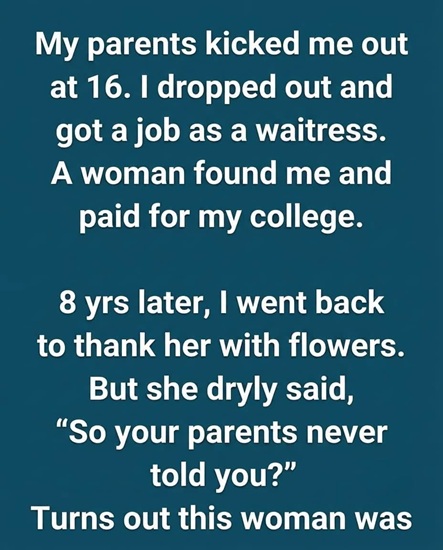
I stood there motionless, my body trembling slightly as I held a bouquet of flowers in my hands. The air in the room felt heavy, almost suffocating, as if it was carrying the weight of every unanswered question from my life. In front of me stood a woman I had always known only as a quiet family friend—someone who had been present, yet never truly seen in the way I now understood her. For twenty years, I had lived with a version of my past that shaped everything I believed about myself.
I grew up convinced that my mother had abandoned me, leaving me behind to face a difficult and uncertain life. That belief became part of my identity, influencing the way I saw relationships, trust, and even my own self-worth. It was a story I carried for most of my life without ever questioning its foundation. But everything changed in a single moment when she began to speak. Her voice was calm, yet every word carried an emotional weight that slowly began to dismantle the life story I thought I knew.
The person I believed had left me was not who I had imagined at all. The woman standing before me, the so-called “family friend,” was actually the same person I had been searching for in my heart all these years. As she continued, my mind struggled to process what I was hearing. It felt as though two separate realities were colliding inside me.
One version of my life was built on abandonment and confusion, while the other revealed quiet care, hidden presence, and silent protection. Every memory I had began to shift under this new truth, taking on meanings I had never considered before.
She explained that she was very young when everything happened. At the time, she had been overwhelmed by life circumstances, fear, and a deep belief that she could not provide a stable future for me. She spoke about feeling lost and unprepared, convinced that the most painful decision she ever made might also be the one that gave me a better chance at life.
Her words described a moment of unbearable emotional conflict. Signing the documents that separated us legally was not an act of indifference, but one of profound internal suffering. She believed that stepping away physically was the only way to protect me from growing up in the same struggles she herself had faced.
As she shared her story, my memories began to reorganize themselves. Moments that once felt random or mysterious suddenly formed a pattern I had never recognized. Financial help that appeared at critical times, anonymous support during school years, and quiet attendance at important life events—all of it began to point toward a truth I had never seen clearly before.
She had never truly left.
Instead, she had remained close in ways that were invisible to me. She watched from a distance, carefully ensuring that I was safe and supported without revealing her identity. Every success I celebrated, she had quietly witnessed. Every difficult moment I faced, she had experienced from the shadows, unable to step forward but never fully gone.
The emotional impact of this realization was overwhelming. The pain I had carried for years did not simply disappear, but it began to transform. What I once saw as abandonment now felt more complicated—filled with sacrifice, fear, and a love that expressed itself in silence rather than presence.
There was also a deep sense of loss that came with the truth. So many years had passed without honesty between us. We had lived parallel lives, always connected in reality but separated by misunderstanding. That distance could not simply be erased, even with clarity finally revealed.
Still, beneath the sadness, something new began to form. I started to see her not as the figure responsible for my pain, but as a human being who had carried an impossible burden for decades. She had lived with constant emotional conflict, torn between love, guilt, and the belief that she was doing what was best for me.
As she finished speaking, silence filled the room. Neither of us moved for a moment. It felt as if the weight of everything unspoken between us was finally settling into place. The truth had not fixed our past, but it had changed its meaning entirely.
I looked at her differently then. Not as a stranger, not as a distant figure from my childhood, but as someone who had never stopped caring in the only way she knew how—quietly, carefully, and from afar. That realization carried both pain and understanding at the same time.
When I finally stepped forward, the distance between us felt smaller, yet still significant. There were no perfect words to heal what had been lost, and no simple way to rewrite two decades of silence. But there was honesty now, and that alone changed everything.
The bouquet in my hands suddenly felt symbolic—fragile, heavy, and uncertain, much like the relationship we were now trying to rebuild. I did not know what the future would look like, but for the first time, it was based on truth rather than misunderstanding.
In that moment, I understood something important: family is not always defined by presence or visibility. Sometimes it is defined by sacrifice, difficult decisions, and love expressed in ways that are not immediately recognized.
What began as a moment of emotional collapse slowly turned into the beginning of something new. It was not a perfect reunion, nor a complete healing of old wounds, but it was a step toward understanding. And sometimes, that is the only place where real healing can begin.

