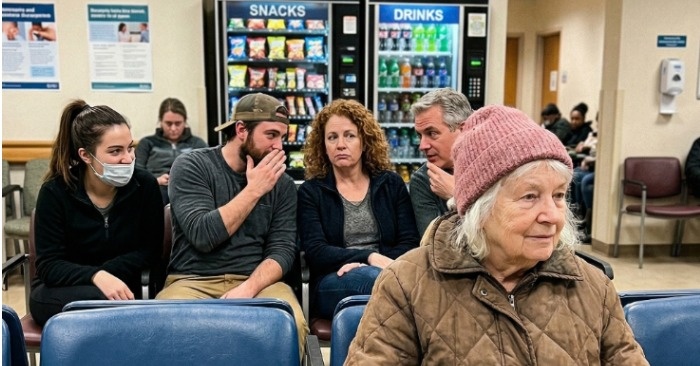
In a busy urban hospital, where the sound of footsteps, distant announcements, and quiet conversations blended into a constant background noise, a waiting room remained filled throughout the afternoon hours.
Patients and families occupied nearly every seat, each person carrying their own concerns, anxieties, and hopes while waiting for medical updates or scheduled consultations with hospital staff.
Among the many individuals present, an elderly woman sat alone in a distant corner, positioned slightly away from the central flow of movement and attention within the room.
She wore a simple, slightly worn coat that did little to protect her from the cool weather outside, along with modest shoes that showed visible signs of long-term use.
Her posture was calm but slightly hunched, suggesting both physical fatigue and long experience with waiting in difficult or uncertain situations.

In her hands, she held a small brown leather bag that appeared aged but carefully maintained, which she kept close at all times as if it contained something important.
Occasionally, she would open the bag briefly, glance inside, and then close it again with gentle care, repeating the action with quiet consistency.
Her movements were slow and intentional, showing no urgency, as though she was fully aware of her surroundings but chose not to engage with them directly.
The waiting room around her remained active, with people checking phones, speaking softly to companions, or watching the doors that led deeper into the hospital.
Despite the general activity, subtle attention began to shift toward the elderly woman, as some patients and visitors noticed her isolated presence in the corner.
A few individuals exchanged quiet remarks, trying to understand why she was there alone and why she appeared so detached from the surrounding environment.

One person speculated softly that she might have arrived early or mistakenly entered the wrong department, while another suggested she might simply be resting indoors.
These comments were not spoken loudly, but they reflected the natural curiosity that often arises in shared public spaces such as hospital waiting areas.
Despite the attention around her, the woman remained composed, showing no reaction to the assumptions or the subtle judgment being expressed nearby.
She adjusted her grip on the bag occasionally and continued to sit patiently, as though she was waiting for a moment that only she understood.
After some time, a nurse approached her with a calm and professional demeanor, observing her briefly before speaking in a polite and gentle tone.
“Ma’am,” the nurse asked carefully, “are you sure you are in the correct waiting area for your appointment?”
The elderly woman slowly lifted her head, meeting the nurse’s gaze with quiet confidence, despite her tired appearance and aged features.
“Yes,” she replied softly, “I am exactly where I am supposed to be.”
Her answer was brief but certain, carrying a sense of calm assurance that ended the conversation without further explanation.

The nurse paused for a moment, then nodded respectfully before returning to her duties, leaving the woman undisturbed in her corner.
As time continued to pass, the waiting room changed gradually as patients were called in and new arrivals took their places.
Through all these movements, the elderly woman remained seated, maintaining her quiet presence without shifting her position significantly.
Her stillness became more noticeable as the activity around her increased, creating a contrast between motion and complete calm.
Eventually, the doors leading to the surgical wing opened quickly, breaking the steady rhythm of the waiting room environment.
A young surgeon stepped out, visibly affected by the demands of a long and intense medical procedure, his expression focused and serious.
He scanned the room with urgency, as though searching for someone specific among the many individuals seated in the waiting area.
After a brief moment, his attention locked onto the elderly woman sitting in the corner, and he immediately began walking toward her.
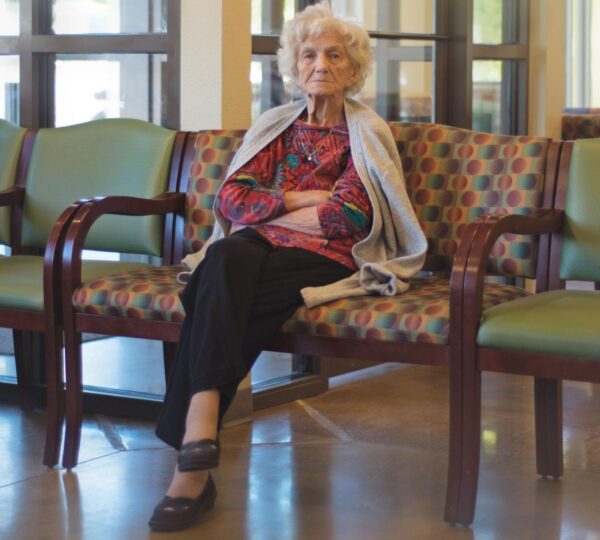
The room gradually grew quieter as people noticed the interaction forming between the surgeon and the seemingly unnoticed woman.
Upon reaching her, the surgeon spoke respectfully, his tone reflecting both urgency and trust.
“Thank you for coming,” he said. “We need your help.”
These words created a noticeable shift in the atmosphere of the room, as nearby individuals began to listen more closely to the exchange.
The elderly woman looked up calmly, showing no surprise, only steady recognition of the situation unfolding in front of her.
“Are you certain you cannot proceed on your own?” she asked gently, her voice steady and composed.
The surgeon shook his head. “If I could, I would not have called you,” he replied honestly.
He then handed her a set of medical scans, which she accepted carefully, placing her attention immediately on the details in front of her.
At that moment, the environment in the waiting room felt noticeably still, as if others unconsciously paused to observe what was happening.
The woman studied the scans slowly at first, her eyes moving with concentration as she analyzed the medical information presented.

Within moments, her expression shifted from calm observation to focused expertise, indicating a deep understanding of what she was reviewing.
Her posture straightened slightly, and her attention became more precise, as she examined details that others might easily overlook.
After a brief silence, she spoke with clarity and certainty.
“This is not what you think it is,” she said. “If you proceed in that direction, the outcome could be dangerous for the patient.”
The surgeon listened carefully without interruption, maintaining full attention on her assessment and observations.
“Then what do you recommend?” he asked respectfully after a brief pause.
She pointed calmly at a different area on the scan, indicating a specific point of concern that required immediate attention.
“Here,” she said. “This is where the issue is located. You must act quickly. Time is limited.”
Her voice remained steady, carrying no emotion beyond professional focus and certainty.
The surgeon nodded without hesitation, accepting her guidance and preparing to return to the operating area.
Before leaving, he turned briefly toward the room, acknowledging the presence of those who had been watching quietly.
“This is the person who trained me,” he said. “My mentor.”
The statement changed the atmosphere instantly, replacing earlier curiosity and speculation with silence and reflection.
People in the waiting room lowered their gaze or turned away, realizing that their earlier assumptions had been incorrect.
The elderly woman returned the scans calmly, her expression unchanged, as though the moment held no personal importance beyond the task itself.
“Go now,” she said softly. “Do not waste time.”
The surgeon nodded once more and quickly returned through the doors leading to the surgical wing.
As he disappeared from view, the waiting room remained silent for several moments, as people processed what they had just witnessed.
The woman adjusted her position slightly, holding her bag once again in both hands, returning to her original quiet posture.
However, the perception of those around her had changed completely, replacing curiosity with respect and understanding.
What had once been an unnoticed presence in a crowded room was now recognized in a completely different light.
The waiting room slowly returned to its normal activity, but the memory of the brief exchange remained with those who had witnessed it.
In that moment, the story became not about appearance or assumption, but about quiet expertise, experience, and unexpected recognition.
And the elderly woman, once overlooked, remained a silent reminder that true knowledge is not always visible at first glance.
