
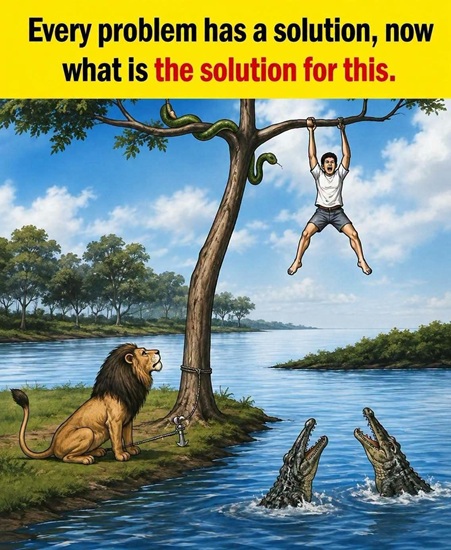
At first sight, the illustration seems to show a man caught in a situation with no safe escape. A snake is positioned close to one possible route, crocodiles occupy the nearby water, and a lion creates another serious obstacle on land. Every direction appears dangerous, so the natural reaction is to search immediately for the least risky path. That is exactly what makes the puzzle interesting. The picture encourages viewers to think that the man must make a quick decision, even though immediate movement may not be necessary.
Instead of asking which dangerous route he should take, the better question may be whether he should move at that particular moment at all. Running toward the snake would obviously appear risky because it could bring the man closer to a potentially dangerous animal. Entering the lake would not provide an obvious solution either, since crocodiles are shown in the water. Trying to cross the open ground near the lion presents another problem.
When the scene is examined only in terms of these three choices, the man seems completely trapped. However, this interpretation assumes that everything shown in the picture will remain exactly the same. A visual puzzle captures only one moment, while the fictional situation it represents can continue to develop over time. This is where patience becomes an important part of the proposed solution. The man does not necessarily need unusual strength, exceptional speed, or a hidden tool to escape.
Instead, he can observe what is happening around him and wait for the circumstances to change. The animals shown in the illustration are living creatures rather than permanent barriers. Within the logic of the riddle, they can move from their original positions and direct their attention elsewhere. Once this possibility is considered, the scene becomes less about choosing between three dangerous paths and more about recognizing the right moment to move.
One commonly suggested solution involves waiting for the lion to approach the lake. Lions, like other animals, need water, so the fictional scenario assumes that the lion may eventually become thirsty and move toward the water. This should not be interpreted as a guaranteed prediction of how a real lion would behave in a similar situation. Wild animals can be unpredictable, and a simple illustration cannot accurately represent all the factors affecting their behavior.
For the purposes of the puzzle, however, the lion’s movement provides the change needed to create a possible opening. Once it leaves its original position, the arrangement of dangers around the man is no longer identical to what viewers first saw. The activity near the lake also changes the fictional situation involving the crocodiles. According to the intended reasoning behind the puzzle, the presence and movement of a large animal near the water may temporarily shift attention toward that area.
Again, this is part of the riddle’s imagined sequence rather than practical wildlife guidance. The important point is that several dangers that initially appeared to surround the man do not necessarily remain arranged in exactly the same way. As the lion moves, the man gains an opportunity to evaluate a route away from the immediate threats. He avoids directly confronting any of the animals and instead takes advantage of the changing circumstances.
Timing therefore becomes more important than speed. Moving immediately could expose the man while all of the apparent dangers remain in their original positions. Waiting for too long could also mean missing whatever opportunity the fictional situation creates. The proposed answer requires him to observe the scene carefully and act when conditions become more favorable. In that sense, patience does not mean doing nothing indefinitely. It means delaying an action until there is a better reason to believe that the available route is safer. That distinction is central to understanding why the puzzle has a less obvious solution than simply running in one direction.
Many visual riddles work by encouraging viewers to accept assumptions without noticing them. In this case, one assumption is that the man must escape immediately. Another is that the snake, lion, and crocodiles will remain exactly where they appear in the image. Once those assumptions are questioned, the puzzle becomes much easier to interpret. A still illustration freezes a single instant for the viewer, but it does not necessarily mean the imagined events themselves are frozen. Time can pass, animals can move, and the relationship between the obstacles can change. The answer emerges when viewers begin treating the scene as a sequence of events rather than one permanent arrangement.
The puzzle also illustrates how visible danger can influence decision-making. When several threats appear simultaneously, attention naturally moves toward finding the quickest escape. Standing still may seem like the least useful option because it does not immediately increase the distance between the man and the animals. Yet within the fictional rules of this riddle, observation can provide information that immediate movement cannot. By watching how the situation develops, the man can potentially identify an opening that was not available seconds earlier. The challenge therefore rewards careful reasoning rather than impulsive action.
Another interesting feature of the puzzle is that the solution does not require inventing something that cannot be seen. There is no need to imagine a secret tunnel, an invisible bridge, a weapon, or another person arriving to rescue the man. The proposed answer relies instead on elements already present in the scene. There is a lion, there is water, and there is the possibility that time will pass. Connecting these details produces the intended reasoning. The lion changes position, the situation around the water changes, and the man uses the resulting opportunity to move away rather than directly challenging any animal.
Of course, this does not mean the illustration should be treated as genuine survival instruction. Real encounters with lions, crocodiles, snakes, or other dangerous wildlife involve circumstances that cannot be accurately represented by a simple puzzle image. Different species behave differently, individual animals may react unpredictably, and environmental conditions can dramatically affect what happens. Someone facing an actual wildlife emergency should rely on appropriate guidance from qualified local wildlife or emergency authorities. The puzzle is intended as entertainment and a reasoning exercise, not as a scientifically guaranteed method for escaping dangerous animals.
Making that distinction also prevents an entertaining riddle from becoming misleading. Images shared online are sometimes accompanied by confident statements claiming that a particular solution is unquestionably correct in real life. This puzzle does not provide enough information to support such a conclusion. Distances between the man and animals are unclear, the species may not be identifiable, and the illustration cannot tell viewers exactly what any animal would do next. The patience-based answer should therefore be understood as a proposed solution within the fictional rules of the visual challenge. It explains the puzzle without presenting speculation as verified real-world fact.
The scene becomes especially interesting when viewers stop thinking of the animals as three separate walls. Initially, the snake blocks one direction, the crocodiles appear to block another, and the lion seems to eliminate the remaining option. Together, they create the impression of a complete trap. But living animals can move, and movement can alter the available space. If one threat changes position, the entire arrangement can change with it. The man does not need every animal to disappear. He only needs a sufficiently safe opening to become available within the logic of the puzzle.
This explains why patience is often presented as the key to the answer. The man is not expected to overpower the lion or somehow become faster than every animal around him. Instead, he waits and observes. When the lion eventually moves toward the water in the puzzle’s proposed sequence, the man reassesses the area. A direction that previously seemed too dangerous may now provide a possible route away. His advantage comes from choosing the moment carefully rather than trying to defeat the threats physically.
The riddle can also be viewed as a small exercise in flexible thinking. People often approach problems using only the choices that appear immediately available. If all of those choices seem bad, the situation can feel impossible. Sometimes, however, the conditions surrounding a problem are not permanent. Waiting, collecting additional information, or examining how different elements interact can reveal another option. This general observation should not be confused with advice to delay action during real emergencies, where circumstances may require immediate professional guidance. It simply explains the reasoning mechanism that makes this particular puzzle work.
There may also be other interpretations depending on the exact version of the illustration. Visual puzzles often circulate in several forms, and small changes in the position of an animal, tree, branch, shoreline, or other object can affect what solutions appear possible. Because the image does not provide measurements or detailed information, it would be difficult to claim that only one solution could ever be imagined. The waiting strategy is best presented as a commonly proposed answer to this version of the riddle. Viewers may notice other possibilities, which is one reason these puzzles often generate discussion when they are shared.
What remains consistent is the central trick: the first image does not necessarily represent the conditions that must exist when the man finally attempts to escape. Once time is added to the reasoning, the apparently impossible trap becomes a changing environment. The lion may leave its original location, activity may shift toward the water, and the man may eventually find an opening leading away from the immediate danger. Instead of asking which animal he should risk approaching, he waits until he does not need to make that choice. The solution therefore comes from changing the timing of the decision rather than choosing a different threat.
In the end, the puzzle’s proposed answer is surprisingly simple. The man waits, watches the scene, and avoids making an unnecessary move while every route appears dangerous. Within the fictional logic of the riddle, the lion eventually approaches the lake, changing the arrangement and creating an opportunity for the man to move away. This sequence should be understood as part of an entertainment puzzle rather than a factual guarantee about wildlife behavior. Its appeal comes from showing how dramatically a problem can change when viewers question their initial assumptions.
The larger idea behind the riddle is not that waiting always solves dangerous situations. Rather, it demonstrates how observation and timing can completely change the way a fictional problem is understood. At first, every visible path appears blocked because the viewer treats the illustration as a permanent scene. Once movement and time are considered, new possibilities appear. The man does not need extraordinary abilities; he needs the circumstances to become more favorable before acting. That simple shift in perspective turns what initially looks like an impossible escape into a clever visual logic challenge.

