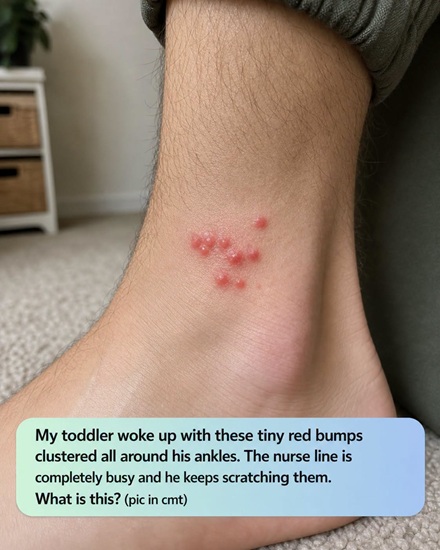
A toddler goes to sleep with completely normal-looking skin. The next morning, a parent notices something unexpected.
Several tiny red bumps have appeared around the child’s ankles. They look irritated. They seem extremely itchy.
And the toddler keeps scratching. When marks appear suddenly like this, it is understandable to start searching for an explanation.
Could they be flea bites?
Possibly.
Small, itchy bumps clustered around the ankles can be consistent with flea bites, particularly when there has been exposure to animals or an environment where fleas may be present.
But there is something important to understand before reaching a conclusion.
The location of a rash cannot confirm its cause.
And neither can a photograph alone.
Why flea bites are often suspected
Fleas frequently bite areas around the feet, ankles and lower legs.
Their bites may appear as small red bumps and can occur close together.
They are often itchy.
Those characteristics can make fleas seem like an obvious explanation when a child suddenly develops marks around the ankles.
If a dog or cat lives in the home, suspicion may increase.
But even then, certainty is not possible based solely on appearance.
Pets can live in a home without having fleas.
And people without pets can potentially encounter fleas through other environments.
So the pattern provides information.
It does not provide a diagnosis.
First, look beyond the bumps
The child’s overall condition matters.
Before spending too much time comparing the rash with photographs online, look at how the toddler is behaving.
Are they alert and playing normally?
Are they eating and drinking?
Is there a fever?
Are the bumps only itchy, or are they painful?
Is there swelling?
Are new spots appearing elsewhere?
Those observations can be more important than whether the bumps resemble a particular image found online.
The timing matters too.
Try to remember when the skin first looked different.
If possible, take a clear photograph so changes can be compared later.
Then keep watching.
Sometimes the next few hours provide useful information.
Several things can resemble insect bites
Flea bites are only one possibility.
Other insect bites can look similar.
Skin irritation caused by something touching the body can also create red, itchy areas.
Some forms of dermatitis or eczema can resemble clusters of bites.
Other skin conditions and infections can occasionally begin with small red marks as well.
That is why diagnosing a toddler from a photograph can be unreliable.
Two rashes may look almost identical while having completely different causes.
The safest question is therefore not simply, “Does this look like fleas?”
It is also, “Does anything else about my child suggest that medical attention is needed?”
Comfort can come first
If the toddler otherwise seems well and there are no emergency symptoms, simple measures can help reduce irritation while appropriate advice is being obtained.
Gently wash the affected skin.
Avoid vigorous scrubbing.
A cool, clean compress may help soothe itching and discomfort.
Keeping fingernails short can also be useful.
Young children may scratch without realizing how much damage they are doing.
Repeated scratching can break the skin.
Once the skin barrier is damaged, bacteria can potentially enter more easily.
Preventing scratching completely may be unrealistic.
Reducing it is still worthwhile.
But what about creams?
That requires more caution.
Do not automatically reach for an adult treatment
An anti-itch product that is appropriate for an adult may not necessarily be suitable for a toddler.
Some medications and creams have age restrictions.
Where the product is applied can also matter.
Broken, irritated or infected skin may require different advice.
Before using a medication on a young child, check the product instructions and seek guidance from an appropriate healthcare professional or pharmacist when needed.
Do not combine several creams in an attempt to stop the itching faster.
And do not assume that using more of a product will provide greater relief.
Medication should be used according to its instructions and appropriate professional advice.
Meanwhile, there is another part of the mystery that can be investigated.
The environment.
If fleas seem possible, look for evidence
If the family has pets, checking them can provide useful information.
A flea comb can help reveal adult fleas or flea debris in the coat.
Pet bedding may also deserve inspection.
Carpets, upholstered furniture and places where animals regularly rest can become part of a flea problem.
Vacuuming relevant areas can help as part of environmental control.
Wash suitable bedding and fabrics according to their care instructions.
But avoid turning suspicion into aggressive pest treatment before there is evidence.
Especially when a young child is in the home.
Household insecticides require caution
Seeing itchy bites can create an understandable urge to spray everything immediately.
That is not necessarily the safest response.
Pest-control products contain specific instructions about where and how they can be used.
Some treated areas may need to remain inaccessible to children and pets for a period of time.
Never apply household insecticide directly to a child’s skin.
Do not spray bedding, toys or other belongings unless the product specifically allows that use.
Always follow the label.
If an infestation is suspected but difficult to manage, professional pest-control advice may be appropriate.
And if a pet is involved, another professional may be useful too.
A veterinarian.
Pet flea treatments are not interchangeable
Treating a pet can be an important part of controlling fleas.
But flea medications designed for animals need to be selected carefully.
A product intended for one species may be unsafe for another.
Some dog flea treatments, for example, can be dangerous to cats.
An animal’s age and weight can also affect which treatment is appropriate.
Veterinary guidance can help identify a suitable product.
There is another complication.
Removing the visible fleas from a pet does not necessarily eliminate the entire problem.
Flea eggs and immature stages may remain elsewhere in the environment.
That is why effective flea control may involve both the animal and its surroundings.
But throughout that process, one priority should remain unchanged.
The toddler.
Watch the skin for changes
A small group of itchy bumps that remains stable is different from an area that becomes progressively more inflamed.
Look for increasing redness.
Watch for warmth or swelling.
Pay attention if the area becomes increasingly painful.
Drainage or pus can also be concerning.
These changes may indicate that scratched skin has developed a secondary infection or that something else is occurring.
A fever or a child who begins appearing generally unwell should also prompt medical advice.
If the rash spreads unexpectedly or simply does not fit the pattern of ordinary insect bites, contact an appropriate healthcare professional.
And some symptoms require much faster action.
Know when it becomes an emergency
Most uncomplicated insect bites do not cause severe allergic reactions.
But severe reactions can occur.
Difficulty breathing is an emergency.
Significant swelling of the tongue, mouth or throat also requires immediate help.
So does fainting or collapse.
A toddler who becomes unusually limp or unresponsive needs urgent medical attention.
Do not wait for an ordinary nurse-line callback when severe symptoms like these are developing.
Contact the appropriate emergency medical service for your location.
The distinction is important.
A child scratching several bumps while otherwise behaving normally presents a very different situation from a child experiencing breathing problems or becoming unresponsive.
Online photographs have limits
Searching online is often one of the first things worried parents do.
It can provide useful general information.
But photographs can also create false certainty.
Lighting can change how red a rash appears.
Camera quality can hide texture.
Different skin tones can change the visible appearance of inflammation.
And photographs cannot communicate whether the skin feels hot, tender or swollen.
They cannot show how quickly the rash developed.
They cannot tell a clinician whether the child has a fever.
That is why finding a photograph that looks identical does not establish the diagnosis.
Use online information to understand possibilities.
Not to eliminate professional assessment when it is needed.
A few details can help a clinician
If you contact a healthcare professional, prepare some basic information.
When did the marks first appear?
Are more developing?
Where on the body are they located?
Are they itchy or painful?
Is there swelling?
Does the child have a fever?
Has the family recently traveled?
Have any new soaps, detergents, lotions or skin products been introduced?
Has anyone actually found fleas on a pet or in the home?
These details help create a much clearer picture than appearance alone.
And there is no need to decide on the diagnosis before making the call.
Describe what you see.
Let the clinician help determine what it might mean.
The most useful approach is actually simple
When a toddler wakes with clusters of itchy red bumps around the ankles, flea bites belong on the list of possibilities.
But they are not the only possibility.
Start by checking how the child feels overall.
Keep the irritated skin clean.
Use a cool compress if it provides comfort.
Try to reduce scratching.
Be cautious about medications and pesticides.
Investigate possible flea exposure if there is a reasonable reason to suspect it.
And watch for changes.
If symptoms worsen, infection seems possible or the child becomes unwell, seek appropriate medical advice.
If serious breathing problems, significant mouth or throat swelling, collapse or unusual unresponsiveness develops, seek emergency help immediately.
The bumps themselves may ultimately turn out to have a simple explanation.
But there is no need to guess with certainty from a picture.
The most important clue is not always the shape of the rash.
Sometimes it is the child standing behind it — how they are behaving, how they are feeling and whether anything else is changing.
