
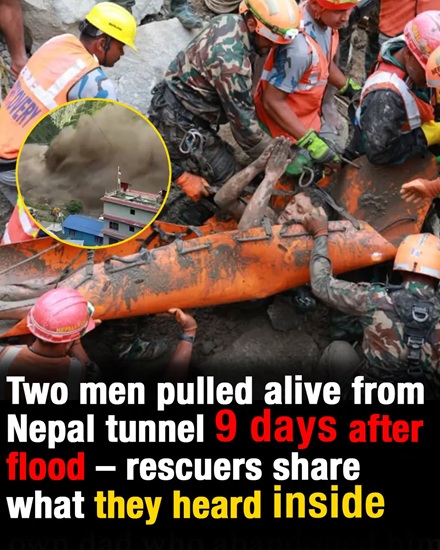
For more than a week, rescue teams searching Nepal’s flood-damaged hydropower tunnels faced an increasingly difficult question.
Could anyone still be alive underground?
Mud and debris blocked passages.
Some sections had been flooded.
Hundreds of hydropower workers remained unaccounted for as crews slowly pushed deeper into damaged facilities.
With each passing day, the search became more difficult.
Then rescuers reached a section of tunnel that changed the picture.
Two men were alive.
They had survived for nine days.
And within another day, rescuers would find someone else.
The Disaster Struck on August 26
Nepal’s catastrophic flooding began on August 26, 2026, after a massive high-altitude collapse involving ice, rock and debris near the country’s border with China’s Tibet region.
The material crashed into the river system below, generating a destructive surge through parts of the Trishuli River valley.
The flood moved with devastating force.
Communities were overwhelmed.
Buildings disappeared beneath water and debris.
Roads and bridges were destroyed.
Hydropower infrastructure suffered extensive damage.
And as information gradually emerged from isolated areas, the human toll continued climbing.
But some of the most complicated rescue operations were happening somewhere largely invisible from the surface.
Underground.
Hundreds of Workers Were Missing
Hydropower is an important part of Nepal’s energy system, and projects in mountainous areas frequently include extensive underground tunnels.
When the flood struck, many workers were inside or near those facilities.
Water, mud and debris entered tunnel systems.
Access points became blocked.
Some workers managed to escape.
Others disappeared.
By the end of August, authorities believed that more than 900 hydropower workers were missing across affected projects, with hundreds potentially trapped underground.
That transformed the tunnels into major search-and-rescue priorities.
But reaching them would not be easy.
Every Meter Presented Another Obstacle
Rescuers encountered enormous amounts of mud.
Some passages were blocked by debris.
Others contained water.
Equipment could not simply be driven through every tunnel.
Teams sometimes had to advance slowly while clearing material ahead of them.
There was also the danger of additional collapses.
Rescuers had to consider whether water might remain trapped behind blockages.
Unstable ground could create new hazards without warning.
Nepalese teams were joined by international specialists as the operation expanded.
Indian and Chinese rescuers were among those assisting at hydropower sites.
Heavy equipment was brought in.
Crews began clearing passages.
Progress could be frustratingly slow.
Yet every additional meter mattered.
Because nobody knew exactly what might be waiting beyond the next blockage.
Then Came the First Major Breakthrough
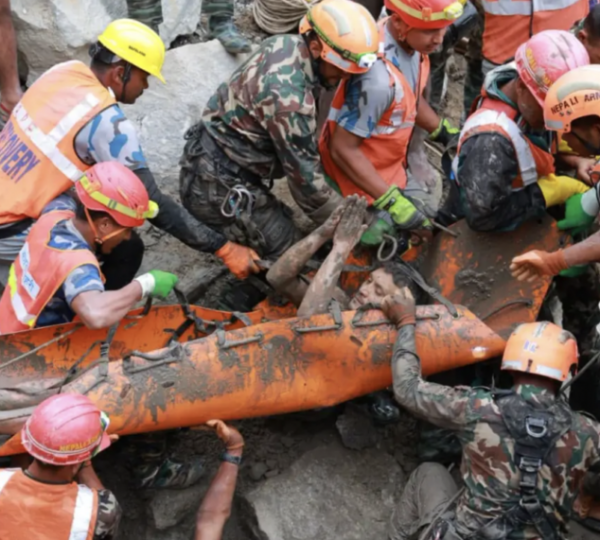
On September 4, rescuers searching a tunnel connected to the Upper Trishuli 3A Hydropower Station reached two workers.
They were alive.
Reports identified them as Sanjay Sah and Kabir Maharjan.
The men had been trapped for approximately nine days.
Rescuers found them roughly 170 meters inside the tunnel.
After more than a week surrounded by stories of destruction and loss, their survival offered a rare moment of hope.
Both men were removed from the tunnel and taken for medical treatment.
Sah’s condition was reported as not critical.
The rescue immediately raised another possibility.
If two people had survived that long underground, could others still be waiting?
The Search Continued
Finding Sah and Maharjan did not mean crews could stop.
Hundreds of workers remained missing.
Other hydropower tunnels had not yet been fully searched.
Some were so heavily obstructed that rescuers could only move gradually.
At the Chilime area, Indian rescue teams encountered major blockages.
Elsewhere, Chinese and Nepalese crews worked through damaged tunnel systems.
Excavators were used where possible.
In some locations, controlled blasting was necessary to break through obstacles.
Each operation carried risk.
A tunnel might appear stable at the entrance while conditions deeper inside were completely different.
Mud could hide structural damage.
Water could remain trapped.
And the possibility of finding survivors had to be balanced against the safety of the rescuers themselves.
Then another discovery proved that continuing the search mattered.
A Third Man Was Found Alive
On September 5, rescue teams reached another trapped worker.
He had survived even longer.
The man was identified as Chinese national Lu Haitao.
He was found at the Upper Trishuli-1 Hydropower Project approximately 225 meters inside a tunnel.
Lu had been trapped for around ten days.
After rescuers brought him out, he was taken for medical treatment.
He was reported to have mild hypothermia but was otherwise in stable condition.
The discovery provided another remarkable example of survival.
And it gave rescue teams further reason to continue pushing through the blocked underground passages.
Three men had now emerged alive after spending more than a week trapped.
But outside those tunnels, the scale of the disaster remained overwhelming.
The Death Toll Continued Rising
By early September, more than 1,300 deaths had been reported in Nepal.
Thousands of people remained missing.
The missing included Nepalese residents, workers and foreign nationals.
Across the border in Tibet, Chinese authorities were also dealing with deaths and large numbers of missing people connected to the disaster.
The numbers changed as rescue and recovery operations reached previously inaccessible locations.
Communication failures made the situation more difficult.
Some affected areas had been cut off.
Road damage prevented easy access.
Families were searching for relatives while authorities tried to build a clearer picture of who had survived.
And as more bodies were recovered, another difficult task emerged.
Identification.
Some Victims Could Not Be Identified Visually
Floodwaters can carry people far from where they were last seen.
Mud and debris can make recovery difficult.
Time creates additional complications.
Authorities reported that some recovered bodies could no longer be reliably identified through appearance alone.
DNA sampling and other forensic methods therefore became necessary.
Families waiting for news faced an agonizing situation.
For some, confirmation could take time.
For others, relatives were still officially missing.
And underground, teams were continuing to search tunnels where workers had last been seen.
Every successful rescue offered hope.
Every recovery also revealed more about the violence of the flood.
Survivors Described How Quickly Everything Changed
Some workers who escaped the hydropower tunnels have described terrifying conditions.
At the Upper Trishuli-1 project, survivor Dhan Bahadur Tamang recalled being inside a tunnel when floodwater suddenly surged through the structure.
The situation became dangerous almost immediately.
He survived by holding onto pipes as water moved around him.
Later, he and other workers attempted to find a route toward safety.
They moved through darkness with limited light.
The group stayed close together.
Eventually, they reached daylight.
Tamang survived with injuries.
Others were not as fortunate.
His experience offered an important clue about what may have happened deeper underground.
Some Tunnel Sections May Have Created Pockets of Survival
Flooded tunnels are extremely dangerous.
But underground systems are also complex.
Elevation changes, sealed sections and pockets of air can create very different conditions within the same facility.
The survival of Sah, Maharjan and Lu demonstrated that some workers could remain alive for many days if they reached a protected location.
That does not mean everyone trapped underground had the same opportunity.
Conditions varied dramatically from one tunnel to another.
Still, the rescues prevented teams from assuming that time alone had eliminated the possibility of finding survivors.
Even after nine or ten days, someone could still be waiting.
That realization changed the emotional meaning of every blocked passage.
Another Survivor Was Found Elsewhere
During the same period, rescuers also found a Nepalese woman alive after she had spent days trapped in debris in Nuwakot.
She was taken for treatment.
The discovery was separate from the hydropower tunnel operations.
But it reinforced the same message.
Remarkable survival remained possible.
For rescue crews who had spent days recovering victims, moments like these provided rare encouragement.
Yet the wider emergency remained immense.
Entire communities had been transformed.
And the economic consequences were beginning to become clearer.
The Damage Extended Across Infrastructure
Early government estimates placed losses from the disaster at approximately 387.5 billion Nepalese rupees, or around $2.56 billion.
Thousands of homes were destroyed.
Many additional buildings were damaged.
Roads and bridges required major repairs.
Businesses and public infrastructure were affected.
Hydropower facilities suffered particularly serious losses.
That damage could have consequences extending well beyond the immediate disaster.
Nepal depends heavily on hydropower for electricity.
Projects under construction represent significant investments in the country’s future energy supply.
When tunnels, machinery and access roads are destroyed, rebuilding can take considerable time.
But economic calculations were not the immediate priority for families waiting outside rescue sites.
They wanted names.
They wanted answers.
Most of all, they wanted people brought out alive.
Questions Remain About the Initial Collapse
Early descriptions of the disaster referred to a glacier-related collapse involving enormous amounts of ice, rock and debris.
Scientists and authorities have continued examining exactly how the event developed.
Large Himalayan disasters can involve several connected processes.
Ice can collapse.
Rock can fall.
Debris can block or suddenly enter waterways.
Water can then move downstream with tremendous force.
For that reason, assigning one simple cause before scientific analysis is complete can be misleading.
What is clear is that a massive volume of material entered the river system and generated devastating downstream flooding.
The exact sequence continues to be important for understanding what happened.
It could also help experts assess future risks.
For rescuers, however, another question remains far more immediate.
Who is still alive?
The Tunnel Rescues Changed What Was Possible
When Sanjay Sah and Kabir Maharjan were located, they had spent nine days trapped.
When Lu Haitao emerged, approximately ten days had passed since the disaster.
Their survival challenged the assumption that the rescue phase had necessarily ended.
It had not.
Some sections of the tunnel systems remained unexplored.
Others could only be reached after removing enormous quantities of debris.
And hundreds of workers were still unaccounted for.
That meant crews had a reason to keep going.
Slowly.
Carefully.
Meter by meter.
Each Blockage Could Hide a Different Outcome
Rescue work after a disaster of this scale carries an unavoidable emotional tension.
Behind one obstruction, crews may find nothing.
Behind another, they may recover someone who did not survive.
Then, unexpectedly, they may hear a voice.
That possibility became real again after the three tunnel rescues.
For the families of missing workers, the discoveries did not provide answers about their own relatives.
But they demonstrated that survival underground for more than a week was possible.
And sometimes, possibility is enough to keep an entire rescue operation moving.
The Wider Tragedy Cannot Be Forgotten
The stories of individual survivors naturally attract attention.
They provide rare moments of relief during an enormous catastrophe.
But they exist alongside devastating loss.
More than a thousand people have died.
Thousands remain unaccounted for.
Families have lost homes and livelihoods.
Communities face a long reconstruction process.
Rescue workers themselves continue operating in dangerous conditions.
The three men pulled from the tunnels represent only a tiny fraction of the people affected.
Yet their stories matter for another reason.
They show why rescuers cannot simply look at the calendar and decide hope has expired.
Nine Days Became Ten
First came Sah and Maharjan.
Nine days underground.
Then came Lu.
Around ten days.
Each rescue pushed the boundary a little farther.
And each time a survivor emerged, another family received the news countless others were still waiting to hear.
The disaster had taken almost everything familiar from parts of the affected region.
But deep inside damaged hydropower tunnels, some people had found enough protection to stay alive.
Rescuers eventually reached them.
That is the detail that has given the continuing search its most important payoff.
The blocked tunnels are not simply places where workers disappeared.
At least some became places where people survived.
And as long as rescuers can safely keep moving deeper, every unopened section carries the same unanswered question.
What — or who — might still be waiting on the other side?

