What Really Happens When You Sleep on Your Left Side? The Evidence Is More Interesting Than the Myths
Most people have a favorite sleeping position without thinking much about it.
Some curl up on their right side.
Others naturally turn left.
Some prefer sleeping on their back.
And a smaller group feels most comfortable on the stomach.
But one position has attracted an unusual amount of health advice online.
Sleeping on the left side.
It has been credited with everything from improving digestion to helping the liver “detox” the body.
Some claims sound convincing because they refer to real anatomy.
But there is a problem.
Anatomy alone does not prove a health benefit.
When researchers actually examine left-side sleeping, a much more interesting picture appears.
Some benefits are supported by evidence.
Others are mostly internet mythology.
And one of the best-supported effects involves something millions of people experience at night.
The Strongest Evidence Involves Acid Reflux
Anyone who has experienced nighttime heartburn knows how disruptive it can be.
You lie down expecting to sleep.
Then the burning begins.
Acid reflux occurs when stomach contents move upward into the esophagus.
For people with gastroesophageal reflux disease, or GERD, this can happen repeatedly.
Lying down can make the problem more noticeable because gravity is no longer helping keep stomach contents down in the same way it does while standing.
But something interesting happens when sleeping position changes.
The left side appears to have an advantage.
Why the Left Side Can Matter
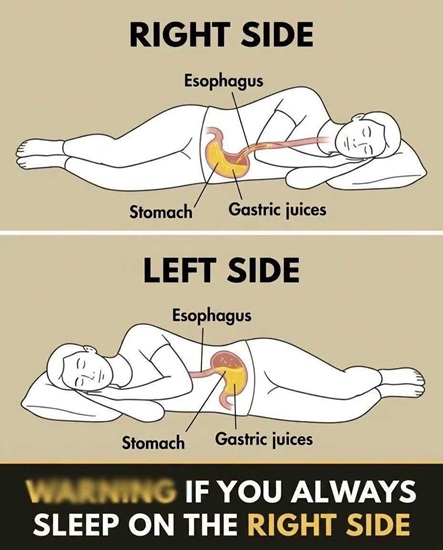
The stomach is not positioned symmetrically inside the body.
Because of its anatomy and its relationship with the esophagus, changing body position alters how stomach contents sit relative to the junction leading into the esophagus.
When a person lies on the left side, that arrangement can make reflux less likely.
Research comparing sleeping positions has found lower nighttime acid exposure on the left side than in some other positions.
Studies have also found that acid can clear from the esophagus more quickly in this position.
That gives left-side sleeping one genuine evidence-based benefit.
For someone dealing with nighttime reflux, the difference may actually be noticeable.
But there is more to the story.
The Right Side Can Behave Differently
Research has found that right-side sleeping can be associated with more nighttime reflux in people with GERD compared with sleeping on the left.
That does not mean sleeping on the right is generally unhealthy.
It means body position can affect reflux because of gastrointestinal anatomy.
This distinction matters.
A finding about one medical condition should not be transformed into a universal rule about health.
If someone does not experience reflux and sleeps comfortably on the right, there is no good reason to assume they are damaging their body.
The benefit is specific.
Not magical.
Changing Position May Help Without Medication
For some people with nighttime GERD, simply spending more time on the left side may reduce symptoms.
Clinical research has tested interventions designed to encourage people to sleep on their left.
Participants experienced improvements in nighttime reflux measures.
That makes position therapy an interesting low-cost strategy.
But it should not be treated as a replacement for all other care.
Persistent reflux may require additional lifestyle changes or medical treatment.
And there are several other things worth considering before bedtime.
When You Eat Can Matter Too
Going to bed immediately after a large meal can make reflux more likely.
Allowing time between dinner and lying down may help.
Some people also benefit from elevating the upper body during sleep.
This is different from simply stacking several soft pillows under the head.
The goal is to elevate the upper torso so gravity can help reduce reflux.
Combined with left-side sleeping, these adjustments may provide additional relief for some people.
But frequent symptoms deserve attention.
Heartburn that keeps returning should not simply be ignored.
Pregnancy Is Another Situation Where Position Matters
Left-side sleeping is frequently recommended during pregnancy.
But the internet version of that advice often becomes unnecessarily strict.
Side sleeping is generally encouraged later in pregnancy.
The reason involves the growing uterus and major blood vessels.
When someone lies flat on the back later in pregnancy, the weight of the uterus can compress large blood vessels.
That can affect circulation and may cause dizziness or discomfort.
Turning onto the side reduces that pressure.
But here comes the important correction.
It does not always have to be the left side.
Both Sides Can Be Acceptable During Pregnancy
Major medical guidance supports side sleeping during later pregnancy.
The left side is often comfortable and commonly recommended.
But the right side can also be acceptable.
The important distinction is generally sleeping on the side rather than remaining flat on the back later in pregnancy.
This matters because pregnant people already have enough to think about.
They do not need unnecessary anxiety about accidentally turning onto the “wrong” side.
People move during sleep.
That is normal.
If someone wakes on their back, guidance generally suggests simply turning onto the side again.
No panic is required.
Pillows Can Make a Big Difference
Side sleeping is not always comfortable automatically.
The shoulders carry pressure.
The hips may feel uneven.
The lower back can become uncomfortable.
A pillow between the knees can help keep the hips and spine better aligned.
During pregnancy, another pillow beneath the abdomen may provide support.
A properly sized pillow beneath the head can also prevent the neck from bending too far upward or downward.
These adjustments may sound minor.
But comfort determines whether someone can actually remain asleep.
And sleep quality matters more than forcing the body into an uncomfortable position all night.
What About the Heart?
This is where another popular claim begins to fall apart.
Some articles say sleeping on the left side “gives the heart a break.”
That sounds reasonable because the heart sits slightly toward the left side of the chest.
But the human cardiovascular system is not that simple.
There is no strong evidence that every healthy person should sleep on the left to make the heart’s job easier.
In fact, some people with heart failure may find left-side sleeping uncomfortable.
Research has observed that some patients with congestive heart failure naturally avoid the left-side position.
Why?
They may become more aware of their heartbeat or experience discomfort.
So the claim that left-side sleeping universally improves heart function is too broad.
Healthy Hearts Do Not Need a Special Nightly Position
For most healthy people, the heart continues doing its job regardless of whether they sleep on the left or right side.
It pumps blood continuously.
Circulation adapts to normal changes in body position.
Gravity affects circulation, but that does not mean one side automatically “rests” the heart.
Someone with diagnosed cardiovascular disease may have individual reasons to prefer one position.
Those decisions are better based on symptoms and medical guidance.
Not a viral graphic.
And the same caution applies to another organ frequently mentioned in left-side sleeping claims.
The liver.
Does Left-Side Sleeping Detox the Liver?
No convincing evidence shows that healthy people can improve liver detoxification simply by sleeping on the left side.
The liver does perform important detoxification and metabolic functions.
That part is true.
It processes nutrients.
It metabolizes medications and other substances.
It helps remove or transform compounds circulating through the bloodstream.
But these functions happen continuously.
The liver does not wait for you to turn left before beginning its nighttime cleaning shift.
And sleeping on the right side does not normally “congest” a healthy liver.
That idea takes a real biological function and adds an unsupported conclusion.
“Detox” Is Often Used Too Loosely
The word detox sounds scientific.
But online wellness content frequently uses it without defining what toxin is supposedly being removed or how the claimed process has been measured.
The body already has sophisticated systems for processing and eliminating waste products.
The liver participates.
So do the kidneys.
The lungs remove carbon dioxide.
The gastrointestinal system eliminates other material.
No special sleeping side has been shown to switch these systems into a dramatically enhanced detoxification mode.
The body is more complicated than that.
What About the Lymphatic System?
Another popular claim says sleeping on the left side improves lymphatic drainage.
The explanation often mentions the thoracic duct.
And there is a small piece of real anatomy behind the story.
The thoracic duct drains lymph into the venous circulation on the left side near the neck.
But that anatomical location does not prove that sleeping on the left improves whole-body detoxification.
The lymphatic system functions throughout the day and night.
Breathing, muscle movement and normal physiological processes contribute to lymph movement.
Healthy people do not need to choose a particular sleeping side for the lymphatic system to function.
So once again, a real anatomical fact has been stretched into a much larger health claim.
The Spleen Myth Works the Same Way
The spleen is located in the upper left part of the abdomen.
That is true.
From there, some online claims make a leap.
They suggest sleeping on the left improves blood flow to the spleen and makes it function better.
Evidence for that conclusion is lacking.
The spleen performs important roles involving blood cells and immune function.
But there is no established medical recommendation that healthy adults should sleep on the left to improve spleen performance.
Being located on one side of the body does not mean lying on that side boosts an organ.
If it did, human physiology would be much simpler.
Does It Help With Bowel Movements?
Another claim sounds especially convincing because it involves gravity.
Some articles say that sleeping on the left helps waste travel through the intestines and improves bowel movements.
The digestive tract does have a specific anatomical arrangement.
But digestion is not controlled primarily by material simply falling through the intestines.
The gastrointestinal tract uses coordinated muscular contractions known as peristalsis.
These contractions move contents through the digestive system.
There is not strong clinical evidence establishing left-side sleeping as a reliable treatment for constipation.
For bowel regularity, other factors generally matter much more.
Fiber, Fluids and Movement Matter More
Constipation can have many causes.
Diet is one.
Hydration can matter.
Physical activity can matter.
Medications can contribute.
Medical conditions can contribute.
Changes in routine can also affect bowel habits.
Someone with persistent constipation should not expect changing sleeping sides to solve an underlying problem.
A comfortable position is fine.
But it is not a substitute for addressing the actual cause.
That brings us to the bigger question.
If left-side sleeping is not a universal health trick, should you bother trying it?
The Answer Depends on Why You Are Doing It
If you experience nighttime acid reflux, trying the left side is reasonable and supported by evidence.
If you are pregnant, side sleeping later in pregnancy is generally recommended, with either side potentially acceptable.
If you simply find the left side comfortable, that is another perfectly good reason.
But if you are forcing yourself to sleep on the left because you believe your liver cannot detoxify otherwise, the evidence does not support that worry.
The same applies to claims about the spleen or lymphatic system.
Your body does not require one exact orientation every night to function.
There Is No Perfect Sleeping Position for Everyone
The best sleeping position depends partly on the individual.
Someone with reflux may benefit from the left side.
Someone who snores heavily may find side sleeping better than lying on the back.
Someone with shoulder pain may need to avoid sleeping directly on the painful side.
Someone with certain heart conditions may find the left side uncomfortable.
Pregnancy introduces another set of considerations.
So asking, “What is the healthiest sleeping position?” may be the wrong question.
A better question is:
“What position works best for my body and my health needs?”
That answer can change from person to person.
Back Sleeping Has Trade-Offs Too
Some people feel most comfortable lying on their back.
This position can help distribute body weight evenly and may feel good when the mattress and pillow provide appropriate support.
But it is not ideal for everyone.
Back sleeping can worsen snoring in some people.
It can also worsen obstructive sleep apnea because gravity may contribute to narrowing of the upper airway.
Later in pregnancy, sleeping flat on the back is generally discouraged.
Again, no position wins every category.
Stomach Sleeping Is Not Automatically Wrong Either
Sleeping on the stomach may reduce snoring for some people.
But it creates another challenge.
The head usually has to remain turned to one side.
That can strain the neck.
The position may also affect the lower back depending on the mattress and pillow.
Some people remain perfectly comfortable.
Others wake with stiffness.
The body’s response matters.
A sleep position should help you remain asleep, not leave you fighting discomfort until morning.
Sleep Quality Is the Bigger Goal
This is the part often lost in viral advice.
Your body needs sufficient, restorative sleep.
The side you choose is only one piece of that.
A consistent sleep schedule matters.
A comfortable environment matters.
A supportive mattress and pillow matter.
Untreated sleep disorders matter enormously.
So does repeatedly waking during the night.
Spending hours worrying about maintaining the “perfect” position can defeat the purpose.
Good sleep is not a performance.
Listen to Symptoms, Not Internet Rules
If lying on the right consistently triggers heartburn and the left feels better, that is useful information.
If one shoulder hurts when you sleep on it, change sides.
If back sleeping causes heavy snoring or breathing problems, that deserves attention.
If a particular position causes chest discomfort or significant shortness of breath, medical evaluation may be appropriate.
Your symptoms provide more useful information than a one-size-fits-all social-media claim.
And sometimes symptoms reveal a problem that position alone cannot fix.
When a Sleeping Problem Deserves Medical Attention
Frequent nighttime reflux should be discussed with a healthcare professional, particularly if it is persistent or severe.
Difficulty swallowing deserves evaluation.
So does unexplained chest pain.
Repeated choking or gasping during sleep may suggest sleep apnea.
Loud snoring combined with significant daytime sleepiness is another reason to seek assessment.
Persistent pain that prevents normal sleep also deserves attention.
Changing sides can sometimes improve comfort.
But it should not become a way of ignoring symptoms that need proper evaluation.
So What Really Happens When You Sleep on the Left?
The answer is less dramatic than many viral posts suggest.
But it is more scientifically useful.
For people with nighttime GERD, sleeping on the left can reduce acid exposure and may improve symptoms.
During later pregnancy, sleeping on the side is generally preferable to lying flat on the back, although the right side can also be acceptable.
Beyond those situations, there is no strong evidence that left-side sleeping automatically detoxifies the liver, drains the lymphatic system, strengthens the spleen or guarantees better bowel movements.
Those claims go beyond what research has established.
The Real Benefit Is Knowing the Difference
Left-side sleeping is neither a miracle nor a myth.
It has specific benefits in specific situations.
That distinction matters.
You do not need to reject the position because some claims about it are exaggerated.
And you do not need to believe every health benefit attached to it online.
Use the evidence where it exists.
Be skeptical where it does not.
And above all, choose a position that allows you to sleep comfortably while taking any individual medical needs into account.
Because after all the claims about organs, gravity and detoxification are stripped away, the most important goal remains surprisingly simple.
Get enough good-quality sleep.
And if the left side helps you do that comfortably — especially if it also reduces nighttime reflux — then it may be exactly the right side for you.
