Those Two Letters on a Bathroom Door Have a Story Most People Never Hear
You may have walked past them hundreds of times without giving them much thought.
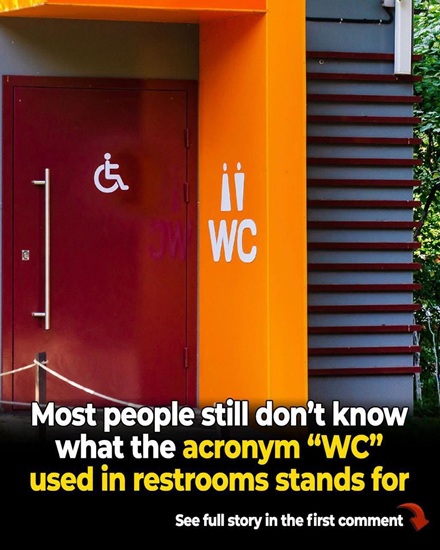
Two letters printed on a door:
WC.
They appear in hotels, airports, railway stations, restaurants and other public buildings in many parts of the world.
Most travelers eventually learn what the sign points to.
But what do the letters actually stand for?
The answer takes us back several centuries.
And the story begins before the modern bathroom even existed.
WC Means “Water Closet”
The letters WC are an abbreviation for water closet.
Historically, the term referred to a small room or enclosed space containing a flushing toilet.
The word “water” distinguished the fixture by its use of water to carry waste away.
The word “closet” could refer to a small private room.
Put them together, and “water closet” became a practical name for the new sanitary fixture and the space containing it.
But the technology behind it had been developing for a very long time.
One important chapter began in Elizabethan England.
An Unusual Invention Appeared in 1596
Sir John Harington was an English courtier, writer and godson of Queen Elizabeth I.
In 1596, he described an early flushing toilet.
The device used water from a cistern to wash waste from the bowl.
For the late 16th century, the idea was remarkably ambitious.
Yet inventing a flushing mechanism was only part of the challenge.
Homes did not have the extensive modern water and sewer infrastructure people take for granted today.
Without those systems, a flushing toilet could not simply transform sanitation overnight.
The idea was there.
The infrastructure was not.
And it would take nearly two centuries for another crucial improvement to arrive.
Then a Scottish Inventor Changed the Design
In 1775, Scottish watchmaker and inventor Alexander Cumming received a patent for an improved flushing toilet.
One feature of his design proved especially important.
Cumming incorporated an S-shaped trap in the waste pipe.
The curve retained water.
That may sound like a minor detail.
It was anything but.
The trapped water created a barrier between the room and the drainage system.
This helped prevent unpleasant gases from traveling back through the pipe and entering the building.
Modern plumbing traps still rely on the same fundamental idea: maintaining a water seal between indoor spaces and the drainage system.
A simple curve in a pipe helped solve a major problem.
But another transformation was still coming.
Indoor Sanitation Gradually Became More Practical
During the 19th century, plumbing technology and urban sanitation infrastructure continued developing.
Flushing toilets became increasingly practical in buildings connected to suitable water supplies and drainage systems.
The water closet became associated with indoor sanitation.
And as the fixture became more familiar, people needed convenient ways to identify it.
Writing “water closet” every time was unnecessary.
Two letters could do the job.
WC.
That abbreviation was short, clear and easy to put on a sign.
Then something interesting happened.
The letters traveled beyond the language that created them.
WC Crossed Language Barriers
Today, WC can be encountered in numerous countries where English is not the primary language.
That makes the abbreviation particularly useful for travelers.
Someone may not know the local word for toilet.
They may not understand every sign in a railway station.
Then they see WC.
No long translation is necessary.
The letters have become recognizable in many international settings.
Hotels use them.
Public buildings use them.
Transport facilities may use them.
Maps and directional signs may display them.
A centuries-old English abbreviation ended up surviving in places far beyond Britain.
But there is one major country where the term can feel much less familiar.
Why WC Can Seem Unusual to Americans
In the United States, people generally use other words.
“Restroom” is common for public facilities.
“Bathroom” is widely used in everyday speech, even when the room does not actually contain a bathtub.
As a result, someone raised in the United States may encounter WC more frequently while traveling internationally than at home.
The destination is familiar.
Only the label changes.
That linguistic difference is a reminder that people have created many indirect or polite ways of referring to toilets.
But the story of WC is about much more than vocabulary.
Behind those two letters is one of the most consequential changes in everyday life.
Sanitation Is the Bigger Story
A toilet may seem too ordinary to deserve historical attention.
Yet safe sanitation is fundamental to public health.
Poor sanitation can contribute to the transmission of diseases including cholera, dysentery and typhoid.
Modern sanitation systems help separate human waste from living environments and water supplies.
That transformation required much more than inventing a toilet.
It required pipes.
Water systems.
Sewers.
Treatment infrastructure.
Engineering.
Maintenance.
And widespread access.
The small WC sign sits at the visible end of that enormous system.
But that system is still not available equally to everyone.
Billions Still Lack Safely Managed Sanitation
The history of sanitation is not merely a story about the distant past.
According to WHO and UNICEF estimates for 2024, around 3.4 billion people worldwide lacked safely managed sanitation services.
Among them were hundreds of millions of people using limited or unimproved services, while hundreds of millions still practiced open defecation.
That puts the familiar WC sign into a different perspective.
For many travelers, it is simply something they look for in an airport.
Globally, safe sanitation remains an unfinished challenge.
The technology has existed in recognizable forms for centuries.
Universal access has not yet followed.
The Letters Survived While Bathrooms Changed
Modern toilets bear little resemblance to the earliest flushing experiments.
Materials changed.
Plumbing improved.
Sewer networks expanded.
Water treatment advanced.
Building standards evolved.
Yet the abbreviation WC survived many of those changes.
That is unusual.
Technology often changes its vocabulary along with its design.
In this case, an old expression remained useful.
Two letters continued doing their job.
A Sign You Can Understand Without Speaking the Language
Imagine arriving in a country for the first time.
You leave an airplane and enter a busy terminal.
Announcements are being made in a language you do not understand.
Directional signs contain unfamiliar words.
Then you notice:
WC →
Suddenly, one piece of information is perfectly clear.
That is part of the reason the abbreviation remains useful.
It is compact enough for maps.
Simple enough for signs.
And familiar enough in many countries that it can function almost like a symbol.
Not everywhere uses it.
But where it appears, those two letters can communicate a great deal.
The Name Is Older Than the Modern Bathroom
There is another detail hidden inside the phrase itself.
A “water closet” was not originally another name for everything modern English speakers might include under “bathroom.”
The emphasis was on the toilet and its enclosed space.
Bathing and toilet facilities did not necessarily occupy the same room.
That historical distinction helps explain why “water closet” can still refer specifically to a toilet compartment rather than an entire bathroom.
The words preserved an older way of organizing indoor spaces.
And the abbreviation preserved the words.
One Small Sign Contains Centuries of Development
Consider the timeline.
In 1596, Harington described an early flushing toilet.
In 1775, Cumming patented an improved design incorporating a water-retaining trap.
Over the following centuries, plumbing, sewerage and sanitation infrastructure became increasingly sophisticated.
The water closet became a recognizable part of buildings.
Its name was shortened.
And WC eventually became familiar far beyond its original linguistic setting.
The object changed enormously.
The letters barely changed at all.
That Is What Makes WC So Interesting
There is nothing visually dramatic about the abbreviation.
No complicated symbol.
No elaborate instructions.
Just W and C.
Yet behind them are centuries of attempts to solve a basic human problem safely and practically.
Inventors contributed ideas.
Engineers developed infrastructure.
Cities built sanitation networks.
Language adapted to the new technology.
And eventually a short abbreviation found its way onto doors around the world.
Most people never think about that history.
They simply follow the sign.
Next Time You See WC, You Will Know the Answer
The mystery itself is easy to solve.
WC stands for Water Closet.
The phrase developed alongside the history of indoor sanitation and flushing toilets.
Its abbreviation became a convenient way of identifying toilet facilities and remains recognizable in many parts of the world.
But those two letters represent much more than an old-fashioned name.
They connect a modern traveler with centuries of plumbing history.
From Harington’s 16th-century design to Cumming’s important 18th-century improvement, and from expanding sanitation systems to the signs found in modern international buildings, the story kept evolving.
All while the label remained remarkably small.
Two letters on a door.
A few seconds to read them.
And more than four centuries of history sitting quietly behind them.
