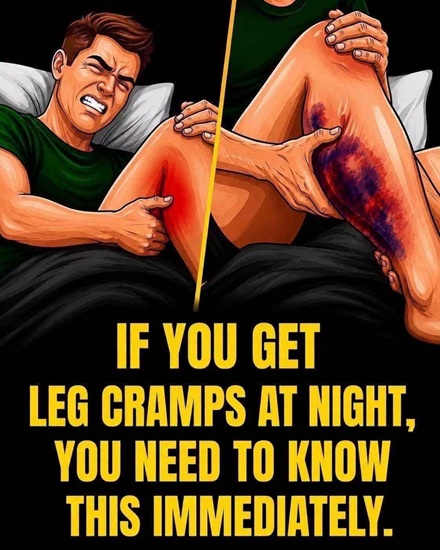
Muscle Cramps Can Wake You Up Without Warning — And the Cause May Be Different Than You Think
It can happen when you are exercising.
It can happen while you are sitting still.
And for many people, it happens in the middle of the night.
Without warning, a muscle suddenly contracts.
The calf becomes hard and painful.
For several uncomfortable seconds — or sometimes minutes — getting the muscle to relax can feel almost impossible.
Most muscle cramps are temporary and harmless.
But when they keep returning, it is natural to wonder what the body is trying to tell you.
The answer is not always as simple as “drink more water” or “take magnesium.”
There are actually several possibilities.
What Happens During a Muscle Cramp?
A cramp is an involuntary muscle contraction.
Instead of tightening and relaxing normally, the muscle suddenly contracts without you intending it to.
The calf is a particularly common location.
Cramps can also affect the thighs, feet, hands and other muscle groups.
Many episodes resolve within seconds or several minutes.
The muscle may remain sore afterward.
Nighttime leg cramps can be especially frustrating because they interrupt sleep and sometimes leave the affected area tender the following morning.
But why they occur is not always obvious.
In fact, sometimes doctors never identify a specific cause.
1. A Muscle May Simply Be Overworked
Exercise is healthy, but muscles have limits.
A workout that is much harder or longer than what your body is accustomed to can contribute to cramping.
The muscle becomes fatigued.
This is particularly common during demanding physical activity.
Running, swimming and other repetitive exercises can sometimes trigger cramps.
Hot conditions can add another challenge.
More heat often means more sweating.
More sweating means greater fluid loss.
And that brings us to one of the most familiar explanations.
2. Dehydration Can Contribute — But It Is Not the Only Cause
The body needs adequate fluid for normal function.
During heavy exercise or hot weather, dehydration may contribute to muscle cramping.

Fluid loss can become particularly significant when someone is sweating heavily.
Vomiting and diarrhea can also produce substantial fluid losses.
But there is an important distinction.
Not everyone who experiences a leg cramp is dehydrated.
Many people develop nighttime cramps despite drinking normally.
So reaching automatically for a large bottle of water does not explain every case.
Sometimes the issue may involve electrolytes.
But even there, the story is more complicated than many online claims suggest.
3. Low Electrolyte Levels Can Sometimes Play a Role
Muscle and nerve function depend partly on substances such as sodium, potassium, calcium and magnesium.
Abnormally low levels of certain electrolytes can contribute to muscle symptoms, including cramps.
However, experiencing cramps does not prove that you have a magnesium or potassium deficiency.
That is an important point.
Taking supplements without knowing whether you actually need them may be unnecessary and, in some circumstances, unsafe.
People with kidney problems or those taking certain medications need particular caution with electrolyte supplements.
When a deficiency is suspected, medical evaluation and appropriate testing can provide much more useful information than guessing.

And sometimes the problem has nothing to do with nutrition at all.
4. Staying in One Position for Too Long May Matter
Muscles generally benefit from regular movement.
Long periods of sitting can leave the legs feeling stiff and uncomfortable.
Standing for extended periods may also contribute to muscle fatigue.
Changing position regularly can help.
Walking for a few minutes, moving the ankles and gently stretching the calves can reduce stiffness for some people.
But repeated cramps that continue despite movement may point toward another explanation.
Sometimes the source of the problem is not actually the muscle.
It can be the nerve controlling it.
5. Nerve Problems Can Produce Cramping Symptoms
Nerves carry signals between the brain, spinal cord and muscles.
When a nerve becomes compressed or irritated, symptoms can travel into the legs.
Depending on the underlying condition, this may include pain, tingling, numbness, weakness or cramping.
Certain problems involving the lower spine can produce leg symptoms.
This becomes particularly important when cramps occur alongside neurological changes.
A recurring calf cramp is one thing.
Cramping combined with persistent numbness or weakness deserves more attention.
But nerves are not the only internal system capable of producing leg discomfort.
Blood flow can matter too.
6. Circulation Problems Can Sometimes Feel Like Cramps
Peripheral artery disease can reduce blood flow to the legs.
One possible symptom is cramping or aching that appears during physical activity such as walking.
The discomfort may improve after resting.
That pattern is different from suddenly waking at night with an isolated calf cramp.
People who repeatedly experience leg pain during activity, particularly those with cardiovascular risk factors, should discuss the symptoms with a healthcare professional.
Not every “muscle cramp” is necessarily caused by the muscle itself.
And another common situation involves pregnancy.
7. Leg Cramps Are Common During Pregnancy
Pregnant people frequently report leg cramps, particularly later in pregnancy.
They often occur at night.
The exact explanation is not always clear.
Changes in circulation, increased physical demands and other pregnancy-related changes may contribute.
Gentle stretching and appropriate physical activity may help some people.
Staying adequately hydrated is sensible as well.
But supplements should not automatically be started because of cramps.
During pregnancy, decisions about magnesium or other supplements are best discussed with a healthcare professional.
8. Your Medication Could Be Relevant
Muscle symptoms can sometimes occur as side effects of medication.
Certain diuretics can alter fluid and electrolyte balance.
Statins can cause muscle-related symptoms in some people.
Other medications may also contribute.
But noticing cramps after starting medication does not mean you should simply stop taking it.
Abruptly discontinuing prescribed treatment can be dangerous.
Instead, tell the healthcare professional who prescribed it.
They can determine whether the medication might be involved and whether any adjustment is appropriate.
Another possible factor is alcohol.
9. Heavy Alcohol Use Can Affect Muscles and Nerves
Alcohol can influence hydration and nutrition.
Long-term heavy alcohol use can also affect the nervous system and muscles.
For that reason, alcohol consumption may sometimes be relevant when investigating recurrent muscle symptoms.
That does not mean one drink automatically causes a nighttime leg cramp.
Context matters.
Frequency matters.
Amount matters.
And when cramps continue repeatedly, the broader health picture becomes increasingly important.
10. Some Health Conditions Can Increase Cramping
Muscle cramps sometimes occur alongside medical conditions.
Kidney disease can be associated with cramping, including in people undergoing dialysis.
Thyroid disorders can affect muscle function.
Diabetes may be associated with nerve or circulation problems that can contribute to leg symptoms.
Peripheral artery disease can cause exercise-related cramping.
Neurological conditions can also produce muscle spasms or cramps.
Again, an occasional cramp does not mean you have one of these conditions.
Most isolated cramps are not evidence of serious disease.
The pattern is what matters.
But when a cramp is happening right now, you probably care less about the cause than about making it stop.
Fortunately, there are several simple things to try.
Gently Stretch the Contracted Muscle
Stretching is one of the first measures commonly recommended for an ordinary muscle cramp.
If the calf is affected, straighten the leg gently.
Then bring the toes toward the shin.
Do not pull aggressively.
A gentle stretch is enough.
The goal is to lengthen the muscle that has suddenly contracted.
Some people also find relief by standing carefully and putting weight on the affected leg.
Slow movement can sometimes help once the muscle begins relaxing.
Massage is another option.
Gentle Massage May Help the Muscle Relax
Using your hands to massage the cramped area can help relieve the sensation of tightness.
Do not press so hard that you create additional pain.
The muscle has already been contracting forcefully.
Gentle pressure is usually more appropriate.
Walking slowly may also help after the worst part of the cramp has passed.
And if the muscle still feels extremely tight, warmth can be soothing.
Heat May Feel Good During or After a Cramp
A warm towel can be placed over the affected area.
A heating pad may also help if used safely.
A warm shower or bath is another option.
Heat can feel relaxing when the muscle remains tense.
After the cramp has ended, some people prefer cold for residual soreness.
Neither approach needs to be complicated.
Use what feels comfortable and avoid temperatures that could injure the skin.
But what about one of the internet’s most famous cramp remedies?
Pickle juice.
Pickle Juice Is Not a Guaranteed Cure
Pickle juice has become popular, particularly among athletes.
Small studies have investigated whether its strong taste might trigger reflexes involving the nervous system and shorten certain exercise-associated cramps.
That is interesting.
It is not the same as proving that pickle juice reliably treats ordinary nighttime leg cramps.
It also contains substantial sodium.
People who need to limit sodium intake should be cautious.
So you do not need to keep a jar of pickle juice beside the bed simply because you occasionally get calf cramps.
For most people, gentle stretching is a much more straightforward place to begin.
Pain medication is another area where expectations should be realistic.
Ibuprofen Will Not Usually Stop a Cramp in Seconds
NSAIDs such as ibuprofen or naproxen can sometimes help with soreness that remains after a painful cramp.
They generally do not act quickly enough to stop the muscle contraction while it is occurring.
These medications also have risks.
They may not be appropriate for people with certain kidney, gastrointestinal, cardiovascular or bleeding problems.
They can also interact with other medications.
So they should not be treated as an automatic solution for every cramp.
During the cramp itself, stretching and gentle massage are usually more practical.
Can You Prevent Cramps From Returning?
Sometimes prevention is possible.
If strenuous exercise seems to trigger cramps, gradually increasing training intensity may help.
Regular stretching can be useful for some people.
Adequate hydration is sensible, particularly during exercise or hot weather.
People who lose large amounts of fluid through sweating may also need appropriate electrolyte replacement.
If you sit for long periods, getting up periodically and moving the legs may help reduce stiffness.
But prevention depends heavily on the cause.
Someone whose cramps are related to a medication, nerve problem or circulation issue may need a different approach.
And sometimes there is no obvious trigger to remove.
Many Nighttime Cramps Have No Clear Explanation
This is one of the most overlooked facts about muscle cramps.
Sometimes they simply happen.
A person can be well hydrated.
Their electrolyte levels can be normal.
They may not have exercised excessively.
And they can still wake up with a painfully contracted calf.
Doctors refer to some unexplained cramps as idiopathic.
That means no specific cause has been identified.
So an online article promising that one vitamin, drink or stretch will eliminate every leg cramp should be approached carefully.
There is no universal explanation.
And there is no universal cure.
When a Cramp Should Not Be Ignored
An occasional cramp that disappears quickly is usually not alarming.
Frequent or unusually severe cramps are different.
Seek medical advice if cramps repeatedly disrupt sleep or daily activities.
Cramps that last unusually long should also be evaluated.
Pay particular attention when other symptoms appear.
Persistent numbness.
Weakness.
Swelling.
Redness.
Skin changes.
Significant pain that does not improve.
These can provide clues that something beyond an ordinary muscle cramp may be happening.
And that leads to the most important point.
Do Not Treat Every Cramp as a Magnesium Problem
When a calf suddenly tightens at 2 a.m., it is tempting to search for one simple explanation.
Dehydration.
Magnesium.
Potassium.
Too much exercise.
Sometimes one of those really is involved.
But sometimes it is not.
The cramp may involve fatigue.
A medication.
Pregnancy.
A nerve.
Circulation.
Another medical condition.
Or no identifiable cause at all.
That is why the most useful question changes when cramps become frequent.
At first, the question is:
How do I make this muscle relax?
Stretching, gentle massage and movement may help answer that.
But if the cramps continue night after night, another question becomes more important:
Why does this keep happening?
That is the payoff worth remembering.
An occasional cramp is usually just an unpleasant interruption.
A repeated pattern is information.
And when your body keeps repeating the same message, finding the reason can be more useful than simply trying another home remedy.
Medical disclaimer: This article provides general educational information and is not a substitute for professional medical advice, diagnosis or treatment. Anyone experiencing persistent, severe, unexplained or worsening muscle cramps, particularly with weakness, numbness, swelling or other concerning symptoms, should consult a qualified healthcare professional.
