
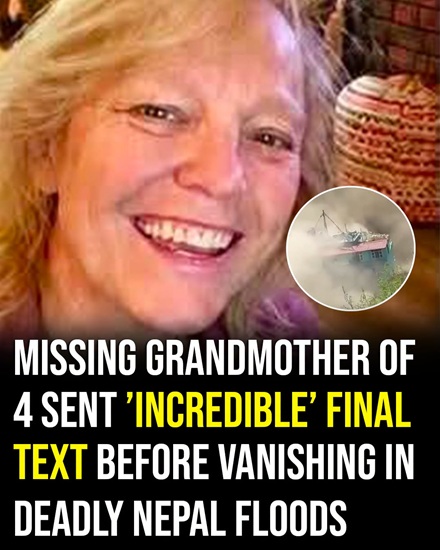
Mary Sorensen’s family is continuing to wait for answers after the 60-year-old Georgia woman disappeared during the devastating flooding that struck the Nepal-Tibet border region in August 2026. Sorensen, a mother and grandmother of four who lived north of Atlanta, had traveled thousands of miles to complete a spiritual pilgrimage to Mount Kailash. The journey had been something she dreamed about for years, and her family said she successfully completed the pilgrimage before beginning the long trip home.
What was supposed to be the final stage of an important personal experience instead became the beginning of an agonizing search for information after catastrophic flooding swept through the area. Sorensen traveled to the Himalayan region with a group connected to her yoga and meditation practice. Mount Kailash has deep religious significance and attracts pilgrims from several spiritual traditions, including Hinduism, Buddhism, Jainism and the Bon tradition.
For Sorensen, however, the trip was not simply another destination on a travel itinerary. Her relatives have described it as a deeply meaningful goal connected to her spiritual outlook and her desire to experience a place she had thought about visiting for a long time. Her son Riley Wildeman has described his mother as adventurous, independent and capable of finding something positive in almost every situation. According to him, Sorensen often approached life according to her own instincts rather than worrying excessively about what other people expected.
She enjoyed new experiences, valued personal reflection and tried to see goodness in the people around her. Those qualities, her family says, help explain why traveling to Mount Kailash felt so natural for her despite the distance and physical demands involved. Sorensen accomplished what she had traveled there to do. She reached the sacred mountain, completed the pilgrimage and began moving back toward the border region as she prepared for the journey home.
Her family expected that she would eventually travel through Kathmandu before flying back to the United States. She had no indication when beginning that return journey that the region was about to experience a natural disaster of extraordinary scale. Shortly before communication was lost, Sorensen sent her family a message that has since become especially meaningful. She told them how grateful she was that they were her family. At the time, the words were apparently part of an ordinary conversation following an extraordinary journey rather than a deliberate farewell. Only after she disappeared did the message take on the painful significance her relatives now associate with it.
Riley has explained that his mother was looking forward to the lengthy trip home because she wanted time to think about what she had experienced. The pilgrimage had apparently affected her deeply, and she hoped to use the journey back to reflect on how she could explain its meaning to her family. She expected to return home with stories and memories. Instead, her final known communication became one of the few things her relatives could hold onto while waiting for news.
For the family, that message has brought both sadness and comfort. They have not interpreted it as evidence that Sorensen knew something terrible was going to happen. There is no indication that she expected the disaster that followed. Rather, the words have become meaningful because they clearly expressed how much she loved and appreciated her family shortly before contact disappeared.
Riley has said that if the message ultimately proves to have been the last communication they ever receive from his mother, he considers the expression of gratitude an extraordinary final message. At the same time, he has emphasized that the family has not abandoned hope of finding her alive. The two emotions exist together: appreciation for the message she sent and hope that it will not actually be her final goodbye.
Before the flooding, Sorensen had concrete plans for what she would do after returning to the United States. Her family expected her to reach Atlanta, spend a short amount of time at home and then travel to Maine to reunite with her husband Brian. She was also looking forward to seeing members of her family, including her granddaughters. Those ordinary plans make the sudden disappearance particularly difficult for her relatives to process.
The situation changed dramatically when destructive flooding and mudslides struck the Nepal-Tibet border corridor. Floodwaters carrying mud, rocks and debris moved through mountainous areas and damaged buildings, roads, bridges and other infrastructure. The destruction affected local residents as well as international travelers who had been moving through the region after visiting Mount Kailash.
The disaster created enormous logistical problems for rescue workers. Mountainous terrain can already make communication and transportation difficult under normal circumstances. When roads, bridges and communications infrastructure are damaged at the same time, determining where travelers went and whether they reached safety becomes considerably more challenging.
Foreign pilgrims were among the people affected because the border route is commonly used by travelers entering and leaving the Mount Kailash region. Americans and visitors from other countries became separated from travel groups or were unable to contact their families. In the first days after the disaster, dozens of Americans were reported as unaccounted for while officials attempted to determine who had escaped, who had been evacuated and who remained missing.
Sorensen was among the Americans whose whereabouts could not initially be confirmed. Her family began contacting government agencies and searching for information almost immediately. They reached out to the U.S. State Department and also attempted to obtain assistance through authorities connected with Nepal and China.
The family’s available information suggested that Sorensen had reached an immigration facility near the Nepal-Tibet border shortly before the flooding. Her husband Brian has said the timeline indicated that the floodwaters may have arrived only minutes after she reached that location. Because authorities have not publicly reconstructed every moment of Sorensen’s movements, that timing should be understood as the family’s interpretation of available records rather than a complete official account.
Still, the possibility that she was close to the affected border facility when the flood arrived has been particularly frightening for her relatives. The region experienced severe destruction, and some buildings and roads were overwhelmed by water, mud and debris. That has made it difficult to know whether people escaped into nearby areas, were transported elsewhere or became trapped.
Large disasters frequently create confusion in missing-person records. Someone may be reported missing by family members while already being safely evacuated somewhere without functioning communications. The same individual can also appear on multiple lists maintained by travel companies, government agencies or local authorities. Conversely, authorities may not immediately know that someone was present in the affected area.
For those reasons, the number of people described as missing during the early stages of a disaster can change significantly. Some people establish contact later, while others remain unaccounted for as searches continue. Reports that previously missing travelers were eventually contacted have provided some hope to families waiting for information.
However, there has been no verified public information establishing that Sorensen was one of those people who successfully made contact. Her family has therefore continued treating her as missing rather than assuming either a positive or tragic outcome. Declaring someone safe without confirmation would be inaccurate, just as declaring someone dead without evidence would be irresponsible.
This uncertainty has been one of the hardest parts of the experience for Brian and the rest of the family. A confirmed outcome, even a painful one, provides information people can begin to process. A disappearance leaves relatives suspended between possibilities, following every update while wondering whether the next telephone call could finally contain news.
Brian has spoken openly about imagining the possibility that his wife could eventually call and explain that communications had failed and she was safe. That hope remains important to him despite his awareness of how destructive the flooding was. He has not suggested that he knows she survived; rather, he has expressed a wish that disrupted communications or evacuation could explain her disappearance.
The family’s determination to keep hoping reflects what they say Sorensen taught them about life. Riley has emphasized that his mother encouraged optimism and did not easily give up when circumstances became difficult. As the family searches for answers, they are trying to apply that same attitude to the uncertainty surrounding her disappearance.
Their hope should not be confused with certainty. Rescue operations after major floods can continue for lengthy periods, particularly when isolated communities and remote mountain areas are involved. Until officials obtain verified information about Sorensen’s whereabouts, there is no responsible basis for predicting the final outcome.
Brian has also discussed his wife’s spirituality while explaining how he is coping emotionally. He described Sorensen as someone who viewed human life through a spiritual lens and believed that existence extended beyond the physical body. Those comments represent the family’s personal beliefs and should be understood in that context rather than as factual evidence regarding Sorensen’s current condition.
According to her family, Sorensen’s spiritual outlook influenced many areas of her life. Prayer, yoga, meditation and reflection were important to her, making the Mount Kailash pilgrimage a particularly appropriate journey. It was not something she undertook impulsively. She had thought about making the trip for years before finally reaching the mountain at age 60.
Her relatives have said the successful completion of the pilgrimage gave her enormous satisfaction. That fact has become another source of comfort during the search. Whatever eventually emerges about her disappearance, they know that Sorensen achieved something she deeply wanted to experience.
The journey also involved physical determination. Pilgrimages around Mount Kailash occur at high altitude and can present significant physical challenges. Travelers often need to prepare for difficult weather, thin air and remote conditions. Sorensen’s willingness to undertake such a trip reflects the adventurous personality her children have described.
At the same time, the natural disaster that followed was far beyond the normal challenges associated with such travel. Flooding and mudslides can transform valleys and roadways with extraordinary speed, giving people very little time to respond. Debris-filled water is particularly destructive because it can carry rocks, soil and damaged structures over large distances.
Emergency workers responding to the disaster have therefore had to operate under extremely difficult conditions. Destroyed roads can prevent conventional vehicles from reaching isolated locations. Damaged communications can leave rescue teams without immediate information about how many people were present in a particular area.
Search teams have also had to consider the possibility that survivors moved away from the most heavily damaged locations in search of shelter. Someone who escaped an immediate flood might later become difficult to locate if roads and telephone networks were no longer functioning. This possibility is among the reasons families continue waiting for official confirmation.
The humanitarian impact extends far beyond foreign pilgrims. Local communities have lost homes, relatives and infrastructure. Entire families have been displaced, and authorities face the challenge of restoring transportation, food supplies, healthcare access and communications while simultaneously searching for missing people.
Reports of large casualty totals describe the enormous scope of the disaster, but those statistics can obscure the individual stories involved. Every missing person’s name represents relatives waiting somewhere for information. Sorensen’s family is one of many experiencing that painful uncertainty.
For Americans affected by the disaster, U.S. diplomatic officials have worked with local authorities to identify travelers and confirm their status. These efforts can involve reviewing border records, contacting hospitals or shelters, communicating with travel groups and comparing missing-person information supplied by families.
The process can take time, particularly when governments in multiple countries are involved. Sorensen’s journey passed through the Nepal-Tibet region, meaning information about her movements can involve different border authorities and agencies. Her family has therefore sought help through several official channels rather than relying only on social media or unofficial reports.
That approach is important because misinformation spreads rapidly during major disasters. Photographs, casualty numbers and supposed survivor lists can circulate online without verification. Families searching for missing relatives can be especially vulnerable to inaccurate claims because they are desperate for information.
The safest approach is to rely on confirmed statements from authorities, verified news organizations and the relatives directly involved. In Sorensen’s case, there has been no confirmed announcement that resolves her status. She should therefore continue to be described as missing unless her family or responsible authorities provide an update.
The family has also avoided presenting assumptions as facts. They know she had reached the border region, and they know catastrophic flooding occurred. What they do not yet know is exactly what happened to her when the water arrived.
That missing piece is the question at the center of their search. Was Sorensen able to leave the facility? Did she join other travelers moving toward safety? Was she transported somewhere without communications? Or did she become caught in the disaster itself? Without reliable evidence, none of those possibilities can responsibly be presented as the confirmed answer.
The possibility of communication problems has helped keep hope alive. In large disasters, mobile networks and electricity can disappear for extended periods. People who are safe may not immediately be able to contact relatives thousands of miles away.
At the same time, the family understands that the flood caused significant loss of life. Their optimism therefore exists alongside awareness of the danger Sorensen faced. Riley and Brian have not attempted to minimize that reality.
Instead, they have spoken about trying to live with two possibilities at once. They hope she survived and may still be somewhere awaiting contact or identification. They also recognize why her final message has become so valuable if the outcome eventually proves tragic.
That message was simple but deeply personal. Sorensen told the people closest to her that she was grateful for them. It did not contain dramatic predictions or signs that she expected danger. Its emotional power comes precisely from how ordinary and sincere it was.
Many families never receive such clearly affectionate words immediately before a sudden disappearance. Sorensen’s relatives therefore view the message as a gift even while desperately hoping they will eventually receive another one.
Her son has spoken particularly warmly about the type of mother she was. He describes someone who encouraged independence and believed that life should be experienced rather than merely observed. Her decision to make the pilgrimage in her sixties reflected that philosophy.
For her grandchildren, Sorensen was also a grandmother whose life involved more than quiet routines at home. She traveled internationally, pursued spiritual experiences and remained curious about the world. Those qualities formed part of the example she gave the younger members of her family.
Her husband Brian had shared decades of life with her. The couple had been married for many years and built a blended family that eventually included four granddaughters. Sorensen’s disappearance therefore affects several generations at once.
The plans waiting after her return are another reminder of how suddenly disasters can interrupt ordinary life. She expected to arrive home, unpack and soon travel again to spend time with her husband and grandchildren. There was no planned separation or unresolved disappearance before the flood.
Her family had every reason to expect that the next stage of the story would involve hearing about her pilgrimage. They imagined photographs, descriptions of the landscape and conversations about how the experience had affected her spiritually.
Instead, they have spent their time contacting officials, monitoring rescue operations and trying to reconstruct her movements.
Riley has said his mother wanted the long travel time home precisely because she needed to organize her thoughts. The experience at Mount Kailash had given her a great deal to process, and she wanted to explain it properly to her family.
The fact that she was thinking about those future conversations shows why her final text should not be treated as a knowingly composed farewell. Nothing publicly reported indicates that Sorensen believed she was about to disappear.
Her words simply happened to be particularly loving shortly before circumstances changed dramatically.
The family’s interpretation of those words has evolved with the situation. Initially, they were part of a normal family conversation. After the flooding, they became a reminder of Sorensen’s priorities and the affection she felt for them.
If she is eventually found safe, the message will remain a meaningful expression of gratitude from an important journey. If the outcome is different, the words will carry a very different emotional significance.
This uncertainty explains why Riley has described the text both as comforting and heartbreaking. It allows the family to remember exactly what was on Sorensen’s mind shortly before communication ended.
Her story also highlights the unpredictability involved in international travel to remote locations. Pilgrims can prepare for altitude, weather and difficult roads, but certain natural disasters cannot be reasonably anticipated or controlled.
Mount Kailash itself remains one of the world’s most significant pilgrimage destinations. People travel there for reasons that can be deeply connected to faith, identity and personal transformation.
Sorensen’s family believes she obtained the spiritual experience she had hoped for before the disaster occurred. She completed the pilgrimage rather than being forced to abandon the goal halfway through.
That knowledge does not reduce their desire to have her home again, but it provides another positive memory from the final days before she disappeared.
The broader disaster response remains essential for determining what happened to thousands of affected people. Rescue operations, identification efforts and restoration of communications can gradually reduce the number of unresolved missing-person cases.
Each successful contact provides hope while also demonstrating why early missing-person counts should be treated carefully. Someone who cannot be reached today may be confirmed safe tomorrow.
But each passing day can also make families more anxious. Waiting becomes increasingly difficult as rescue operations shift toward longer-term recovery efforts.
Sorensen’s relatives therefore face an emotional situation without a simple solution. They cannot force information to emerge faster, and they cannot know which possibility will eventually prove correct.
What they can do is continue communicating with authorities, share accurate identifying information and remain available if officials discover new evidence.
The U.S. government and authorities in the region have been involved in efforts to account for foreign citizens. Families of missing travelers can provide travel itineraries, passport information and last-known communications to assist those searches.
Border and immigration records may be especially valuable because they can establish where someone was at a particular time. In Sorensen’s case, those records helped her family identify the border facility as an important part of the timeline.
However, records alone cannot show precisely what happened after the flood arrived. Witness accounts, rescue lists, medical records or physical searches may ultimately be needed to answer that question.
That is why the investigation remains open rather than resolved by the immigration information.
Some relatives of people missing after natural disasters describe repeatedly checking their phones, hoping that an unfamiliar number might bring news. Brian has expressed a similar desire to receive a call telling him Sorensen is alive and on her way home.
For now, that telephone call has not been publicly reported.
The family’s spiritual perspective has helped them cope with the uncertainty. Brian has spoken about viewing Sorensen’s spirit as something larger than the physical circumstances surrounding her disappearance.
Those beliefs are deeply personal and offer him a framework for handling circumstances he cannot control.
Riley’s response has focused strongly on hope. He has said he believes finding his mother remains within the realm of possibility and that giving up prematurely would contradict lessons she taught her children.
There is something especially poignant about a family using a missing person’s own values to guide them while searching for her.
Sorensen encouraged them to remain optimistic, and now they are trying to practice that optimism under circumstances far more difficult than anything they expected.
Their public comments have also helped keep attention on the unresolved search without claiming information that does not exist.
That balance is important. Missing-person coverage should neither sensationalize tragedy nor manufacture reassurance.
Responsible reporting can explain the seriousness of the disaster while clearly acknowledging uncertainty.
In Sorensen’s case, the known story has three important parts. She completed a long-awaited pilgrimage to Mount Kailash. She began traveling home and sent her family a loving message. Then devastating flooding struck the region and her whereabouts became unknown.
Everything beyond those established points must be treated carefully unless additional evidence emerges.
The family continues hoping that a breakdown in communications, evacuation or another circumstance may explain why they have not heard from her.
At the same time, they understand the enormous scale of the destruction and do not pretend that the situation is simple.
That mixture of hope and realism has characterized their public statements from the beginning.
For Riley, the qualities he admires in his mother remain visible even in her absence. Her adventurous spirit explains why she went. Her spirituality explains why the pilgrimage mattered. Her devotion to family explains the final message she sent.
Those elements allow relatives to tell her story as the story of a person rather than reducing her to another name on a missing-person list.
Mary Sorensen is a mother, wife, grandmother and traveler whose family expected her to return home after completing something deeply meaningful to her.
Her disappearance turned that anticipated homecoming into an international search for answers.
Until reliable information establishes otherwise, she remains missing.
Her loved ones continue contacting officials, following developments and hoping that someone will eventually be able to tell them where she is.
They also continue returning to the words she sent shortly before communication disappeared.
For a family living through extraordinary uncertainty, those words have become a reminder that Sorensen finished her pilgrimage feeling grateful for the people she loved.
That knowledge cannot answer what happened at the border, but it provides something tangible during a situation defined largely by unanswered questions.
Her relatives hope the story is not finished.
They hope that eventually there will be another telephone call, another conversation and another opportunity for Sorensen to explain the journey she had been so eager to describe.
Until that moment arrives — or authorities provide another confirmed answer — the family says it will continue holding onto hope.
The broader search and recovery effort also continues to remind the public that casualty and missing-person figures during major disasters can change. People should avoid sharing unverified claims about Sorensen or any other missing traveler.
A family waiting for news should not have to confront false reports declaring someone alive or dead based on rumors.
Any meaningful update about Sorensen should come from her relatives or appropriate government authorities.
For now, the accurate description of her situation remains straightforward: Mary Sorensen disappeared after completing her Mount Kailash pilgrimage and reaching the Nepal-Tibet border area shortly before catastrophic flooding.
Her family has not received confirmation explaining what happened afterward.
They continue searching, waiting and hoping.
And while the uncertainty remains painful, they also have one message from Sorensen that captures exactly how she felt about them before everything changed.
She was grateful for her family, excited to reflect on a journey she had dreamed about for years and expecting to return home to the people she loved.

