
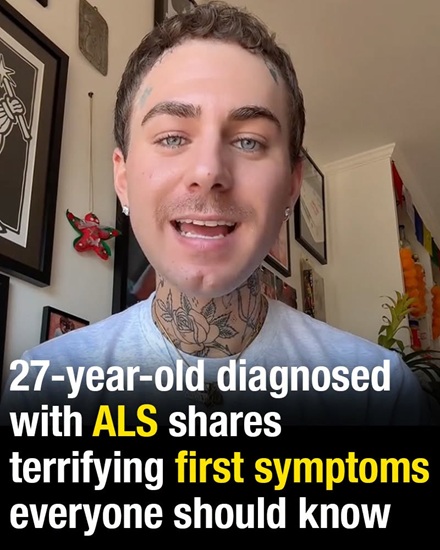
Mikey Stone was only 26 years old when he learned that the physical changes he had been experiencing were connected to amyotrophic lateral sclerosis, commonly known as ALS. Now 27, he has spoken publicly about the gradual development of his symptoms and the long process that eventually led to his diagnosis. What began as a sensation he could describe only as “weird” in his left foot slowly became something much more serious. His experience has drawn attention because it shows how the early stages of a neurological condition can sometimes begin with changes that seem minor or easy to dismiss.
ALS is a progressive neurological disease that affects the nerve cells responsible for controlling voluntary muscle movement. As those motor neurons become damaged, communication between the brain and muscles is gradually lost. This can lead to increasing muscle weakness and eventually affect a person’s ability to walk, use their arms and hands, speak, swallow and breathe. There is currently no cure for ALS, although medical treatment, rehabilitation and supportive care can help manage symptoms and may help some people maintain function for longer periods of time.
Stone has said that his first noticeable symptom appeared while he was working as a server in Colorado. His left foot simply did not feel normal, but at first there was no obvious explanation for the sensation. Over time, that strange feeling developed into stiffness, and the stiffness eventually extended upward into his calf. He later began noticing muscle twitching in the same general areas. According to his account, those changes gradually became more widespread over the following years rather than appearing all at once.

As the symptoms continued, Stone began having increasing difficulty with walking. His legs started to feel heavy, weak and unusually tired, making normal movement require much more effort than before. He has compared the sensation to trying to walk through the shallow part of a swimming pool, where resistance makes every step harder. What initially seemed like an isolated problem with one foot slowly became a more significant issue that interfered with everyday mobility.
In another account of his experience, Stone described losing normal movement in one of his feet. He said the change affected the way he walked so noticeably that he compared his gait to walking with a peg leg. At first, his difficulties were not immediately recognized as ALS. Symptoms involving weakness, fatigue, stiffness or changes in walking can have many possible causes, and they do not automatically point to one specific disease. This is one reason neurological conditions such as ALS can require careful evaluation over time.
Stone also experienced other health concerns during the period when he was trying to understand what was happening. He has described feeling feverish and mentally foggy during a friend’s birthday gathering and later experiencing severe abdominal discomfort. When he sought medical help, doctors initially considered other explanations, including COVID-19. Those additional symptoms should not be interpreted as standard indicators of ALS, and his overall experience reflects his individual medical history rather than a universal pattern that applies to everyone with the disease.
After approximately three years of appointments, evaluations and visits with different doctors and specialists, Stone eventually received an ALS diagnosis. He has said that hearing the diagnosis was an overwhelming moment and that he felt as though his life flashed before his eyes. Being diagnosed in his twenties is less common than receiving an ALS diagnosis later in adulthood, which made his situation especially difficult to process. His story also illustrates how emotionally challenging a lengthy search for answers can be when symptoms continue to progress.
Stone has discussed a rare genetic finding related to his individual case, involving the SLC1A2 gene. Genetics can play a role in some cases of ALS, but researchers continue to study the many different factors that may contribute to the disease. Not every person with ALS has the same genetic findings, and most common muscle symptoms do not indicate that someone has the condition. A single patient’s genetic result should therefore never be used to make assumptions about another person’s health.
Since receiving his diagnosis, Stone has continued speaking publicly about what he is experiencing. He has said that one of his goals is to continue walking for as long as possible before he may eventually need a wheelchair. By discussing his condition openly, he has helped bring attention to both the physical and emotional challenges associated with ALS. At the same time, every person’s experience with the disease can be different, including the symptoms that appear first and the rate at which those symptoms progress.
Some early signs associated with ALS can involve changes in movement and muscle function. People may experience difficulty walking, increased tripping, weakness in the arms or legs, muscle cramping or twitching, or problems holding and handling objects. Speech can sometimes become slower or less clear, and some individuals may develop difficulty swallowing. ALS can also affect emotional expression in certain people, causing episodes of laughing or crying that may be difficult to control.
However, these symptoms are not specific to ALS. Muscle twitching, fatigue, stiffness, weakness and occasional coordination problems can occur for many reasons, including conditions that are much more common and less serious. Experiencing one of these symptoms does not mean a person has ALS. Medical professionals evaluate symptoms together with a person’s medical history, physical examination and, when appropriate, neurological testing before reaching a diagnosis.
This is an important distinction when health stories are shared online. Reading about another person’s diagnosis can raise awareness, but it can also create unnecessary fear if common symptoms are presented without proper context. Stone’s story should therefore not be interpreted as evidence that an unusual feeling in the foot automatically indicates ALS. Instead, the broader message is that persistent or worsening changes in strength, coordination or movement deserve attention from a qualified healthcare professional.
ALS remains a relatively rare disease, and scientists are continuing to investigate why it develops. Research has identified both genetic and non-genetic factors that may be involved, but many questions remain unanswered. Some cases occur in families, while others develop in people without a known family history of ALS. Researchers are studying motor neurons, genetics, cellular processes and environmental influences in an effort to better understand the disease and develop improved treatments.
The process of diagnosing ALS can also be complicated because there is no single symptom that proves someone has the condition. Doctors often need to evaluate how symptoms change over time while considering other neurological, muscular or metabolic conditions that can produce similar problems. Testing may include neurological examinations and assessments of nerve and muscle function. The exact process depends on the individual and should always be guided by trained medical professionals.
Stone’s experience has attracted attention because of how ordinary the beginning appeared. A strange sensation in one foot gradually progressed into stiffness, twitching, weakness and difficulty walking. Years later, those changes became part of a much larger diagnosis. His story shows why people should pay attention to significant and persistent changes in their bodies while also avoiding self-diagnosis based on isolated symptoms or social-media content.
It is equally important to remember that ALS does not progress in exactly the same way for every patient. Symptoms can begin in different parts of the body, and the speed of progression can vary significantly. Treatment plans and supportive care are therefore individualized. Medical teams may include neurologists, physical therapists, respiratory specialists, speech professionals, nutrition specialists and other healthcare providers depending on a patient’s needs.
For Stone, life after diagnosis has involved adapting to a condition that can gradually affect independence and mobility. His decision to speak openly about what he is facing has given others an opportunity to learn more about ALS while also showing the human side of the disease. His experience is personal, but the broader lesson is one of awareness rather than alarm. Persistent neurological or muscular changes deserve proper evaluation, but they should never be interpreted without medical context.
The most responsible response to unexplained symptoms is not to assume a diagnosis but to seek appropriate healthcare guidance. Anyone noticing worsening weakness, repeated problems with walking, persistent muscle changes or other unusual neurological symptoms should discuss them with a qualified medical professional. A healthcare provider can determine whether the symptoms are temporary, connected to a common condition or require additional specialist evaluation.
Stone’s journey began with something that seemed small: an unusual sensation in his foot. Over time, it developed into a series of progressive changes that ultimately led to his ALS diagnosis. His story serves as a reminder that awareness can be valuable when it is presented carefully, accurately and without exaggeration. It also reinforces an equally important message: individual experiences should inform awareness, not replace professional medical assessment.
This article is intended only for general informational and awareness purposes and should not be considered medical advice. Symptoms such as muscle twitching, weakness, stiffness, fatigue or difficulty walking can have many different explanations and do not necessarily indicate ALS. Anyone experiencing persistent, worsening or unexplained symptoms should contact a qualified healthcare provider for an appropriate evaluation.

