
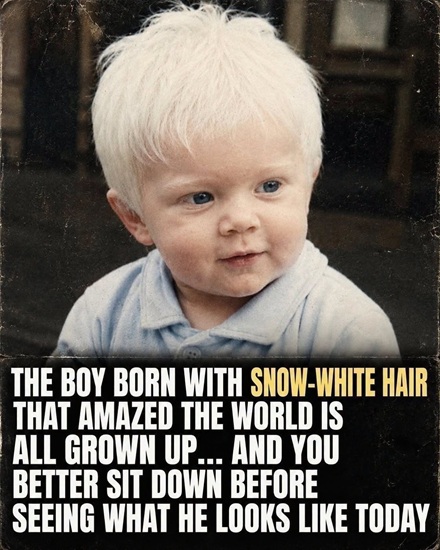
When photographs of a newborn boy with unusually white hair began spreading across the internet, people around the world immediately noticed how distinctive he looked. The baby, named Csincsa Bence, was born in Székesfehérvár, Hungary, on December 26, 2015. Contemporary Hungarian reports described him as having a surprisingly full head of extremely pale, almost milk-white hair. His appearance was so unusual for a newborn that photographs quickly attracted attention beyond the hospital and his family’s immediate circle.
What started as an unexpected feature at birth soon became the reason thousands of people wanted to learn more about him. At first glance, some viewers assumed that his white hair might be connected to albinism. That conclusion was understandable because albinism can affect pigmentation in the hair, skin, and eyes. However, doctors who examined Bence did not describe him as having albinism. Reports published in Hungary at the time stated that physicians believed the unusual coloration was more likely related to a localized or temporary difference in pigmentation.
More importantly, the doctors described him as healthy after routine medical examinations. This distinction matters because appearance alone cannot reliably establish a medical diagnosis. Extremely light hair may attract attention, but there can be different reasons for changes in pigmentation. Medical professionals consider a person’s overall health and other physical characteristics before determining whether a particular condition is present. In Bence’s case, the available contemporary reporting indicates that doctors did not see his unusual hair color as evidence of a serious medical problem.
The physicians quoted in early coverage also suggested that his hair might become darker as he grew older. They believed that pigmentation could increase during childhood, potentially changing the appearance that made him famous as a newborn. This was presented as a possibility rather than a guaranteed prediction. Without reliable long-term medical follow-up available publicly, it would be inaccurate to state with certainty exactly how much his hair later changed.
Bence’s photographs spread because his appearance was immediately memorable. A newborn with thick, snow-white hair is uncommon enough that viewers naturally wanted to know the story behind the images. Social media made that curiosity grow quickly, allowing the photographs to reach people far beyond Hungary. Within a short period, his hair became the feature most often discussed whenever his name or picture appeared online.
Early Hungarian reports offered a relatively simple picture of the situation. Bence had been born with unusually pale hair, his family was surprised by the appearance, and doctors said he appeared healthy. The medical explanation provided at the time focused on pigmentation rather than on a confirmed disease. This straightforward account is important because later internet versions of viral stories can sometimes become more dramatic as they are repeatedly rewritten.
One detail that should be treated carefully is Bence’s birth weight. Different articles published over the years have repeated different numbers. Contemporary local Hungarian reporting described him as weighing approximately 3.35 kilograms and measuring about 54 centimeters. Some later international stories gave a substantially higher weight. When different reports conflict, the earlier local coverage is generally more useful for understanding what was originally reported.
Another point requiring caution is the claim that Bence had a confirmed rare genetic disorder. Genetics certainly influence human pigmentation, but the early reports about him did not establish a specific rare genetic diagnosis. Doctors instead described his hair color as an unusual pigmentation phenomenon and specifically rejected the assumption that he had albinism. Turning that medical uncertainty into a definite genetic diagnosis would therefore go beyond the available evidence.
Human pigmentation is complex and can vary significantly between individuals. Melanin contributes to the color of hair, skin, and eyes, but the way pigmentation develops can differ during infancy and childhood. Babies may also experience changes in hair texture or color as they grow. An unusual hair color can therefore be visually striking without automatically indicating that something is wrong with a child’s health.
This is one reason Bence’s story became interesting from both a human and scientific perspective. People were fascinated by an appearance they rarely saw, while doctors approached the situation more cautiously. Instead of diagnosing him based only on his hair, they examined his general health and considered possible explanations for the unusual pigmentation. That difference between public curiosity and medical evaluation is important.
According to contemporary reports, Bence underwent routine examinations after birth. Those reports described the results as reassuring and indicated that he was considered healthy. Additional attention was naturally given to his pigmentation because the hair color was so unusual, but there was no indication in those early stories that the white hair was causing him immediate medical difficulties.
The attention surrounding his appearance demonstrates how quickly an unusual physical characteristic can become a person’s entire identity online. To many people who saw the original images, Bence was simply “the baby with white hair.” Yet a physical trait is only one part of any person. The photograph captured a remarkable feature, but it could never provide a complete picture of the child behind it.
That consideration becomes particularly important because Bence became famous before he was old enough to understand what public attention meant. He did not choose to become an online subject. His photographs circulated while he was still a newborn, and people who had never met him began discussing his appearance. This is common with viral images involving children, where publicity can arrive long before the person pictured has any ability to participate in the decision.
Because of that, later reporting about a viral child should be especially careful. Curiosity about what Bence looks like today is understandable, but curiosity alone does not justify creating unsupported information. Reliable public sources provide substantial information about his birth and the doctors’ observations at that time, while trustworthy details about his later childhood are far more limited.
Many online articles use headlines suggesting that they can reveal exactly where a famous child is today. Some may show photographs supposedly depicting the same person years later. However, photographs should not automatically be accepted as authentic simply because another child has similar white or light-colored hair. Proper identification requires reliable sourcing, particularly when the subject is a private individual who originally became famous as a minor.
The same rule should apply to descriptions of Bence’s personality. Claims that he grew into a humble, confident, kind, or particularly outgoing young person may sound positive, but such details need evidence. Unless Bence, his family, or a reliable source has publicly provided those descriptions, they should not be presented as established biographical facts.
There is also insufficient reliable evidence to describe his present-day hobbies, friendships, education, ambitions, or personal relationships in detail. Filling those gaps with assumptions would transform a factual story into an invented biography. A responsible account should therefore clearly separate information documented at the time of his birth from speculation about the years that followed.
The lack of extensive recent public information does not make the story incomplete. People who unexpectedly become famous as babies are not required to spend the rest of their lives in public view. A family may choose greater privacy after an intense period of attention, and that choice should not automatically be interpreted as mysterious or unusual.
In fact, privacy can be a perfectly normal outcome of a viral childhood moment. Millions of photographs become popular temporarily before public attention moves elsewhere. The person featured in the image may continue growing, attending school, spending time with family, and developing interests outside public view. There is no need for the internet to document every stage of that person’s life.
Bence’s story also illustrates the importance of avoiding medical speculation from photographs. A viewer looking at an image may immediately attach a diagnosis to an unusual feature, but visual similarity is not medical evidence. Conditions affecting pigmentation can have different causes and characteristics, and diagnosis belongs to qualified professionals who can evaluate the individual directly.
Albinism itself is not simply another word for white hair. It refers to a group of inherited conditions involving reduced production of melanin and can affect several parts of the body. Some forms can also involve vision-related issues. A person cannot responsibly be described as having albinism merely because a photograph shows pale hair or skin.
This is particularly relevant to Bence because early medical reporting specifically stated that doctors did not believe he had albinism. Repeating the opposite claim simply because it makes a headline sound more dramatic would distort what was originally reported. Accuracy requires preserving that distinction.
The same caution applies to phrases such as “rare disease” or “mysterious disorder.” Those expressions can create the impression that physicians identified an illness when the available information does not support that conclusion. An unusual physical characteristic may be rare without being harmful. Describing rarity and describing disease are not the same thing.
Bence’s case therefore offers a useful example of why careful language matters in health-related stories. A responsible article can explain that he had strikingly white hair, that doctors evaluated him, that albinism was not considered the diagnosis, and that a pigmentation difference was suggested as an explanation. There is no need to exaggerate beyond those facts.
It is also important to recognize that pigmentation exists across a broad range of normal human variation. People naturally differ in hair color, skin tone, eye color, and many other visible characteristics. Some differences are common, while others are unusual enough to attract attention. Uncommon does not automatically mean unhealthy.
Public reactions to unusual appearance can nevertheless have consequences. People may stare, ask personal questions, make assumptions, or discuss someone online without considering how the person might feel. This can be especially sensitive when children are involved. Respectful curiosity means recognizing that the person deserves dignity regardless of how unusual a physical feature appears.
For a child, family support can generally be important when dealing with visible differences, although specific claims about Bence’s later upbringing should not be invented without evidence. Parents can help children understand that physical characteristics do not determine their value. They can also encourage others to focus on the whole person rather than treating a visible trait as the only interesting thing about them.
These principles are broader than Bence’s individual story. Children with birthmarks, unusual hair colors, visible disabilities, distinctive facial features, or other noticeable characteristics can all experience unwanted attention. Adults can help create a healthier environment by responding with respect rather than treating difference as entertainment.
Social media adds another layer because photographs can reach enormous audiences quickly. A person who becomes recognizable through a viral image may have little control over how the photograph is described or reused. Captions may change, context may disappear, and inaccurate claims can become attached to the image as it moves between websites.
This is one reason later articles should return to reliable original reporting whenever possible. A claim repeated by dozens of websites is not necessarily true if those websites are all copying the same unsupported source. Repetition can make misinformation look established even when no independent evidence exists.
Bence’s case demonstrates this problem clearly. The original Hungarian coverage contains specific information from the period around his birth. Later retellings sometimes add medical diagnoses, dramatic transformations, detailed personality descriptions, or supposed updates that are harder to authenticate. Responsible publishing should give greater weight to the information closest to the original event.
The most firmly documented part of the story remains straightforward. Bence was born in Hungary in December 2015 with an unusually full head of extremely light hair. Doctors who examined him reportedly considered him healthy. They did not diagnose him with albinism and believed the hair color could be related to an unusual pigmentation difference.
Physicians also considered the possibility that his hair would gradually darken. Such changes can occur as pigmentation develops, but the original prediction should not be rewritten as a confirmed later result unless reliable follow-up evidence establishes it. Saying that his hair “might darken” is different from claiming that doctors later proved exactly what happened.
This distinction between prediction and outcome is a small but important example of accurate reporting. Medical professionals frequently describe possibilities rather than certainties. When their comments are later summarized online, cautious language can disappear and be replaced with definitive claims. Preserving uncertainty is part of preserving the truth.
There is similar uncertainty about authenticated recent images of Bence. Searching the internet can produce photographs of children and young people with pale hair, but visual resemblance does not prove identity. Without dependable attribution, those photographs should not automatically be presented as showing Bence today.
This matters not only for accuracy but also for privacy. Incorrectly identifying another child as someone from an old viral story could create unnecessary exposure for that person. Publishers should therefore be cautious before labeling photographs of minors or private individuals.
Curiosity about a dramatic “before and after” transformation can generate clicks, but accuracy is more important than producing a satisfying ending. Sometimes the available evidence simply does not tell us what a person looks like many years later. A responsible article can say that clearly rather than creating an answer.
Bence’s fame was unusual because it was based almost entirely on appearance rather than something he had done. He was too young to perform, compete, speak publicly, or deliberately build an audience. The internet became fascinated with him because a photograph captured a rare-looking physical characteristic.
That makes his story different from the stories of adult public figures who intentionally maintain public careers. A child who appeared in viral photographs does not automatically become a lifelong celebrity. Public curiosity should therefore be balanced against the individual’s right to grow outside continuous media attention.
Another valuable lesson from the story is that dramatic photographs often need context. Someone seeing Bence’s picture without an explanation could easily assume that his hair had been artificially colored. Another viewer might assume that he had a particular medical condition. Neither assumption can replace factual information from people who actually examined him.
Providing that context improves the story rather than making it less interesting. The real explanation reported at the time was already unusual: a healthy newborn had exceptionally white hair, doctors rejected the most obvious assumption of albinism, and they believed an unusual pigmentation process was involved.
That combination was enough to capture international attention. There is no need to create a more dramatic condition or invent a medical mystery. Facts can remain compelling when they are presented clearly.
Bence’s story can also encourage broader understanding of biological diversity. Human bodies do not develop according to a single visual template. Variation appears in countless forms, from hair and eye color to height, facial features, fingerprints, and many other characteristics.
Some variations are so uncommon that people may never encounter them personally. When an image showing such a feature appears online, curiosity is natural. But curiosity becomes more useful when it leads to careful learning rather than unsupported conclusions.
The original response to Bence demonstrates both sides of this process. Many viewers were amazed by his appearance, while medical professionals focused on evaluating whether there was any health concern. Their conclusions helped separate the extraordinary visual impression from the actual medical situation.
That approach remains valuable whenever an unusual-looking child becomes the subject of viral content. Appearance should not be treated as proof of illness, and strangers should not diagnose someone through a photograph. Reliable information should come from appropriate medical sources when such information has been made public.
It is equally important not to use visible differences as a source of ridicule. Bence’s hair was unusual, but unusual characteristics should not be treated as flaws. Respectful discussion can acknowledge that something is rare without suggesting that a person is somehow less normal or less worthy because of it.
The language used in headlines also matters. Terms such as “strange baby,” “mysterious child,” or “shocking condition” can unnecessarily turn a person into a spectacle. A factual description such as “a newborn with unusually white hair” communicates the interesting part of the story without making a negative judgment about the child.
This kind of neutral language is particularly appropriate for articles intended to reach broad audiences. Readers can understand why the photographs became popular without being encouraged to view the child as something bizarre. It also keeps the focus on documented information.
Likewise, a publisher does not need to pretend to be part of Bence’s hometown or speak on behalf of Hungarian families in order to discuss the story. The information can be presented from a neutral perspective based on publicly reported material. There is no need to use language such as “our local boy,” “our community,” or “people here remember him” unless the publisher genuinely has that relationship and can support the claim.
Avoiding artificial local positioning helps keep the article transparent. Readers should be able to distinguish factual reporting from personal or community commentary. A neutral international audience can still find Bence’s story interesting without being told that the writer represents people in Hungary.
The same approach applies to supposed public reactions. Contemporary reports indicate that Bence attracted considerable online attention. That can be stated without inventing dramatic comments from neighbors, teachers, classmates, or strangers who were never interviewed.
Invented quotations are especially problematic because they can make unsupported information look authoritative. A statement placed inside quotation marks may appear to come directly from a real person. Unless a reliable source establishes that the person actually said it, such quotations should not be added to a factual article.
Descriptions of Bence’s present character should be handled similarly. It would be appealing to say that he became exceptionally confident or learned to embrace the attention, but those statements require evidence. Positive speculation is still speculation.
A safer and more accurate approach is to discuss confidence and acceptance as general ideas. Children who receive attention because of visible differences often benefit from supportive families, respectful peers, and environments where they are valued for their entire personality. That general principle can be explained without claiming to know Bence’s private experiences.
The same distinction can be made when discussing childhood development. It is reasonable to say that Bence, like every child, grew beyond the newborn shown in the famous photographs. It is not reasonable to invent details about what schools he attended, which activities he enjoyed, or what career he hopes to pursue.
Keeping those boundaries protects both accuracy and privacy. It also demonstrates that an article does not need complete access to someone’s personal life in order to tell a meaningful story.
The broader meaning of Bence’s story lies partly in the way audiences respond to difference. His photographs became popular because they challenged viewers’ expectations about how a newborn’s hair might look. That surprise opened a conversation about pigmentation, genetics, appearance, and human variation.
It can also remind people that physical traits do not define a person’s future. The white hair was the reason strangers initially noticed Bence, but it cannot tell us what kind of person he became. Appearance can create a first impression, but it is never a complete biography.
That is perhaps one of the most important lessons surrounding viral childhood photographs. The internet tends to freeze people in the moment when they first became famous. Years later, viewers may still think of them primarily as the child in one old picture.
Real lives are much larger than viral images. Children grow, personalities develop, circumstances change, and interests emerge. Much of that development may occur privately, beyond cameras and headlines.
There is nothing unusual about not having public access to every stage of that process. In fact, allowing a child to grow without constant online scrutiny can be entirely appropriate. A viral photograph does not create a permanent obligation to provide updates to strangers.
For readers who remember Bence’s original photographs, the natural question may still be, “What happened to him?” The most truthful answer is that reliable public information about his later life is limited. That may not provide the dramatic conclusion found in some viral articles, but it respects the evidence that is actually available.
What can confidently be remembered is the original event. A newborn boy in Székesfehérvár attracted attention because his hair was extraordinarily white. Doctors examined him, described him as healthy, and said they did not consider him albino. They believed the hair’s coloration was associated with pigmentation and suggested that it might change as he grew.
Those facts already make the story unusual and memorable. Adding unsupported diagnoses or imagined details is unnecessary.
Bence’s case is also a reminder that medical information should be handled carefully even in seemingly lighthearted human-interest stories. Describing a physical feature incorrectly can spread misconceptions about real health conditions. Readers may come away believing that all white-haired children have albinism or that every unusual pigmentation pattern indicates disease.
Accurate reporting can correct those misconceptions. Visible traits can have many explanations, and diagnosis requires more than appearance. The original medical comments about Bence illustrate exactly why that distinction matters.
The internet’s continuing interest in him also reflects a wider fascination with transformation. People enjoy seeing how children from old photographs look many years later. That curiosity is understandable, but reliable identification remains essential.
A dramatic comparison is not valuable if the second photograph belongs to a different person. Publishers should therefore prioritize authentication over visual similarity. If verification is unavailable, it is better to acknowledge the uncertainty.
This principle applies beyond Bence’s story. Online audiences frequently encounter “then and now” posts featuring people who became famous as children. Some are accurate, while others rely on unrelated photographs, mislabeled social-media accounts, or information copied from unreliable websites.
Readers can protect themselves from misinformation by looking for original sources, named interviews, direct family statements, or reputable publications that explain where new information came from. A caption repeated across numerous anonymous pages does not automatically become evidence.
Bence’s story is especially suitable for that careful approach because much of the reliable information comes from reporting published shortly after his birth. Those articles give readers a clear picture of what physicians and family members were saying at the time.
The later years are less thoroughly documented. Rather than treating that gap as an invitation to speculate, it can simply be recognized as an area where public information is limited.
There is also a valuable privacy lesson in this. Not knowing everything about a person is normal. The modern internet sometimes creates the expectation that anyone who once went viral should remain permanently searchable, but individuals do not lose their privacy simply because one moment of their childhood attracted attention.
This is especially true for someone who became famous as an infant. Bence could not meaningfully consent to becoming a recognizable online figure when the original photographs were published.
Publishers revisiting such stories can therefore balance reader interest with restraint. They can explain why the images became famous, clarify the medical information that was publicly reported, and avoid intruding into areas of life that are not reliably documented.
That approach allows the story to remain interesting without turning a private individual’s childhood into fictional entertainment.
Ultimately, the most accurate version of Bence’s story remains grounded in a small number of well-supported facts. He was born in Hungary in December 2015 with remarkably white hair. His appearance attracted significant attention. Medical professionals reportedly found him healthy, rejected albinism as the explanation, and suggested that an unusual pigmentation difference was responsible.
Doctors thought the hair might darken later, although reliable public information confirming his exact present-day appearance remains limited. That uncertainty should be preserved rather than replaced with an invented conclusion.
The story can still carry a wider message. Human appearance varies in remarkable ways, and unusual traits do not automatically indicate illness. Curiosity can lead to understanding when it is accompanied by accurate information and respect.
It also demonstrates why a person should never be reduced to a single physical characteristic. Bence became known because of his white hair, but the child behind those photographs was always more than the feature that made strangers notice him.
His viral photographs remain memorable years later, yet the most respectful way to revisit them is not to create a dramatic biography that cannot be verified. It is to tell the documented story accurately, acknowledge what remains unknown, and allow privacy to exist where the public record ends.
In that sense, the lasting significance of Bence’s story is larger than the unusual color of his hair. It is a reminder of human diversity, the extraordinary power of photographs to travel online, the dangers of making medical assumptions from appearance, and the importance of separating verified information from speculation.
What the evidence supports is already remarkable. A healthy newborn arrived with hair so unusually white that photographs traveled far beyond his birthplace and fascinated people around the world. What happened throughout every later stage of his private life is not equally well documented, and responsible reporting should not pretend otherwise.
The most appropriate conclusion is therefore a simple one. Bence’s unusual appearance created an unforgettable first impression, but appearance was never the whole story. His photographs can encourage curiosity about human biology while also reminding readers that individuals—especially children—deserve to be treated as people rather than internet curiosities.
Facts, respectful language, and clearly acknowledged uncertainty provide a stronger story than exaggeration. They allow readers to appreciate why the newborn with snow-white hair attracted so much attention without inventing a diagnosis, personality, lifestyle, or present-day identity that reliable evidence does not establish.

