
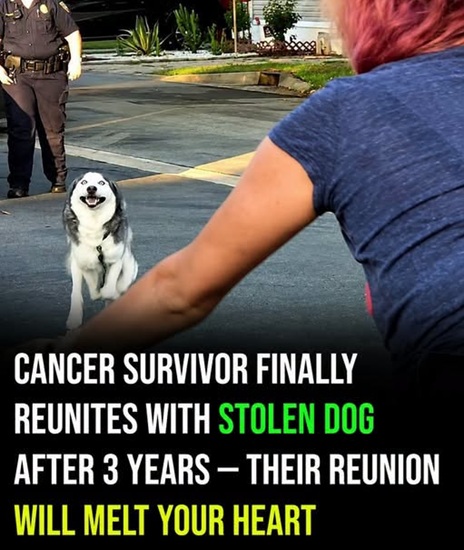
Kameroun Mares’ bond with her Siberian husky, Semper Fidelis, began during one of the most difficult periods of her life. Mares had been diagnosed with acute lymphoblastic leukemia and was continuing to deal with serious health challenges when she brought the puppy home in 2013. She hoped that caring for a dog would give her companionship, structure and another reason to stay active while coping with depression. Semper quickly became part of her daily routine and an important source of comfort.
She chose the name Semper Fidelis because of its association with faithfulness and loyalty. Years later, that name would take on an even deeper meaning after an unexpected separation lasting more than two years. From the beginning, Mares took practical steps to make sure Semper could be identified if he ever became lost. She brought him to a veterinarian, kept up with his vaccinations and registered his microchip. She also completed local registration connected to the humane society in San Diego.
From her perspective, those records created a clear link between her and the dog. She believed that if Semper ever disappeared and was later scanned by a veterinarian or shelter, the information connected to his chip would help reunite them. What eventually happened showed that microchip registration can become complicated when different records are created for the same animal. In 2015, Mares moved from California to Jacksonville, Florida, and Semper went with her.
Later, a problem involving her medical care required her to return to California. She temporarily left Semper in the care of people she trusted while she handled treatment and other health needs. Mares expected the arrangement to last only until her circumstances became more stable. Instead, while she was away, she received news from her roommate that Semper was missing. She was told that the husky had escaped through the front door and could no longer be found.
The timing made the disappearance especially difficult for Mares. She was already managing serious medical issues while being hundreds of miles away from her dog. She began searching from California and contacted organizations that might have encountered Semper. She reached out to the microchip company, humane societies, shelters and lost-pet groups. She also circulated information online and continued looking through postings that might provide a clue. Because Semper had been registered to her from a young age, Mares expected that a microchip scan would eventually lead someone back to her.
Days passed without a call. Then weeks turned into months. Mares still did not know whether Semper was safe or where he might be. The lack of information was particularly confusing because she believed the microchip records should have helped if someone had found him. She continued searching rather than accepting that he was simply gone. During that period, the most difficult part was not knowing whether Semper was wandering somewhere, living with another person or had been harmed. The uncertainty continued long after the initial disappearance.
A new clue eventually emerged when Mares revisited the information connected to Semper’s microchip. She discovered that a second registration had become associated with the same chip. That discovery raised immediate questions because her original registration had never been intentionally transferred or canceled. The date of the new registration also became important. According to reporting on the case, the additional information was created shortly before Mares was told that Semper had disappeared. The timeline suggested that the story might be more complicated than a dog simply escaping from a house.
As Mares continued investigating, she learned information that changed the nature of the case. According to her account and the investigation surrounding the disappearance, Semper had not simply wandered away. She said the dog had been sold without her permission for $200. That revelation meant she had spent months searching under the wrong assumption about how he had vanished. Rather than being a conventional missing-pet case, the situation involved an unauthorized transfer to another household. The discovery also explained why ordinary searches of shelters and lost-dog reports had failed to locate him.
The family that acquired Semper reportedly did not know that Mares was still looking for the dog. They believed they had purchased him through a legitimate transaction and later registered information connected to his microchip. This created a difficult situation because Mares still had her earlier records, while another family had possession of Semper and its own registration information. The new owners had also become attached to the dog during the time he lived with them. Their lack of knowledge about Mares’ search made the ownership dispute more complicated than simply locating the husky.
A microchip can be extremely useful for identifying a lost pet, but it is not the same as a legal ownership certificate. The chip carries an identification number that can be scanned and then checked against registration databases. If different organizations maintain separate records, conflicting information can sometimes appear. Semper’s case demonstrated that the physical presence of a chip did not automatically resolve the dispute. Mares had long-standing records connected to him, while another family had a later registration and physical possession of the dog. Additional documentation therefore became necessary.
Mares eventually decided that ordinary searches were no longer enough. She hired private investigator Ana Campos to help determine what had happened to Semper and locate him. The investigation produced the breakthrough she had been waiting for. Campos was able to trace Semper and help establish the circumstances surrounding his disappearance. Finding him, however, did not immediately mean that Mares could simply take him home. By that point, another family had been caring for the husky and believed they had acquired him legitimately.
The case therefore moved beyond a search for a missing dog and became a legal ownership dispute. Mares continued working with Campos and obtained legal assistance. She relied on records showing her connection to Semper before he disappeared, including veterinary history, microchip information and other ownership documentation. Those records became important because they predated the later sale and registration. The process focused on establishing that Semper had belonged to Mares before he was transferred without her permission.
The people who had purchased Semper were also placed in a difficult position. Available accounts indicate that they did not know the history behind the dog when they acquired him. They had cared for him, lived with him and formed their own relationship with him. From their perspective, another person was now appearing and claiming a dog they had believed was theirs. This is one reason the case required more than an informal conversation. A documented process was needed to determine who had the stronger legal claim to Semper.
After a lengthy search and legal recovery effort, Semper was finally returned to Mares. The reunion took place on October 18, 2018. By then, the two had been separated for approximately two and a half years. Mares had gone from believing her dog was lost to discovering that he had been sold and was living with another family. She then had to prove her ownership before she could bring him home. The return ended a period of uncertainty that had lasted through years of searching, investigation and legal work.
For Mares, the reunion carried meaning far beyond simply recovering a pet. Semper had entered her life during a time when she was already dealing with cancer and other health challenges. He had been part of the routine she created to help herself cope with depression and remain active. Losing him while she was away for medical care added another emotional burden to an already difficult situation. His return restored a relationship that had begun during one of the most vulnerable periods of her life.
One of the most striking details of the reunion was Semper’s response after returning to Mares. Despite the years they had spent apart, he reportedly still recognized familiar commands and routines she had taught him when he was younger. One of those commands involved being told to go home and moving toward the front door. After such a long separation, that familiar response carried a particularly strong emotional meaning for Mares. The dog she had spent years trying to bring home still remembered the behavior associated with that idea.
The case also highlighted a practical limitation of pet microchips. A microchip is not a GPS device and cannot continuously track an animal’s location. It must be scanned before the identification number can be used to search registration records. Even then, the usefulness of the system depends on the accuracy and consistency of the information stored in different databases. Semper’s case became complicated because another registration was connected to the same chip even though Mares still had her original ownership information.
This does not reduce the value of microchipping. For many lost animals, a registered chip provides an important way for shelters, veterinarians and rescue organizations to contact an owner. Semper’s experience instead shows why owners should keep their information current and preserve additional records. Veterinary documents, vaccination history, adoption or purchase paperwork, licenses and photographs can all help establish a long-term connection to an animal. If ownership is ever disputed, a microchip may be one part of the evidence rather than the only piece.
The story also contains an important lesson for people acquiring pets through private sellers. A buyer may have no reason to know that an animal being offered for sale belongs to someone else. Asking for veterinary records and other proof of ownership can help reduce that risk. Having the animal scanned for a microchip before completing a transaction may also reveal whether registration information already exists. In Semper’s case, the later family apparently believed they were participating in an ordinary sale and only became involved in a dispute because they did not know the dog’s earlier history.
Another important distinction is the difference between a pet that is accidentally lost and one that may have been intentionally transferred. Mares spent significant time searching under the belief that Semper had escaped. Once the second registration and later investigation revealed another explanation, the kind of help she needed changed. The case required investigative and legal support rather than only shelter searches and lost-dog notices. This illustrates why documentation created early in a disappearance can matter if the circumstances later become more complicated.
The timeline helps clarify the length of the separation. Mares brought Semper into her life in 2013 and moved with him to Florida in 2015. In 2016, she temporarily returned to California for medical needs and was later told that Semper had disappeared. The subsequent investigation revealed information about his unauthorized sale and competing microchip registration. After continued searching and legal assistance, Semper was returned in October 2018. The separation therefore lasted approximately two and a half years, though some summaries describe it more generally as nearly three years.
Semper’s name became one of the most memorable elements of the story after his return. Mares had chosen Semper Fidelis long before the disappearance because of its association with loyalty and faithfulness. At that time, it was simply a meaningful name for a puppy she hoped would become a companion during a difficult stage of life. After years apart, the name seemed especially fitting. Their connection had survived relocation, illness, conflicting registrations and a long search that neither Mares nor Semper could have anticipated when they first met.
The documented core of the story is clear. Kameroun Mares owned and registered Semper before he disappeared. She was later told that he had escaped, but an investigation eventually indicated that he had been sold without her permission. Another family had acquired him without knowing that Mares was still searching. Conflicting registration information complicated the situation, and Mares ultimately used investigative and legal assistance to recover the dog. After more than two years apart, Semper was returned to her in 2018.
This account is based on publicly reported information about Kameroun Mares and Semper Fidelis and is written entirely from an outside, third-person perspective. It does not claim that the publisher personally knows Mares, participated in the investigation, witnessed the reunion or has private knowledge about the families involved. Details about the unauthorized sale are presented as reported through Mares’ account and the investigation surrounding the case. The purpose is to summarize the documented events accurately while avoiding invented dialogue, unsupported medical conclusions or claims of firsthand or local involvement.

