
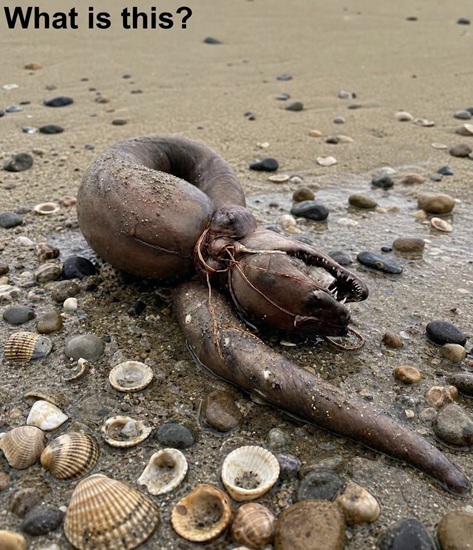
A quiet walk beside the sea can sometimes produce an encounter that nobody expects. According to an account shared online, a person walking along a beach with a dog noticed an unusual elongated creature lying close to the shoreline. At first glance, its appearance was difficult to identify because its long body and prominent mouth looked very different from the fish most casual beach visitors regularly encounter. The animal appeared motionless while waves moved around it near the wet sand.
Instead of immediately approaching or attempting to touch it, the observer reportedly remained at a distance. Photographs were taken with a phone, beginning an effort to understand exactly what had washed ashore. The morning had reportedly begun as an ordinary walk rather than an attempt to search for unusual marine wildlife. Nothing in the supplied account suggests that the observer expected to make a discovery or had specialist knowledge of sea creatures.
That context helps explain why the animal’s appearance created such uncertainty. A long-bodied marine animal with visible teeth can be startling when encountered unexpectedly outside its natural environment. What might appear completely normal to a marine biologist or experienced diver can look extraordinary to someone seeing it for the first time. The unexpected setting made the discovery particularly memorable. The dog also reportedly reacted to the object near the water, which helped draw attention to it. However, it is important not to assign specific thoughts or emotions to the animal without evidence.
Dogs can respond to unfamiliar objects, scents, wildlife, or movement for many different reasons. What can reasonably be said is that the dog’s behavior contributed to the owner noticing something unusual near the shoreline. The account does not establish that the dog somehow understood what the marine animal was. Describing the observable reaction is more accurate than inventing an explanation for it. From a distance, the creature reportedly looked almost snake-like because of its elongated body.
Its mouth was particularly striking and appeared to contain sharp teeth. Those characteristics naturally contributed to the observer’s uncertainty about whether approaching would be sensible. An unfamiliar animal lying still should not automatically be assumed to be harmless or even dead. Some marine animals can remain motionless for periods of time, while waves can also make a dead animal appear to move. Keeping some distance until the situation is better understood is therefore a reasonable precaution.
Rather than stepping closer, the person reportedly used a smartphone camera to get a better view. Modern phone cameras can be useful in situations like this because zoom allows people to examine details without immediately placing themselves next to an unidentified animal. The observer took photographs and later compared them with images of marine animals available online. According to the supplied narrative, the comparison eventually pointed toward a moray eel. The animal was believed to be dead when it was encountered.
That identification provides a plausible explanation for several of the features described in the account. Moray eels are elongated marine fish belonging to the family Muraenidae, and many species possess prominent jaws and sharp teeth. Their body shape can appear more similar to a snake than to the traditional image many people have of a fish. Nevertheless, morays are fish rather than sea snakes. Their unusual anatomy is the result of adaptation to the underwater environments in which they live.
The identification should still be described with some caution because the supplied account does not mention an examination by a marine biologist or wildlife authority. Comparing photographs online can help someone narrow down possibilities, but visual identification by a nonexpert does not provide the same certainty as an assessment by a qualified specialist. The available story therefore supports saying that the creature was believed or reported to be a moray eel. It would be inappropriate to identify a precise species without additional evidence. Accuracy sometimes requires leaving a small degree of uncertainty rather than overstating what is known.
Moray eels occur in marine environments around much of the world, although individual species have different geographical ranges and habitat preferences. They are especially associated with reefs, rocky areas, and underwater crevices where their long bodies provide an advantage. A moray can conceal much of its body inside a narrow opening while keeping its head positioned near the entrance. This behavior gives the animal protection while also allowing it to observe its surroundings. Divers who encounter morays frequently see only the head and part of the body emerging from a crevice.
Their mouths contribute heavily to their intimidating reputation. Many morays possess sharp teeth designed to hold prey, and some species have teeth particularly well suited to the foods they consume. Seeing those teeth unexpectedly on a beach can create a dramatic first impression. In the animal’s natural habitat, however, the jaws are simply part of the biological equipment it uses to survive. Describing them accurately does not require portraying the animal as a monster.
Morays are predators, and their diets vary depending on species and habitat. Fish, crustaceans, and cephalopods can form part of their diet. Their elongated bodies allow them to maneuver through complicated underwater structures while searching for food or shelter. Some species have evolved specialized teeth suited to particular prey. These adaptations demonstrate how closely an animal’s appearance can be connected with its ecological role.
One of the most fascinating features of moray biology involves their feeding mechanism. Morays possess pharyngeal jaws located farther back in the throat in addition to the jaws visible at the front of the mouth. These secondary jaws can help transport captured prey toward the digestive system. Scientific study of this mechanism has made morays particularly interesting examples of evolutionary adaptation. Something that looks frightening from the outside therefore also represents a highly specialized biological system.
Another behavior that can easily be misunderstood is the way morays open and close their mouths underwater. Photographs sometimes make this look like a continuous threatening gesture. In reality, the movement is associated with respiration, helping move water across the gills. A person unfamiliar with morays may interpret the open mouth as an expression of aggression because humans naturally associate exposed teeth with a threat. Biological behavior does not always correspond with those human interpretations.
None of this means that people should handle a wild moray. They have powerful jaws and can inflict serious bites if threatened, handled, or otherwise placed in a situation where they defend themselves. Divers are generally advised to respect wild marine animals and avoid unnecessary interference. Feeding morays by hand or attempting to touch them can create avoidable risk. Observing wildlife without provoking it is a much safer approach.
The situation becomes slightly different when an animal appears to be dead on a beach, but caution still makes sense. An observer may incorrectly assume that an animal has died when it is actually injured or weakened. Even a dead animal can present risks through sharp teeth, spines, damaged fishing equipment, bacteria, or other hazards. There is rarely a good reason for an untrained beach visitor to handle an unidentified carcass simply to determine what it is.
If an unusual marine animal is found ashore, local circumstances determine the appropriate response. Lifeguards, park staff, wildlife authorities, marine rescue groups, or other responsible organizations may be able to provide advice depending on the location. Some animals require specialized assistance if stranded alive, while others should simply be left undisturbed. Regulations can also vary considerably between countries and coastal regions. Because the supplied account does not identify the location, no specific local authority should be invented.
The absence of an exact location is one of several important limitations in the original narrative. The beach is not identified in the material provided, nor is the observer named. There is also no documented statement from an expert confirming the animal’s identity. Those gaps do not mean the story is necessarily false, but they limit what can responsibly be presented as established fact. Adding a beach name, city, eyewitness identity, or official investigation without a source would create information that the original account does not support.
The same caution applies to explaining how the animal ended up on shore. Dead fish and other marine organisms can be transported by tides, waves, and currents. An animal may die offshore and eventually wash onto a beach some distance away. It could also have been injured, caught accidentally, affected by environmental conditions, or died for another reason. Without an examination, there is no reliable basis for selecting one particular explanation.
It would therefore be inaccurate to claim that the moray died because of pollution, fishing activity, a predator, disease, or a storm unless evidence supported that conclusion. Viral stories sometimes fill gaps with dramatic explanations because uncertainty can feel unsatisfying. Responsible reporting should do the opposite. When the cause of death is unknown, the accurate description is simply that it is unknown.
Finding a dead marine animal also does not automatically indicate that the surrounding beach or water is unsafe. Coastal environments naturally receive biological material from the ocean. Seaweed, shells, fish, crustaceans, jellyfish, driftwood, and occasionally larger carcasses can all reach shore through normal processes. A broader environmental concern would require evidence beyond one unidentified or dead animal.
The appearance of a moray outside the water can nevertheless be surprisingly unsettling. Most people build their mental image of fish around familiar species with obvious fins and compact bodies. Morays challenge that expectation because they have extremely elongated forms and relatively unusual heads. Without context, a person may initially wonder whether the creature is even a fish.
This is one reason unusual marine carcasses can attract significant attention online. Photographs remove the environmental context that might otherwise help identify an animal. A damaged or partially decomposed specimen can look even more unfamiliar. People then begin offering guesses, and the most dramatic explanation can sometimes spread faster than the most scientifically plausible one.
Decomposition can significantly alter an animal’s appearance. Skin color may change, tissues can deteriorate, and features that normally help with identification may become distorted or disappear. Waves and scavengers can cause additional damage. A familiar marine species can therefore look surprisingly strange after spending time dead in the water.
Throughout history, badly decomposed marine animals have occasionally inspired stories about unknown creatures or “sea monsters.” In many cases, expert examination has eventually revealed an ordinary known species whose appearance had been dramatically altered after death. Modern photography and access to biological information have made identification easier, but misleading interpretations still occur.
The moray in this account apparently retained enough recognizable features for the observer to compare it with photographs online. Its elongated body and distinctive head reportedly helped point toward an identification. Even so, there are many species of moray, and determining exactly which one was present would generally require clearer information about its physical characteristics and geographic location.
Morays display considerable diversity. Depending on species, they can differ in size, coloration, patterns, teeth, and preferred habitat. Some display striking spots or mottled designs, while others appear relatively uniform. Their geographical distribution also varies. Without knowing where the animal was found, narrowing the identification becomes even more difficult.
This demonstrates why location information is important in wildlife identification. An animal that appears similar to several species can often be narrowed down by determining which species actually inhabit the surrounding region. Because no reliable location is supplied here, that useful piece of evidence is unavailable. Guessing a species would therefore add false precision.
The practical lesson from the encounter is simpler than determining the exact taxonomy of the animal. When an unfamiliar creature appears near the shore, people do not need to touch it in order to investigate. Keeping a safe distance, taking photographs when appropriate, and seeking knowledgeable guidance can provide information without unnecessary contact.
This is especially relevant when walking with pets. Dogs may be tempted to investigate unfamiliar smells or objects more closely than their owners would prefer. Dead fish and other marine organisms can present hazards that are not immediately obvious. Fishing hooks, lines, sharp bones, toxins from certain species, and decomposing biological material are among the reasons pets should be kept away from unknown objects.
The supplied narrative says the dog remained behind the observer and reacted to the discovery. Whatever motivated that behavior, keeping the animal from direct contact would have been sensible. A pet does not need to identify something as dangerous before curiosity creates a problem. A leash provides owners with additional control in situations involving wildlife or unknown material.
People should also resist the temptation to reposition an unusual animal simply to produce a better photograph. Moving a carcass may expose someone to sharp structures or biological material, and moving a living animal can cause stress or injury. A photograph taken from where the animal was originally found also preserves more useful context for anyone later attempting identification.
Scale can be helpful when identifying wildlife, but placing a hand or foot next to an unknown creature is unnecessary. Environmental features already visible in the photograph may provide some indication of size. If authorities or experts require measurements, they can advise on an appropriate method.
The account’s strongest element is ultimately not fear but surprise. An ordinary activity reportedly placed someone unexpectedly close to an animal normally hidden beneath the surface. That contrast transformed a routine walk into something memorable. The ocean contains an enormous diversity of species, many of which most beach visitors will never see alive in their natural habitats.
Beaches provide occasional glimpses into that underwater world because they sit directly at the boundary between land and sea. Tides and waves continuously move material between those environments. Most of what arrives is familiar and receives little attention. Occasionally, however, something unusual enough to stop a passerby appears.
A moray eel fits that category perfectly. Underwater, its elongated body allows it to navigate reef structures and shelter in narrow spaces. On a beach, the same shape looks completely out of place. Removing an animal from its normal environmental context can dramatically change how humans perceive it.
Fear is a common response to unfamiliar wildlife, particularly when prominent teeth are involved. But curiosity and reliable information can transform that first impression. Learning what an animal is, how it lives, and why its body has evolved particular features often reveals a much more interesting story than simply labeling it frightening.
That is why the account does not need invented danger to remain compelling. A dead moray appearing unexpectedly near the shoreline is unusual enough for someone unfamiliar with marine life. Its appearance naturally creates questions. The scientific answers provide genuine substance without requiring claims that anyone was attacked or placed in immediate danger.
Nothing in the supplied narrative indicates that the observer or dog was injured. There is also no information suggesting that the animal behaved aggressively. The account describes a discovery rather than an attack. Maintaining that distinction prevents an unusual wildlife encounter from becoming a misleading danger story.
Similarly, there is no evidence in the provided material that the incident represents a wider environmental problem. One animal on one shoreline cannot establish a trend. Claims about changing ecosystems, pollution, unusual mortality, or public safety would require additional data and qualified sources.
Social-media headlines often encourage readers to imagine the most dramatic explanation before revealing an ordinary identification. That technique can attract attention, but it can also create unnecessary confusion when the teaser becomes separated from the underlying facts. A more useful account explains both the initial surprise and what is actually known afterward.
Here, the central sequence is straightforward. A beachgoer was reportedly walking with a dog when an unusual elongated animal was noticed near the water. The observer maintained distance and photographed it. Later comparison with images led to the belief that the animal was a dead moray eel.
Everything beyond that sequence should be clearly separated into established information about moray biology or acknowledged uncertainty about the specific incident. The exact beach remains unspecified. The precise species remains unknown. The cause of death remains unknown, and the material supplied does not document an expert examination.
Acknowledging those limits strengthens rather than weakens the story. Readers can distinguish the reported encounter from general scientific information. They are not asked to accept fictional details simply because those details would make the narrative sound more complete.
The encounter can also serve as a reminder that wild animals do not always appear where people expect them. Marine creatures can wash onto beaches, birds can become displaced during storms, and terrestrial animals can occasionally enter urban environments. The safest response to unfamiliar wildlife usually begins with giving it space.
For an animal that may still be alive, unnecessary handling can be harmful both to the animal and the person. For a dead animal, handling may still create biological or physical hazards. In either situation, appropriate local authorities can provide guidance when intervention appears necessary.
Photography has made encounters like this easier to document responsibly. A clear image can sometimes allow identification without disturbing an animal at all. It can also preserve evidence for experts if questions remain. The important point is that obtaining a photograph should never require someone to take an unnecessary risk.
Moray eels themselves remain fascinating regardless of how this particular specimen reached the shoreline. They are highly adapted predators with distinctive body plans and feeding mechanisms. Their unusual appearance reflects millions of years of evolution within marine ecosystems rather than anything mysterious.
Their sharp teeth have a practical purpose, their elongated bodies suit their habitats, and even their apparently threatening mouth movements have biological explanations. Understanding those details provides a different perspective on an animal that initially appears intimidating.
The person described in the account reportedly remained unsettled even after finding a likely identification. That reaction is understandable. Knowing that an animal is a recognized species does not instantly erase the surprise of encountering it unexpectedly.
At the same time, identifying it removes the need for supernatural or sensational explanations. The ocean did not produce an unknown monster. It apparently brought a known marine animal into an environment where humans could see it more easily than usual.
That distinction is the heart of the story. Something can look extraordinary without being unexplained. Nature contains countless animals whose ordinary anatomy seems remarkable to people who rarely encounter them.
The next unusual object found on a beach may turn out to be another familiar marine species seen under unfamiliar circumstances. Keeping an appropriate distance and approaching the situation with curiosity rather than panic makes accurate identification much easier.
Ultimately, the supplied account describes an unexpected encounter during a routine beach walk. A person and dog noticed a long, intimidating-looking marine animal near the shoreline, photographs were taken from a distance, and the observer later concluded that it was a dead moray eel.
Without an expert assessment, exact location, or additional documentation, the story should not claim more than the available information supports. But it does not need additional embellishment. An ordinary morning interrupted by an unexpected glimpse of the ocean’s hidden wildlife is already a compelling reminder of how much life exists just beyond the shoreline.

