For almost forty years, one unanswered question followed me quietly through every stage of my life: what happened to my twin sister, Laura? She disappeared on the night of our sixteenth birthday, and from that moment forward, uncertainty became part of our family. There was no clear explanation, no goodbye that made sense, and no final conversation I could hold onto. As the years passed, people gradually stopped asking about her because they assumed time had made the loss easier.
What they did not understand was that uncertainty does not disappear simply because life continues. It changes shape, becomes quieter, and settles into the background, but it never completely leaves. Laura and I had always been close in the complicated way twins often are. We looked enough alike for strangers to confuse us from a distance, but our personalities were different. Laura was spontaneous, impatient, and willing to take risks. I was the cautious one, always reminding her to think before acting.
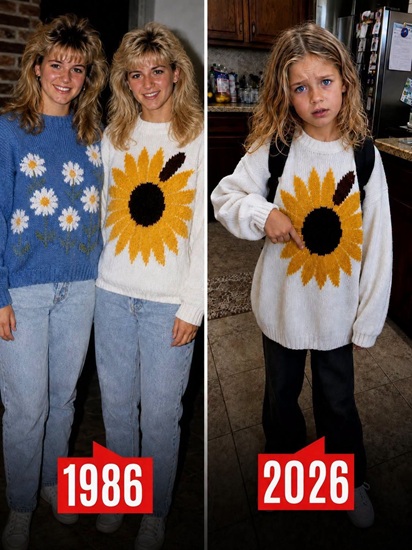
We argued frequently, but our disagreements rarely lasted long. Beneath all of it was the certainty that we were connected in a way neither of us had to explain. Our sixteenth birthday had begun like any other family celebration. There was cake, teasing, photographs, and the familiar chaos that came with two teenagers sharing the same birthday. Laura wore a cream sweater decorated with a large yellow sunflower, one of her favorite pieces of clothing.
Our father had always called her his sunflower when we were young, so she liked anything connected with the flower. Inside the sweater, our mother had stitched Laura’s initials into the fabric. By the next morning, Laura was gone. At first, nobody understood the seriousness of it. Our parents assumed she had left after becoming upset and would return after calming down. Hours passed. Then an entire day. Phone calls were made, questions were asked, and worry slowly became fear.
I remember sitting near the front window and staring at the road. Every approaching car made me sit straighter. Every shadow near the gate made my heart race. I was convinced she would simply come home and complain that everyone had overreacted.
She did not.
The days that followed became confusing and frightening. Adults talked in lowered voices whenever I entered a room. People asked whether Laura had said anything strange or mentioned going somewhere. I tried to remember every conversation we had shared in the days before she vanished.
For years afterward, I blamed myself in ways that were not rational. I wondered whether I should have noticed something in her behavior. Maybe I should have followed her. Maybe I should have asked more questions. Maybe being her twin should somehow have allowed me to understand what she was thinking.
Eventually, I learned that closeness does not mean being able to read another person’s mind.
Our parents reacted to the loss differently. My mother became quieter and increasingly watchful. She developed the habit of looking toward the street whenever a vehicle slowed near the house. My father responded by becoming more controlled and emotionally distant.
At the time, I believed silence was simply the way he survived grief.
Life continued because life always does. I finished school, found work, built relationships, started a family, and eventually became a grandmother. Laura remained in old photographs and memories, but I learned to live without making her disappearance the center of every day.
That did not mean I forgot her.
Certain things could bring her back immediately.
A sunflower in a shop window.
A teenage girl laughing beside her sister.
A familiar hairstyle seen from across a street.
For one brief moment, the past would become completely present again.
Then one ordinary afternoon, everything changed.
My granddaughter Sophie walked into my house talking about school. I barely heard a word she said because I was staring at the sweater she was wearing.
It was cream-colored.
Across the front was a large yellow sunflower.
I felt as though the room had suddenly become smaller.
“Sophie,” I said. “Where did you get that sweater?”
She looked down at it casually.
“A woman at school gave it to me.”
I asked who.
Sophie said the woman’s name was Dolly and that she worked around the school building. She had apparently told Sophie that the sweater had been stored for a long time and that she thought Sophie might like it.
I asked Sophie to take it off.
When she handed it to me, my hands were already trembling.
The fabric was older than I remembered, but the sunflower was unmistakable.
I turned the sweater over and searched the inside seam.
There they were.
Two faded initials.
L.R.
I sat down.
Sophie looked worried.
“Grandma, what’s wrong?”
“This belonged to my sister.”
Saying it aloud felt impossible.
Almost forty years had passed since the last time I had seen Laura wearing that sweater.
Then Sophie remembered something else.
“Dolly said if you ever saw it, you should look under the sunflower.”
I looked at her.
“What exactly did she say?”
“Just that. She said you’d understand.”
I examined the flower carefully.
At first, there appeared to be nothing unusual about it.
Then my fingers caught on a small seam.
Someone had sewn a hidden pocket behind the sunflower.
Inside was a tiny wooden object.
I pulled it free.
It was another sunflower.
But this one had been carved from wood.
The moment I saw it, I knew exactly what it was.
Our father had carved small wooden flowers for us when we were children. Laura kept hers for years, carrying it around as though it were precious.
I turned the carving over.
Her initial was still scratched into the back.
“L.”
I started crying before I could stop myself.
The sweater could have been explained away as coincidence.
The wooden flower could not.
Someone had deliberately sent Laura’s belongings to me.
And that person had done it through my granddaughter.
I barely slept that night.
My mind moved through possibilities faster than I could organize them.
Who was Dolly?
How had she gotten the sweater?
Why did she know about the hidden pocket?
Most importantly, what did she know about Laura?
The following day, I asked Sophie where Dolly usually worked.
I went to the school alone.
When Dolly finally appeared, she stopped the moment she saw me.
There was recognition on her face before either of us said a word.
Then she spoke my name.
“Claire?”
Nobody had introduced us.
I felt cold.
“How do you know who I am?”
She looked uncomfortable and asked if we could speak somewhere private.
We entered an empty room.
I placed the wooden sunflower on a table between us.
“Where did you get this?”
Dolly looked at it for several seconds.
“My mother gave it to me.”
I asked the question slowly.
“Who is your mother?”
She hesitated.
Then she answered.
“Laura.”
For a few seconds, I genuinely believed I had misunderstood her.
“My Laura?”
Dolly nodded.
“Your twin sister.”
I had imagined that moment countless times over the years.
I always believed that if anyone told me Laura was alive, I would immediately feel joy.
Instead, I felt everything at once.
Relief.
Shock.
Anger.
Confusion.
Grief for years that had already disappeared.
“She’s alive?”
“Yes.”
I sat down.
Dolly began telling me what she knew.
According to her, Laura had left home intentionally at sixteen. She had become involved with a boy our parents strongly disliked, and after a series of arguments, she decided leaving was the only way to control her own life.
At sixteen, she believed she could disappear for a while and eventually return when everyone stopped being angry.
Reality turned out to be much harder.
She stayed away.
The relationship with the boy did not last forever.
By the time it ended, Laura had been gone long enough that returning home felt increasingly difficult.
Then she became a mother.
Dolly was her daughter.
I stared at the woman sitting opposite me.
Once I knew what I was looking for, I could see Laura in her face.
There was something in the eyes.
Something about the way she held her hands.
I asked why Laura never came back.
Dolly looked down.
“She did.”
Those two words changed the story again.
Years after disappearing, Laura had returned home with Dolly.
She wanted to reconnect with the family.
She wanted to see me.
She wanted her daughter to know where she came from.
My father answered the door.
And he refused to let Laura inside.
I felt my stomach twist.
Dolly explained that he told Laura too much time had passed. According to him, the family had already endured years of pain and reopening everything would only cause more damage.
He told her I had moved on.
He told her leaving again would be better.
Then he never told me she had returned.
For almost forty years, I believed nobody knew whether Laura was alive.
My father had known.
He knew she had returned.
He knew she had a daughter.
And he said nothing.
“Why?” I asked.
Dolly said Laura believed our father was protecting me.
But there had also been anger.
He had spent years thinking his daughter might be dead.
Learning that she had left willingly made him feel betrayed.
When Laura eventually returned, that anger had not disappeared.
He made a decision while still carrying it.
And that decision changed decades of our lives.
I asked Dolly why Laura had not contacted me directly.
“She thought you knew.”
I stared at her.
Laura believed my father had told me about her return.
When I never contacted her, she assumed that meant I did not want her in my life.
Nothing could have been further from the truth.
I had spent years wondering where she was.
Laura had spent years believing I had rejected her.
We had both lived according to information that was not true.
I needed to speak with my father.
By then, he was elderly and physically far removed from the strict man I remembered from childhood.
I placed the wooden sunflower on the table in front of him.
His expression changed immediately.
He recognized it.
“Where did you find that?”
I did not answer.
Instead, I asked him the only question that mattered.
“When did you know Laura was alive?”
He lowered his eyes.
That was enough.
“You knew.”
He tried to speak.
I did not let him avoid the question.
“You knew she came back.”
Eventually, he admitted it.
Years after Laura disappeared, she arrived at the house with a young daughter.
He was shocked.
He was angry.
He believed allowing her back into our lives would reopen the trauma we had been trying to survive.
He told himself that I had finally begun rebuilding my life.
He believed he was protecting me.
I could barely listen.
“Protecting me from my own sister?”
He said he had been afraid I would be hurt again if Laura returned and later disappeared a second time.
Then he admitted something even more painful.
Part of his decision was not about protecting me.
It was about punishing Laura.
He was furious that she had allowed the family to believe something terrible might have happened to her.
He could not forgive her in that moment.
So he sent her away.
Then years passed.
The longer he kept the secret, the harder it became to admit what he had done.
Eventually, the truth became something he carried silently.
I told him what those years had been like for me.
I told him about every birthday when I wondered whether Laura was alive somewhere.
I told him about strangers I followed with my eyes because their hair or walk reminded me of her.
I told him about becoming a mother without my twin sister beside me.
I told him about becoming a grandmother.
All the milestones she had missed.
All the moments I had imagined sharing with her.
My father cried.
“I thought I was doing the right thing.”
“You weren’t protecting me,” I said. “You were protecting your decision.”
For a long time, I was furious with him.
Understanding why someone made a decision does not automatically make that decision acceptable.
He had acted from a complicated mixture of fear, love, anger, pride, and grief.
Recognizing that complexity eventually helped me understand him.
But it did not erase the consequences.
For several weeks, I moved between relief and anger.
Laura was alive.
That was the truth I had wanted for most of my life.
Yet discovering that truth also forced me to grieve something new.
The years we could have had.
Knowing what happened did not magically restore them.
Answers can remove uncertainty.
They cannot return time.
Dolly and I began talking regularly.
At first, everything felt awkward.
She was my niece, but we were strangers.
Biology could identify our relationship instantly.
Trust still had to be built.
She told me about her childhood.
I told her stories about Laura.
Sometimes Dolly laughed because she recognized the mother she knew in the teenage girl I remembered.
Other times, she became emotional because she was hearing about parts of Laura’s life that had never been discussed.
Through Dolly, I began discovering the person my sister had become.
Laura had worked different jobs.
She had moved several times.
She had made mistakes.
She had raised a child.
She had grown older.
That sounds obvious, but it mattered deeply.
In my memories, Laura was still sixteen.
She still had the same face.
The same sweater.
The same impatient laugh.
For nearly four decades, she had been frozen at the age she disappeared.
Now I had to understand that while I was living my life, Laura had been living hers.
Eventually, Dolly told Laura that she had found me.
Laura was frightened.
She did not know whether I would be angry.
She did not know what our father had told me.
She had spent years believing I had made a choice not to contact her.
Dolly told her the truth.
I had never known.
Even after hearing that, Laura was not immediately ready to meet.
Years earlier, that would have felt like another rejection.
Now I understood.
Laura had spent decades carrying guilt, fear, and assumptions of her own.
Reconnecting was not going to happen through one dramatic conversation.
So I wrote her a letter.
I did not demand that she explain every decision.
I did not accuse her.
I simply told her what had happened from my side.
I told her I never knew she had come back.
I told her I never stopped wondering about her.
I told her that finding out she was alive filled me with both happiness and anger.
Then I wrote the most important part.
“If you ever want to speak to me, the door is open.”
There was no deadline.
No demand.
No condition.
Dolly delivered the letter.
Weeks passed.
Then one day, an envelope arrived.
Inside was an old photograph.
Laura and I were standing beside our father in the backyard.
We were children.
On the back, in handwriting I recognized immediately, were three words.
“I remember too.”
It was the first message directly from my sister in almost forty years.
I cried.
But those tears were different.
They contained grief, but there was hope inside them too.
The photograph was not a full reunion.
It was not an apology.
It was not a promise that everything would suddenly be easy.
But it was a beginning.
I wrote back.
Eventually, Laura wrote again.
Slowly, a conversation developed.
We did not pretend the missing decades could be repaired.
There were difficult questions.
There were long pauses between letters.
Sometimes I became angry.
Sometimes she did.
But beneath that discomfort was something familiar.
The sister I remembered was still there.
She remembered the games we played as children.
She remembered the ridiculous songs we made up.
She remembered the wooden sunflowers.
She remembered our sixteenth birthday.
And she remembered leaving.
Laura eventually told me that she regretted the decision much sooner than anyone realized.
At first, fear kept her away.
Then embarrassment.
Then pride.
Then the feeling that too much time had passed.
When she finally returned and our father rejected her, she accepted his words as proof that her family no longer wanted her.
That belief shaped the rest of her life.
Meanwhile, I believed she had vanished completely.
Neither of us had the truth.
One honest conversation decades earlier might have changed everything.
But that conversation never happened.
At first, that realization made me bitter.
Eventually, it taught me something else.
Peace does not mean repairing the past.
Some things cannot be repaired.
There is no way to return to being sixteen.
There is no way to recover the birthdays, holidays, phone calls, and ordinary days that never happened.
There is no way to make our father answer the door differently.
The past remains exactly where it is.
What can change is what we do after learning the truth.
I stopped imagining that a perfect reunion would somehow erase every painful year.
Instead, I began accepting whatever relationship Laura and I were capable of building now.
That was much gentler.
And much more realistic.
Sophie still has the cream sweater.
The first time she wore it again after everything changed, I expected to feel the old pain.
Instead, I smiled.
The sweater no longer represented only the night Laura disappeared.
It represented the way the truth finally found its way back to me.
A sixteen-year-old girl once left home wearing it.
Almost forty years later, my granddaughter walked into my house carrying it back.
Hidden beneath the sunflower was the tiny wooden carving that connected every part of the story.
Our childhood.
Our father.
Laura.
Dolly.
Sophie.
And me.
The sunflower had survived.
So had my sister.
That did not make everything simple.
My feelings toward my father remained complicated.
He had acted partly out of fear and partly out of anger.
He had convinced himself that silence was protection.
It was not.
His decision created consequences for all of us.
Laura also had to face the pain caused by her own choices.
Leaving at sixteen hurt the family deeply.
She knew that.
I knew that.
Neither of us needed to pretend otherwise.
But people are more complicated than one terrible decision.
Especially decisions made when they are young.
Laura was no longer only the girl who left.
She was also the woman who raised Dolly.
The woman who preserved the sweater.
The woman who kept the wooden sunflower.
The woman who eventually found enough courage to write three words on the back of an old photograph.
I no longer spend my life imagining Laura arriving unexpectedly at the front door.
For decades, that was where I placed my hope.
Now hope looks different.
I know she is alive.
I know she remembers me.
I know we are speaking again.
That is enough for now.
Perhaps one day she will visit.
Perhaps the reunion will be awkward.
Maybe we will cry.
Maybe we will laugh.
Maybe we will sit quietly because nearly forty years is too large to fit into one conversation.
I no longer need to decide what that moment should look like.
There is room for whatever happens.
That is what peace finally became for me.
Not a perfect ending.
Not the restoration of everything we lost.
Not pretending that nobody made painful mistakes.
Peace came from understanding.
For nearly forty years, the question was always the same.
“What happened to Laura?”
Now I know.
And that answer created a different question.
“What do we do with the truth?”
My answer is to keep moving forward.
To tell the truth even when it is uncomfortable.
To stop allowing assumptions to speak for other people.
To leave room for forgiveness without demanding it happen immediately.
To understand that family can be broken and still find new ways to reconnect.
And to accept that some stories do not end where we once believed they did.
Laura’s disappearance shaped almost forty years of my life.
But it no longer controls the rest of them.
I still hope that one day she walks through my door.
The difference is that I am no longer standing there waiting.
My life continues.
So does hers.
And somewhere between what we lost and what we still have, there is finally enough truth for both of us to begin again.
