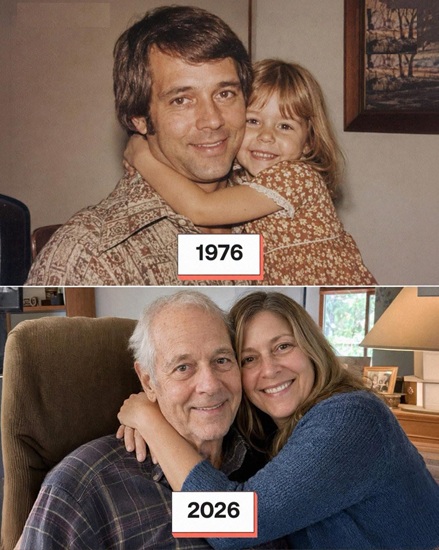
Five days after my stepfather Michael died, I stood at his funeral trying to understand how a person who had occupied such a large part of my life could suddenly be gone. Pancreatic cancer had taken him at 78, and everything had happened far more quickly than I had been prepared for. People moved around me offering condolences, sharing memories, and telling me repeatedly how deeply Michael had loved me. I thanked them because I knew they were trying to help, but most of their words barely registered.
Grief had created a strange distance between me and everything happening around me. Near Michael’s urn stood one of my favorite photographs of him. He was outside, squinting against bright sunlight with a small streak of grease across his cheek. The photograph perfectly captured the Michael I remembered: practical, slightly untidy, and happiest when he had something to repair with his own hands. For years, that picture had rested casually on his nightstand.
Now it had become one of the few things I could look at when I wanted to see his face exactly as I remembered it. “You really left me,” I whispered when nobody was standing close enough to hear. Calling Michael my stepfather had always felt strangely formal. He met my mother, Carina, when I was only two years old, so I had almost no memories of life without him. They married quietly, and although photographs of their wedding existed, I could not remember the ceremony itself. My memories began later, and Michael appeared in nearly every one of them. As far as the little girl I had once been was concerned, he had simply always been there.
One of my earliest memories came from a county fair. I was sitting on Michael’s shoulders with a balloon in one hand and my other hand tangled in his hair. I remembered being able to see above everyone else and believing I was impossibly high in the air. Michael kept both hands wrapped around my ankles and repeatedly promised that he would not let me fall. It was an ordinary childhood moment, but after his death I found myself returning to it again and again.
My mother died in a car accident when I was four. That fact had followed me throughout my entire life, but I remembered very little about the period immediately surrounding her death. What I did remember was Michael staying. While everything else in my young world changed, he remained the person who made breakfast, found missing shoes, read bedtime stories, and sat beside me when I woke from nightmares. I never spent much time wondering why I remained with him because, to me, there was nowhere else I belonged.
As I became older, Michael continued doing all the ordinary things parents do without expecting recognition for them. He attended school events even when he had worked all day. He helped with homework, although mathematics eventually reached a level where neither of us knew what we were doing. He taught me to ride a bicycle, then later taught me to drive. When I was old enough to own a car, he insisted that knowing how to change a tire was more important than knowing how to turn on the radio.
There were disagreements, of course. Michael could be stubborn, and I inherited enough stubbornness to make arguments between us memorable. During my teenage years, we occasionally went hours without speaking because neither of us wanted to apologize first. Yet even during those arguments, I never questioned whether he would be there when I needed him. Whatever legal or biological terminology other people used, Michael was my father in every way that mattered to me.
When doctors eventually diagnosed his cancer, moving back home felt automatic. I reorganized my schedule, packed what I needed, and returned to the house where I had grown up. I drove Michael to medical appointments, prepared meals when he could tolerate food, organized medication, and sat beside him during increasingly difficult days. Sometimes we talked about old memories. Other times he was too tired to speak, and I simply stayed beside him.
I never viewed caring for him as an obligation. Michael had spent most of my life taking care of me without keeping score. When the roles reversed, I wanted to give him the same certainty he had given me as a child: whatever happened, he would not face it alone. Even when his illness became exhausting for both of us, leaving him was never something I considered.
After his death, however, the house changed.
Everything still looked familiar, yet every room felt incomplete. Michael’s jacket remained hanging where he had left it. His favorite mug was still in the cupboard. A pair of old work gloves remained on the garage bench. There were half-finished projects he would never return to, and I could barely look at them without expecting to hear him walking through the door.
Following the funeral, friends and relatives gathered at the house. Conversations stayed deliberately quiet, interrupted by the occasional clinking of plates and glasses. Someone laughed too loudly in the kitchen and immediately lowered their voice, apparently feeling guilty for allowing happiness into a grieving house. I stood near the hallway holding a glass of lemonade I had barely touched.
The house still smelled like Michael.
There was wood polish, old furniture, aftershave, and the lavender soap he had always insisted he did not use despite being the only other person living there.
Aunt Sammie eventually came over and wrapped me in a tight hug.
“You don’t have to stay here by yourself,” she told me. “Come stay with me for a while.”
I looked around the hallway.
“This is my home.”
Sammie’s smile remained fixed.
“We can talk about it later, sweetheart.”
Something about the conversation bothered me, although at the time I could not explain why. Perhaps I simply did not want anyone suggesting that Michael’s house had suddenly stopped being mine because he was gone. Before I could think about it further, I heard an unfamiliar man’s voice behind me.
“Clover?”
I turned.
An older man stood several feet away. He looked to be in his late sixties, with deep lines across his face and a tie that appeared uncomfortable around his neck. He held a cup between both hands but did not seem interested in drinking from it. His expression suggested that approaching me had required considerable courage.
“I’m sorry,” I said. “Did you know Michael?”
The man nodded.
“For many years.”
He introduced himself as Frank.
I searched my memory but could not place him.
“I don’t think we’ve ever met.”
Frank hesitated.
“We weren’t supposed to.”
I immediately stopped thinking about the funeral reception around us.
“What does that mean?”
Frank moved slightly closer and lowered his voice. Before answering, he glanced toward the living room and then toward the kitchen, apparently checking whether anyone was listening.
“If you want to understand what happened after your mother died,” he said, “look in the bottom drawer of Michael’s garage.”
I stared at him.
“What are you talking about?”
Frank said he had made Michael a promise years earlier. Michael had apparently given him very specific instructions about when he could speak to me.
“This was part of the promise,” Frank explained.
“Who exactly are you?”
He reached into his pocket and handed me a business card.
“I’m sorry, Clover,” he said quietly. “I wish your parents could explain it themselves.”
Before I could stop him, he walked away.
I remained in the hallway staring at the card.
The conversation had taken less than a few minutes, but Frank’s words immediately became louder in my mind than everything happening around me.
The bottom drawer.
I waited until everyone had gone home before entering the garage.
By then, it was late. The house had finally become silent, and abandoned glasses and plates remained around the kitchen. I considered waiting until morning, but there was no possibility that I could sleep without finding out what Frank meant.
The garage door opened with a familiar creak.
Inside, the smell of oil, cedar, dust, and old machinery immediately brought Michael back to me. His workbench stood against the wall beneath shelves filled with tools and containers. He had built most of the cabinets himself years earlier and proudly complained whenever anyone suggested replacing them.
I walked toward the drawers.
The lowest one was noticeably deeper than the others.
I had seen it thousands of times but could not remember ever opening it.
I pulled the handle.
It stuck.
I tried again with both hands, and the drawer finally moved forward with a low groan.
Inside was a sealed envelope.
My name was written across the front.
I recognized Michael’s handwriting immediately.
Beneath it was a manila folder containing papers, letters, and what looked like a torn journal page.
My knees suddenly felt weak.
I sat directly on the cold garage floor and opened the envelope.
Michael’s letter began with my name.
He wrote that if I was reading it, Frank had kept the promise they had made. Michael had specifically instructed him not to tell me anything until after his death. He did not want me carrying an old family burden while I was caring for him.
Then he told me something about my mother’s death that I had never known.
Carina had indeed died in a car accident.
That part had never been a lie.
But she had not simply been driving somewhere without purpose.
She had been on her way to meet Michael.
According to his letter, they had been working on paperwork concerning my future care. Michael wanted his role in my life formally protected so there would never be uncertainty about who would raise me if something happened to my mother.
There was a problem.
Aunt Sammie opposed the arrangement.
According to the documents Michael had preserved, Sammie believed that a biological relative should have a stronger claim to raising me than a stepfather. She had discussed taking legal action and challenging Michael’s position.
My mother had become frightened by the possibility of a prolonged family dispute.
Michael wrote that he had encouraged her not to panic.
He wanted them to proceed carefully.
But Carina got into the car anyway.
She never arrived.
I lowered the letter.
For most of my life, I had accepted the sentence “Mom died in a car accident” because there was nothing else I could do with it. Suddenly, I knew where she had been going and what she had been thinking about during those final hours.
She had been thinking about my future.
I forced myself to continue reading.
After Carina’s death, the disagreement did not disappear.
According to Michael, Sammie again challenged whether he should continue raising me. Lawyers became involved. Letters were exchanged. Arguments were made about biological relationships and whether Michael had sufficient legal standing.
Michael fought to keep me.
I had never known.
I had been four years old, grieving a mother I barely understood I had lost.
Michael made a decision.
He would deal with the adults.
I would be allowed to remain a child.
In his letter, he explained that he never wanted me growing up believing that I had been something adults fought over.
“You were never a case file,” he wrote.
“You were my daughter.”
I could barely see the page through my tears.
He had protected me from more than losing another parent.
He had protected me from knowing there had ever been a possibility of losing him.
Inside the folder were documents connected with the story Michael had described. There were papers concerning guardianship arrangements and copies of old correspondence. I slowly went through them, comparing dates and names.
Then I found a letter from Sammie.
The tone was formal and distant.
She questioned whether Michael was the appropriate person to raise me and emphasized that he was not biologically related to me.
Reading those words as an adult was very different from hearing a simplified family story as a child.
Then I found the journal page.
I recognized my mother’s handwriting from old cards Michael had saved.
One sentence immediately stood out.
“If anything happens, don’t let them take her.”
I read it again.
And again.
Then I held the page against my chest and closed my eyes.
Michael had never told me what he had endured.
He never reminded me that he had fought for me.
He never used the story to make himself look heroic.
He simply raised me.
That realization changed the way I remembered my entire childhood.
All those school mornings, birthdays, arguments, scraped knees, driving lessons, terrible dinners, and ordinary evenings had happened because Michael had made a deliberate choice to remain.
The next morning, Aunt Sammie called.
She knew that Michael’s will was going to be discussed with his attorney that day and suggested we arrive together.
“Family should sit together,” she said.
The sentence would have sounded harmless twenty-four hours earlier.
Now it felt completely different.
“You never sat with us before,” I replied.
There was a long silence.
Eventually, Sammie said that what happened after my mother’s death had been complicated.
She told me that she and Carina had a difficult relationship and that she and Michael had also disagreed.
Then she said something I could not ignore.
“I know you cared about Michael.”
“Cared?”
I tightened my grip on the phone.
“I loved him. He was my father.”
Sammie paused again.
She told me she only wanted the meeting to go smoothly.
I did too.
But I was no longer willing to pretend that the past had never happened.
At the attorney’s office, Sammie appeared composed. She greeted everyone politely and kissed my cheek before sitting down. Her appearance was careful and elegant, exactly as I remembered from family gatherings.
I said very little.
The attorney began reviewing Michael’s instructions.
I listened.
When he finally asked whether anyone had questions, I stood.
“I need to say something.”
Everyone turned toward me.
I looked directly at Sammie.
“I found the letters.”
Her expression changed.
I told her that I knew about the old legal dispute.
I knew she had challenged Michael’s place in my life after my mother died.
I knew there had been lawyers and correspondence.
Sammie began to respond.
I stopped her.
“You tried to separate me from the only parent I had left.”
She insisted that the circumstances had been complicated and that she believed she had been acting in what she considered my best interests.
Perhaps that was how she remembered it.
But Michael’s documents had given me another perspective.
“He didn’t need to share my blood to be my father,” I said. “He raised me. He stayed.”
The attorney quietly confirmed that Michael had preserved correspondence concerning the dispute.
The room became uncomfortable.
I did not enjoy confronting Sammie.
This was not revenge.
I simply refused to allow Michael’s role in my life to be reduced to a technical relationship now that he could no longer defend himself.
“He gave me everything that mattered,” I said. “And he never asked me to repay him for it.”
That evening, I returned to Michael’s house.
I had no interest in reading another legal document.
Instead, I opened an old storage box labeled “Clover’s Art Projects.”
Michael had kept an unbelievable amount of useless childhood artwork.
There were faded drawings, paper animals, school projects, dried paint, and decorations held together by glue that had stopped working years earlier.
Near the bottom, I found a macaroni bracelet.
I had made it in second grade.
The elastic was worn and the paint had faded, but I remembered giving it to Michael.
He had reacted as though I had handed him something expensive.
He wore it for the entire day.
He even wore it to the grocery store.
I slipped the bracelet over my hand.
It barely fit around my wrist.
“Still holds,” I whispered.
Behind an old paper-mâché volcano was a Polaroid.
I was sitting on Michael’s lap with one front tooth missing.
He wore an old flannel shirt I used to steal whenever I was sick.
I knew exactly where that shirt was.
It still hung behind his bedroom door.
I walked upstairs and took it down.
The fabric was old and soft.
I put it on and carried the Polaroid outside.
Then I sat on the porch steps.
For several minutes, I simply looked at the photograph.
Eventually, I remembered Frank’s business card.
I took out my phone.
“Thank you for keeping your promise,” I wrote. “I understand everything differently now. More importantly, I understand how loved I was.”
I sent the message.
Frank did not answer.
That was fine.
He had already done what Michael asked of him.
I leaned back and looked through the window toward the empty house.
For years, people had technically described Michael as my stepfather.
After reading those documents, the word somehow felt even less important.
Michael had been there for almost every memory that mattered.
He taught me how to ride a bicycle.
He taught me how to drive.
He waited outside school.
He stayed awake when I came home late.
He sat beside me after heartbreaks.
He celebrated achievements that probably meant more to him than they did to me.
When he became sick, I cared for him because that was what family did.
None of those things required shared DNA.
The papers hidden in the garage had not transformed Michael into my father.
He already was my father.
They simply showed me how deliberately he had chosen that responsibility.
I went inside and placed his letter on the kitchen table.
“You chose me,” I whispered.
For the first time since his death, saying those words did not make me feel completely abandoned.
Michael was gone, but the evidence of the life he had built around me remained everywhere.
It was in the garage.
It was in the ridiculous macaroni bracelet.
It was in the old photographs.
It was in the flannel shirt hanging from my shoulders.
And it was in the person I had become.
The following morning, I began looking into what could be done to formally honor Michael’s place in my family history. Whatever administrative or legal options might eventually be available, I knew the symbolism mattered more to me than any document.
A certificate could not create our relationship.
A court could not measure it.
A surname could not explain it.
Michael had already spent decades proving what he was to me.
He stayed when staying became difficult.
He protected me when I was too young to understand that I needed protecting.
Most importantly, he allowed me to grow up without carrying the weight of an adult conflict that was never mine to carry.
That may have been the greatest gift of all.
For years, he kept the truth hidden because he believed protecting my childhood mattered more than receiving recognition for his sacrifices.
Only when he knew he would no longer be there did he arrange for Frank to point me toward the drawer.
Michael had trusted that when the time came, I would be strong enough to understand.
He was right.
I had entered the garage believing I was an orphan grieving the only father I remembered.
I walked out knowing something deeper.
I had never simply been the child Michael happened to raise.
I was the daughter he chose to fight for.
The difference mattered.
That night, I sat on the porch again with the Polaroid beside me.
The house was still painfully quiet.
I still missed him.
Nothing I discovered could change the fact that Michael was gone.
But grief no longer felt quite as empty as it had at the funeral.
There was something underneath it now.
Gratitude.
I thought about
