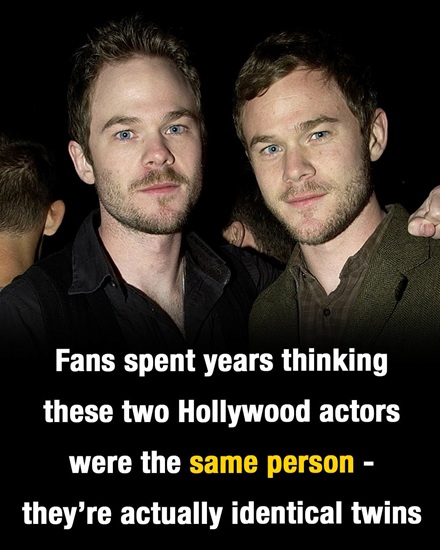
For years, some viewers may have assumed that the actor playing Jimmy Olsen in Smallville was the same person who appeared as Iceman in the X-Men films. The confusion is understandable because Aaron and Shawn Ashmore are identical twin brothers who have both worked in film and television for decades. Their resemblance is striking, and the fact that they often appeared in science-fiction, superhero and genre projects made the mix-up even easier. What looked like one actor jumping from one major franchise to another was actually two separate performers building careers at roughly the same time.
Aaron and Shawn Ashmore were born on October 7, 1979, in Richmond, British Columbia, Canada. Their physical similarity was obvious from childhood, and it quickly became relevant once they entered the entertainment industry. Both began acting at a young age, initially appearing in commercials. Their early experiences showed just how difficult it could be for casting professionals to choose between two children who looked nearly identical and could both perform the same material.
According to Shawn, some casting decisions became so close that directors occasionally settled them with a coin toss. Rather than telling one twin he had performed better than the other, casting teams would explain that both boys were equally suitable for the role. A coin flip then became a practical way to choose one while reducing the feeling that one brother had been personally rejected. It was certainly an unusual way to begin an acting career, but it became one of the most memorable stories from their childhood.
The method may sound surprisingly blunt, but Shawn has described it as something that made the outcome feel fairer. If one brother lost because of chance, he did not necessarily have to believe the other was considered more talented. For children growing up in a competitive industry, that distinction could matter. Instead of rivalry becoming the center of their experience, acting remained something both brothers were able to pursue.
As they became older, their professional paths started separating more clearly. Shawn eventually became closely associated with the X-Men movie franchise, while Aaron developed a strong television career. Even so, the genres they worked in frequently overlapped. Both appeared in superhero stories, science fiction, thrillers and dramatic television series. That overlap kept audiences guessing long after the brothers had established separate résumés.
Shawn Ashmore became internationally recognized for playing Bobby Drake, also known as Iceman, in the X-Men films. He first appeared in the role in the 2000 film X-Men. Although Bobby was not one of the central characters in the first movie, Shawn returned for later installments and received considerably more screen time. Over the years, the character became one of the most recognizable roles of his career.
He returned as Iceman in X2: X-Men United in 2003. The sequel developed Bobby Drake much more fully and placed him at the center of several important storylines. Viewers learned more about his family and his experiences as a mutant. Shawn’s performance helped make Bobby part of the younger generation of characters within the franchise.
Shawn reprised the role again in X-Men: The Last Stand in 2006. By that point, he had become firmly associated with the superhero series. He later returned once more in X-Men: Days of Future Past in 2014, appearing alongside actors from different generations of the franchise. That long connection with one comic-book character ensured that many viewers would permanently associate Shawn’s face with Iceman.
But superhero movies represented only one part of Shawn’s career. He also worked extensively in television and other film genres. Earlier in his career, he played Jake Berenson in the television adaptation of Animorphs. The series introduced him to audiences already interested in science fiction and fantasy.
Shawn later took on roles in horror and thriller films. He appeared in The Ruins and starred in the survival thriller Frozen, released in 2010. That film should not be confused with Disney’s animated movie of the same name. The thriller followed characters trapped on a ski lift and required a very different type of performance from the large-scale action of X-Men.
Television continued to become increasingly important for Shawn. He joined the crime series The Following as FBI agent Mike Weston, working alongside Kevin Bacon. The show ran for three seasons and gave him a substantial dramatic role outside the superhero genre. It also demonstrated that his career was not limited to science fiction or comic-book material.
Shawn later appeared in The Boys as Lamplighter. The role returned him to a superhero-related universe, although the tone of the series was drastically different from X-Men. The Boys presents superheroes through a darker, more satirical and violent lens. His appearance added another genre credit that could easily remind viewers of his earlier work.
He also became involved in performance-capture and video-game storytelling. Shawn played Jack Joyce in Quantum Break, a project combining interactive gameplay with live-action elements. The role allowed him to work in another form of entertainment while still performing a character in a cinematic style.
In recent years, many television viewers have come to know Shawn through The Rookie. He plays Wesley Evers, an attorney and the husband of Detective Angela Lopez. The character became an important recurring presence in the series. For younger viewers who never saw the original X-Men films in theaters, Wesley may now be the role they most strongly associate with Shawn.
While Shawn was building those credits, Aaron Ashmore was creating his own acting career. Aaron appeared in a wide range of television projects before landing several roles that became especially popular with science-fiction and superhero audiences. His path looked similar enough to Shawn’s that confusion between the two continued.
Aaron appeared in Veronica Mars as Troy Vandegraff. The role gave him exposure in a teen mystery series that developed a strong fan following. He also worked in Canadian productions and television films before joining one of the most recognizable superhero shows of the 2000s.
That major role came when Aaron joined Smallville as Jimmy Olsen. The character is one of the best-known supporting figures in Superman mythology and is traditionally associated with Clark Kent and the Daily Planet. Aaron began playing Jimmy during the sixth season of the series and became a regular part of the show’s world.
For viewers already familiar with Shawn as Iceman, Aaron’s arrival on Smallville could easily create confusion. His face looked familiar because it essentially was. The difference was that the actor standing in front of the camera was Shawn’s identical twin brother.
The situation becomes even more amusing because Shawn had already appeared in Smallville years before Aaron joined the cast. Shawn played Eric Summers, a teenager who temporarily gained Clark Kent’s powers. He appeared in the role during the show’s early seasons and later returned.
That means both Ashmore brothers appeared in Smallville, playing entirely different characters. Someone unaware that Aaron and Shawn were twins could understandably assume the same actor had been brought back years later and cast as Jimmy Olsen. In reality, the series had simply hired both brothers at different stages.
Aaron’s role as Jimmy Olsen became one of the defining television credits of his career. His character became involved with Chloe Sullivan and other central figures in the series. He worked at the Daily Planet and became part of the wider Superman mythology surrounding Clark Kent.
After Smallville, Aaron remained closely connected with science-fiction television. He joined Warehouse 13 as Steve Jinks, an agent working with a team responsible for tracking mysterious artifacts. The series mixed science fiction, fantasy, adventure and humor, making it another project likely to attract many of the same viewers who had followed Smallville.
Steve Jinks possessed an unusual ability to recognize when someone was lying. Aaron remained with the series for an extended period and became an important part of the ensemble. Once again, his participation in genre television made it easy for casual fans to continue confusing his work with Shawn’s.
Aaron later starred in Killjoys as John Jaqobis. The science-fiction series followed bounty hunters operating in a complex interplanetary society. Aaron appeared alongside Hannah John-Kamen and Luke Macfarlane, and the show ran for five seasons.
That long-running role further established Aaron as a familiar face in science-fiction television. By that point, both brothers had accumulated enough genre credits that viewers could encounter them repeatedly without realizing they were watching two different people.
Aaron also appeared in Netflix’s Locke & Key as Duncan Locke. The fantasy series involved magical keys, supernatural threats and a family dealing with a complicated history. The role continued the pattern of Aaron appearing in projects centered around fantasy and speculative storytelling.
More recently, Aaron gained attention for playing Gil Timmins in Ginny & Georgia. Gil is connected to Georgia’s past and is the father of Austin Miller. Aaron’s appearance in the series brought him to another large streaming audience, many of whom may not have followed his earlier science-fiction work.
This created a new generation of Ashmore confusion. Viewers who were watching The Rookie recognized what they thought was Shawn Ashmore when Gil appeared in Ginny & Georgia. Some assumed Shawn was simply working on both series.
In reality, the actor playing Gil is Aaron, while Wesley Evers in The Rookie is Shawn. The brothers were once again appearing in popular shows watched by overlapping audiences. Their identical appearance made the mistake completely understandable.
Online discussions show that many viewers were genuinely surprised when they discovered the truth. Some admitted they had watched entire episodes believing Gil and Wesley were played by the same man. Others said they had known that the Ashmores were twins but still mixed up which brother belonged to which show.
That second type of confusion may be even more amusing. Knowing that two actors exist does not necessarily make it easy to remember which one is on screen. The resemblance remains strong enough that viewers may still need to check the cast list.
For fans who want a simple way to remember, the major roles provide useful reference points. Shawn is Iceman from X-Men and Wesley from The Rookie. Aaron is Jimmy Olsen from Smallville and Gil from Ginny & Georgia. Those pairings make it much easier to separate their recent and older work.
There is one additional complication: Shawn’s role as Eric Summers in Smallville. That means the rule is not as simple as saying Shawn belongs to X-Men while Aaron belongs to Smallville. Both brothers appeared in the Superman series, although Aaron had the much larger and longer-running role.
This unusual overlap makes the twins particularly interesting to fans of superhero television. Few identical twin actors have both appeared in major comic-book properties while also appearing separately within the same television universe.
The brothers’ resemblance may be the first thing people notice, but their acting careers have not been identical. Shawn’s biggest early success came through theatrical superhero films. Aaron became especially visible through long-running television roles. Over time, however, both men expanded into a wide range of projects.
Shawn’s television career eventually became just as important as his film work. The Following and The Rookie gave him recurring and long-running characters. Aaron also moved beyond science fiction into contemporary drama through Ginny & Georgia. Their careers continued evolving while still occasionally crossing the same genre territory.
This overlap is one reason viewers continue to rediscover the twin connection. If the brothers had chosen completely different professions, the resemblance might have remained little more than a family curiosity. Instead, both spent decades appearing on television screens and in movies.
Their names do not make things much easier. Casual viewers may remember the surname Ashmore without remembering whether the credit listed Aaron or Shawn. Combined with identical faces, that creates ideal conditions for mistaken identity.
Fans who watch both brothers regularly often say they become easier to distinguish over time. Small differences in voice, facial expressions and mannerisms may become more obvious with familiarity. Hairstyles and facial hair can also make one easier to recognize in a particular role.
Still, many viewers continue getting them wrong. That should not be surprising. Identical twins naturally share many facial characteristics, and television styling can either emphasize or hide the subtle differences between them.
The recent confusion surrounding Ginny & Georgia and The Rookie shows that the phenomenon is not limited to older fans. New audiences are encountering Aaron and Shawn through streaming and making the same discovery that viewers made years earlier with Smallville and X-Men.
Streaming may even increase the chances of confusion. Someone can watch an episode of The Rookie one evening and switch immediately to Ginny & Georgia. The memory of Shawn’s face as Wesley remains fresh when Aaron appears as Gil.
The viewer recognizes the face but may notice something feels slightly different. The voice may seem different, or the facial expressions may not match perfectly. Without knowing about the twin relationship, those differences can easily be interpreted as changes in styling or acting.
Then the credits provide the answer.
Aaron Ashmore.
Not Shawn.
For some viewers, that discovery leads immediately to an internet search and the realization that there are two nearly identical actors with decades of separate work behind them.
The same experience happens with older productions. A viewer can watch Shawn as Iceman in X-Men, then start Smallville and see Aaron as Jimmy Olsen. The assumption that it is the same actor is logical until the cast list says otherwise.
Then, if that same viewer reaches one of Shawn’s Eric Summers episodes, things become even more confusing. Now both brothers genuinely have appeared in the same show.
The casting history almost sounds designed to confuse audiences, but it simply reflects two working actors accepting roles independently. Their twin relationship was not part of the Smallville storyline.
Their careers also demonstrate how difficult it can be for child actors to maintain long-term success. Aaron and Shawn began working when they were young, yet both successfully transitioned into adult acting careers. That alone is notable.
Many young performers leave the entertainment industry or struggle to find adult roles. Both Ashmore brothers continued booking substantial work across different decades and entertainment formats.
They also avoided becoming permanently marketed as a twin act. Although their resemblance created opportunities when they were children, their adult careers generally treated them as individual performers. Each brother auditioned for and developed his own characters.
That independence allowed both to build professional identities beyond the novelty of being identical twins. Shawn was not simply “Aaron’s brother,” and Aaron was not merely “Shawn’s twin.” Each accumulated major credits of his own.
The coin-toss auditions from their childhood make that outcome especially interesting. At the beginning, casting directors sometimes treated the boys as equally suitable options. The choice between them could literally depend on chance.
Decades later, the difference between their careers is much clearer. The coin may once have determined who appeared in a commercial, but adult roles were built through individual auditions, performances and professional relationships.
Their careers also developed at different speeds at different times. Shawn’s X-Men breakthrough gave him an early international movie profile. Aaron’s television work later gave him multiple long-running characters with devoted fan bases.
Success in acting rarely develops in a perfectly balanced way, even for siblings. One performer may have a major project while another is between roles. The fact that both brothers continued working despite inevitable comparisons suggests they managed the unusual situation effectively.
There has never been a major public narrative of hostility between them over their careers. Instead, interviews generally present the brothers as understanding the unusual circumstances they shared. Growing up with coin-toss casting decisions may have helped normalize the idea that professional outcomes could depend on factors beyond personal worth.
That perspective would be useful in an industry where rejection is constant. Two actors can give equally strong auditions and only one can receive the job. Aaron and Shawn learned that lesson earlier and in a more literal way than most performers.
Their story also shows how much audiences rely on facial recognition rather than credits. Viewers often assume a familiar face belongs to the person they already know. If two actors look nearly identical, that shortcut naturally fails.
The result is years of amusing mistakes.
Jimmy Olsen becomes Iceman.
Gil becomes Wesley.
Eric Summers becomes Jimmy Olsen.
The viewer may not realize anything is wrong until a name in the credits forces a second look.
Social media has made those realizations more visible. In the past, someone might privately discover the twins after checking a television guide or magazine. Today, viewers can post the realization online and immediately find hundreds of people admitting they made the same mistake.
These conversations often become less about embarrassment and more about shared amusement. People compare which roles they had incorrectly attributed to the other brother. Some realize they have been combining the twins’ entire filmographies in their minds for years.
That can produce an impressively long imaginary résumé.
One fictional Ashmore would have played Iceman, Jimmy Olsen, Wesley Evers, Gil Timmins, Steve Jinks, Lamplighter, John Jaqobis and numerous other characters.
The real explanation is much simpler.
There are two actors.
Their careers just happen to overlap in remarkable ways.
The similarities between their professional choices make the story more entertaining. Both could have pursued very different types of work, but science fiction and superhero projects repeatedly appeared in their careers.
That may be partly because casting opportunities often build on previous credits. Once an actor becomes familiar to genre audiences, producers working on similar projects may see that performer as a natural fit. Over decades, those patterns can create a recognizable career identity.
For Aaron, Smallville, Warehouse 13, Killjoys and Locke & Key form a substantial collection of genre television. For Shawn, X-Men, Animorphs, The Boys and Quantum Break provide a similarly strong connection with speculative stories.
At the same time, both brothers have demonstrated that they can work outside those genres. Shawn’s The Rookie is primarily a police drama. Aaron’s Ginny & Georgia is centered on family relationships, secrets and personal drama.
These recent projects introduce the brothers to audiences that may not consider themselves science-fiction or superhero fans at all. That expands the confusion beyond the viewers who originally encountered them through comic-book adaptations.
The identical-twin connection may therefore continue surprising audiences for years. Streaming keeps older shows and films readily available, while new projects continue introducing Aaron and Shawn to different generations.
A teenager discovering Ginny & Georgia today may learn about Aaron first. Later, watching X-Men could create the reverse version of the traditional confusion.
Instead of thinking Jimmy Olsen became Iceman, that viewer may wonder why Gil suddenly has mutant ice powers.
The order changes, but the surprise remains the same.
One of the most interesting details is that neither brother needs the twin story in order to have a noteworthy career. Shawn’s X-Men work alone would make him familiar to millions of viewers. Aaron’s extended runs on Smallville, Warehouse 13 and Killjoys would likewise provide a substantial television résumé.
Their shared identity simply adds another layer to careers that already stand independently.
That is why reducing them to a celebrity look-alike curiosity would miss much of what makes their story interesting. These are not two unrelated actors who happen to look similar. They are identical brothers who entered the industry together and then successfully built separate professional lives within it.
They experienced auditions together as children.
Sometimes they competed for the same role.
Sometimes chance decided who got it.
Then adulthood carried them toward different projects.
The similarities never disappeared, but the careers became increasingly distinct.
Fans may still need a moment to identify which brother is on screen, but the characters themselves belong to separate bodies of work.
Shawn made Bobby Drake his own across multiple X-Men films.
Aaron developed Jimmy Olsen across several seasons of Smallville.
Shawn turned Wesley Evers into a familiar part of The Rookie.
Aaron brought Gil Timmins into the complicated family world of Ginny & Georgia.
Those performances cannot simply be exchanged because the actors look alike.
Each brother brought his own interpretation and experience to the role.
That point becomes clearer the more audiences watch them. Facial resemblance may create the initial confusion, but performance eventually reveals individual differences.
Even so, checking the credits remains the easiest solution.
If the role is Iceman, it is Shawn.
If the role is Jimmy Olsen, it is Aaron.
If the role is Wesley, it is Shawn.
If the role is Gil, it is Aaron.
And if the character is Eric Summers in Smallville, the answer returns to Shawn.
That final twist guarantees the Ashmore family trivia will never become completely simple.
Perhaps that is part of the fun.
Their story began with casting professionals flipping coins because both boys seemed equally suitable for commercial roles.
Decades later, audiences still face their own version of the same problem.
They see a familiar Ashmore face and try to decide which brother is standing in front of the camera.
Fortunately, unlike the casting directors from childhood, viewers do not need a coin.
They can simply check the credits.
The answer may still be surprising.
