
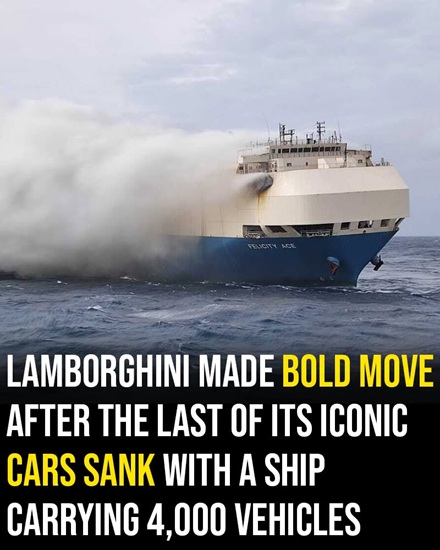
Lamborghini had already prepared to close the chapter on one of its most famous modern supercars when an unexpected disaster changed those plans. The Aventador had been in production since 2011, and the limited LP 780-4 Ultimae was created as the model’s farewell edition. Then, in February 2022, the vehicle carrier Felicity Ace caught fire while crossing the Atlantic Ocean. The ship was carrying thousands of vehicles from several Volkswagen Group brands, and after days of efforts to save it, the vessel eventually sank near the Azores.
Among the vehicles lost were cars from Porsche, Audi, Bentley, Volkswagen and Lamborghini. Lamborghini later confirmed that 85 of its vehicles had been aboard the ship. Most were Urus SUVs, but 15 of the cars were Aventador Ultimae models. Those 15 cars created a particularly difficult problem because the Ultimae had been designed to mark the end of Aventador production, meaning Lamborghini could not simply replace them with ordinary vehicles still coming off the assembly line.
The Aventador had already enjoyed a long and successful production life by that point. Introduced in 2011 as the successor to the Murciélago, it became Lamborghini’s flagship V12 supercar for more than a decade. During that period, the company introduced a wide range of versions, including the Aventador S, SV, SVJ and numerous limited editions. The Ultimae was intended to combine many of the strongest elements of those earlier models into one final production series.
Lamborghini planned a total of 600 Aventador Ultimae models, consisting of 350 coupes and 250 roadsters. The limited run was designed as a celebration of the Aventador’s naturally aspirated V12 era before Lamborghini moved toward a new generation of electrified flagship cars. For collectors and customers, the model represented more than just another high-performance Lamborghini. It was positioned as the closing statement of a major chapter in the company’s history.
The Ultimae was powered by Lamborghini’s naturally aspirated 6.5-liter V12 engine. It produced 780 metric horsepower, which is approximately 769 horsepower. According to Lamborghini’s official specifications, the coupe could accelerate from 0 to 100 km/h, or 0 to 62 mph, in about 2.8 seconds. Its claimed maximum speed was 355 km/h, or roughly 221 mph, placing it among the fastest road-going Aventador versions ever produced.
Its performance was supported by several advanced chassis systems. The Ultimae used electronically controlled all-wheel drive, rear-wheel steering and Lamborghini Dynamic Steering. Drivers could choose between different driving modes, including Strada, Sport, Corsa and Ego, allowing the car’s responses to be adjusted for road use, more aggressive driving or individual preferences. The model was therefore intended to be more than a cosmetic farewell edition.
That made the loss of 15 Ultimae examples aboard the Felicity Ace especially complicated. These cars had already been built and assigned to customers. They were not sitting in a warehouse waiting for buyers, and there was no longer a normal production flow from which identical replacements could easily be selected. By the time the ship sank, Lamborghini was already moving toward the end of Aventador manufacturing.
CEO Stephan Winkelmann later confirmed that Lamborghini would rebuild the 15 lost Aventador Ultimae models. The company also worked to replace other Lamborghini vehicles destroyed in the incident, including Huracán and Urus models. Replacing those ongoing-production cars was more straightforward, but recreating the Ultimae models required significantly more effort because the Aventador program was already winding down.
Modern automotive production depends on complicated supply networks, and a supercar such as the Aventador uses thousands of specialized components. Carbon-fiber structures, electronic systems, interior materials, trim pieces, powertrain components and model-specific parts must all arrive at the correct time. Once production of a vehicle is ending, suppliers may already be preparing to stop manufacturing those components or shift resources to new projects.
For Lamborghini, replacing the lost Ultimae cars therefore meant re-establishing parts of a supply chain that was already being closed. The company needed to coordinate with suppliers again, secure the necessary materials and create room in its manufacturing schedule. It was not simply a matter of turning on an old assembly line for a few hours and building 15 additional cars.
The situation also occurred during a period when the global automotive industry was facing significant supply-chain disruption. Semiconductor shortages were affecting manufacturers around the world, while shipping and production networks were still dealing with instability. This broader environment made the task of reproducing a discontinued limited-edition supercar even more unusual.
For the affected buyers, however, Lamborghini’s decision meant that their orders would not simply disappear with the ship. These customers had selected a very specific limited-production model, and many Aventadors were highly customized through Lamborghini’s Ad Personam program. Rebuilding the cars therefore involved recreating the original orders rather than simply offering customers another Lamborghini with similar performance.
That distinction was important because the Ultimae was already considered historically significant within Lamborghini’s lineup. It represented the final regular-production Aventador and one of the last expressions of Lamborghini’s flagship V12 without hybrid assistance. The company’s next-generation flagship would retain a V12 engine but combine it with an electrified powertrain.
The Felicity Ace disaster began on February 16, 2022, when a fire broke out aboard the ship in the Atlantic Ocean. All 22 crew members were safely evacuated, an important fact in a disaster that resulted in enormous financial losses but no reported loss of life among the crew. Salvage teams later attempted to manage the burning vessel, but the situation remained difficult.
On March 1, 2022, the Felicity Ace sank near Portugal’s Azores archipelago. The ship went down with its remaining cargo, which included thousands of vehicles. The incident attracted global attention partly because many of those vehicles were expensive performance and luxury models. Porsche alone had more than 1,000 vehicles aboard, while Audi, Bentley, Volkswagen and Lamborghini also suffered losses.
The destruction of the vehicles created an unusual challenge for several automakers. Manufacturers normally have procedures for replacing cars that are damaged before delivery, but the scale of the Felicity Ace loss was exceptional. Thousands of completed vehicles disappeared at once, forcing brands to reorganize production and delivery schedules for customers who had been waiting for their cars.
Lamborghini’s situation became especially memorable because of the 15 Ultimae models. The company had already intended the Aventador to leave production, yet the shipwreck effectively required one more chapter. Reports frequently described the situation as Lamborghini being forced to “restart” Aventador production, although the Sant’Agata Bolognese factory itself had never stopped operating.
What actually needed to be revived were the Aventador-specific manufacturing processes and supply arrangements. Lamborghini was still producing other vehicles at the same plant, including the Huracán and Urus. The unusual part was reactivating enough of the Aventador program to recreate cars from a final-production series that had essentially reached its planned conclusion.
This distinction helps explain why the event was such a challenge. Automakers regularly adjust assembly schedules for current models, but restarting a discontinued configuration is much more difficult. Suppliers may have already completed their final parts deliveries, tooling may have been reassigned, and workers may have moved to other production programs.
Lamborghini nevertheless committed to finishing the replacement cars. That decision protected customers who had already ordered and paid deposits for limited-production vehicles. It also prevented the 15 lost examples from effectively reducing the number of Ultimae customers who would receive the model they had originally been promised.
The replacement effort did not represent a new commercial run of Aventadors. Lamborghini was not reopening order books to sell additional Ultimae models to new buyers. Instead, the company was recreating vehicles that had already existed and had been destroyed during shipping. This distinction also helped preserve the intended exclusivity of the Ultimae production series.
Collectors often pay close attention to production numbers, especially for limited-edition supercars. Increasing the planned number of vehicles can affect perceptions of rarity. Lamborghini’s response to the shipwreck was therefore structured around replacing lost customer vehicles rather than expanding the original Ultimae run.
The Aventador’s overall production history was already impressive. By the time production eventually ended, Lamborghini had built 11,465 Aventadors across all versions. That made it the most-produced V12 Lamborghini in the company’s history. Its success reflected how much Lamborghini’s global business had grown compared with earlier flagship models.
For comparison, previous Lamborghini V12 cars such as the Countach, Diablo and Murciélago were produced in much smaller numbers. The Aventador reached a significantly larger global customer base while still maintaining its position as an expensive, low-volume supercar by ordinary automotive standards.
Its technical construction also helped distinguish it from previous Lamborghini flagships. The Aventador used a carbon-fiber monocoque designed to combine high rigidity with reduced weight. It retained Lamborghini’s famous scissor doors and dramatic wedge-shaped proportions, while introducing a modern interpretation of the company’s traditional flagship design language.
The V12 engine was another central part of its identity. Lamborghini’s twelve-cylinder road cars have been a defining part of the company since its earliest years. The Aventador continued that tradition with a naturally aspirated engine rather than turbocharging, giving the car a distinctive high-revving character and sound.
The Ultimae was developed as a celebration of that engineering approach. Lamborghini described it as combining performance elements from the track-focused SVJ with qualities associated with the Aventador S and other variants. The result was intended to be powerful and capable while still suitable for road use.
Its styling also reflected its special status. Lamborghini offered exclusive paint options, carbon-fiber details and extensive customization. Customers could personalize interiors with different materials, stitching, trim and colors. Many buyers of limited-production Lamborghinis use the company’s Ad Personam program to create highly individual specifications.
That level of personalization made replacing lost cars more complicated. A customer who had ordered a unique exterior color, special upholstery and specific trim would understandably expect the replacement to match the original order. Lamborghini therefore needed to reproduce not only the general model but the individual configurations that had been lost at sea.
Insurance helped manage the financial side of the disaster. Volkswagen Group confirmed that insurance arrangements covered damage connected with the lost cargo. That did not eliminate the manufacturing challenge, however. Money could compensate for destroyed vehicles, but manufacturers still had to physically build replacements if customers wanted the cars they had ordered.
For regular-production vehicles, the solution could involve assigning customers new build slots. With the Aventador Ultimae, the situation required a more complicated response because the underlying production program was ending. Lamborghini had to maintain or restore access to parts that otherwise would no longer have been needed.
The replacement process eventually succeeded. Lamborghini completed the additional Ultimae cars and continued toward the definitive end of Aventador production later in 2022. The unusual shipwreck therefore delayed the final goodbye but did not prevent the company from delivering replacements to affected customers.
By September 2022, Lamborghini publicly marked the end of Aventador production. The final example was an Aventador LP 780-4 Ultimae Roadster created through the Ad Personam program and destined for a customer in Switzerland. Its completion officially brought more than a decade of Aventador manufacturing to a close.
The final car carried symbolic significance beyond simply being the last number in a production sequence. Its configuration reportedly referenced the historic Lamborghini Miura Roadster, connecting the end of one important V12 era with another famous model from the company’s past.
There has occasionally been some confusion about exactly when the final Aventador physically left the production line. Some later reports indicated that the final vehicle had been completed earlier in the summer, while Lamborghini publicly announced the definitive end of production in September. What is clear is that by the fall of 2022, Aventador production had ended after the replacement effort.
The final total of 11,465 cars covered more than ten years of production and numerous variants. The Aventador began as a new flagship in 2011 and evolved continuously through performance upgrades, design revisions and special editions. Its lifespan ultimately stretched long enough to become one of the most recognizable supercars of its generation.
The Ultimae’s role in that history became even more distinctive because of the Felicity Ace disaster. A farewell model normally follows a predictable pattern: orders are completed, final cars leave the factory, and production ends. The Aventador’s farewell instead included a cargo-ship fire, lost cars at the bottom of the Atlantic and a temporary manufacturing revival.
The event also demonstrates how vulnerable global vehicle delivery can be even after manufacturing is complete. A supercar may successfully pass final inspection at the factory and still need to travel thousands of kilometers before reaching its owner. Ocean shipping remains a routine part of global automotive logistics, but rare disasters can disrupt even carefully planned deliveries.
In this case, the Felicity Ace represented one of those rare events. The ship was designed specifically to carry vehicles, yet the fire ultimately resulted in the loss of virtually its entire cargo. The cars had already been manufactured, but they never reached their intended customers.
The fact that the crew was evacuated safely remains the most important outcome from a human perspective. Vehicles can be rebuilt or financially replaced, while lives cannot. The automotive story surrounding the lost supercars became prominent because of the extraordinary financial and production consequences, but the successful evacuation prevented the event from becoming a much greater tragedy.
Lamborghini’s response also demonstrated the importance placed on relationships with high-end customers. Buyers of limited-production supercars often wait significant periods for their vehicles and may have selected detailed personalized specifications. Simply refunding those customers would have been one possible solution, but Lamborghini chose instead to recreate the lost cars.
That decision required extra work but preserved the original customer agreements. It allowed affected buyers to eventually receive the specific final-generation Aventador they had ordered rather than being told that the vehicle could no longer be produced.
The episode also helped reinforce the Ultimae’s historical significance. The model was already intended to symbolize the end of a naturally aspirated flagship era, and the unusual production story added another layer to its identity. Today, examples are recognized not only as final-edition Aventadors but also as cars connected with one of the strangest production interruptions in Lamborghini history.
After the Aventador finally ended, Lamborghini moved toward its next flagship generation. The Revuelto, introduced afterward, retained a naturally aspirated V12 but combined it with electric motors and a plug-in hybrid system. That shift made the Aventador Ultimae an important dividing line between two eras of Lamborghini engineering.
The Aventador therefore did not represent the end of Lamborghini’s V12 tradition itself. Instead, it marked the end of the company’s modern flagship V12 operating without hybrid assistance. The Revuelto continued the twelve-cylinder philosophy while adding electrification to improve performance and meet changing technical requirements.
This transition makes the final Ultimae examples especially interesting from an automotive-history perspective. They are among the last Lamborghini production cars to deliver the company’s flagship V12 experience in the traditional non-hybrid format that had defined generations of models before them.
The Felicity Ace story has sometimes been simplified into the claim that Lamborghini “reopened an entire factory.” That description overstates what happened. Lamborghini’s factory never stopped producing cars altogether. The more accurate explanation is that the company had to reactivate or extend Aventador-specific production processes and supply arrangements after the model’s planned manufacturing run had effectively concluded.
The reality is still remarkable without exaggeration. Restarting supply for a limited-edition supercar after production has been wound down is a complicated industrial task. It requires cooperation from suppliers, manufacturing teams, logistics departments and customers.
Another frequently repeated part of the story concerns individual owners who reportedly had multiple cars aboard the ship. Some automotive personalities publicly discussed losing expensive vehicles in the disaster, including Aventador Ultimae examples. Those personal stories helped bring attention to the event, but Lamborghini’s officially confirmed replacement program remains the strongest factual foundation.
The manufacturer confirmed that the 15 lost Ultimae cars would be rebuilt. That commitment is the central reason the incident became a notable chapter in Aventador history. Without it, the cars lost at sea might simply have become missing examples from the final production run.
Instead, Lamborghini effectively preserved the planned customer deliveries. The original vehicles remained lost, but replacement cars were produced with the same purpose and specifications. The final Aventador count and production history could therefore proceed in the way Lamborghini intended.
The story also illustrates why vehicle manufacturing does not end when a car leaves the assembly line. The full process includes logistics, transportation, customs procedures, dealer preparation and final customer delivery. Until the buyer actually receives the car, unforeseen events can still disrupt the transaction.
For companies selling rare and expensive vehicles, this creates additional responsibility. A customer waiting for a limited-production supercar may not consider a refund or substitute model equivalent to receiving the exact car originally ordered. Lamborghini’s response acknowledged that difference.
The Aventador Ultimae itself remained an extraordinary machine regardless of the shipping story. Its performance figures, limited production and place within Lamborghini history would already have made it desirable. The Felicity Ace incident simply gave the model an unusually dramatic final chapter.
Its 6.5-liter V12 was among the most powerful versions of the Aventador engine. The car retained the naturally aspirated response that had defined Lamborghini’s flagship models while incorporating modern electronic control systems and active chassis technology.
The transmission remained Lamborghini’s seven-speed Independent Shifting Rod automated manual system, a gearbox that contributed to the Aventador’s distinctive driving character. While newer dual-clutch transmissions can shift more smoothly, Lamborghini continued using this system throughout the Aventador’s life.
The all-wheel-drive system helped the Ultimae transfer its substantial power to the road, while rear-wheel steering improved agility at lower speeds and stability at higher speeds. Carbon-ceramic brakes provided stopping performance appropriate for a car capable of exceeding 350 km/h.
All of those features reinforced why customers were unwilling to view a different Lamborghini as an identical replacement. An Urus SUV or Huracán supercar might also be valuable and fast, but neither represented the same historical model or engineering package as the Ultimae.
Lamborghini’s decision to rebuild the cars therefore protected more than their monetary value. It protected the customers’ opportunity to own one of the final examples of a specific V12 generation.
Once those replacements were completed, Lamborghini could finally close the Aventador chapter. The model’s production run had survived an unexpected extension caused by circumstances far outside the factory’s control.
The final ending came later than planned, but it remained definitive. Lamborghini moved forward with its next-generation vehicles, suppliers transitioned to new components, and the Aventador assembly process was ultimately retired.
The story continues to attract attention because it sounds almost fictional. A legendary supercar reaches the end of production, 15 final-edition examples are placed on a cargo ship, the ship catches fire and sinks, and the manufacturer then has to recreate the lost cars.
Yet the basic facts are well documented. The Felicity Ace caught fire in February 2022 and sank on March 1 near the Azores. Roughly 4,000 vehicles were aboard. Lamborghini had 85 vehicles on the vessel, including 15 Aventador Ultimae models.
Lamborghini confirmed that it would replace those 15 cars despite the Aventador’s production program already approaching its conclusion. That required additional coordination with suppliers and manufacturing operations.
By later in 2022, the Aventador finally reached the definitive end of production. The final total reached 11,465 vehicles across the entire model family.
The episode therefore became one of the strangest farewell stories associated with a modern supercar. Lamborghini had already planned the Aventador’s retirement, but an event thousands of kilometers away from its Italian factory forced the company to revise those plans.
For the customers whose cars disappeared beneath the Atlantic, the replacement program meant their orders eventually survived the disaster even though the original vehicles did not.
For Lamborghini, it meant keeping a production chapter open slightly longer than expected and solving a complicated supply-chain problem for a relatively small number of extremely significant cars.
And for the Aventador itself, the shipwreck created an unexpected final chapter before one of Lamborghini’s most successful V12 models could truly come to an end.
More than a decade after the Aventador first entered production, the final Ultimae models eventually left Sant’Agata Bolognese and closed the story for good. The successor generation brought hybrid technology, but the Aventador’s naturally aspirated V12 legacy remained intact.
The Felicity Ace disaster did not change what the Aventador represented, but it gave its farewell an extraordinary twist. Lamborghini believed the final cars had already been built. The Atlantic Ocean had other plans, and the company ultimately had to build them again.

