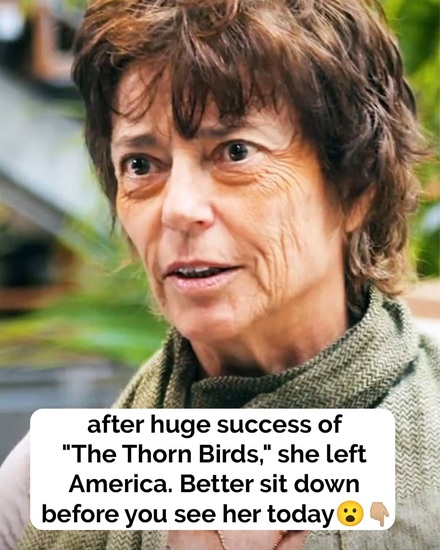
Rachel Ward became internationally known through one of the most memorable television events of the 1980s. In 1983, she played Meggie Cleary in The Thorn Birds, the sweeping miniseries adapted from Colleen McCullough’s bestselling novel. The production drew an enormous audience and made Ward recognizable far beyond the modeling and acting circles in which she had already begun building a career. Her performance placed her opposite Richard Chamberlain, whose portrayal of Father Ralph de Bricassart became equally central to the story.
Yet the miniseries would ultimately change Ward’s life in ways that extended far beyond professional success. Born on September 12, 1957, in Oxfordshire, England, Ward grew up in a very different environment from the Australian landscapes later associated with her life and work. She attended Hatherop Castle School and later studied at the Byam Shaw School of Art in London. As a teenager, however, she decided to leave formal education and pursue modeling. That choice quickly opened doors in fashion and photography, where her appearance helped her establish an international profile.
Long before The Thorn Birds, she had already appeared in major magazines and commercial work. Ward’s transition from modeling to acting happened gradually. She began appearing in commercials and then moved into film and television. One important early role came in the 1981 film Sharky’s Machine, directed by and starring Burt Reynolds. Her work in the film brought her wider attention and contributed to a Golden Globe nomination in the New Star of the Year category in 1982. This meant that she was not completely unknown when the opportunity to audition for The Thorn Birds arrived. Still, the role of Meggie Cleary would elevate her career to an entirely different level.

Casting Meggie was not a simple process. The character needed to be convincing across a wide span of adulthood, changing from a young romantic woman into someone shaped by disappointment, motherhood, difficult choices, and the passage of time. Producers reportedly considered more than 200 women for the role, while dozens eventually auditioned. The difficulty was understandable because the actress needed to carry much of the emotional weight of the miniseries while also appearing believable at different ages.
Ward ultimately won the part, although she later spoke candidly about the insecurity she felt during the process. She has recalled that the people evaluating her were highly confident about her appearance while considerably less certain about her acting ability at the time. Rather than hiding that memory, Ward has often discussed it with humor. She was sent to work with an acting coach, an experience that helped prepare her for a role far more demanding than the screen work she had previously undertaken.
Meggie Cleary was not a character who remained emotionally fixed. Audiences first encountered her as a young woman and then followed her through years of complicated family and romantic experiences. Costume design, makeup, and physical presentation were all used to help demonstrate the passage of time. Ward has recalled being aged for the later parts of the story and wearing clothing designed to make Meggie appear more mature. Those visual changes supported a performance that needed to show the character developing emotionally as well.
One of the most famous visual elements associated with Ward’s performance was the pale pink “Ashes of Roses” gown. The dress became closely connected with a memorable scene involving Meggie and Father Ralph. Decades later, the costume remains one of the most discussed pieces from the production. The continuing interest demonstrates how strongly the miniseries relied not only on dialogue and acting but also on visual storytelling to create its romantic and emotional atmosphere.
At the center of The Thorn Birds was the relationship between Meggie and Father Ralph. Richard Chamberlain played Ralph as a man torn between personal feelings and his commitment to the Catholic Church. Meggie’s attachment to him became one of the major forces shaping her life. Their relationship was designed as a tragic and complicated romance rather than a straightforward love story. That conflict kept audiences invested because the characters repeatedly faced choices that carried lasting consequences.
The production’s structure allowed those consequences to unfold across many years. Rather than telling a short romance, The Thorn Birds explored family relationships, ambition, faith, marriage, grief, and generational change. This helped give the miniseries a scale closer to an epic novel than a conventional television drama. Viewers had time to become attached not only to Meggie and Ralph but also to the wider Cleary family and the many characters surrounding them.
The cast included several highly respected performers. Barbara Stanwyck played Mary Carson, while Jean Simmons portrayed Fiona Cleary. Christopher Plummer, Richard Kiley, Piper Laurie, Bryan Brown, and others contributed to the large ensemble. The presence of experienced actors gave Ward a particularly demanding environment in which to work, but it also helped strengthen the production. The series became notable not simply for one central romance but for the quality and range of its supporting performances.
When The Thorn Birds aired in the United States in March 1983, it became a major television event. Tens of millions of viewers watched the approximately ten-hour production. At a time when audiences had far fewer channels and no streaming services, a successful network miniseries could dominate popular conversation for several nights. The Thorn Birds did exactly that. It quickly became one of the best-known television productions of its era.
Awards recognition followed. The miniseries won multiple Golden Globe Awards, including Best Miniseries, and also received several Emmy Awards. Ward earned a Golden Globe nomination for her work as Meggie. Richard Chamberlain, Barbara Stanwyck, Jean Simmons, Richard Kiley, and other members of the production were also recognized in different categories. The awards reinforced the fact that the show was not simply popular with audiences but was also treated as a major television production.
Despite that success, Ward did not immediately feel confident about her own contribution. She later said that negative reviews affected her deeply. Some critics questioned whether she was ideally cast in such a demanding dramatic role, and Ward internalized much of that criticism. Rather than seeing the success of the miniseries as proof of her own achievement, she sometimes felt that the production had succeeded despite her performance.
Those feelings stayed with her for years. Ward had not come from an extensive acting-school background and had learned much of her craft while already working professionally. The enormous attention surrounding The Thorn Birds therefore arrived at a moment when she was still developing confidence as an actress. Sudden fame can amplify both praise and criticism, and Ward experienced both on an unusually large scale.
With time, however, her view of the performance became more balanced. Ward later reflected that acting styles had changed and that her own instincts had always been relatively naturalistic. She began to see some of the tension she felt during production as the result of being pushed toward a style that did not always suit her naturally. This allowed her to look back at Meggie with more understanding than she had immediately after the miniseries aired.
A particularly meaningful reassessment came through her family. Years later, Ward’s daughter watched The Thorn Birds and praised her mother’s performance. Ward has said that this response mattered deeply to her. Professional reviews had once made her doubt herself, but hearing admiration from her own daughter changed the emotional meaning of the role. It was no longer simply a piece of early-career work judged by critics. It had become part of her family history.
The production also changed her life in a much more direct and personal way. While filming The Thorn Birds, Ward met Australian actor Bryan Brown. Brown played Luke O’Neill, the man Meggie marries in the story. Their fictional marriage was difficult and unhappy, but the relationship developing between Ward and Brown away from the cameras was very different. The two actors fell in love during the making of the miniseries.
Their romance became one of the best-known behind-the-scenes stories associated with the production. Ward later said that the chemistry between them was real, even while they were portraying a troubled fictional relationship. Brown and Ward married in 1983, not long after production was completed. What might initially have appeared to be an on-set romance developed into a lasting marriage.
The couple went on to build a family together in Australia. They had three children, Rosie, Matilda, and Joe. Ward’s connection with Australia therefore became much deeper than a temporary professional experience. She increasingly built her life there, balancing acting with marriage and motherhood. The country eventually became her permanent home.
For Ward, The Thorn Birds would always carry this double significance. It was the project that brought international fame and also the place where she met the man who became her husband. Even if she sometimes felt uncertain about her own acting, she could never view the production as merely another professional credit. It changed the course of both her career and private life.
After the miniseries, Ward continued working in film. One of her prominent Hollywood roles came in Against All Odds in 1984, where she starred opposite Jeff Bridges and James Woods. The film arrived while her international profile was still extremely high. It demonstrated that Hollywood was interested in her beyond the success of Meggie Cleary, although her career would eventually take a different path from that of someone pursuing permanent Hollywood celebrity.
Ward increasingly built her professional life around Australia. She continued acting but also began thinking more seriously about writing and filmmaking. Marriage and motherhood changed her daily life, and she later returned to formal study. She earned qualifications in communications and writing through the University of Technology Sydney, expanding her skills beyond performance.
Returning to education was an important step. As an actress, Ward had spent years depending on scripts, directors, and casting decisions. Writing and directing offered greater control over the stories she wanted to tell. Instead of waiting for roles, she could become involved in creating projects from the beginning. That change gradually became central to her later career.
Ward began directing short films and developed a strong interest in working behind the camera. Her project Martha’s New Coat received recognition and helped establish her as more than an actress experimenting with directing. The work demonstrated that she had developed a genuine filmmaking voice. It also marked a significant shift from the young performer who had once doubted whether she belonged in a major television production.
In 2009, Ward directed the feature film Beautiful Kate. She also adapted the screenplay from the novel by Newton Thornburg. The film starred Ben Mendelsohn, Rachel Griffiths, Sophie Lowe, and Bryan Brown. It explored difficult family relationships, memory, secrets, and unresolved emotional wounds. The tone was far removed from the sweeping romance of The Thorn Birds, showing how much Ward’s creative interests had evolved.
Working with Brown on Beautiful Kate demonstrated that their marriage had also become a creative partnership. More than two decades after meeting on The Thorn Birds, they could collaborate in a very different context. Ward was now directing rather than simply appearing opposite him as a fellow actor. This reversal reflected how much her confidence and professional identity had changed.
Ward did not completely leave acting behind. In 2000, she appeared in the television adaptation of On the Beach, alongside Bryan Brown and Armand Assante. Her performance brought another major piece of awards recognition. She received a Golden Globe nomination in 2001, nearly two decades after The Thorn Birds. The nomination demonstrated that her acting career had remained substantial long after her breakthrough role.
She later appeared in Australian television productions including Rake, The Straits, and Devil’s Playground. Ward became increasingly selective, however, as directing, family life, and other interests took up more of her attention. Her career stopped resembling the traditional path of an actress continually seeking major leading roles. Instead, she moved between different creative positions depending on the project.
Her daughter Matilda Brown eventually entered the entertainment industry as well. Ward reportedly encouraged Matilda to develop skills behind the camera rather than relying entirely on acting. The advice reflected Ward’s own professional journey. She understood how uncertain acting could be and how much additional control could come from learning filmmaking and storytelling.
Mother and daughter eventually worked together in The Death and Life of Otto Bloom. Rachel and Matilda portrayed the same character at different ages. Their physical resemblance made the casting particularly effective. The collaboration created a rare opportunity for Ward to share a professional project with her daughter while also reflecting the generational connections that had become increasingly important in her life.
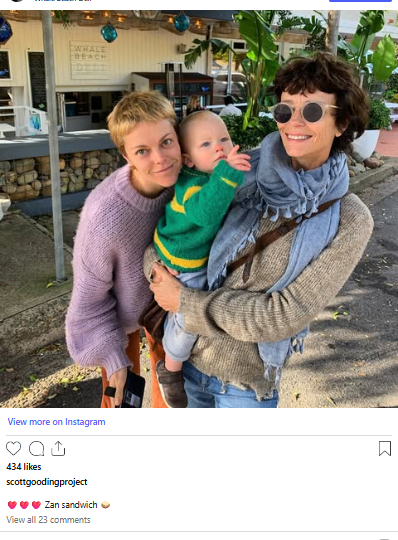
Ward and Brown later became grandparents. Their expanding family added yet another stage to a relationship that began during the filming of one of television’s biggest romantic dramas. The actors who met as young performers on a miniseries eventually became parents and grandparents together. That long timeline gives their on-set romance a significance very different from the short celebrity relationships often associated with entertainment productions.
Ward also received recognition for contributions beyond film and television. She was appointed a Member of the Order of Australia. Her public work included advocacy and support connected with disadvantaged and at-risk young people. This part of her biography demonstrated interests extending beyond entertainment, although acting and filmmaking remained the activities through which she was best known internationally.
As Ward grew older, her relationship with public attention also changed. During her modeling years, appearance was a central part of her career. As Meggie Cleary, her beauty became one of the aspects repeatedly emphasized by the press. Aging therefore placed her in a culture that often judges actresses differently from male performers once they are no longer seen primarily as young stars.
Ward gradually rejected the idea that she needed to preserve the image audiences remembered from the 1980s. She became increasingly comfortable allowing her appearance to reflect her actual age and daily life. Her priorities had moved toward family, creative work, and eventually farming. Those interests mattered more to her than maintaining a carefully managed celebrity image.
By 2026, Ward had embraced another major chapter of her life through regenerative farming in Australia. She and Bryan Brown have been connected with rural property in northern New South Wales, where Ward became deeply involved in the land and cattle operation. Farming represented an extraordinary change from the fashion industry and Hollywood, yet it fit the pattern of reinvention that had characterized much of her life.
Ward has spoken about developing a strong sense of purpose through farming. She became interested in regenerative agricultural practices intended to improve soil and landscape health. Rather than treating the property simply as a place to relax away from entertainment, she became actively involved in learning how the land worked. This gave her a new form of responsibility and creativity.
Her connection with the Australian landscape also became emotionally important. Ward has acknowledged that she took time to feel completely at home after moving from England. Although she built her marriage and family in Australia, part of her remained strongly attached to the landscapes of her childhood. Farming helped deepen her relationship with the country where she had spent most of her adult life.
This creates an interesting connection with The Thorn Birds. The story that made Ward famous was itself deeply associated with Australian land and family inheritance, even though the television adaptation was largely filmed elsewhere. At the time, Ward was a British actress stepping into an Australian story. Decades later, she had become an Australian citizen whose daily life was closely connected to rural land.
Her family became part of that relationship as well. Children and grandchildren could visit the farm, making the property another place where the next generation created memories. Ward’s later life therefore combined several themes that had been present throughout her biography: family, creativity, identity, and finding a sense of belonging.
The contrast with her early modeling career is striking. As a young woman, Ward was photographed for fashion publications and became known for elegance and beauty. In later life, she became comfortable working outdoors and speaking about soil, cattle, and ecological regeneration. Both periods are authentic parts of the same person. One does not cancel the other.
That ability to change direction may be one of the defining features of Ward’s life. She became a model, moved into acting, became a wife and mother, returned to education, wrote, directed, and eventually became deeply involved in farming. At each stage, she was willing to move beyond the identity for which other people already knew her.
This makes her story more interesting than a simple account of a former television star. If Ward had done nothing after The Thorn Birds, the role alone would have guaranteed her a place in television history. Instead, she spent the following decades developing interests that had little to do with preserving that fame.
The enduring popularity of The Thorn Birds means that new viewers continue discovering Ward as Meggie. The miniseries remains available through different forms of distribution, allowing audiences born long after 1983 to encounter its characters. For those viewers, Ward may initially appear frozen in time as the young actress at the center of the story.
Her real life, of course, continued far beyond that image. She experienced criticism, professional uncertainty, marriage, motherhood, later acting success, directing, and new forms of work. Seeing only Meggie gives audiences one powerful chapter but not the full story.
The miniseries itself continues to attract attention because of its unusual combination of romance, tragedy, religion, and family drama. Its story was unapologetically emotional. Characters made decisions with consequences that followed them for years. Losses accumulated, relationships changed, and happiness rarely came easily.
Richard Chamberlain later reflected on how much tragedy the story contained. That relentless sequence of emotional difficulties was part of what kept viewers watching. The characters were constantly attempting to reconcile what they wanted with responsibilities or choices that stood in their way.
Meggie’s relationship with Father Ralph embodied that conflict most clearly. Ralph could not simply abandon his ambitions and religious commitments without consequences, while Meggie could not simply stop loving him. Their inability to create an ordinary life together gave the story its long-running tension.
Luke O’Neill represented another attempt at a different future for Meggie. Her marriage to him did not become the escape she wanted. Bryan Brown therefore played a character central to one of Meggie’s unhappiest relationships while simultaneously becoming the man Ward fell in love with in real life.
That contrast became increasingly remarkable with every passing decade. The fictional couple did not last, while the two actors built a marriage that endured. What looked temporary behind the scenes became permanent, while the relationship written for television became part of a finished story.
Ward and Brown’s marriage has lasted for more than four decades. Their partnership survived changing careers, parenthood, professional travel, and the ordinary pressures of a long life together. Their relationship is now inseparable from discussions of what happened behind the scenes of The Thorn Birds.
Yet it is important not to reduce Ward’s success to meeting her husband. The miniseries also demanded a major performance from an actress still learning her craft. She had to portray decades of Meggie’s life and hold her own beside several established stars. The fact that she felt insecure does not change the responsibility she carried.
Her Golden Globe nomination provides one measure of the recognition she received. More importantly, viewers continued to remember her decades later. A performance can be technically debated by critics while still creating a lasting emotional connection with audiences.
Ward’s own changing attitude toward her work also demonstrates how performers can become their harshest critics. An actress may remember every difficult scene and negative review, while viewers remember only how deeply they connected with the character. Those two perspectives can exist simultaneously.
Time ultimately allowed Ward to place the role within a much larger life. Once she had raised children, directed films, and spent decades with Brown, the anxieties surrounding one early performance no longer needed to define her. The Thorn Birds could become something she appreciated without pretending she had always felt confident about it.
This maturity is visible in the way she speaks about acting today. Rather than presenting herself as someone who always knew exactly what she was doing, Ward acknowledges uncertainty. That openness makes her career more relatable and historically interesting.
Her transition to directing also suggests that early insecurity did not destroy her creative ambition. Instead, she eventually moved into a position requiring considerable authority. Directors must make decisions, guide actors, shape performances, and take responsibility for an entire production.
Ward’s journey from questioning whether she was good enough in front of the camera to confidently working behind it represents a major transformation. It also illustrates how professional development can continue well beyond a person’s early success.
Family gave that development another dimension. Her children grew up around parents involved in acting and filmmaking. At least one of them, Matilda, entered the industry herself. Ward could therefore share both the excitement and difficulty of creative work from the perspective of a parent.
When Ward advised Matilda not to rely entirely on acting, she was drawing from personal experience rather than dismissing the profession. She knew what it felt like to depend on casting and external judgment. Encouraging filmmaking skills offered her daughter more ways to participate in storytelling.
Their eventual collaboration made that advice particularly meaningful. Rather than simply copying her mother’s career, Matilda developed her own path while still occasionally sharing creative space with her parents.
The same could be said of Ward herself. She did not follow a predictable route from model to actress to permanent celebrity. Every few years, another part of her life seemed to become more important.
In her late 60s, farming became one of those priorities. That change did not represent withdrawal from life. Instead, Ward described it as another form of engagement and purpose. Working with land required learning, patience, and long-term thinking.
Regenerative farming is especially suited to that perspective because it focuses on what happens over time rather than immediate appearance. Soil, vegetation, water, and livestock management all involve systems that develop gradually. For someone whose earlier career was associated with images captured in a moment, the contrast is significant.
Ward’s experience also demonstrates that retirement does not need to mean inactivity. People can discover entirely new interests later in life. A person recognized for one profession does not have to remain attached to it forever.
At 68, Ward continues to represent several different chapters at once. Television fans see Meggie Cleary. Film audiences may remember Against All Odds. Australian viewers may know her directing work. Her family knows a wife, mother, and grandmother. Her current life includes farming and land management.
None of these identities is necessarily more authentic than the others. Together they show the complexity of a long adult life.
The story also explains why The Thorn Birds remains so personally important despite Ward’s mixed feelings about her performance. Without it, her career and family might have developed in completely different ways. She might never have met Bryan Brown. She might never have built the same connection with Australia.
One television production therefore became a turning point that reached far beyond ratings and awards. It shaped where Ward lived, whom she married, and the family she eventually built.
That kind of impact cannot be measured simply by whether every critic approved of her acting in 1983. The project became part of her personal history regardless of professional debate.
More than forty years later, Ward and Brown remain together, and their relationship is one of the most enduring real-life stories connected with the miniseries. Their children are adults, grandchildren have arrived, and the glamorous production that brought them together belongs to another era of television.
Yet people continue asking what happened to Rachel Ward after The Thorn Birds. The answer is that a great deal happened.
She acted in additional films and television productions. She returned to education. She earned further awards recognition. She became a filmmaker and director. She raised a family in Australia. She became a grandmother. She developed a deep involvement with farming and the land.
The actress who once feared that she had disappointed audiences eventually built a creative life broad enough that no single review could define it.
Her story therefore has a natural appeal beyond nostalgia. It demonstrates how uncertain beginnings can lead to unexpected directions without needing to be exaggerated into a perfect success story.
Ward faced criticism. She doubted herself. Some career paths became more important while others faded. Her priorities changed. That is part of what makes the biography believable.
There was no single moment after The Thorn Birds when everything became easy. Instead, she continued making choices and adapting.
That long process ultimately gave her more control over her creative and personal life than she possessed when fame first arrived.
Today, the image of Meggie Cleary descending the staircase in the famous pink gown remains preserved exactly as it appeared in 1983. Rachel Ward herself did not remain frozen in that image.
She aged, changed professions, raised children, directed films, lost some of the insecurity of youth, and discovered new reasons to feel connected to Australia.
That contrast between the permanent image on screen and the changing person behind it may be the most fitting way to understand her legacy.
The Thorn Birds will probably always be the production most strongly associated with Rachel Ward. Its enormous audience, memorable characters, awards, and continuing popularity guarantee that place in television history.
But the role was never the whole story.
The more complete story is about a young model who moved into acting, accepted an intimidating role, experienced both criticism and worldwide recognition, and met her future husband during production.
It is also about the woman she became afterward: a mother, filmmaker, director, grandmother, advocate, and farmer.
Rachel Ward’s life after The Thorn Birds did not simply continue. It repeatedly changed direction.
And that may be why her story remains compelling more than four decades later. The television character is remembered because Meggie’s life changed dramatically over time. Ward’s own life, in a completely different way, did much the same.
