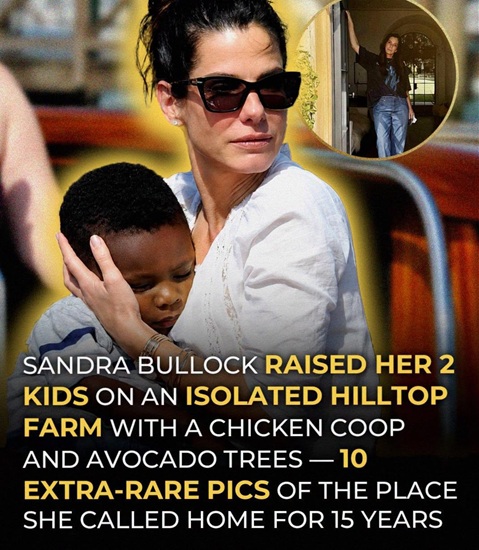
Sandra Bullock has spent decades building one of Hollywood’s most recognizable careers, but her life away from movie sets has also included a significant interest in real estate. Over the years, the Academy Award-winning actress has bought, renovated, rented, and sold properties in several parts of the United States. Her portfolio has included homes in California, Texas, Georgia, Louisiana, New York, and other locations. Some of those properties were private retreats, while others were treated more like investments.
Looking at them together offers a broader picture of how Bullock’s personal priorities changed over time. It also helps explain why several major property decisions attracted attention during the same years she began stepping back from Hollywood. One of the most distinctive homes associated with Bullock was her large farm in Valley Center, California. The property covered roughly 91 acres and was located northeast of San Diego in an area known for open land, agriculture, and privacy.
Bullock placed the estate on the market in September 2022 with an asking price of $6 million. Unlike the typical image of a celebrity mansion in Beverly Hills, this property was surrounded by avocado and citrus trees, mountain scenery, and extensive natural landscaping. Its secluded location made it especially appealing to someone looking for distance from the pace of Los Angeles. The estate was frequently described as a peaceful retreat rather than a traditional Hollywood showpiece. The main residence was a single-story adobe-style ranch measuring close to 6,000 square feet.
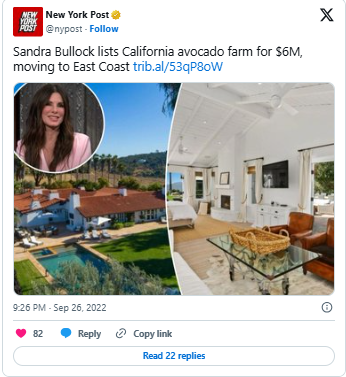
Listing information described four bedroom suites, several bathrooms, and an interior designed to blend rustic elements with modern comfort. Wide-plank wood floors, exposed ceiling beams, French doors, and large windows helped connect the house to the surrounding landscape. The home also included multiple fireplaces and a smart-home system. Its overall design emphasized warmth and privacy rather than overly formal luxury. Bullock had reportedly made substantial improvements during her years of ownership.
The kitchen was another major feature of the house. Reports described an eat-in gourmet layout with high-end appliances and a large dining area designed for everyday use rather than formal entertaining alone. The home also featured spaces that opened toward courtyards, verandas, and gardens. At the center of the property was a landscaped courtyard with a fountain and flowering vines. The layout was intended to make the outdoor environment feel like an extension of the interior. The effect was more similar to a countryside estate than a typical suburban home.
Outside, the property included a saltwater swimming pool and spa surrounded by landscaped areas. Bullock had also added walking paths across the acreage, making it easier to move through the property without leaving the grounds. Ancient olive trees were reportedly brought in as part of the landscaping, while existing groves and mature vegetation remained important parts of the setting. The property was designed around quiet outdoor living and privacy. That atmosphere was one of the reasons listing materials emphasized its sense of calm and isolation.
Agriculture was a major part of the estate’s identity. Reports noted approximately 1,200 organic avocado trees in addition to citrus trees and other plantings. The groves had existed before Bullock bought the property, but they remained a defining feature of the land. There was also a walk-in chicken coop and several areas that could support additional agricultural or recreational uses. This made the estate unusually versatile compared with a standard luxury home. It could function as a residence, a private retreat, or a working agricultural property.
The estate was made up of several parcels rather than one simple residential lot. One area contained the main ranch house, while another included a barn and horse-related facilities. A separate parcel included an additional residence with three bedrooms and two bathrooms, along with various outbuildings. Listing information also described undeveloped areas that could potentially support new construction. The property therefore offered more than just a single home. It had the scale and flexibility of a private compound.
Bullock had owned the Valley Center property for many years before deciding to sell. Public property records cited in real-estate reporting show that she purchased it in 2007 for approximately $2.725 million. During her ownership, she renovated and expanded several parts of the estate. By the time it was listed in 2022, the property had been significantly transformed. Its $6 million asking price reflected both the size of the land and the work completed over the years.
The estate ultimately sold for $5.6 million in November 2022. The final sale price was below the original asking price but still substantially higher than Bullock’s purchase price. However, the difference between those numbers should not automatically be interpreted as pure profit. Renovation costs, taxes, maintenance expenses, property management, and transaction fees can all affect the real financial outcome of a long-term property investment. The confirmed fact is simply that the recorded sale price was much higher than what Bullock had paid in 2007.
The timing of the sale attracted additional interest because Bullock was also changing other parts of her life. Around the same period, she had publicly announced that she was taking a break from acting. In March 2022, while promoting The Lost City, Bullock said she wanted to spend more time at home with her children and family. She did not provide a specific date for returning to films. At the time, her comments were understood mainly as a decision to prioritize family after years of continuous work.
Bullock had reached a point in her career where stepping away was possible. Her filmography already included major commercial successes and critically acclaimed performances. She had starred in films such as Speed, Miss Congeniality, The Proposal, Gravity, and The Blind Side. Her performance in The Blind Side earned her the Academy Award for Best Actress. By 2022, however, she made clear that professional momentum was no longer her only priority. Home life had become more important.
That family focus later took on deeper meaning when the public learned about her longtime partner Bryan Randall’s health. Randall had been diagnosed with amyotrophic lateral sclerosis, commonly known as ALS. He chose to keep the diagnosis private while he was alive. Bullock respected that decision and helped care for him without publicly revealing what was happening. This meant that her decision to step away from acting occurred while she was dealing with responsibilities that audiences did not fully understand.
Randall died in August 2023 at the age of 57. His family revealed after his death that he had lived with ALS for three years. They explained that he had made an early decision to keep his illness private and that the people around him had worked hard to honor that wish. The announcement gave the public new context for the years in which Bullock had withdrawn from much of her professional life. It also revealed how much she had been managing outside the public eye.
Bullock’s sister, Gesine Bullock-Prado, later acknowledged the role her sister played in Randall’s care. In a tribute after his death, she praised Bullock and the nursing team that had helped support him. She also encouraged people who wished to honor Randall to consider donations to the ALS Association and Massachusetts General Hospital. Her message made it clear that Bullock had been deeply involved in caregiving during his illness. It also reinforced how deliberately private the family had kept the situation.
Bullock herself remained relatively quiet about Randall’s illness and death for several years. That changed in August 2026 when she appeared on the SmartLess podcast. During the conversation, she spoke openly about the emotional burden of caring for Randall while keeping his diagnosis confidential. She explained that he had specifically asked her not to share the information publicly. Bullock said she understood the request and did her best to honor it.
The secrecy was emotionally difficult. Randall’s illness unfolded during the COVID-19 pandemic, when many people were already experiencing isolation and uncertainty. Bullock was simultaneously raising her children, helping manage Randall’s care, and keeping his condition private. She described that combination as an exceptionally dark period. The emotional strain was intensified by the fact that she could not freely discuss what was happening with everyone close to her.
Her sister was reportedly one of the few people who knew early on. Bullock later said that she eventually confided in some trusted friends. Still, the circle remained limited because she wanted to respect Randall’s wishes. This left her carrying significant responsibilities while maintaining a public silence. Her later comments helped explain why she had become so focused on family during those years.
Bullock also discussed the complicated nature of grief. She said she felt she had begun grieving Randall years before his death because his illness had changed their lives so profoundly. That emotional timeline should not be confused with the medical timeline. Randall’s family described his ALS battle as lasting three years. Bullock was explaining when she personally began experiencing the loss, not suggesting that his diagnosis had lasted longer than his family reported.
Her children were also affected by Randall’s illness. Bullock has said that her daughter Laila viewed Randall as a father figure. Her son Louis was also old enough to understand that something serious was happening. Bullock tried to protect both children from feeling responsible for adult problems. She later explained that she did not want her son to feel pressure to become the “man of the family” while he was still young.
These circumstances make Bullock’s 2022 career break easier to understand. She was not simply stepping away from acting because she was tired of Hollywood. She was dealing with caregiving, parenting, privacy, and eventually grief. At the time, however, she could not fully explain those reasons without revealing Randall’s diagnosis. That is why much of the context became clear only after his death.
It is still important not to assume that every property transaction Bullock made was directly connected to Randall’s illness. Real-estate decisions can involve many factors, including location, finances, family needs, privacy, and lifestyle preferences. Bullock has not publicly stated that every home she sold was part of one single personal plan. The more accurate observation is that several important changes in her property portfolio happened during the same broader period when her family life was changing.
Reports surrounding the Valley Center sale indicated that Bullock was interested in finding a farm closer to family on the East Coast. This suggested that proximity to loved ones may have influenced the decision to leave the California property. Her sister Gesine has long been associated with Vermont, and Bullock has remained close to her family. The desire to be closer to relatives would fit with the family-centered priorities Bullock had already described publicly.
The Valley Center farm was not Bullock’s only significant California property. Over the years, she has owned homes in Beverly Hills, Malibu, the Hollywood Hills, and units in the well-known Sierra Towers building. These homes represented very different styles of real estate, from urban high-rise living to private coastal retreats. Bullock’s property choices were spread across different types of neighborhoods rather than concentrated in one area.
Her Sierra Towers holdings drew attention in 2022 when she sold units in the building. One condo sold for approximately $4.4 million after Bullock had purchased it years earlier for about $3.55 million. The residence featured two bedrooms, multiple bathrooms, floor-to-ceiling windows, and views over Los Angeles. The building itself has long been associated with celebrities and other high-profile residents. Selling those units was another sign that Bullock was reshaping her real-estate portfolio.
Bullock was also linked to neighboring properties in Malibu. One of the homes had direct ocean views and private beach access. Reports indicated that another nearby property was later made available as a rental. At one point, a Malibu property associated with Bullock was reportedly offered for approximately $30,000 per month. That price reflected both the location and the premium attached to private coastal real estate.
Her Malibu holdings demonstrated that not every home in her portfolio was used only as a personal residence. Some properties were leased or held as investments. This is common among high-net-worth property owners with multiple homes. Bullock’s real estate history therefore includes both lifestyle purchases and properties with potential investment value. The distinction is important when discussing her portfolio.
Texas has also played a long-standing role in Bullock’s property history. She has owned homes in Austin and maintained business interests there. One residence she owned in Austin was eventually listed and sold after years of ownership. The property included several thousand square feet of living space, a pool, a hot tub, and views toward downtown. Bullock’s connection to Austin stretched beyond real estate and reflected her long-term relationship with the city.
New Orleans was another important location. Bullock has been associated with a historic residence there, reflecting her interest in homes with architectural character. The city’s historic neighborhoods differ significantly from the modern style of many Los Angeles luxury properties. Bullock’s choices suggest that she was interested in more than one type of architecture. Her portfolio included both older historic homes and newer luxury residences.
Georgia also became part of Bullock’s real-estate story. She purchased a waterfront property on Tybee Island in the early 2000s. The compound eventually included a main house and a separate guesthouse near the ocean. It was used as a retreat and was later made available as a vacation rental. Bullock eventually sold the property for several million dollars.
The Tybee Island estate had a very different atmosphere from her California holdings. It was designed around coastal living and outdoor access rather than urban convenience. The compound included enough space for family and guests while still maintaining privacy. Its location made it more suited to vacations and extended stays than daily Hollywood life. The property showed once again how varied Bullock’s real-estate interests were.
She has also owned homes in the Hollywood Hills. One property near the Sunset Strip was sold after years of ownership. That residence included vaulted ceilings, landscaped grounds, a swimming pool, and multiple outdoor areas. Like some of her other homes, it had previously been offered for lease. This further illustrates how Bullock sometimes used properties as income-producing assets when she was not living in them herself.
One of her most prominent long-term homes has been a large Tudor-style estate in Beverly Hills. Bullock reportedly purchased the property for more than $16 million in 2011. The estate sits on several acres and includes thousands of square feet of interior living space. Its scale and privacy make it more consistent with the type of celebrity residence many people associate with Hollywood. Yet even this property fits Bullock’s broader pattern of prioritizing privacy.
Privacy appears repeatedly throughout her property choices. The Valley Center farm was secluded behind gates and open land. The Tybee Island compound offered waterfront separation. Her Beverly Hills estate sits on a large private lot. For an internationally recognized actress, properties like these can provide something more valuable than luxury alone: distance from public attention.
That need for privacy became especially important during Randall’s illness. His decision to keep ALS confidential required Bullock to maintain a high level of discretion. The public knew very little about what was happening even as she reduced her professional commitments. Her homes likely provided private spaces where family life could continue without constant outside attention.
By 2026, Bullock had begun returning more visibly to work. Her professional comeback included renewed activity connected with Practical Magic 2. The project reunites her with Nicole Kidman decades after the original film. Her return has been gradual rather than sudden. Bullock has continued to emphasize the importance of balancing work with family.
She has also shared occasional glimpses of her personal life through social media. In August 2026, she posted a collection of photographs from her summer with a caption referencing friends, family, animals, outdoor activities, and work. The post included rare glimpses of her children while still maintaining their privacy. It suggested that Bullock was beginning to re-enter public life while keeping family at the center.
That balance is significant because it reflects how much her priorities have changed since the height of her nonstop acting schedule. Bullock has not abandoned her career. Instead, she appears to be approaching it differently. Work is now one part of a larger life that includes motherhood, family relationships, friendships, and personal recovery after loss. Her recent public appearances suggest a more measured approach to professional commitments.
The real-estate decisions she made over the years mirror that evolution. Some homes suited one stage of her life and were later sold when her needs changed. Others became investments, rentals, or family retreats. The Valley Center farm may be the clearest example because she owned it for around fifteen years before eventually letting it go. It represented a long chapter rather than a short-term purchase.
The farm itself was unusual enough to attract attention even without Bullock’s name attached to it. Its combination of agricultural land, multiple residences, mature groves, walking trails, gardens, and extensive privacy made it a distinctive property. Bullock’s improvements helped turn it into an even more personal retreat. When it sold, it marked the end of a significant period in her real-estate history.
The sale should also be viewed carefully from a financial perspective. Bullock bought the estate for approximately $2.725 million and sold it for $5.6 million. That increase is substantial on paper. But without knowing the full cost of renovations, taxes, maintenance, insurance, and other expenses, it would be inaccurate to state that she personally earned the entire difference as profit. Responsible reporting requires keeping those distinctions clear.
The same caution applies to estimates of Bullock’s overall real-estate wealth. Public records and reputable property reports can identify many transactions, but they do not always reveal the complete picture. Celebrities often use trusts, companies, or other legal structures when purchasing homes. As a result, publicly reported portfolios are best understood as collections of properties linked to an individual over time rather than an exact list of everything currently owned.
What is clear is that Bullock has maintained a diverse real-estate presence for decades. Her properties have included oceanfront homes, high-rise condos, historic residences, suburban estates, rural farmland, and private compounds. Few actors have been publicly linked to such a wide range of property types. That variety makes her real-estate history particularly interesting.
Yet the deeper story is not really about expensive houses. The property transactions overlap with periods of major personal change. Bullock stepped back from acting, focused on her children, cared privately for Randall, and later experienced his death. Her decision to sell certain homes happened during those same years, although not every sale should be interpreted as directly connected to those events.
Her relationship with her sister also remained important throughout this period. Gesine Bullock-Prado continued her career as a pastry chef, television personality, and author. Bullock was seen supporting her sister during the success of the cookbook My Vermont Table. Their relationship offered a glimpse of the family connections Bullock was prioritizing while spending less time in Hollywood.
In many ways, Bullock’s story demonstrates how limited the public view of a celebrity’s life can be. A property sale may appear to be nothing more than a business transaction. A break from acting may look like a career decision. A move may seem like a lifestyle preference. Only later can additional context reveal what someone was dealing with privately at the same time.
Randall’s ALS diagnosis is a powerful example. While the public saw Bullock stepping away from movies, she was helping care for someone facing a serious progressive illness. She could not explain the full situation without going against his wish for privacy. Her silence was therefore intentional and connected to a promise she had made to him.
When she finally spoke about it in 2026, she focused on the emotional experience rather than turning the illness into a dramatic public narrative. She discussed isolation, caregiving, parenting, and grief. She also made clear that much of the hardest part happened before Randall’s death. Her comments helped explain the emotional weight of the years that had previously been hidden from public view.
That context makes her gradual return to work more meaningful. Bullock is not simply resuming a career after a normal break. She is returning after years that included caregiving, loss, and major family responsibilities. Her professional life now appears to be structured around those realities rather than competing with them.
Sandra Bullock’s real-estate history remains impressive in its own right. The Valley Center farm, Malibu homes, Sierra Towers units, Texas properties, Georgia retreat, and Beverly Hills estate each represent different chapters. Some were investments, others private sanctuaries, and several were eventually sold after long periods of ownership.
The Valley Center property stands out because of its scale, design, and timing. Bullock transformed a rural estate into a private retreat filled with groves, gardens, walking paths, and multiple living areas. She then sold it in 2022 during a period when family had become her main priority. The decision was one part of a much larger personal and professional transition.
Today, Bullock appears to be moving into another chapter. She is working again, spending time with her children, remaining close to family, and speaking more openly about experiences she once had to keep private. Her houses may attract headlines because of their value, but the more meaningful story is how her priorities changed around them.
Over decades, Bullock built a life that included both extraordinary professional success and a remarkable collection of properties. Yet the most revealing part of that history is not the price of any one home. It is the way those homes reflected changing needs for privacy, family connection, investment, and personal space. Her real-estate journey is ultimately intertwined with the broader story of how she chose to live when the cameras were not around.
