
Some of the funniest family stories begin with moments that seem serious for only a few seconds. In this lighthearted narrative, a young child unintentionally creates exactly that kind of situation during a large family dinner. Everyone is enjoying food and conversation when an innocent question suddenly makes the adults at the table extremely nervous. What sounds like the beginning of an embarrassing revelation eventually turns out to involve nothing more unusual than folding laundry.
The humor comes from the enormous difference between what the child means and what the adults initially imagine. Because the story is presented as a personal-style anecdote rather than independently verified reporting, it is best enjoyed as family-oriented storytelling rather than treated as documented news. The narrator is around six years old when the memorable dinner takes place. Relatives have gathered around a large wooden table used for special occasions, filling the room with conversation and the familiar sounds of a busy family meal.
Roasted chicken and cornbread are part of the dinner described in the story, while grandparents, parents, aunts, uncles, and cousins talk around the table. For a young child, being surrounded by adults telling stories can create a strong desire to participate. The narrator has begun to understand family dinners as occasions when everyone shares interesting things. Naturally, the child decides that there is something important the entire family needs to hear.
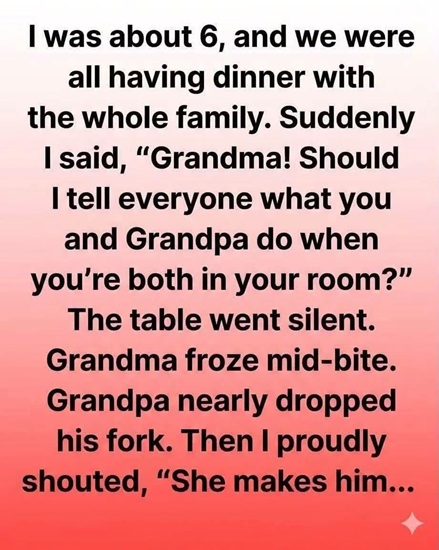
Grandpa happens to be telling one of his fishing stories when the narrator decides to speak. Without recognizing how the words might sound to adults, the child asks Grandma whether everyone should be told what she and Grandpa do when they are alone in their room. The question immediately changes the mood. Conversations stop, attention shifts away from Grandpa’s story, and relatives turn toward the child. Nobody knows what information is about to be revealed. The narrator, meanwhile, remains completely comfortable because there is nothing embarrassing about the observation from a six-year-old’s point of view.
Grandma pauses and carefully asks what the child has actually seen. Grandpa appears considerably less relaxed than he did while telling his fishing story. The narrator’s parents recognize that children can reveal unexpected observations without understanding why adults might consider certain subjects private. Other relatives wait for an explanation, probably wondering how an ordinary dinner has suddenly become so uncomfortable. The suspense lasts only a short time, but it feels much longer because the opening question is so ambiguous. The child remains unaware of the tension and prepares to share the supposedly important secret.
Then comes the answer nobody expects: Grandma makes Grandpa fold the laundry. That is the entire revelation. There is no scandal, inappropriate secret, or serious family issue hidden behind the child’s dramatic introduction. The narrator has simply noticed that Grandpa helps with a normal household chore when the grandparents are together. To a six-year-old, that observation apparently seems interesting enough to announce at dinner. To the adults, however, the original wording suggested something completely different.
For a brief moment, everyone has to process what they have just heard. The tension disappears almost instantly and is replaced by laughter. Relatives who had been preparing themselves for an uncomfortable disclosure now realize that their own assumptions created the awkwardness. Grandma may feel slightly embarrassed by the attention but can also appreciate the innocence behind the announcement. Grandpa has an opportunity to respond with humor instead of defensiveness. His acknowledgment that the child is technically correct gives everyone another reason to laugh.
That sudden transition is the heart of the story. Nothing about folding laundry is inherently funny. The humor depends entirely on the expectation created before the answer is revealed. Adults understand the phrase “what you do when you’re alone in your room” differently from a young child who is simply describing something observed at home. The same words therefore produce two completely different interpretations. When the innocent meaning finally becomes clear, the contrast between expectation and reality creates the punchline.
The child’s intentions are important as well. There is no attempt to embarrass Grandma or Grandpa, expose private information, or create trouble. The narrator simply wants to participate in the family conversation. Children often hear adults exchange stories and naturally want to contribute stories of their own. They may not yet understand which phrases carry additional meanings or why certain information makes adults react strangely. In this case, the child believes the laundry arrangement is an amusing household fact worth sharing with everyone.
Young children are still learning how context affects language. A sentence can have a straightforward literal meaning while suggesting something entirely different to someone with more social experience. Adults frequently interpret words using assumptions developed over many years, while children may use those same words much more literally. That difference can create misunderstandings that are confusing in the moment but funny afterward. The dinner story works because both interpretations are understandable even though only one reflects what the child actually means.
The family’s reaction keeps the anecdote warm rather than uncomfortable. Once everyone understands the truth, the relatives do not shame the narrator for speaking. Instead, they laugh at the misunderstanding. Grandpa joins the humor by acknowledging his laundry responsibilities, and Grandma can relax once she realizes what the child intended to reveal. The narrator is allowed to remain part of the joke rather than becoming the target of it. That distinction helps make the memory something the family can enjoy later.
Grandpa’s response is especially important because it prevents the moment from becoming awkward again. Instead of acting offended that his household chores have been announced publicly, he accepts the observation. A simple humorous response communicates that there is nothing wrong with helping fold laundry and nothing serious has been exposed. The family can therefore laugh about the enormous buildup surrounding such an ordinary fact. The supposed secret becomes funny precisely because it is so harmless.
The anecdote also demonstrates how quickly people can form conclusions before receiving all the information. The child initially provides only a vague description, leaving the adults to fill in the missing details themselves. Their nervous reactions are based not on anything that has actually been revealed but on what they fear might be revealed next. When the answer finally arrives, it shows how far those assumptions were from reality. This structure is common in comedy because suspense encourages the audience to anticipate one outcome before an unexpected alternative appears.
There is a useful distinction between this kind of observation and a serious lesson about family behavior. The narrative does not need to become a discussion about hidden conflicts, broken trust, or accountability because none of those issues actually appears in the central anecdote. It is simply a humorous misunderstanding involving a child and several relatives. Expanding it into a dramatic family dispute would change its meaning. Keeping the focus on the innocent mistake preserves the tone that makes the story enjoyable.
The large family gathering also provides the perfect environment for the misunderstanding. With many relatives present, one unexpected comment immediately receives a much larger audience than it would during an ordinary meal. The silence becomes more noticeable because the room had previously been full of conversation. Likewise, the eventual laughter becomes louder because so many people experience the same moment of relief together. The contrast between those two reactions gives the scene much of its energy.
Holiday meals often become settings for lasting memories for similar reasons. Families may gather around tables they use only on special occasions, prepare familiar recipes, and repeat stories that have been heard many times before. Yet the moments people remember most vividly are often unplanned. A child’s unexpected comment can become more memorable than the carefully prepared meal or the stories adults intended to tell. Years later, relatives may still recall exactly how everyone reacted even if many other details from that evening have faded.
The story’s description of food and surroundings helps establish that sense of familiarity. Roasted chicken, cornbread, a large table, and overlapping conversations create an image of a busy family gathering. These details are not extraordinary, which is precisely why the child’s announcement stands out. The scene begins with ordinary routines before suddenly becoming quiet. Then, after the harmless explanation, it returns to laughter and conversation. The interruption lasts only moments but becomes the part of the gathering everyone remembers.
The narrator’s young age also explains why the dramatic wording is so innocent. A six-year-old is unlikely to anticipate every implication adults may attach to a particular phrase. Children often describe situations using the most direct words available to them. If Grandma and Grandpa fold laundry together in a bedroom, then saying that this is what they do when they are alone may seem completely accurate. The adults supply the additional meaning themselves. Recognizing that difference is essential to keeping the story in its intended humorous context.
It is equally important not to exaggerate what happened after the revelation. Nothing in the supplied anecdote establishes that the event caused a lasting conflict or changed the relationships within the family. Quite the opposite, the story says the incident became something relatives continued laughing about later. Adding arguments, punishments, hidden secrets, or serious consequences would therefore distort the original meaning. The memorable outcome is laughter and a family joke, not confrontation.
The story can also be told without presenting invented details as established facts. There is no need to assign the family a specific city, neighborhood, profession, political viewpoint, or other background that the source does not provide. Those additions would contribute little to the central narrative and could create a false impression that the anecdote is verified reporting about identifiable people. Keeping the setting general allows the focus to remain where it belongs: on a universally understandable family misunderstanding.
This approach also makes the story relevant to readers regardless of where they live. The humor does not depend on a particular local culture or community issue. Families in many different places can recognize the experience of a child saying something unexpectedly direct during a gathering. Household chores, family meals, grandparents, and childhood misunderstandings are broad human experiences. The narrative can therefore remain relatable without pretending to speak on behalf of any particular local population.
There is another small but meaningful element hidden inside the joke: Grandpa folding laundry is completely ordinary. Household responsibilities can be shared in many different ways, and there is nothing unusual about one partner helping another with clothing or other chores. The child’s decision to treat it as a dramatic secret says more about childhood curiosity than about the grandparents’ relationship. Once the adults realize this, the supposed revelation becomes even funnier because the reality is so routine.
The phrase “family secret” therefore functions primarily as comedic misdirection. Readers may initially expect the narrator to reveal something dramatic, just as the relatives do. Instead, the secret turns out to be an everyday activity. Presenting the story accurately means preserving that harmless conclusion rather than attempting to manufacture a more sensational one. The contrast between the dramatic setup and ordinary answer already provides everything the anecdote needs.
Afterward, the event naturally becomes material for future family gatherings. Someone may mention the dinner years later and immediately remind everyone of the moment when the child nearly gave Grandma and Grandpa a collective panic. By then, the narrator is old enough to understand why the original question produced such a strong reaction. That new understanding can make the memory even funnier. A childhood statement that once seemed perfectly normal becomes amusing from an adult perspective.
Family stories often survive through this kind of repetition. Different relatives may remember slightly different details, but the central event remains recognizable. Someone said something unexpected, everyone reacted, and the situation resolved in laughter. These anecdotes become part of a family’s informal history because they capture personalities and relationships more effectively than carefully planned occasions sometimes do. They remind people not only what happened but also how everyone responded to one another.
The narrator’s role changes with time as well. As a child, the speaker is responsible for the misunderstanding without realizing it. As an older narrator, the person can look back and understand both sides of the moment. The innocent interpretation remains clear, but so does the reason the adults became nervous. That combination of childhood perspective and later understanding gives the anecdote its storytelling appeal. Readers are allowed to recognize the joke before the young narrator does.
At its core, this is a story about perspective. The child sees a simple household routine and considers it interesting information. The adults hear an ambiguous question and imagine a far more embarrassing possibility. The exact same situation therefore produces innocence on one side and anxiety on the other. Once everyone shares the same understanding, the tension disappears. Nothing about the underlying event has changed; only the interpretation has.
That is why context matters so much when listening to unexpected statements. A dramatic-sounding introduction does not always lead to a dramatic reality. Sometimes the missing information completely changes the meaning of what was said. The dinner anecdote demonstrates this in the safest and funniest possible way. The family waits only a few seconds before discovering that the feared revelation involves a basket of laundry rather than anything remotely scandalous.
The lasting memory is therefore not about a genuine secret being exposed. It is about the few seconds when everyone believed one might be. Grandma’s pause, Grandpa’s concern, the parents’ reactions, and the relatives’ attention all build toward an answer that instantly removes the tension. The narrator’s innocence makes the contrast complete. Once the truth is known, there is little left to do except laugh.
Ultimately, the family dinner becomes memorable because of something nobody could have planned. A young child wants to participate in the conversation and chooses an observation that seems important. The wording accidentally creates suspense, the adults prepare themselves for embarrassment, and the truth turns out to be wonderfully ordinary. Grandma asks Grandpa to fold laundry. That is the entire secret, and its harmlessness is exactly what makes the story work.
Years later, the anecdote can still bring back the warmth and humor of that gathering without requiring exaggeration or invented drama. It remains a simple story about childhood innocence, adult assumptions, and a family willing to laugh together once the misunderstanding becomes clear. The narrator did not reveal a scandal or expose a troubling secret. Instead, one innocent sentence transformed an ordinary dinner into a memory everyone could share—and all because a six-year-old thought the rest of the family deserved to know who was helping Grandma fold the laundry.

