
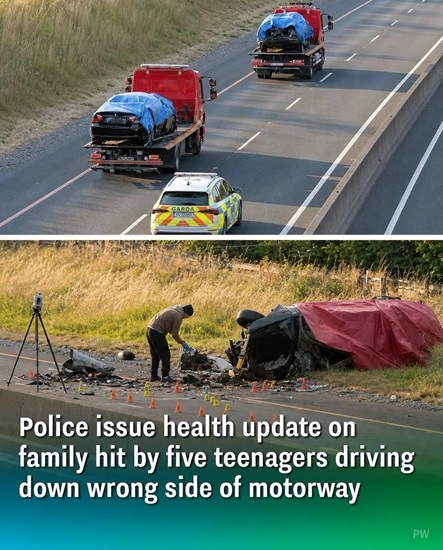
A fatal wrong-way crash on Ireland’s M9 motorway left five teenagers dead and seriously injured four members of another family. The collision happened in the early hours of August 16, 2026, near Moone in County Kildare. Gardaí said a BMW carrying five teenage boys was travelling in the wrong direction before colliding head-on with a Hyundai. The Hyundai was carrying three women and a seven-year-old boy. All five teenagers in the BMW died, while the four occupants of the other car were taken to hospital with serious injuries.
The crash remains one of the most serious road tragedies reported in Ireland in 2026. The injured family was travelling toward Dublin Airport when the collision occurred. Later reporting identified the three women as sisters Alma Kinsella, Niamh Kinsella and Ella Hendricken, while the child was Alma’s seven-year-old son, Yemi. In the days after the crash, Alma and Niamh were reported to be receiving treatment at Tallaght University Hospital.
Ella was being treated at St Vincent’s University Hospital, while Yemi was receiving specialist care at Children’s Health Ireland at Crumlin. Local reporting said the child had suffered serious leg injuries. The family’s long-term medical outlook has not been fully made public. The five teenagers who died were identified in news reports as Joe Carthy, Jack Kennedy, Alex McCarthy, Jeremy O’Brien and Kamil Pustkowski. They were connected to communities including Athy, Carlow and Limerick.
Their deaths left families, friends and classmates facing sudden and permanent loss. Funerals and memorial gatherings took place in the days following the collision. The circumstances surrounding the crash have generated difficult questions, but the grief experienced by the families of the teenagers remains real. Losing a child or sibling in a road collision creates a personal tragedy that extends far beyond the first days of public attention.
At the same time, the suffering of the injured family remains a central part of the story. Four people survived the crash, but all sustained injuries serious enough to require hospital care. Recovery from severe road trauma can involve surgery, repeated medical assessments, rehabilitation and changes to ordinary family routines. The exact treatment required by each survivor has not been fully disclosed, so it would be wrong to speculate about permanent disability or future procedures. What is publicly known is that the family remained under medical care in the days following the collision. Their recovery deserves the same attention as the circumstances that caused the crash.
The seven-year-old boy’s injuries have understandably caused particular concern. Reports said Yemi was being treated for serious leg injuries at a specialist children’s hospital. A major injury at that age can interrupt school, play, family routines and daily independence, but the precise long-term impact in his case has not been confirmed. Public reporting should therefore avoid claims that he will need to relearn specific skills unless his medical team or family provides that information. His privacy is especially important because he is a child. The most responsible approach is to rely on confirmed updates and avoid turning his recovery into speculation.
Emergency crews responded to an extremely difficult scene during the early hours of the morning. Gardaí, firefighters, paramedics and other responders had to deal with multiple fatalities and several seriously injured survivors. Their immediate priorities included protecting the crash scene, assisting the injured and preserving evidence for investigators. The M9 was closed for a period while emergency services and crash investigators worked. Major road incidents require both urgent medical decisions and careful evidence collection. Those two responsibilities often continue at the same time under difficult conditions.
The wrong-way movement of the BMW became the central issue in the investigation. Authorities confirmed that the vehicle was travelling against the normal flow of motorway traffic before the collision. Reports also said Gardaí had received information about a wrong-way vehicle shortly before the crash. Questions were raised afterward about what contact police had with the BMW before it entered the motorway. A Garda representative body said officers were advised not to pursue the vehicle once it was travelling against traffic because of the danger to other motorists. The precise sequence of events remains subject to formal investigation.
The crash was also referred to Fiosrú, Ireland’s policing ombudsman. Such a referral allows an independent body to examine the circumstances surrounding Garda involvement. It does not automatically mean that any officer acted improperly. Independent review is intended to establish what happened and whether procedures were followed appropriately. Public discussion should therefore avoid treating the referral itself as proof of wrongdoing. The purpose of the process is to reach conclusions through evidence.
Wrong-way motorway driving is especially dangerous because motorists travelling correctly may have only seconds to react. Motorways are designed around separated traffic moving in the same direction. When one vehicle enters in the opposite direction, the closing speed between vehicles can become extremely high. A driver travelling normally may suddenly see headlights directly ahead in a lane where no vehicle should be approaching. Even rapid braking or evasive action may not be enough to prevent impact. That is one reason wrong-way crashes often result in severe injuries or fatalities.
The M9 collision has also led to discussion about dangerous driving footage shared online. Garda Commissioner Justin Kelly spoke publicly about reckless driving and the role social media can sometimes play when dangerous behavior is filmed for attention. Reports after the crash described videos showing vehicles being driven against traffic on Irish roads. However, the existence of dangerous-driving videos online does not by itself prove the motivation behind this particular collision. Investigators still have to determine which footage is relevant and when it was recorded. Online assumptions should not replace verified evidence.
This distinction matters because social media can rapidly turn speculation into apparent fact. Videos can be reposted with incorrect dates, names or descriptions. A clip that appears to show the final journey may have been recorded earlier or involve different people. Some reporting has linked earlier dangerous-driving footage to people connected with the crash, but those claims need careful attribution. Public users should not assume that every circulating video documents the final moments before the collision. Investigators are better positioned to establish authenticity and timing.
The same caution applies to claims about criminal activity before the crash. News reports have discussed Garda suspicions concerning events involving the teenagers earlier that night. Suspicion, however, is not the same as a criminal conviction. The teenagers who died are no longer able to respond to allegations made about them. Responsible reporting should clearly distinguish between confirmed facts, police suspicions and unverified online claims. Sensational language can easily distort a tragedy that is already serious enough without added speculation.
The family in the Hyundai should also be described carefully. Available reporting indicates that they were travelling normally when the wrong-way vehicle entered their path. There has been no credible report suggesting that they caused the collision. Their journey was interrupted by circumstances they did not create. That distinction is important because road crashes often generate confusion when information spreads rapidly online. Confirmed facts should remain separate from rumor.
The collision created two different forms of loss. Five families lost teenagers, while another family was left with four seriously injured members. Recognizing the grief of the teenagers’ relatives does not minimize the suffering of the injured family. Likewise, acknowledging the innocent family’s injuries does not require hostility toward grieving parents or siblings. Compassion can exist alongside accountability. The circumstances of the crash should be investigated without turning relatives into targets.
Community members later gathered to support the injured family. A vigil was held in Graiguecullen, where candles were lit and people came together to express concern for Alma, Niamh, Ella and Yemi. Religious and community leaders spoke about the seriousness of the crash and the impact it had on several families. Such events provide practical and emotional support without establishing what every local resident thinks or feels. It is more accurate to describe the people who attended than to claim that an entire community shared one reaction.
A fundraiser was also established to help the injured family. Reports said it attracted significant financial support in the days after the collision. Large medical events can create practical burdens involving transport, accommodation, time away from work and other expenses. Public fundraising can sometimes help families manage those pressures. The exact use of funds is for the organizers and family to determine. Financial support does not remove the uncertainty surrounding medical recovery.
The three adult women may face different recovery paths depending on their injuries. Serious road trauma can affect mobility, work, caregiving responsibilities and everyday independence. Some patients recover quickly from certain injuries, while others require long periods of rehabilitation. It would be inaccurate to predict which outcome applies to these women without medical confirmation. Their progress should be described only through information they or their representatives choose to share. Private recovery does not need to become continuous public content.
The child’s return to ordinary routines may also take time. School, friendships and familiar activities can become important once doctors determine that he is ready. Children recovering from serious injuries can benefit from stability, but every case is different. Some return to normal activities relatively quickly, while others require additional support. The exact timeline belongs to his family and medical team. Public interest should not override his right to privacy.
The families of the five teenagers also faced funerals and memorial services in the days after the crash. These gatherings became moments for relatives and friends to mourn young lives that ended suddenly. Funeral coverage should be handled with restraint because grief does not disappear simply because the circumstances of death were controversial. Parents and siblings are not automatically responsible for the actions of a person who died. Respecting their loss does not prevent public discussion of dangerous driving. Both realities can be recognized at the same time.
Public anger after a crash of this nature can be intense. Many people understandably focus on the fact that the injured family was travelling in the correct direction when another vehicle approached them head-on. But anger should not turn into harassment of relatives or unverified accusations. Accountability depends on evidence and investigation, not collective blame. The strongest public response is one that focuses on preventing similar behavior while respecting those who are grieving. Emotional reactions should not become an excuse for misinformation.
The crash has also intensified discussion about how young people interact with risky driving content online. Dangerous behavior can attract attention, comments and shares, which may sometimes create social incentives for reckless conduct. Authorities and lawmakers have raised concerns about such material. Social-media platforms have policies against some forms of dangerous content, though enforcement remains an ongoing issue. Any broader policy discussion should remain evidence-based rather than assuming that one platform or one type of content caused this specific collision.
Young drivers as a group should not be treated as reckless simply because the people who died were teenagers. Most young motorists do not deliberately drive against motorway traffic. General road-safety research does show that inexperience can affect crash risk, but this case involved extreme behavior far beyond ordinary driving errors. Effective safety discussion should focus on specific actions rather than broad stereotypes. That approach is both more accurate and more useful. It also avoids unfairly labeling an entire age group.
Police pursuit procedures have become another subject of discussion. A wrong-way vehicle creates an unusual challenge because a pursuit may introduce another high-speed vehicle into an already dangerous situation. Authorities must consider the risks to uninvolved motorists. Reports said Garda officers were advised not to pursue the BMW once it was travelling in the wrong direction. The wisdom and implementation of those procedures may be examined further. Any conclusion should come from the formal review rather than social-media speculation.
Irish officials have also discussed improved pursuit training and other road-safety measures following the crash. Those discussions are part of a broader public-policy response to dangerous driving. Reporting them does not require endorsing or opposing any particular proposal. A neutral account can simply explain which measures officials are considering. Readers can evaluate those ideas themselves. Avoiding political advocacy is especially important when reporting on a local or national issue from outside the affected community.
Road design can also play a role in preventing wrong-way entry. Motorways use signs, lane markings and ramp layouts intended to make direction clear. Some jurisdictions have introduced detection systems that alert authorities when a vehicle enters incorrectly. Such technology can be useful, but it cannot eliminate every risk. Deliberate dangerous driving may bypass safeguards intended to prevent ordinary mistakes. Infrastructure and driver behavior both matter.
Speed is another major factor in the severity of wrong-way collisions. When two vehicles travel toward each other at motorway speeds, the relative closing speed is very high. This reduces reaction time and increases the physical forces involved in a crash. Modern cars contain airbags, seat belts and structural protections, but those systems cannot prevent every severe injury. Head-on motorway collisions remain among the most dangerous types of road incidents. The M9 crash tragically demonstrated that reality.
Investigators have appealed for witnesses and dashcam footage connected to the crash. Video evidence can help establish where the BMW entered the motorway and what happened in the minutes before impact. Dashcam recordings can be especially useful because eyewitness memories may be incomplete after a sudden event. People who possess relevant footage should provide it directly to Gardaí. Posting it publicly can complicate the investigation or expose families to unnecessary distress. Evidence is most useful when handled through official channels.
CCTV, digital communications and vehicle data may also help investigators reconstruct events. Modern investigations can involve information from phones, traffic cameras and electronic systems. Not every source will necessarily be relevant, and legal procedures govern access to private data. The public cannot know what evidence investigators already possess. Claims that a particular clip or message proves the entire case should therefore be treated cautiously. Formal analysis takes time.
Postmortem examinations were conducted following the deaths of the five teenagers. Such examinations are standard after sudden or unexplained deaths and can provide information relevant to the investigation. Their existence does not imply a particular theory about what caused the crash. Toxicology findings, if requested, may take time. Until authorities release results, statements about alcohol, drugs or impairment would be speculative. Responsible reporting should avoid filling that gap with assumptions.
The investigation may continue for some time because serious crashes often require detailed reconstruction. Vehicle condition, road evidence, witness accounts, digital records and medical findings can all contribute to a final understanding. Independent review of police contact may proceed separately from the crash investigation itself. Different agencies may therefore reach conclusions on different timelines. Early reporting should not be treated as the final record. Updates matter when new verified information becomes available.
Another wrong-way driving incident was reported in Ireland shortly after the M9 crash, increasing public concern. The timing naturally drew attention, but separate incidents should not automatically be treated as evidence of one coordinated trend. Similar behavior can occur independently. Authorities need evidence before making such connections. Responsible reporting should distinguish between a pattern supported by data and several highly visible incidents occurring close together. That difference matters.
For ordinary motorists, encountering a wrong-way driver is one of the most frightening situations possible. Drivers should prioritize avoiding a collision if they can do so safely, reduce speed when possible and contact emergency services once it is safe. Attempting to follow, confront or block the wrong-way driver can increase danger. Professional responders are better equipped to manage the situation. Road users should focus on their own safety and that of passengers.
The M9 crash also demonstrates why road safety depends on shared responsibility. Motorways work because drivers follow predictable rules about direction, speed and lane use. One extreme violation can place many strangers at risk within seconds. The injured family did not choose to participate in that danger. Their experience illustrates how reckless driving can affect people completely unrelated to the original decision. Road safety is therefore not only about protecting the driver making a choice.
The long-term cost of a major crash often extends beyond medical treatment. Families may need to rearrange work, childcare, transport and household routines. Relatives can spend long periods travelling to hospitals or providing support. Children may miss school, and adults may need time away from employment. These practical effects can continue even after the most serious medical crisis has passed. They are part of the aftermath even when they receive little public attention.
Hospitals treating the four survivors have their own responsibility to protect patient confidentiality. That means detailed updates may remain limited unless the family chooses to release them. A lack of public information should not be interpreted as secrecy. Medical privacy exists for good reason. Public concern can be expressed without demanding constant access to private health information. This is especially important when one patient is a child.
Emergency responders may also need support after attending scenes involving multiple deaths and injured children. First responders are trained for traumatic incidents, but training does not make them emotionally unaffected. Services often have internal systems to help personnel after especially difficult events. It would be speculative to claim that specific responders developed psychological problems in this case. The most accurate statement is that the scene required demanding professional work under extremely serious conditions.
Schools connected with the teenagers may also have had to support classmates and friends. The sudden death of several young people can affect entire peer groups. Counseling and bereavement resources are often made available after such incidents. Young people may also encounter graphic images or rumors online, which can make grief more difficult. Responsible adults can help by discouraging repeated exposure to disturbing material. Support should focus on grief rather than sensationalism.
The same principle applies to people sharing crash-related content online. Images from serious collisions can spread quickly and remain searchable for years. Before reposting them, users should consider whether doing so serves any legitimate purpose. Families may encounter those images repeatedly during an already painful period. Graphic content can also reach children or people who knew those involved. Respectful reporting does not require displaying every available image.
The collision has prompted understandable demands for prevention. Prevention can involve enforcement, education, road design, technology and platform policies. None of those measures alone can guarantee that another wrong-way incident will never happen. Complex safety problems usually require several approaches working together. Claims that one reform would definitely have prevented this specific crash should therefore be treated cautiously. Evidence should guide future decisions.
Education can still play an important role. Young motorists need clear information about the consequences of extreme driving behavior. Road-safety messages are most effective when they explain real risks without exaggeration. Framing reckless driving as entertainment or a challenge can make dangerous conduct seem socially rewarding. Parents, schools and peers can all help challenge that idea. Safe driving should be treated as normal rather than boring.
Social-media platforms also have responsibilities when dangerous content is uploaded. Material that appears to encourage high-risk behavior can spread quickly through recommendation systems. Platforms can enforce policies, remove violating content and reduce incentives for dangerous stunts. At the same time, moderation decisions can be complicated because not every video showing dangerous behavior is intended to encourage it. Context matters. Transparency about enforcement can help public understanding.
The broader debate should not overshadow the people directly affected. Alma, Niamh, Ella and Yemi remain individuals rather than symbols in a road-safety discussion. The five teenagers who died were also individuals with families and personal histories. Public policy may eventually change because of the crash, but the people involved should not be reduced to examples. Respectful coverage keeps their humanity visible. It avoids turning tragedy into abstract argument.
For the injured family, the most important developments will likely happen privately. Medical progress may come through small improvements that never appear in headlines. Rehabilitation can be slow and uneven. Family members may need to adjust expectations repeatedly as doctors learn more. Public support can help, but recovery remains personal. Their future should not be predicted by strangers.
For the families of the teenagers, grief will also continue privately after public ceremonies end. Funeral coverage lasts only a short time, while bereavement can continue for years. Parents may have complicated feelings about the circumstances of the deaths. Outsiders should not assume whether they feel anger, guilt, denial or anything else. Those emotions belong to the families themselves. Respectful reporting avoids inventing them.
The most useful way to discuss this crash is therefore to remain close to verified facts. A BMW carrying five teenagers travelled in the wrong direction on the M9 and collided head-on with a Hyundai carrying three women and a seven-year-old boy. The five teenagers died. The four people in the Hyundai suffered serious injuries. Gardaí and independent authorities continue examining the circumstances. Those facts are already serious without embellishment.
It is also important to remember that the situation remains developing. Medical conditions can change, and investigative findings may clarify what happened before the collision. Early information can be incomplete. Future reporting should update earlier accounts when reliable authorities release new details. Accuracy sometimes requires correcting or refining what was first reported. That is part of responsible journalism.
The injured family’s recovery should remain a priority in any continuing coverage. Public attention initially focused on the dramatic circumstances of the crash, but survivors often face the longest consequences. Hospital stays, rehabilitation and disrupted routines continue after the road reopens. Their experience is not finished because the investigation moves into another phase. Supporting their privacy is one way to recognize that reality.
The deaths of the five teenagers are equally permanent. Their communities have been left with funerals, memories and unanswered questions. The circumstances surrounding their actions may remain part of public discussion, but those discussions should not erase the reality of loss. Five young lives ended on one night. Their families now have to live with that fact. No investigation can reverse it.
For road users more broadly, the collision is a reminder that extreme driving decisions can affect complete strangers. A motorway depends on every driver travelling in the correct direction and following predictable rules. When that basic structure breaks down, the consequences can become catastrophic within seconds. Drivers cannot control every danger around them. They rely partly on others to behave responsibly. That shared dependence is central to road safety.
The most constructive response is therefore prevention rather than sensationalism. Dangerous driving should not be celebrated online. Road-safety systems should continue improving where evidence supports change. Police procedures can be reviewed carefully. Platforms can examine how risky content spreads. Families and schools can discuss driving responsibility in practical terms.
None of these conversations requires pretending to speak on behalf of Irish residents or telling local people what political position to take. A factual account can explain what happened, what officials are reviewing and what safety concerns have been raised. Readers can form their own conclusions. This distinction is important when reporting on a local tragedy for an international audience. Neutrality protects both accuracy and trust.
Ultimately, the M9 collision left two painful realities behind. Five teenagers died, and another family of four was seriously injured. The investigation may eventually provide a more complete explanation of how the BMW came to be travelling against motorway traffic. Medical teams will continue focusing on the survivors. Families on both sides will continue dealing with consequences that cannot be reduced to a headline.
The most respectful way to remember the crash is to avoid misinformation, unsupported blame and exaggerated claims. Confirmed facts should remain clearly separated from allegation or speculation. The injured child deserves privacy, the surviving adults deserve space to recover, and grieving relatives deserve basic dignity. Investigators deserve the opportunity to complete their work before conclusions are declared online. Accuracy and compassion can exist together.
As public attention moves on, the people affected will continue living with what happened on August 16, 2026. The road reopened, but the consequences did not disappear. Five families lost young people, while another family continues recovering from serious injuries. That continuing aftermath is the part of the story most easily forgotten once headlines fade. It is also the reason careful, factual reporting matters long after the initial shock has passed.

