
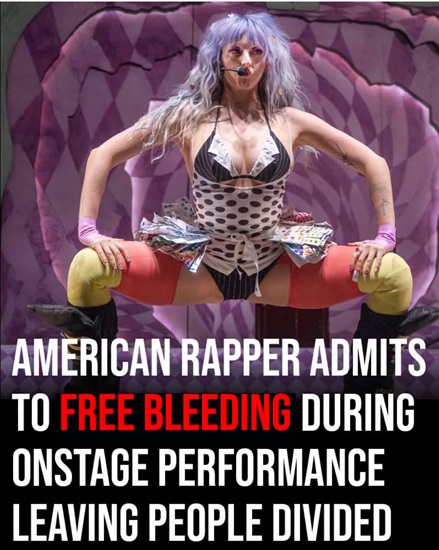
Ashnikko became the focus of an unexpected online debate after making a candid comment about menstruation during her performance at Sziget Festival in Budapest. The artist, whose real name is Ashton Nicole Casey, told the audience that she felt her period was about to begin and joked that she might end up “free bleeding” while still onstage. The comment was brief and playful in the context of the live show, but clips of the moment later circulated widely online and drew very different reactions from viewers.
The 2026 edition of Sziget Festival took place in Budapest from August 11 through August 15, bringing together a large international lineup of artists and thousands of festivalgoers. Ashnikko’s appearance was one performance among many, but her spontaneous comment about menstruation quickly became one of the most discussed moments connected with her set. During the performance, Ashnikko told the audience that she felt as though her period was about to start.
She then said that if she began free bleeding while onstage, she wanted the crowd to respond with “respect and love.” She also encouraged fans to send hearts toward her. She followed the remark by turning it into a playful chant about “free bleeding in Budapest.” The tone appeared humorous rather than medical or instructional. She was not giving health advice or telling fans that they should manage their periods in the same way.
The live audience appeared to receive the moment positively, according to reporting about the performance. Online, however, the reaction was much more mixed. Some viewers found the comment refreshing because it treated menstruation as a normal subject that did not need to be hidden.
Others reacted with discomfort or disbelief. Some questioned how anyone could feel comfortable free bleeding, while others simply did not think the topic belonged in a public concert setting.
A third group defended Ashnikko by pointing out that she seemed to be warning fans not to be surprised if visible blood appeared during the performance. From that perspective, the comment was less about making a statement and more about acknowledging what might happen naturally.
The discussion quickly moved beyond Ashnikko herself and into a broader debate about menstruation, hygiene, public comfort and the meaning of free bleeding.
Free bleeding generally refers to menstruating without using conventional products such as tampons, sanitary pads or menstrual cups to collect the flow.
Some people who free bleed simply allow menstrual blood to reach ordinary underwear or clothing. Others use absorbent period underwear while avoiding more traditional products.
This means the term does not always describe exactly the same practice.
One person may free bleed only during lighter days.
Another may use period underwear.
Another may choose not to use any menstrual product at all.
The reasons for doing so can also differ.
Some people find pads irritating.
Some dislike using tampons.
Others find menstrual cups uncomfortable.
For some, free bleeding is simply the method that feels most comfortable.
Cost can also influence menstrual choices.
Pads, tampons and other disposable products represent recurring expenses.
For people who struggle to afford menstrual products, going without them may sometimes be a matter of necessity rather than a deliberate lifestyle choice.
That is an important distinction because free bleeding is sometimes discussed online as though everyone who does it is making the same personal or political statement.
The reality is more varied.
Some people intentionally free bleed as a way of challenging menstrual stigma.
They reject the idea that periods should always remain completely hidden or treated as embarrassing.
Others make the choice for practical reasons and have no interest in turning it into a public statement.
Ashnikko’s comment touched directly on that stigma because she was willing to discuss the possibility of visible menstrual blood during a highly public performance.
For supporters, that openness was part of the appeal.
They saw nothing wrong with acknowledging a normal bodily function in front of a crowd.
For critics, the issue was not necessarily whether menstruation itself was normal.
Some were more concerned about the presence of blood in a shared public environment.
Those are two different questions and are often mixed together during online debates.
It is possible to believe periods should not be treated as shameful while still preferring that blood be contained in crowded public spaces.
It is also possible to believe someone should be free to manage their own period without assuming everyone else should do the same.
Online arguments frequently flatten those distinctions.
Another point that needs careful clarification involves health claims.
Some social-media users claimed that free bleeding is healthier than using pads.
That is not an established universal medical conclusion.
Different menstrual-management methods have different advantages and disadvantages.
Properly used pads are generally considered a normal and widely accepted way of managing a period.
Tampons can also be used safely when changed according to health guidance and manufacturer instructions.
Menstrual cups are another option.
Period underwear can be useful for some people.
Free bleeding can also be a personal choice.
No single method is automatically best for everyone.
Health needs, comfort, access, flow level and personal preference all matter.
Free bleeding may reduce irritation for someone who finds pads uncomfortable.
Avoiding tampons also removes the specific risk of toxic shock syndrome associated with leaving tampons inserted for too long.
But those points do not prove that free bleeding is inherently healthier for every person.
Another online comment described menstrual blood as exceptionally “clean.”
That wording is also misleading if treated as medical fact.
Menstrual blood is not dirty in the sense of being something shameful or impure.
However, it is still blood.
Like other human blood, it can potentially carry blood-borne pathogens.
That does not make menstruation dangerous or abnormal.
It simply means ordinary hygiene still matters.
A balanced explanation can recognize both points at once.
Periods are normal.
Menstrual blood should not be stigmatized.
At the same time, bodily fluids should be handled sensibly.
These ideas do not contradict one another.
Good hygiene is relevant regardless of which menstrual method someone chooses.
Someone who free bleeds may need to change clothing or period underwear regularly.
Pads need to be changed.
Tampons need to be changed.
Menstrual cups need to be cleaned.
Every approach involves practical care.
The idea that free bleeding means ignoring hygiene entirely is therefore inaccurate.
Likewise, the idea that using menstrual products automatically makes someone cleaner or healthier is too simplistic.
Individual choices depend on individual circumstances.
Ashnikko’s festival comment did not go into any of these medical details.
She made a personal, humorous remark during a performance.
The health debate came later when viewers began reacting to clips online.
That distinction is important because some claims circulating after the performance came from commenters, not from Ashnikko herself.
She did not tell fans that free bleeding was medically superior.
She did not tell people to stop using pads or tampons.
She did not present herself as giving health guidance.
She said she felt her period might begin and that she could potentially free bleed while performing.
That is a much narrower statement.
Another important distinction is that the available reporting does not establish that she actually experienced visible menstrual bleeding during the performance.
She described what might happen.
It would therefore be inaccurate to write that she definitely free bled onstage unless there were additional verified evidence.
The viral debate was triggered by the possibility she mentioned.
That alone was enough to attract strong reactions.
The moment also fit with Ashnikko’s broader performance style.
She is known for theatrical visuals, direct lyrics and an unconventional public image.
A candid comment about menstruation therefore did not come entirely out of nowhere within her artistic presentation.
Still, the topic surprised many people.
Concert audiences are accustomed to artists discussing relationships, emotions, politics, sexuality and personal experiences.
Menstruation remains a subject that some people still regard as more private.
That cultural difference helped turn a few seconds of stage banter into a much larger discussion.
The internet also changes how these moments are interpreted.
A person standing in the audience experiences the full atmosphere of the concert.
They hear the tone.
They see the performer’s body language.
They hear the crowd react.
Someone watching a short clip on social media may see only a few seconds removed from that wider context.
That difference can shape reactions dramatically.
A joke that feels harmless in a room can look much more provocative when isolated as a viral video.
This pattern appears repeatedly in celebrity coverage.
A full performance can last an hour.
One sentence becomes the headline.
That does not make the sentence unimportant, but it means context matters.
Ashnikko’s Budapest comment was clearly memorable.
It was also brief.
The broader online debate became much larger than the original moment itself.
Menstruation has historically been surrounded by euphemisms and stigma in many cultures.
People often avoided saying “period” directly.
Advertising for menstrual products frequently used indirect imagery rather than realistic representations of menstrual blood.
Those norms have gradually changed.
Public discussion of periods is now much more common.
Athletes speak about how menstrual cycles affect training.
Celebrities discuss period pain.
Health campaigns address period poverty.
Schools and workplaces increasingly recognize that menstrual symptoms can affect daily life.
Despite that shift, visible menstrual blood still makes many people uncomfortable.
Ashnikko’s comment exposed that discomfort very directly.
Some people believed the openness was healthy and normalizing.
Others felt it crossed a personal boundary.
Neither reaction should automatically be presented as representing everyone.
The response was clearly divided.
That is the most accurate way to describe what happened.
The issue also touches on the difference between personal autonomy and shared environments.
A person has significant freedom in choosing how to manage their own period.
But festivals, workplaces, public transportation and other shared spaces also create practical expectations about hygiene.
Those considerations can coexist.
Respecting someone’s bodily autonomy does not require pretending shared-space hygiene is irrelevant.
Likewise, acknowledging shared-space concerns does not require treating menstruation as shameful.
A thoughtful discussion can hold both ideas at once.
The social-media debate often did not.
Some comments were openly dismissive.
Others became overly defensive.
Still others made exaggerated health claims.
That is common when a viral clip turns into a culture-war style argument.
The strongest statements often travel fastest.
Nuance rarely does.
A calmer look at the facts produces a simpler picture.
Ashnikko was performing at a major music festival.
She felt her period might start.
She told the crowd.
She joked about free bleeding.
Some people enjoyed the openness.
Some did not.
That is the core of the story.
The health side of the discussion is also more straightforward than many comments suggest.
Free bleeding is a real menstrual-management practice.
Some people find it comfortable.
Some people choose it for personal, financial or ideological reasons.
It can generally be managed safely with attention to hygiene.
It is not medically proven to be the best method for everyone.
It also does not mean menstrual blood is uniquely harmless.
Those distinctions prevent unnecessary misinformation.
Another issue sometimes connected with free bleeding is environmental waste.
Disposable menstrual products create waste.
Someone who avoids disposable pads and tampons may reduce that waste.
However, free bleeding is not the only way to do that.
Reusable pads, menstrual cups and period underwear are also options.
Environmental concerns therefore do not lead automatically to one particular method.
The same applies to cost.
Avoiding disposable products may reduce recurring expenses.
Reusable products may also save money over time, although they can involve an initial purchase.
For people facing period poverty, access itself may be the real problem.
That wider issue is very different from a celebrity joking about free bleeding during a festival performance.
It is useful not to merge every menstrual discussion into one argument.
Ashnikko’s moment was first and foremost entertainment news.
It became a health discussion only because social-media commenters began making claims about what free bleeding means.
Responsible coverage should correct those claims without turning the story into a medical diagnosis or personal judgment.
There is no verified indication that Ashnikko was experiencing an abnormal period.
There is no reason to speculate about her health.
She described the expected beginning of menstruation.
That is all.
The same caution applies to interpreting her motives.
It would be speculative to claim she was deliberately launching a campaign against menstrual stigma.
She may personally support openness about menstruation, but the documented moment itself was spontaneous and humorous.
The safest description is that she spoke openly about the possibility of her period beginning during the show and turned the comment into part of her stage banter.
The crowd appeared to enjoy it.
The internet was less unanimous.
That contrast became the story.
Some fans praised her confidence.
Others said they did not understand how someone could feel comfortable free bleeding.
Others argued that viewers were reacting too strongly to something biologically normal.
The disagreement reveals how differently people interpret bodily functions when they become visible in public.
There is no reason to insult either side to report that disagreement.
The article does not need to tell readers how they should feel.
It can simply explain what happened and provide accurate context.
That approach is also more useful for readers.
Someone unfamiliar with the term free bleeding can learn what it means.
Someone who saw exaggerated claims online can understand which parts are opinion and which are supported by health information.
Someone interested only in the performance can understand why the clip became viral.
The event does not need additional sensationalism.
The original comment was already unusual enough to attract attention.
Adding false claims would only make the reporting less reliable.
One example would be saying that Ashnikko “shocked the entire festival.”
That would be unsupported because the live audience reportedly responded positively.
Another would be saying she “bled all over the stage.”
There is no verified evidence in the reporting that this actually happened.
Another would be claiming that doctors say free bleeding is healthier than pads.
That would also be misleading.
Accuracy requires resisting those kinds of exaggerations.
The factual version is more balanced.
Ashnikko performed at Sziget Festival in Budapest in August 2026.
She told the audience she felt her period was about to begin.
She said that if she free bled while onstage, she wanted their support.
She playfully repeated a line about “free bleeding in Budapest.”
Clips circulated online afterward.
People reacted in very different ways.
That is enough to explain why the story spread.
It also shows how quickly social media can amplify conversations that would once have remained limited to people inside a venue.
Before smartphones, the comment might have become a funny memory shared by concertgoers.
Now a short clip can reach people around the world within hours.
Every viewer brings different cultural expectations to the same video.
That helps explain why reactions become so varied.
Some cultures discuss menstruation more openly.
Others remain more conservative about bodily functions.
Individual family backgrounds also influence what people consider appropriate in public.
A single viral clip therefore encounters audiences with very different assumptions.
That does not make one interpretation automatically correct.
It simply means context matters.
Ashnikko’s remark also demonstrates how performers sometimes use personal vulnerability to connect with audiences.
Talking about a period can make a celebrity seem less distant because it acknowledges something ordinary that millions of people experience.
For supportive fans, that may have been the most appealing part of the moment.
She was not pretending that performing on a major stage separated her from basic bodily realities.
Others may have preferred not to hear about it.
Both reactions are possible.
What matters is keeping the conversation respectful.
Menstruation should not be used as a reason to degrade or shame someone.
At the same time, discomfort with the idea of visible blood does not automatically make someone hostile toward menstruation.
People can have different boundaries.
Online debate becomes less useful when every disagreement is interpreted as evidence of bad character.
This story does not require that kind of framing.
It is better understood as a clash of expectations.
Ashnikko treated her period casually.
Some viewers appreciated that.
Some found it too personal.
The resulting debate revealed that public attitudes toward menstruation continue to vary considerably.
The health discussion around free bleeding shows similar variation.
There are potential advantages for some users.
There can also be practical disadvantages.
Someone with a heavy flow may find free bleeding difficult to manage.
Someone with a lighter flow may find it easier.
Someone working from home may have different practical concerns from someone working in a shared office.
Context matters.
There is no single experience of menstruation.
That is also why general claims should be avoided.
Saying “we were meant to free bleed” is an opinion, not a medical rule.
Humans menstruated long before modern period products existed, but that does not mean modern products are unnatural or harmful by definition.
They were developed to make menstrual management more practical.
People can use them or choose alternatives.
The availability of options is generally useful.
Similarly, someone who chooses free bleeding is not automatically making an anti-product statement.
It may simply be what feels comfortable.
That flexibility is often lost in viral debates because people search for a clear side to support.
The reality is less dramatic.
Menstrual management is highly personal.
Different methods work for different people.
Ashnikko’s comment did not change that.
It simply brought one less commonly discussed option into the spotlight.
There is also no need to frame free bleeding as a new trend invented by social media.
People have menstruated without commercial products throughout human history.
The modern term describes a practice that has received renewed attention in contemporary discussions about menstruation, cost, comfort and stigma.
That historical context helps prevent another form of misinformation.
The practice is not new.
The public terminology and online conversation around it are newer.
Ashnikko’s viral clip became part of that modern conversation.
Whether she intended it or not, the moment prompted many people to ask what free bleeding actually means.
That curiosity can be useful if it leads to accurate information.
It becomes less useful when it produces shaming or unsupported medical claims.
One of the most reasonable takeaways is that menstruation itself does not need to be treated as embarrassing.
Another is that hygiene still matters.
A third is that personal menstrual choices should not automatically be turned into universal rules.
These conclusions are compatible with one another.
The debate does not need an extreme answer.
It also does not need to become political.
Ashnikko’s comment concerned her own body during a concert.
It was not a local civic issue or an attempt to influence public policy.
Treating it as straightforward entertainment and health-context reporting avoids inventing a broader agenda that the documented event does not support.
That makes the story easier to report responsibly.
There is no need to tell readers what they should believe about free bleeding.
There is no need to encourage or discourage the practice universally.
The article can present the verified event and explain the term accurately.
Readers can form their own opinions.
The same approach works with the social-media comments.
A handful of quoted reactions illustrate disagreement.
They do not represent the entire public.
Millions of people may never have seen the video.
Others may have watched without commenting.
The loudest responses should therefore not be described as universal opinion.
Calling the reaction “divided” is more accurate.
That distinction matters whenever online comments are used in entertainment reporting.
Social media is not a scientific survey.
A viral comment with many likes does not prove that most people hold that view.
It shows only that the comment resonated with some users on that platform.
Ashnikko’s story is a good example.
Strong positive and negative reactions both appeared.
Neither can claim to represent everyone.
What can be established is that the clip generated enough discussion to attract entertainment coverage.
That is the factual basis for describing it as a viral debate.
The performer herself appeared comfortable with the topic.
She made the announcement without visible embarrassment and incorporated it into the show.
That confidence became part of why supporters responded positively.
They saw a musician treating menstruation as ordinary rather than something to hide.
Critics interpreted the same behavior differently.
They saw a personal bodily detail being shared in a setting where they believed it was unnecessary.
The same few seconds therefore supported opposite interpretations.
That is often how viral moments work.
The event itself is simple.
The meaning people assign to it becomes complicated.
In this case, the factual center should remain clear.
Ashnikko said her period might start.
She mentioned the possibility of free bleeding.
She asked for support if it happened.
She joked about it.
The crowd appeared receptive.
Online users argued afterward.
The rest is context.
And the context shows that menstruation remains a topic capable of provoking strong reactions despite being a normal biological process.
Public comfort around periods has changed considerably, but it has not become uniform.
Some people welcome direct discussion.
Others prefer privacy.
Performers like Ashnikko sometimes push those boundaries simply by speaking openly about their own experiences.
That alone can become newsworthy.
The most responsible way to cover such a moment is to avoid shame, exaggeration and unsupported medical claims.
Free bleeding is not automatically unhygienic.
It is not automatically healthier than conventional products.
Menstrual blood is not something shameful.
It is also still blood and should be handled with ordinary hygiene awareness.
Ashnikko did not instruct anyone else to follow her example.
She described what might happen to her personally.
That is the clearest way to understand the incident.
The viral debate around the performance ultimately says as much about the audience as it does about the artist.
One short comment exposed very different ideas about privacy, comfort, bodies and public performance.
Some viewers laughed.
Some defended her.
Some were uncomfortable.
Others became curious.
All of those reactions emerged from the same moment.
And once the video left the festival and entered social media, the conversation became much larger than the comment that started it.
For Ashnikko, it was a brief piece of spontaneous stage banter.
For the internet, it became a debate about how openly menstruation should be discussed and what free bleeding actually means.
The documented facts do not require any more dramatic conclusion than that.
A musician spoke candidly about an ordinary bodily process.
A live crowd appeared to take it in stride.
Online audiences were far more divided.
And the reaction showed that even in 2026, a few honest words about menstruation can still generate a surprisingly large conversation.

