
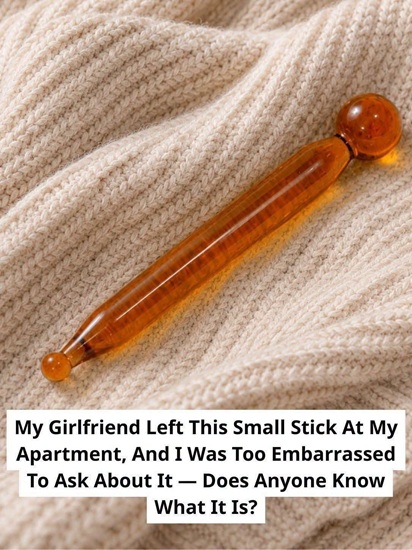
At first, the small object was difficult to identify. It had a substantial feel, an unusual shape, and the kind of appearance that suggested it belonged to another era. Nothing about it immediately explained what it was supposed to do. There were no digital components, instructions, or familiar modern features to provide an obvious answer. Yet the object clearly appeared to have been designed for a practical purpose rather than simply for decoration.
That was what made it so intriguing. When an old household or office object survives after the everyday routine associated with it has changed, something once completely familiar can suddenly look mysterious. A groove that once had an obvious purpose may now appear decorative. A metal edge can look strange when there is no longer anything attached to it. Without knowing how previous generations used an item, even a relatively simple tool can become surprisingly difficult to recognize.
After examining the shape more closely, however, the mystery began to disappear. The object appeared to belong to the long history of desktop tape dispensers. Its purpose was straightforward: hold a roll of adhesive tape securely, allow the user to pull out the amount needed, and provide an edge against which the tape could be cut.
Today, that explanation sounds almost too ordinary. Tape dispensers are so common that most people rarely think about their design. Yet older versions can look dramatically different from the lightweight plastic models found in modern homes, classrooms, workshops, and offices.
The history behind these tools begins with the development of pressure-sensitive adhesive tape. During the 1920s, 3M engineer Richard Drew worked on an early masking tape after observing difficulties encountered by automobile painters who needed cleaner ways to separate painted areas.
That work eventually contributed to the development of additional adhesive products. Around 1930, 3M introduced cellulose tape, and transparent tape subsequently became increasingly useful for household, office, and commercial tasks.
Once rolls of tape became widely used, another practical problem appeared.
People needed a convenient way to handle them.
Anyone who has ever lost the loose end of a tape roll understands part of the difficulty.
The roll needs to remain stable.
The end needs to remain accessible.
And the tape needs to be cut cleanly.
A dedicated dispenser combines those functions in one relatively small object.
Early tape dispensers began appearing during the 1930s as manufacturers developed more convenient ways of using the increasingly popular adhesive material.
One well-known development was 3M’s “snail”-style dispenser, introduced in 1939. Its built-in serrated cutting edge helped establish a design principle that remains familiar today.
The basic concept has endured remarkably well.
Place the tape roll inside or onto the holder.
Pull the free end forward.
Measure the desired length.
Press the tape against the cutting edge.
Separate the strip.
Modern dispensers may use different materials and shapes, but the essential action remains largely unchanged.
This explains several characteristics that can otherwise make an older dispenser confusing.
Many desktop versions were designed with substantial weight.
That weight served a practical function.
A dispenser that slides across the desk every time someone pulls the tape is inconvenient.
A heavier base allows the user to operate the dispenser with one hand.
The other hand can hold whatever is being wrapped, repaired, or labeled.
What initially seems like unnecessary bulk therefore becomes an important design feature.
Older desk accessories were also sometimes created with greater attention to their appearance because they were expected to remain visible on desks for long periods.
That does not mean every vintage tape dispenser was expensive or decorative.
Many were straightforward working tools.
But manufacturers produced a wide variety of models using different materials, shapes, and finishes.
This is why identifying an individual vintage example requires caution.
A brown or amber appearance does not automatically mean the object is made from Bakelite.
It might be wood.
It might be another molded material.
It might combine metal with plastic or wood.
Its surface may also have changed after decades of exposure, handling, cleaning, or sunlight.
Color alone cannot reliably determine composition.
The same caution applies to age.
Knowing that tape dispensers existed during the 1930s does not prove that every old-looking dispenser comes from that decade.
Similar tools continued to be produced throughout the 1940s, 1950s, 1960s, and later.
Some designs remained popular for years.
Others were copied or modified by different manufacturers.
Without a maker’s mark, patent number, catalog reference, or documented history, assigning a precise manufacturing date can easily become speculation.
That distinction is particularly important when sharing information about vintage objects.
There is nothing wrong with saying that an object appears to be an older tape dispenser.
Problems begin when uncertain details are presented as established facts.
A careful identification separates what can be observed from what still needs verification.
For example, a central area capable of supporting a tape roll is meaningful evidence.
A serrated cutting edge provides another strong clue.
Wear patterns near those components can support the identification further.
Manufacturer information can make the conclusion even stronger.
Many older commercial products include identifying marks on their undersides.
A company name may be molded directly into the material.
A logo might appear on a metal plate.
A patent number can sometimes provide particularly useful information.
Searching that number can lead to original design records.
Patent databases contain numerous tape-dispenser designs from the twentieth century, demonstrating how manufacturers repeatedly experimented with the appearance of an otherwise simple tool.
Some designs were compact.
Others were heavy and substantial.
Some emphasized practicality.
Others were clearly intended to complement an office desk.
This diversity explains why an unfamiliar vintage model can be difficult to recognize even when someone uses a modern tape dispenser every day.
The purpose is familiar.
The visual language is different.
Once the purpose becomes clear, however, many details suddenly make sense.
The opening becomes the place where a roll once rested.
The cutter becomes obvious.
The object’s weight becomes functional rather than mysterious.
The shape begins to reveal the movement its designers expected users to make.
That moment of recognition is one reason identifying old objects can be so satisfying.
Nothing about the object itself changes.
What changes is the observer’s understanding.
One minute it is an unexplained piece of material.
The next, it becomes a practical desk tool.
That transformation can also create a stronger appreciation for everyday design.
Tape dispensers are not normally treated as major technological achievements.
Yet someone had to solve several small problems to make them convenient.
The roll needed to rotate smoothly.
The loose end needed to remain accessible.
The dispenser needed enough stability to resist the pulling force.
The cutter needed to separate tape without requiring scissors.
Those are ordinary problems, but solving ordinary problems effectively is an important part of good design.
The same principle can be seen throughout the history of office equipment.
Consider the stapler.
Its purpose is simple.
So is a pencil sharpener.
A hole punch.
A letter opener.
A paperweight.
A desk organizer.
None seems particularly mysterious while surrounded by the working environment for which it was designed.
Remove that context for several decades, however, and even familiar tools can become puzzles.
Some old office objects have disappeared almost entirely because technology eliminated the tasks they performed.
Others, like tape dispensers, survive because the original task still exists.
People continue using adhesive tape.
That makes an old dispenser especially interesting because it offers a direct comparison between past and present.
A modern version may be inexpensive molded plastic.
An older example might be heavier and constructed very differently.
Both perform essentially the same task.
That contrast can make people reflect on how manufacturing has changed.
Modern mass production has made many everyday products inexpensive and widely accessible.
That is a genuine advantage.
A useful office tool no longer needs to represent a significant purchase.
If a dispenser breaks, replacing it may be simple.
At the same time, some older surviving objects feel unusually substantial.
Their weight and materials can create the impression that they were intended for long service.
Many undoubtedly were.
But it is worth avoiding the assumption that everything made in the past was superior.
Earlier generations also produced inexpensive goods.
Some broke quickly.
Some were poorly designed.
Many disappeared precisely because they did not survive.
The vintage objects encountered today represent only a portion of everything that was originally manufactured.
Durable products have a greater chance of remaining in drawers and offices decades later.
This survival effect can influence how we think about historical craftsmanship.
Still, an object that has survived for decades deserves some appreciation.
Every scratch may reflect use.
Every worn edge may have a history.
A dulled cutting surface could have separated thousands of strips of tape.
The people who used it may have wrapped gifts, repaired documents, sealed packages, or attached notes.
We usually cannot reconstruct those individual moments.
But the wear demonstrates that the object participated in ordinary life.
That can make it more interesting than a completely unused reproduction.
It becomes evidence of repeated human interaction.
This is one reason vintage objects sometimes acquire sentimental value that has little relationship to their financial value.
An inherited tape dispenser may not be rare.
It may not attract serious collectors.
But if it sat on a parent’s or grandparent’s desk for decades, it can become meaningful because of that association.
Historical value, sentimental value, and market value are different things.
They should not be confused.
Determining whether an old dispenser is financially valuable requires identifying the specific model.
Manufacturer matters.
Age matters.
Condition matters.
Material matters.
Rarity matters.
Collector demand matters.
An ordinary mass-produced dispenser may have limited resale value.
An uncommon model associated with a recognized designer or manufacturer could be more desirable.
Original packaging or documentation can sometimes increase collector interest.
Without those details, giving a precise value would be unreliable.
The safest conclusion is that an object can be worth keeping even when it is not worth much money.
Its usefulness may be enough.
Its design may be interesting.
Its connection with family history may matter.
Or someone may simply enjoy having an older working object on a desk.
If the dispenser still functions, using it can create another connection with its original purpose.
A compatible tape roll can be placed onto the holder.
The free end is pulled forward.
The desired length is drawn across the front.
Then the tape is pressed against the serrated cutter.
The process is almost identical to using many modern dispensers.
That familiarity can be surprisingly satisfying.
A tool manufactured decades ago may still perform a task in exactly the way its designer intended.
However, old objects should be handled carefully.
Vintage plastics can become brittle.
Wood can dry or crack.
Metal can corrode.
Old adhesives or finishes may react badly to aggressive cleaning products.
If the object’s exact material is unknown, heavy restoration should generally be avoided until more information is available.
Strong solvents are particularly risky.
Something safe for metal may damage plastic.
A cleaner appropriate for modern plastic may affect an older molded material.
Excess water can damage wood or certain finishes.
Gentle cleaning is usually the safer starting point.
There is also no requirement that every old object be restored until it looks new.
Wear can be part of its history.
A scratch is not always a defect that needs to disappear.
Patina can demonstrate age and use.
Collectors often prefer original surfaces to poorly executed restoration.
For a personally meaningful object, preservation may be more appropriate than attempting to recreate its original showroom appearance.
The process of identifying an old tool can itself become part of its value.
You begin with questions.
What is this opening for?
Why is the base so heavy?
Why is there a sharp edge here?
Was something supposed to rotate inside?
Then the clues begin connecting.
A roll fits the central space.
The cutting edge aligns with where tape would be pulled.
The weight stabilizes the base.
Suddenly, the entire object makes sense.
That experience resembles the satisfaction people get from visual puzzles.
The information was visible from the beginning.
The brain simply had not organized it correctly yet.
Once the correct interpretation appears, it can become difficult to understand why the object ever seemed mysterious.
That is a normal feature of perception.
Human brains are extremely efficient at recognizing familiar patterns.
Usually, that ability helps us navigate the world quickly.
But it can also cause us to commit too early to the wrong interpretation.
If an unfamiliar object resembles something else, the mind may keep trying to fit it into that first category.
Looking from another angle can break the pattern.
Turning the object upside down can help.
Moving farther away can help.
Examining individual components instead of the whole object can help.
So can asking what kind of physical movement the design seems to encourage.
Does something rotate?
Does something slide?
Is there a surface designed to be pressed?
Is one edge intentionally sharp?
Functional questions often reveal more than appearance alone.
Measurements can provide additional clues.
The diameter of an opening may correspond to a standard tape roll.
A slot may match the width of an older office product.
Even the location of wear can show how the item was held.
Research becomes more effective once those observations have been made.
Instead of searching vaguely for “strange brown vintage object,” someone can search for a heavy desktop tool with a roll holder and serrated cutter.
That description is much more likely to produce useful comparisons.
Museum collections can provide reliable historical context.
The Smithsonian’s National Museum of American History, for example, preserves examples connected with the development of Scotch tape and early tape dispensers.
Such collections show that seemingly ordinary office products can be historically significant.
They also provide a useful reminder that older dispensers were manufactured in different materials.
One documented early example is metal.
That alone demonstrates why an unidentified dispenser should not automatically be called Bakelite or wood simply because it looks old.
Patent records can add another layer of information.
A patent drawing may show the original configuration of a dispenser.
It may identify the designer or company.
It can also provide dates that help establish when a particular design first appeared.
Vintage catalogs and advertisements can sometimes answer questions that physical examination cannot.
They may show original colors.
They can reveal the manufacturer’s intended use.
They may even provide the original retail price.
Together, these sources help reconstruct the context that disappeared as the object aged.
That context is what turns an unidentified item into a piece of everyday history.
And everyday history deserves attention.
History is not limited to presidents, wars, famous buildings, or groundbreaking inventions.
It is also the history of kitchens.
Workshops.
Classrooms.
Factories.
Offices.
And the small tools people touched thousands of times without considering them important.
A tape dispenser belongs to that category.
Its purpose may be modest, but it tells a story about changing materials and working habits.
It also illustrates the relationship between technology and design.
Transparent adhesive tape created a new need.
The dispenser developed around that need.
Once the design became effective, the underlying concept survived for generations.
That is an impressive achievement for such an ordinary object.
Many technologies change so dramatically that earlier versions become almost unrecognizable.
The tape dispenser is different.
Place a vintage version beside a modern one and their appearance may vary considerably.
But watch someone use both, and the continuity becomes obvious.
Pull.
Measure.
Cut.
The movement remains the same.
That continuity connects the present with the past in a particularly accessible way.
No specialist knowledge is necessary to understand why the tool exists.
Anyone who has struggled with a loose tape roll understands the problem.
That makes the history immediately relatable.
It also explains why learning the answer can feel strangely comforting.
The mysterious object does not turn out to be something dangerous or incomprehensible.
It turns out to be a solution to an everyday problem.
People before us encountered minor frustrations just as we do.
They designed tools to solve them.
Some of those tools worked well enough to remain recognizable generations later.
There is something reassuring about that continuity.
It reminds us that ordinary life has always involved small problems and small acts of ingenuity.
Not every invention needs to transform civilization.
Sometimes making tape easier to cut is enough.
That perspective can change how we look at objects around us today.
Many things we barely notice were carefully shaped around repeated human actions.
A door handle.
A pair of scissors.
A stapler.
A bottle opener.
A tape dispenser.
Their familiarity hides their design.
Only when we encounter an unfamiliar version do we start noticing how much thought is involved.
The same curiosity can be applied whenever an unidentified item appears during cleaning or sorting.
Instead of immediately throwing it away, examine it.
Look underneath.
Search for markings.
Check whether parts move.
Consider whether something is missing.
Think about where it was found.
An object discovered inside an old desk probably has a different likely purpose from one found among kitchen utensils.
Context can be an important clue.
Ask older relatives if they recognize it.
Compare it with museum photographs.
Search manufacturer markings rather than relying exclusively on visual similarity.
A little investigation can prevent an interesting object from being discarded simply because its purpose is no longer obvious.
Of course, not every mysterious discovery will turn out to be historically significant.
Sometimes an old object really is just an old object.
That is perfectly fine.
Curiosity does not require every answer to be dramatic.
The satisfaction comes from understanding.
In this case, the most likely answer is wonderfully ordinary.
A tape dispenser.
A tool created to hold a roll securely and make cutting tape easier.
That simple explanation accounts for the object’s shape, stability, and cutting mechanism.
What it does not automatically reveal is the exact manufacturer, material, or age.
Those details require additional evidence.
Maintaining that distinction makes the story more accurate.
It is possible to appreciate an object without exaggerating its history.
In fact, the real story is often interesting enough.
Pressure-sensitive tape transformed numerous everyday tasks.
Manufacturers responded by designing dispensers that made the product easier to use.
Those dispensers evolved through different shapes and materials.
Some survived long enough to become unfamiliar to later generations.
One eventually turns up in a drawer.
Someone picks it up.
They wonder what it is.
And the cycle of rediscovery begins.
Once identified, the object may never look mysterious again.
The central opening becomes obvious.
The cutter becomes obvious.
Even the weight suddenly feels logical.
Knowledge reorganizes what the eyes were already seeing.
That may be the most enjoyable part of the entire discovery.
The object did not contain a hidden mechanism.
It did not require an elaborate explanation.
It simply needed context.
There is a broader lesson there about observation.
First impressions are useful, but they are not always complete.
Looking again can reveal information the first glance missed.
Changing perspective can make an unfamiliar pattern suddenly familiar.
That lesson applies to visual puzzles, historical objects, and many ordinary situations.
Slow observation often produces better answers than immediate certainty.
For an unidentified vintage item, that means resisting the urge to make confident claims before enough evidence is available.
Perhaps the object is from the mid-20th century.
Perhaps it is older or newer.
Perhaps it is Bakelite.
Perhaps it is wood or another material.
Those questions can remain open until markings or documentation provide answers.
The basic function can still be appreciated.
And that function tells a satisfying story on its own.
Someone designed an object sturdy enough to hold tape in place.
Someone manufactured it.
Someone purchased it.
Someone used it.
Perhaps many people used it.
Then, eventually, it was placed in a drawer or box and forgotten.
Years passed.
Its purpose became less obvious.
Then another person found it.
What had once been completely ordinary became mysterious.
And after a little investigation, it became ordinary again—but in a much more interesting way.
That transformation is why small discoveries like this can be so enjoyable.
They encourage us to pay attention to objects we normally overlook.
They reveal how design changes over time.
They remind us that usefulness itself can be a form of craftsmanship.
The object does not need to be rare.
It does not need to be worth hundreds of

