
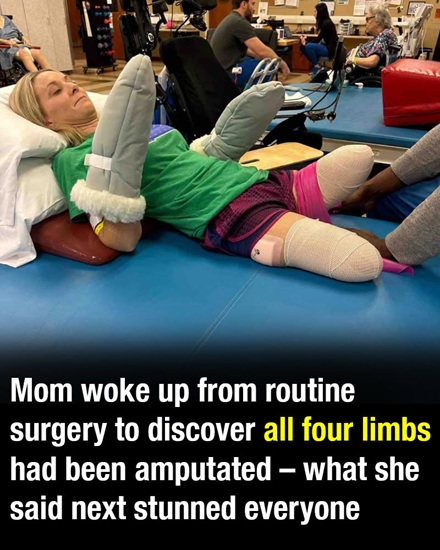
A medical emergency in December 2023 changed nearly every part of Lucinda “Cindy” Mullins’s life. The Kentucky mother had been receiving treatment connected to kidney stones when an infection developed and her condition deteriorated rapidly. What initially involved treatment for a relatively common medical problem became a fight for survival after she developed sepsis and septic shock. Mullins required intensive hospital care as doctors worked to stabilize her and protect her vital organs.
Although she survived the immediate crisis, the severe illness caused irreversible damage to portions of all four of her limbs. Mullins had been dealing with kidney stones and had undergone treatment that included the placement of a temporary stent. Her health later worsened dramatically, and her husband, DJ, found her seriously ill at home. She received initial medical attention in Stanford, Kentucky, before being transferred to the University of Kentucky Hospital in Lexington for more advanced care.
By that point, the situation had become extremely serious. Doctors were no longer dealing simply with kidney stones but with a severe infection and the dangerous systemic response that followed. Septic shock can cause a significant drop in blood pressure and interfere with adequate blood flow throughout the body. During Mullins’s medical crisis, doctors focused on keeping her alive and preserving the function of essential organs. She remained heavily sedated for part of her hospitalization while the medical team treated her condition. Doctors also attempted procedures intended to address circulation problems in her extremities. Despite those efforts, some of the tissue in her arms and legs had been damaged beyond recovery.
That medical sequence is important because simplified descriptions of Mullins’s story can create the wrong impression about what happened. She did not simply enter a hospital for an ordinary procedure and unexpectedly wake up moments later without four limbs. Her condition developed into a severe medical emergency involving infection, sepsis, septic shock and major circulation problems. The amputations became necessary after doctors determined that the damage to portions of her limbs could not be reversed.
On December 18, 2023, Mullins asked her doctor to explain the situation directly. She later recalled wanting the medical team to be straightforward about what was happening. Doctors explained that her legs would need to be amputated. The following day, December 19, she underwent surgery in which both legs were amputated below the knees. The damage to her upper extremities was also severe, and portions of both arms ultimately had to be removed below the elbows.
For Mullins and her family, the medical crisis created a completely new reality in a matter of days. Activities that had previously required no thought would now involve rehabilitation, adaptive techniques, assistance or prosthetic technology. Yet when Mullins later spoke publicly about learning that amputations were necessary, she repeatedly emphasized that her first concern was survival. She knew the situation was serious, but she also understood that she had been given the opportunity to return to the people who mattered most to her.
Rather than describing her experience only through anger or loss, Mullins spoke about being grateful that she was alive. She emphasized that she could still see her husband, children, relatives and friends. She also acknowledged that difficult periods would inevitably be part of her future. Her optimism did not erase the seriousness of becoming a quadruple amputee, but it shaped the way she chose to discuss the experience publicly.
Her Christian faith was another important part of her personal response. Mullins has described feeling a sense of peace after doctors explained why the amputations were necessary. She believed there was still a purpose for her life and spoke about trusting that she would be able to face what came next. Those comments reflected Mullins’s personal religious beliefs rather than a medical explanation for her recovery. Medical treatment saved her life, while faith was one of the ways she said she emotionally processed the enormous changes she faced.
Her husband and children quickly became central to her recovery. Mullins is married to DJ Mullins, and the couple have two sons. During the early stages of recovery, she needed assistance with many ordinary activities while healing from major surgery. Members of her family helped with those practical needs while also adjusting emotionally to the sudden changes. What had happened affected the entire household, even though Mullins was the person who had endured the medical emergency.
Her extended family also provided support. Early reporting described relatives helping Mullins with daily care as she recovered. Those moments illustrated one of the realities of major limb loss: recovery extends far beyond the operating room. Healing from surgery is only one part of the process. Patients may also need rehabilitation, new equipment, prosthetic fitting and considerable assistance while learning different ways to perform everyday tasks.
Before becoming critically ill, Mullins had worked in health care for many years. She was employed as a certified medical assistant at Bates, Miller & Sims, a family medical practice. After surviving septic shock and undergoing amputations, she expressed a desire to eventually return to her professional life. The goal reflected her determination to regain independence rather than allowing the events of December 2023 to determine everything that would happen afterward.
Returning to ordinary life, however, required a long rehabilitation process. Mullins needed to learn how to navigate the world with significant changes to both her upper and lower limbs. Tasks such as moving around, eating, dressing and handling objects could require different techniques or specialized equipment. Rehabilitation therefore became an essential part of her recovery as she worked toward performing more activities independently.
She spent time at Cardinal Hill Rehabilitation Hospital in Lexington, where she continued building strength and learning new skills. Rehabilitation after multiple amputations is not a single event or achievement. It involves repeated practice and adjustments as a person becomes comfortable with different equipment and methods. Mullins’s progress unfolded gradually, with individual milestones representing months of work rather than an immediate return to the life she had before becoming ill.
One of those milestones came when she began learning to walk with prosthetic legs. In 2024, footage showing Mullins taking steps with prostheses and the assistance of a walker attracted significant public attention. The moment was understandably emotional, but it was also the product of extensive rehabilitation. Each step represented work performed long after the initial hospital emergency had ended.
Her experience with prosthetic technology eventually connected her personal recovery with a broader issue affecting amputees: access to appropriate prosthetic devices. Different prostheses can serve different purposes. A device useful for one everyday activity may not necessarily be ideal for another. Insurance coverage can therefore have a meaningful effect on what equipment a person can obtain and how independently that person can participate in different activities.
Mullins later became involved in advocacy related to prosthetic insurance coverage in Kentucky. Her involvement was connected to her own experience as an amputee and should not be interpreted as her claiming to represent every resident of the state. She had firsthand knowledge of relying on prosthetic technology and used that experience to support changes that could expand access to appropriate devices for people covered by certain private health plans.
That effort became connected with Kentucky Senate Bill 97. The legislation addressed insurance coverage involving prostheses and orthoses and established requirements for certain health-benefit plans. Among other provisions, the measure dealt with aspects of coverage and insurance practices related to prosthetic and orthotic care. The legislation moved through Kentucky’s formal legislative process rather than being the work of any single individual.
Governor Andy Beshear signed Senate Bill 97 on April 7, 2026. Under the legislation, relevant provisions are scheduled to affect applicable health plans beginning in 2027. Mullins publicly celebrated progress on the issue and thanked the people involved, including supporters and public officials. Describing her as an advocate involved in the effort is more precise than suggesting that she personally “passed” the legislation, because laws are enacted through a legislative and executive process involving numerous participants.
The distinction matters when telling a real person’s story. Mullins’s experience gave her an important personal perspective on prosthetic access, but the legislation had sponsors, lawmakers who voted on it and a governor who ultimately signed it. Her contribution can be recognized without overstating her individual role. That approach also keeps the story focused on documented events instead of turning it into political persuasion.
Community support became another significant part of Mullins’s recovery. Fundraising efforts were organized to help the family manage the practical costs associated with her changed circumstances. Medical care, rehabilitation, accessibility modifications and prosthetic equipment can create substantial financial needs. Supporters responded by contributing money and helping the family prepare for a life that would require different accommodations.
The public response also demonstrated how widely Mullins’s story had traveled beyond her local community. People who had never met the family followed updates about her rehabilitation and celebrated her milestones. Mullins and her family repeatedly expressed appreciation for the assistance they received. At the same time, her story remained fundamentally about a family adapting to a permanent medical change rather than simply a series of inspirational moments shared online.
Her two sons were an especially important source of motivation. Mullins repeatedly emphasized how much it meant to return to them after surviving septic shock. Her husband has also spoken publicly about the ways their children adapted to their mother’s new circumstances. Like adults, children can have questions when a parent experiences a major medical event, and the Mullins family had to navigate those conversations while continuing everyday family life.
The relationship between Mullins and her children also helps explain why she resisted describing her experience entirely as a tragedy. She had lost all or part of four limbs, but she had survived. From her perspective, survival meant she could continue being a mother and remain present as her sons grew older. That did not eliminate the challenges she faced, but it gave her a powerful reason to continue working through rehabilitation.
Mullins has never suggested that the process was effortless. Maintaining a positive outlook does not mean every day after a catastrophic illness is easy. Major amputations involve physical changes, repeated medical appointments, rehabilitation and practical adjustments that can continue for years. Her public optimism exists alongside those realities rather than replacing them.
The same caution is necessary when discussing the medical side of her experience. Kidney stones are common, and Mullins’s severe outcome should not be interpreted as something that normally happens after kidney-stone treatment. Her case involved an infection that progressed to sepsis and septic shock. That escalation produced an extraordinary medical emergency and severe circulation problems that ultimately damaged her limbs.
Sepsis occurs when the body has an extreme response to an infection and can lead to organ dysfunction. Septic shock represents an especially dangerous form of that medical emergency. In Mullins’s case, keeping her alive became the immediate priority. Although doctors were able to protect vital organs and help her survive, the damage to her extremities could not be fully reversed.
This is why accuracy matters when her story is summarized. Saying that she went in for routine surgery and simply woke up without four limbs may make the story sound more dramatic, but it removes crucial medical context. Mullins endured a developing crisis, received intensive treatment and was informed about the need for amputations as doctors understood the extent of the damage.
The actual sequence is already extraordinary without exaggeration.
She entered a medical crisis connected to an infection.
She developed septic shock.
Doctors fought to keep her alive.
Severe circulation problems caused irreversible damage to portions of her limbs.
Amputations became necessary.
Then rehabilitation began.
What happened afterward has been a continuing process rather than a single dramatic recovery moment. Mullins has learned to use prosthetic technology and has worked toward greater independence. She has remained involved with her family and has discussed wanting to maintain important parts of her professional and personal life.
Her story has also evolved over time. Early attention focused understandably on the shocking medical emergency and the amputations. Later updates showed rehabilitation milestones and her efforts to adapt to prosthetic devices. More recently, her involvement in discussions surrounding insurance coverage for prosthetic and orthotic care has added another documented chapter.
None of those developments erase what happened in December 2023. Mullins’s body was permanently changed by a medical emergency she had not anticipated. She and her family had to adjust quickly to circumstances that would affect nearly every aspect of daily life.
Yet Mullins has repeatedly focused on what remained.
She survived.
She returned to her family.
She continued raising her sons.
She worked through rehabilitation.
She began walking with prosthetic legs.
And she became involved in an issue directly connected to the challenges she had personally encountered.
Her response is especially notable because she has not portrayed herself as someone untouched by difficulty. She has acknowledged that challenging moments are part of the journey. Her message has instead centered on the idea that experiencing profound loss does not necessarily mean losing every possibility for a meaningful future.
Family support has remained an essential part of that future. DJ and their children have experienced the changes alongside her, adapting routines and helping when necessary. Other relatives, medical professionals, rehabilitation specialists and members of the community have also played roles in her progress.
The doctors who treated Mullins faced the immediate challenge of keeping her alive during septic shock. Rehabilitation professionals later helped her adapt after the amputations. Prosthetic technology provided new possibilities for mobility and independence. Family and community support helped address the emotional and practical consequences that continued after she left intensive hospital care.
Those different parts of the story are important because survival from a catastrophic illness rarely depends on a single moment. Mullins’s journey involved emergency medicine, surgery, rehabilitation, family assistance and long-term adaptation. Her own determination has been central, but her recovery has also taken place with the support of many other people.
More than two years after the original crisis, her experience cannot reasonably be reduced to the day she lost her limbs. Her life continued beyond the hospital.
She remained a wife.
She remained a mother.
She remained connected to the health-care profession she had worked in for years.
She became a prosthetic user.
And she added her voice to an issue she understood through personal experience.
Her story therefore contains two realities at the same time. The first is the seriousness of what she endured. Septic shock nearly killed her and caused injuries severe enough to require four amputations. Nothing about that reality needs to be minimized.
The second reality is what Mullins chose to do afterward.
She focused on surviving.
She worked toward independence.
She remained engaged with her family.
And she continued planning for a future that looked dramatically different from the one she had imagined before December 2023.
When Mullins has spoken publicly about the experience, gratitude has repeatedly appeared in her comments. She has emphasized being thankful that doctors saved her life and that she was able to see her family again. Her faith has also remained an important part of the way she personally understands what happened.
Those statements should be understood as Mullins’s own perspective rather than a universal lesson about disability, illness or recovery. Every person experiencing major limb loss can respond differently. Mullins’s outlook belongs to her, and accurately reporting it does not require assuming that everyone in similar circumstances would feel the same way.
The same principle applies to her involvement with prosthetic coverage. Her experience can illustrate why access to appropriate prosthetic devices matters without pretending that she speaks for every amputee or every Kentucky resident. Her public advocacy grew from a specific personal experience, while the eventual legislation was handled through Kentucky’s established legislative process.
Ultimately, the most remarkable part of Lucinda Mullins’s experience may not be a single surgery, photograph or rehabilitation milestone. It is the continuation of ordinary life after something extraordinarily difficult happened.
There are still appointments.
There is still rehabilitation.
There are still adaptations.
There are family routines, responsibilities and plans.
There are milestones that once seemed impossible.
And there are new challenges that did not exist before her illness.
Mullins’s story began attracting widespread attention because of the devastating medical emergency that resulted in four amputations. But the years that followed have shown that the amputations were not the ending.
They marked the beginning of an entirely different chapter.
It is a chapter involving prosthetics, rehabilitation, family support, advocacy and continued adjustment. It also involves a woman who has repeatedly said that, despite everything that changed, one fact remains more important to her than what she lost.
She survived.
And because she survived, she returned to the husband and children who had been waiting for her.
For Mullins, that has remained at the center of the story.

