
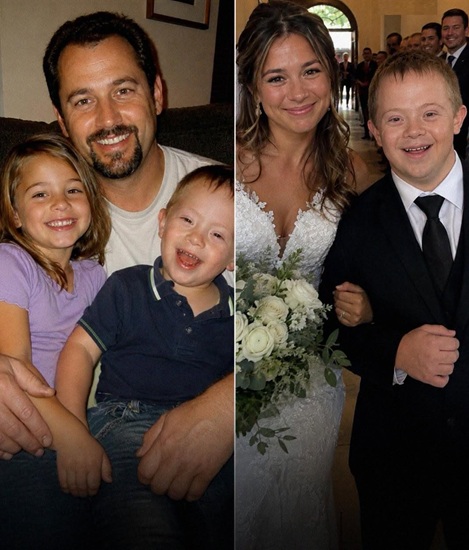
My brother was the one who finally said out loud what I had been too afraid to think about. We were sitting together in the kitchen one evening, and Nathan had been unusually quiet for almost an hour. He kept looking down at his mug, rubbing his thumb along the handle, starting to speak, then stopping himself. Whenever something mattered deeply to him, he needed time to organize the words. I knew he wanted to ask me something important, so I waited and tried not to pressure him.
Eventually, he looked up at me. “Can I do Dad’s part at your wedding?” For a moment, I wasn’t sure what he meant. Dad had always been involved in everything, so there were several things Nathan could have been talking about. Maybe he meant helping people find their seats or standing near the church entrance. Maybe he wanted to carry something or assist one of the ushers. “What part?” I asked. Nathan gave me a puzzled look.
“The walking part,” he said. “Walking you down the aisle.” That was when I understood. Our father had died eleven months earlier, and I still had not fully accepted that he would not be there on my wedding day. Nathan was thirty-one and had Down syndrome. He and Dad had always been extremely close. Their relationship had its own rhythm, built around simple routines that somehow became some of the strongest memories in our family.
Saturday mornings usually belonged to the two of them.
They spent hours in the garage fixing things that probably did not need fixing. Dad showed Nathan how to change oil, organize tools, sharpen garden equipment, and make small repairs around the house. Nathan absorbed every lesson carefully and remembered details the rest of us often forgot.
But Nathan gave Dad something in return.
He reminded him to laugh.
Dad could sometimes take work and responsibilities too seriously. Nathan had a way of interrupting that seriousness with a joke, an unexpected question, or a completely unrelated observation. They made each other happy in a way that was obvious to everyone around them.
When Dad died, the house felt different.
Nathan became quieter.
So did I.
For nearly a year, I avoided deciding who would walk beside me at the wedding.
There were options.
My uncle Patrick had offered without making a big deal about it. Mom could have done it. I could have walked alone. Daniel told me he would support whatever made me feel comfortable.
But every possibility seemed to remind me that Dad was missing.
Then Nathan asked if he could do it.
I covered my mouth because I could feel myself starting to cry.
Nathan waited.
“Sarah?”
I nodded.
“Yes?”
“Yes,” I finally managed. “I want you to walk with me.”
His entire face changed.
He stood up so quickly that the chair scraped against the floor, and then he hugged me with both arms.
“I’ll walk slowly,” he promised.
I laughed.
“That would be helpful.”
Then he said something I had never heard before.
“I practiced with Dad once.”
I pulled away from him.
“What do you mean?”
“For your wedding.”
Nathan explained that years earlier, Dad had joked about the day I might eventually get married. Apparently, he had told Nathan that he would need help making sure he didn’t trip while walking me down the aisle.
At some point, the two of them had even practiced.
Nathan spoke about it as if it were completely ordinary.
To me, it felt enormous.
I started crying again.
Nathan looked worried.
“Did I say something bad?”
“No.”
“Then why are you crying?”
I laughed through the tears.
“Because weddings make people cry.”
He considered that explanation and nodded.
Within days, Nathan had turned the idea into a mission.
He began practicing at home.
My uncle later told me he saw Nathan repeatedly walking through the upstairs hallway with one arm held out, as though I were beside him. He counted his steps, stopped, turned, and started again.
One.
Two.
Three.
Turn.
Repeat.
Nathan wasn’t interested in simply being included.
He wanted to do the job correctly.
A few days later, he surprised everyone by calling the church himself.
He wanted to know exactly what he was supposed to do once we reached the front.
Father Michael called me afterward.
“Your brother is preparing very seriously,” he said.
I laughed.
“That sounds like Nathan.”
Apparently, Nathan had asked whether he should bow, where he should stop, which hand he should use to shake Daniel’s hand, and when he should sit down.
Father Michael patiently explained the sequence.
Nathan would walk beside me to the front of the church. Then he would let go of my arm, greet Daniel, hug me, and take his seat beside Mom.
Nathan wrote it all down.
Then he practiced that too.
Whenever someone expressed concern, his response was always the same.
“I practiced.”
Mom worried the crowd might make him nervous.
“I practiced.”
Uncle Patrick wondered whether the music might affect his timing.
“I practiced.”
Daniel asked whether Nathan wanted someone nearby in case he forgot where to sit.
Nathan looked almost offended.
“I practiced.”
Eventually, everyone stopped asking.
For the first time since Dad died, the processional no longer felt like something I needed to fear.
Nathan wasn’t replacing our father.
Nobody could.
Instead, he was carrying a small part of Dad’s memory beside me.
For several weeks, everything seemed settled.
Then Daniel’s mother raised the subject during dinner.
Her name was Margaret.
I had known her for several years, and although we had never been especially close, we had always treated each other politely.
Margaret cared deeply about appearances and details.
Her table settings matched perfectly. Holiday cards were mailed early. Family photos were coordinated. She noticed things most people would never think about.
That evening, she asked whether Nathan was still walking me down the aisle.
“Yes,” I said.
She paused before answering.
Then she began talking about the wedding photographs.
She suggested that perhaps Nathan did not need such a visible role in the ceremony. She said the photographs of the aisle would become some of the most important images from the wedding and implied that we might want to think carefully about how they would look.
At first, I was simply confused.
Then I understood what she was saying.
She was uncomfortable with Nathan being prominently featured in the wedding photographs.
I felt my entire body go tense.
There were several things I wanted to say.
I wanted to remind her that Nathan was my brother.
I wanted to tell her that my father was dead.
I wanted to ask why anyone else’s opinion about a photograph should matter more than the person standing beside me on one of the most emotional days of my life.
But before I could respond, Daniel reached for my hand underneath the table.
“We’ll work it out,” he said.
For half a second, I thought he meant we would reconsider Nathan’s role.
Then I looked at his face.
He was not agreeing with his mother.
He was trying to prevent the conversation from turning into a family argument that Nathan might eventually hear about.
So I stayed quiet.
Dinner ended shortly afterward.
Once we were back in the car, I asked Daniel what he had meant.
His answer was immediate.
“Nathan is walking you down that aisle.”
I looked at him.
“There was never another option,” he added.
That was all I needed.
We agreed that Nathan would never hear about the dinner conversation.
He had already lost Dad.
He was preparing for something important to him.
There was no reason to burden him with somebody else’s discomfort.
That night, I barely slept.
By early morning, I knew what I wanted to do.
I wasn’t going to reduce Nathan’s place in the wedding.
I was going to make sure we remembered every part of it.
The next day, I called Lena, our photographer.
“I need to change something,” I told her.
She asked what I had in mind.
“I want more coverage of Nathan.”
We already had a second photographer, but I wanted part of the photography plan to focus specifically on him.
I wanted photographs of Nathan getting ready.
I wanted Dad’s cufflinks on his wrists.
I wanted the moments before the ceremony.
I wanted his expression while he waited for me.
I wanted his hands.
I wanted every step down the aisle.
I wanted the moment he handed me over to Daniel and the moment he sat beside Mom.
And I wanted a separate album.
Lena understood immediately.
“So the walk becomes its own story,” she said.
“Yes,” I answered. “Exactly.”
The extra photography cost more than we had originally planned.
I reduced part of the flower budget to cover it.
Two large arrangements were replaced with smaller ones.
Nobody noticed.
Nathan certainly didn’t.
He continued practicing.
Sometimes he sent me updates.
“Twenty-two steps today.”
Another time, he told me he had walked too quickly at the turn and needed to practice again.
Once he called Daniel with a question about the handshake.
“What hand do I use?”
“Your right hand,” Daniel said.
“But Sarah is on my right.”
They apparently spent several minutes solving the problem before Nathan came up with the answer himself.
“I let go of Sarah first.”
“Perfect.”
“I practiced.”
The morning of the wedding arrived faster than I expected.
I had been surprisingly calm until Mom brought out Dad’s cufflinks.
She had saved them for Nathan.
The moment I saw them, I started crying so hard that my makeup artist had to stop working.
Nathan got ready with Daniel and the groomsmen.
At one point, Daniel sent me a photograph.
Nathan was standing in his suit with his hair carefully combed and Dad’s cufflinks visible beneath his sleeves.
His expression was so serious that I almost laughed.
Daniel added a message beneath the picture.
“He has asked what time it is eleven times.”
I replied, “Tell him I’m still here.”
A moment later, Daniel responded.
“He says good.”
When the ceremony was about to begin, I waited in a small room near the back of the church.
Then Nathan walked in.
He stopped when he saw me.
For several seconds, neither of us said anything.
Finally, he smiled.
“You look like Mom in her wedding picture.”
That almost made me cry again.
“You look like Dad,” I told him.
Nathan touched one of the cufflinks.
“I know.”
Then we heard the music begin.
Nathan straightened his shoulders.
He held out his arm.
“Ready?”
“No.”
He frowned.
“That isn’t the right answer.”
I laughed.
“Okay. I’m ready.”
The church doors opened.
Everyone stood.
Daniel was waiting at the front.
Mom was already crying.
Relatives and friends filled the pews.
For a moment, I noticed all of them.
Then I stopped noticing almost everyone except Nathan.
He began counting quietly.
“One.”
We stepped forward.
“Two.”
Another step.
“Three.”
I held his arm a little tighter.
He looked at me.
“Too fast?”
“No.”
He nodded.
“I practiced.”
“I know.”
We kept walking.
Nathan never rushed.
He never forgot the sequence.
Halfway down the aisle, his mouth began to tremble.
I thought he was about to cry.
Instead, he leaned slightly toward me and whispered something.
“Dad would have liked your dress.”
I almost lost my composure completely.
When we finally reached the altar, Nathan stopped exactly where Father Michael had told him.
He released my arm.
He shook Daniel’s hand.
Daniel pulled him into a hug.
Then Nathan turned back toward me.
I expected him to go sit beside Mom.
Instead, he reached inside his jacket.
He pulled out a folded piece of paper.
I looked at Daniel.
Daniel looked at me.
Neither of us knew what was happening.
Father Michael smiled.
Apparently, Nathan had arranged one more thing.
He unfolded the paper carefully.
His hands were shaking.
Then he looked toward the congregation.
“I wrote something,” he said.
The church became completely quiet.
Nathan looked down at the page.
He began by saying that I was his little sister.
Then he spoke about Dad.
He said that Dad had always tried to stay beside me when I was scared.
He explained that Dad could not do that on my wedding day, so Nathan had done it for him.
I covered my mouth.
Nathan continued.
He said Dad had always told him that being an older brother meant taking care of his younger sister.
Then he reached the final line.
“So that is what I am doing.”
I don’t remember much about the next few seconds.
I remember Daniel putting one hand on my back.
I remember Mom crying openly.
I remember people in the church wiping their eyes.
And I remember Nathan carefully folding his paper again.
Then he looked at Father Michael.
“Do I sit now?”
Everyone laughed through their tears.
“Yes,” I said.
Nathan walked over and sat beside Mom.
The ceremony continued.
Eight weeks later, our photographs arrived.
The main wedding album was beautiful.
The second album was the one I kept opening again and again.
It began with Nathan getting ready.
There were photographs of Dad’s cufflinks.
Nathan checking the time.
Nathan waiting near the church doors.
Nathan standing with his arm ready for me.
Then came the processional.
Page after page showed his concentration.
My hand around his arm.
His lips moving as he counted.
The moment he looked over to make sure he wasn’t walking too quickly.
Daniel hugging him at the front.
Then came the speech.
One photograph showed Nathan standing near the altar with the folded paper in both hands.
I was beside him crying.
Daniel stood just behind me.
The guests in the background were softly out of focus.
It was one of the most meaningful photographs from the entire day.
A few weeks later, we invited our families over for dinner.
Daniel’s parents came.
Mom came.
Nathan came too.
I left the album on the coffee table.
I didn’t announce it.
I didn’t hand it to anyone.
Eventually, Margaret picked it up.
When I returned from the kitchen, she was sitting on the couch with the album open across her knees.
She was looking at a photograph of Nathan standing near the church doors.
His arm was extended.
His expression was focused.
“He practiced this?” she asked.
“Every day for three weeks,” I answered.
Margaret turned another page.
Then another.
Eventually, she reached the photographs of Nathan giving his speech.
She stayed on those pages for a long time.
Finally, she closed the album.
“Can I have a copy of that picture?”
I knew which one she meant.
Nathan holding the paper at the altar.
“Yes,” I said.
There was no long discussion.
No dramatic apology.
No attempt to revisit the dinner conversation.
Weeks later, Daniel sent me a photograph from his parents’ house.
The picture Margaret had requested was hanging on the wall.
Nathan stood at the altar in Dad’s cufflinks with the paper in his hands.
The photograph she had once worried about had become one she wanted in her own home.
I never told Nathan about what had been said before the wedding.
He never learned that anyone questioned whether he should appear in those photographs.
He never needed to know.
As far as Nathan was concerned, the story was simple.
Dad couldn’t be there.
Nathan asked whether he could walk beside me instead.
We said yes.
He practiced for weeks.
He counted every step.
He wore Dad’s cufflinks.
He held out his arm.
And when those church doors opened, my brother walked beside me all the way to the altar.
Just as he had promised.

