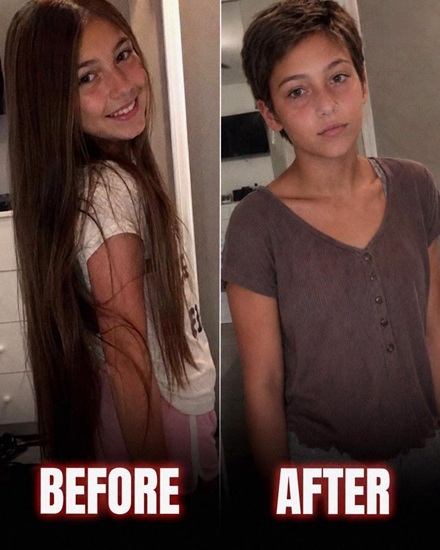
The evening before everything changed, my twelve-year-old daughter Emily was sitting on the floor between my knees while I brushed her hair. It was one of the few routines we had managed to protect from my increasingly demanding work schedule. Her chestnut hair reached almost to her waist, and she loved it more than any possession she owned. Every Sunday, I carefully worked through the tangles while she talked about school, friends, music, and whatever else happened to be important that week.
Whenever I suggested trimming even an inch or two, Emily immediately objected. “Absolutely not.” “The ends need attention.” “They’re fine.” “Emily.” “Mom, I’m never cutting my hair.” She said it so often that it had become a family joke. That was why I knew something was wrong the following afternoon. Emily had spent the day with my mother-in-law, Linda. When the front door opened, Emily rushed inside wearing an oversized hoodie. It was more than ninety degrees outside.
“Why are you wearing that?” “I’m cold.” I stared at her. “You’re cold?” “Yes.” She hurried toward the stairs. Something about the way she avoided looking at me made my stomach tighten. “Emily, wait.” She stopped. That was when I noticed several tiny brown hairs clinging to the fabric near the back of her neck. “Turn around.” “Mom.” “Please.” She slowly faced me. “Take the hood down.” Her eyes immediately filled with tears. I stepped closer. “What happened?”
She reached up with both hands and lowered the hood.
For several seconds, I couldn’t speak.
Her waist-length hair was gone.
Almost all of it.
Instead, Emily had a very short pixie cut.
It appeared to have been done at a salon, but the transformation was so dramatic that my first reaction was not admiration.
It was anger.
“Who did this?”
Emily looked down.
“Grandma knows.”
“Did Grandma make you cut it?”
“No.”
“Then why did she let someone do this?”
“Mom, please.”
“Emily, you wouldn’t even let me trim your ends yesterday.”
“I know.”
“Then tell me what happened.”
She shook her head.
“Talk to Grandma.”
I grabbed my keys.
My relationship with Linda had always been complicated.
She loved Emily deeply.
I never questioned that.
But Linda also believed I worked too much.
She rarely said it directly, yet I saw the judgment whenever she attended another school event in my place.
Science fairs.
Music rehearsals.
School presentations.
Concerts.
Award ceremonies.
Linda seemed to be everywhere.
I was usually somewhere else.
My manager, Melissa, had created a workplace where every request sounded urgent.
An email at seven in the evening required an immediate response.
A Saturday call became a two-hour meeting.
A client changing their mind somehow became everyone’s emergency.
And I almost always answered.
I told myself I was doing it for Emily.
The mortgage needed paying.
Groceries were expensive.
College would arrive faster than I wanted to admit.
A responsible mother provided stability.
That explanation was true.
It was also incomplete.
Somewhere along the way, I had stopped distinguishing between providing for my daughter and being present for her.
When I reached Linda’s house, I was too angry to think about any of that.
She opened the door.
I walked inside.
“What happened to Emily’s hair?”
Linda’s expression changed.
“She showed you.”
“Obviously.”
“I hoped she’d explain first.”
“She told me to ask you.”
Linda sighed.
“Sit down.”
“No. Did you take her to have it cut?”
“Yes.”
My anger immediately rose.
“You had no right.”
“She asked me.”
“Emily loved her hair.”
“I know.”
“She refused to let anyone cut it.”
“I know that too.”
“Then why would you take her to a salon?”
Linda looked genuinely hurt.
“Because she needed me.”
That answer stopped me.
“What does that mean?”
“You need to attend the school concert tomorrow.”
“I’m asking about today.”
“And I’m telling you that tomorrow you’ll understand.”
“Linda, she is my daughter.”
“I know.”
“Then tell me.”
She shook her head.
“This isn’t only Emily’s story.”
I stared at her.
“What are you talking about?”
“Please just show up tomorrow.”
The words landed harder than she intended.
Show up.
As if I didn’t.
Except I knew exactly what she meant.
I drove home furious anyway.
Emily had locked herself in her room.
I knocked gently.
“Can I come in?”
After a moment, she opened the door.
“Did Grandma force you to cut your hair?”
“No.”
“Did anybody force you?”
“No.”
“Are you in trouble?”
She shook her head.
“Then help me understand.”
“Tomorrow.”
I hated that answer.
But I could see she was already overwhelmed.
So I stopped asking.
The next afternoon, I was searching Emily’s backpack for a music folder when a crumpled piece of paper fell onto the floor.
I almost ignored it.
Then I saw the writing.
The message was cruel.
It referred to someone losing their hair and suggested that other students would laugh afterward.
My hands became cold.
“Emily!”
She appeared in the hallway.
“What?”
I held up the paper.
Her face changed.
“Where did you get that?”
“It was in your backpack.”
She reached for it.
I pulled it back.
“Is someone bullying you?”
“No.”
“Don’t lie to me.”
“I’m not.”
“Then who wrote this?”
“I can’t tell you.”
“Emily, if someone threatened you—”
My phone rang.
Melissa.
I ignored it.
It rang again.
Then a third time.
I answered.
“What?”
“We have a problem,” Melissa said.
Of course we did.
There was always a problem.
A client had requested changes.
People were staying late.
She wanted me back at the office.
“I can’t.”
“What do you mean?”
“Emily has her concert tonight.”
There was silence.
“You can watch the video afterward.”
I looked at my daughter.
She was staring at me.
How many times had I done exactly that?
Watched the video afterward.
Looked at photographs afterward.
Asked how something went afterward.
Always afterward.
“No.”
Melissa sounded surprised.
“Excuse me?”
“I’m going to the concert.”
“We need everyone here.”
“Then tonight you’ll have everyone except me.”
“If you leave us short during an important deadline, we may need to discuss your future here.”
Normally, those words would have terrified me.
I needed the job.
But for once, fear did not make the decision.
“Then we’ll discuss it tomorrow.”
I ended the call.
Emily stared at me.
“You’re really coming?”
The surprise in her voice hurt.
“Yes.”
“You don’t have to.”
“I know.”
“Then why?”
“Because I should.”
That evening, I arrived at the auditorium before the program started.
Linda was already sitting there.
She looked almost as surprised as Emily had.
I sat beside her.
Neither of us mentioned our argument.
Then the students walked onto the stage.
I spotted Emily immediately.
Beside her stood her best friend, Maya.
I stared.
Maya had the same short haircut.
Suddenly, I understood that whatever had happened was much bigger than Emily.
Halfway through the program, a teacher approached the microphone.
She said two students wanted to share something about friendship and kindness.
Emily and Maya stepped forward.
Maya looked terrified.
Emily reached for her hand.
Then Maya began explaining.
Several days earlier, older students had targeted her with a cruel prank involving gum placed in her hair.
By the time adults realized what had happened, the gum had become badly tangled close to the roots.
Maya’s parents took her to a salon.
The stylist tried to save her long hair.
It wasn’t possible.
A significant amount needed to be cut.
Maya was devastated.
But she was even more frightened about returning to school.
She believed everyone would stare.
She worried that the students responsible would laugh.
She did not want to walk through the school doors alone.
That was when Emily called Linda.
Not me.
Linda.
Grandma answered immediately.
She met the girls and helped them get to the salon.
While Maya sat crying in the chair, Emily made a decision.
“Cut mine too.”
Linda initially told her no.
Emily had spent years protecting her long hair.
She had refused countless trims.
But this time she insisted.
“If Maya has short hair,” Emily said, “then I want short hair too.”
The stylist asked whether she was certain.
Emily said yes.
So the hair she had treasured for years fell to the floor.
Not because someone forced her.
Not because she was rebelling.
Not because Grandma made a decision without me.
Emily chose it.
She wanted her friend to return to school knowing she would not be the only girl walking through the hallway with a dramatically different appearance.
Then Emily explained the note.
It had not been written to her.
It was intended for Maya.
The school administration had been informed.
The students involved had been identified, and the matter had been referred to the principal according to school procedures.
I felt tears running down my face.
Then Emily thanked Linda.
“Grandma came when we called.”
That sentence broke something inside me.
Grandma came.
Of course she did.
Linda always came.
Every time I had a meeting.
Every time a client needed something.
Every time I told myself the next school event would be different.
Linda had never been trying to replace me.
She had simply been filling the chair I repeatedly left empty.
After the concert, Emily came toward me.
She looked surprised again.
“You stayed for the whole thing.”
I swallowed.
“Of course.”
She raised an eyebrow.
We both knew “of course” was not accurate.
So I corrected myself.
“I should have been staying all along.”
Emily hugged me.
I held her tightly.
Then I stepped back and looked at her haircut.
“You know what?”
“What?”
“It looks pretty good.”
She smiled.
“Maya’s looks better.”
Maya appeared behind her.
“No, yours does.”
They started arguing about it.
I laughed.
Outside the auditorium, I found Linda.
“I owe you an apology.”
“You were scared.”
“I accused you.”
“I understand.”
Then I asked the question I did not want answered.
“Why did Emily call you?”
Linda hesitated.
“Don’t protect me.”
She sighed.
“Because she knew I would come.”
I looked away.
Linda touched my arm.
“I have never wanted to replace you.”
“I know.”
“Emily doesn’t need another mother.”
“I know.”
“I was just filling the empty chair.”
There it was again.
The empty chair.
I had spent years believing my job was proof that I was responsible.
But responsibility without boundaries had slowly turned into absence.
The next morning, Melissa and I had the conversation she promised.
It was uncomfortable.
I did not dramatically quit.
She did not suddenly become a different person.
Real workplaces and real financial responsibilities are more complicated than that.
But I established boundaries.
I explained that genuine emergencies would happen.
I would help when I reasonably could.
But my daughter’s important events were no longer automatically available work hours.
Melissa wasn’t pleased.
Neither was I.
But I had finally understood that if every request became an emergency, my family would always come second.
That afternoon, I asked Emily about her next concert.
She gave me the date.
I entered it into my calendar.
Then I asked about her next rehearsal.
She laughed.
“Mom, you don’t need to attend every rehearsal.”
“I know.”
“Seriously.”
“Fine.”
She narrowed her eyes.
“Just the concerts.”
“Deal.”
Over the following months, Emily’s hair began growing again.
So did Maya’s.
The matching pixie cuts eventually became less noticeable.
But the reason behind them remained important.
Emily’s decision had not magically solved what happened to Maya.
A haircut cannot erase bullying.
Adults still had responsibilities to address the behavior.
The school still needed to respond appropriately.
Maya still deserved support from her family and teachers.
Emily simply did what she could.
She made sure her friend did not feel alone.
That was what amazed me.
At twelve years old, my daughter understood something I had spent years forgetting.
Showing up matters.
When someone is frightened, sometimes the greatest gift is not fixing everything.
Sometimes it is standing beside them.
Emily did that for Maya.
Linda had been doing it for Emily.
And I finally realized my daughter needed the same thing from me.
I could not recover every event I had missed.
There was no way to return to old concerts and occupy the empty seat.
I could not erase the moment Emily looked at me and seemed surprised that I had actually attended.
But I could change what she expected from me in the future.
At her next concert, I arrived twenty minutes early.
I chose a seat near the front.
Linda arrived several minutes later.
This time, I had saved a place for her.
When Emily walked onto the stage, she looked toward the audience.
She saw Grandma.
Then she saw me.
And this time, there was no surprise on her face.
She simply smiled.
That smile meant more to me than any promotion I had ever received.
Emily’s long hair eventually returned.
But I never forgot the pixie cut.
I had originally believed it represented something someone had taken from my daughter.
Instead, it represented something she had willingly given.
She sacrificed something she treasured so her best friend would not have to face humiliation alone.
And while I had spent years believing my role was to teach Emily courage, responsibility, and kindness, she taught me something that evening.
Providing for your child matters.
But so does presence.
Children notice who answers.
They notice who arrives.
They notice who sits in the audience.
They notice who keeps promising “next time.”
Emily had shown up for Maya when Maya needed her.
From that night forward, I promised myself I would learn how to do the same for my daughter.
Not perfectly.
Not at every moment.
But consistently enough that when Emily looked toward the audience, she would expect to find me there.
And the next time she needed someone to come when she called, I wanted her to know that Grandma would not be her only option.
