
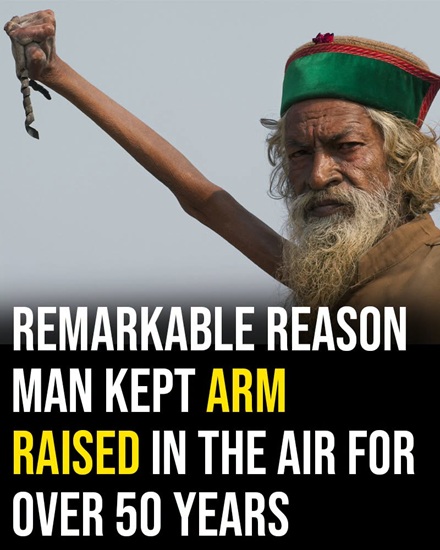
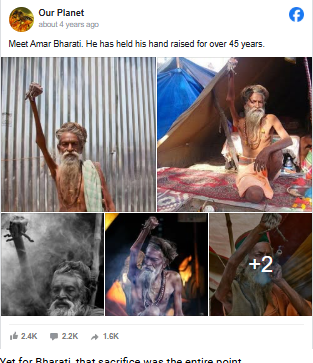
For decades, the story of Indian Hindu ascetic Amar Bharati has fascinated people around the world. Photographs taken over many years show Bharati with his right arm permanently extended above his head, a position he reportedly adopted as part of a deeply personal religious vow. His extraordinary practice has been associated with devotion to Shiva and with his publicly expressed desire for greater peace among people. Over the years, the arm has undergone dramatic visible changes, providing a striking example of the physical consequences that can accompany extremely prolonged immobility.
Published accounts describe Bharati as having lived a considerably different life before becoming a sadhu. He has been reported to have been married, to have had three children and to have worked before choosing an ascetic path. Some profiles describe him as a bank employee who was around 28 years old when he left his previous lifestyle during the early 1970s. Because detailed contemporary documentation of every part of his early biography is limited, these details are best understood as widely reported elements of his story rather than independently verified records.
His decision to become a sadhu represented a major departure from conventional family and professional life. Sadhus are Hindu ascetics who may renounce ordinary possessions, comforts and social attachments while pursuing spiritual goals. Their practices differ significantly depending on tradition, teacher and individual commitment. Bharati’s particular path has been described as one centered on devotion to Shiva, one of Hinduism’s principal deities.
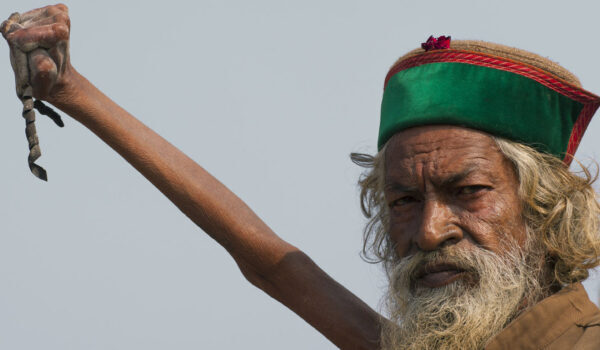
At some point during the early period of his ascetic life, Bharati reportedly made the decision that would eventually make him internationally recognizable. He raised his right arm above his head and resolved not to lower it. Different publications have given slightly different dates for when the practice began, so claims about the exact number of years should be treated with appropriate caution. What is clear from reporting and photographs spanning decades is that the posture has been maintained for an exceptionally long time.
The motivation behind the gesture is important because Bharati has not presented his raised arm as a sporting challenge, public stunt or attempt to establish an endurance record. Accounts of his statements describe the practice as an expression of spiritual devotion and sacrifice. He has also connected it to his hope for peace and his opposition to hostility and conflict between people.
In statements attributed to him over the years, Bharati has questioned why people fight and why hatred continues to divide communities. His message has not been limited to one particular dispute. Instead, he has spoken broadly about wanting people in India and throughout the world to live peacefully. His raised arm consequently became both a personal spiritual commitment and a visible symbol associated with that aspiration.
The practice is extraordinary even within the broad and diverse world of Hindu religious traditions. It would be misleading to suggest that keeping an arm raised for decades is a normal expectation for Hindu believers or even for most sadhus. Hinduism encompasses an enormous variety of beliefs, rituals and devotional practices. Bharati’s decision represents an exceptional form of individual ascetic discipline rather than a standard religious requirement.
The physical consequences of maintaining such a position are clearly visible in photographs of Bharati. His raised right arm appears dramatically thinner than a normally functioning limb. The muscles have visibly diminished, while the hand and fingers have also changed after years without ordinary use. His fingernails have grown to remarkable lengths and curved into distinctive spiral-like shapes.
The visible reduction in muscle size is consistent with a well-established medical phenomenon known as muscle atrophy. Human muscles depend on regular movement and resistance to maintain their size and strength. When a limb remains unused or severely restricted for long periods, muscle tissue can gradually waste away. Even comparatively short periods of immobilization can cause measurable weakness, making the consequences of decades without normal movement potentially profound.
Joints and surrounding tissues are also affected by prolonged immobility. A healthy shoulder, elbow, wrist and fingers normally move through substantial ranges during everyday activities. When those movements disappear for extended periods, stiffness can develop and tissues can shorten. Severe long-term restrictions can contribute to contractures, which limit the normal movement of a joint.
These general medical principles help explain why Bharati’s arm looks so different today. They do not, however, provide enough information to diagnose his precise medical condition. A photograph cannot reveal the complete condition of nerves, cartilage, tendons, blood vessels or other structures within the limb. A proper diagnosis would require direct examination by qualified medical professionals.
Accounts describing the early period of Bharati’s vow say that maintaining the position was intensely painful. Anyone who briefly holds an arm overhead can experience fatigue and discomfort because the muscles are continuously working against gravity. Bharati reportedly endured far more severe discomfort because lowering his arm would have ended the vow he had chosen to maintain.
Some reports state that the intense pain continued for roughly two years before gradually becoming less noticeable. Other accounts suggest that Bharati eventually lost much of the sensation in the limb. These claims have been repeated widely, but detailed publicly available medical documentation confirming the exact progression of his symptoms is limited.
It is therefore safer to distinguish between what Bharati and others have reportedly described and what can be medically established from public evidence. The dramatic physical transformation of his arm is visible. The exact neurological and orthopedic condition of the limb is not.
One of the questions most frequently asked about Bharati is whether he could lower his arm if he suddenly decided to end the vow.
There is no reliable public medical assessment providing a simple answer.
Some reports suggest that the arm has become effectively fixed after decades of immobility. Others emphasize that Bharati continues holding it upward primarily because he remains committed to his spiritual promise.
Those two possibilities are not necessarily mutually exclusive. After such an extraordinary period without normal movement, the arm could have severe physical limitations while Bharati simultaneously remains unwilling to attempt to lower it.
Some popular articles have gone further, claiming that the cartilage in his elbow has deteriorated so extensively that attempting to force the arm downward could break the joint. Such claims should not be treated as established medical facts without direct clinical evidence.
What can reasonably be said is that forcing movement in a limb affected by severe long-term contracture or immobilization could potentially cause injury. Medical treatment of significantly restricted joints is normally approached carefully and according to the condition of the individual patient.
Bharati’s situation is so unusual that general medical knowledge cannot predict precisely what would happen if he attempted to restore movement after decades.
The question may also misunderstand what the raised arm means to Bharati.
For an outside observer, lowering the limb might appear to be the obvious way to end the physical burden.
For Bharati, however, the position reportedly represents a vow.
Ending it would therefore carry spiritual meaning beyond simply changing the position of his body.
That distinction has remained central to accounts of his life.
His raised arm represents a sacrifice he deliberately accepted as part of his religious commitment.
The continuing physical consequences are therefore not incidental to the gesture. Sacrifice and discipline are part of what gives the practice meaning from his perspective.
Over time, Bharati’s unusual commitment attracted considerable attention. Photographers documented his appearance, journalists wrote about his story, and images of the raised arm began circulating internationally.
The development of the internet brought those photographs to an even larger audience.
Images showing his extremely thin arm and unusually long fingernails have repeatedly resurfaced on websites and social-media platforms.
Sometimes those images are presented with dramatic claims about exactly how long the arm has been raised or what would happen if he attempted to lower it.
That is where careful reporting becomes particularly important.
The central story is extraordinary without embellishment.
There is no need to present uncertain medical claims as proven facts.
There is also no need to assign Bharati motivations that differ from those he has publicly associated with the gesture.
His own reported explanation has focused on spiritual devotion and peace.
The physical transformation should be understood within that context.
Bharati’s example has reportedly influenced other sadhus who adopted similar practices. Photographs and accounts describe other ascetics keeping one arm raised for extended periods as expressions of religious discipline.
Some reportedly maintained the position for years.
However, Bharati’s practice is commonly described as having continued for an unusually long period even among those who followed similar paths.
Again, such examples should not be generalized to all Hindu ascetics.
Religious life in India is extraordinarily diverse.
Individual ascetics may adopt practices that have little resemblance to those followed by ordinary worshippers or by members of other ascetic traditions.
Bharati’s story is consequently best understood as the account of one individual’s unusually demanding spiritual commitment.
There is also a broader human dimension to the story.
Our bodies depend on movement.
Every time someone reaches for an object, bends an elbow, rotates a shoulder or opens and closes a hand, muscles and joints are performing functions necessary to preserve mobility and strength.
Bharati deliberately removed most of those normal movements from his right arm.
Years became decades.
As time passed, the consequences became increasingly visible.
Muscle mass diminished.
The arm became thin.
The hand changed.
The nails continued growing.
The raised limb effectively became a physical record of the duration of his commitment.
For many people, that transformation is the first thing they notice when seeing photographs of Bharati.
But the photographs alone do not explain why he accepted those consequences.
Understanding the story requires considering the belief behind the posture.
According to Bharati’s reported statements, he wanted his sacrifice to communicate something larger than himself.
He spoke about peace.
He questioned conflict.
He expressed frustration with hatred and hostility.
And he associated his prolonged gesture with the hope that people could coexist without constant violence.
Whether an observer agrees with his method is a separate question.
Some people may find the sacrifice spiritually meaningful.
Others may regard it primarily as an extraordinary example of physical endurance.
Still others may struggle to understand why anyone would voluntarily accept such permanent bodily consequences.
Those reactions belong to the observer.
Bharati’s own explanation should remain distinct from them.
He has reportedly understood the raised arm as an act of devotion and a call for peace.
That interpretation is essential when describing his story respectfully and accurately.
It also prevents his practice from being reduced to nothing more than an unusual photograph.
At the same time, some details frequently repeated online deserve caution.
The exact year in which the vow began varies between reports.
Claims about his life before becoming a sadhu are largely based on later profiles.
Descriptions of precisely when he stopped feeling pain are difficult to independently verify.
And claims predicting exactly what would happen medically if the arm were lowered lack publicly available clinical documentation.
Acknowledging those limitations does not diminish the extraordinary nature of the documented practice.
It simply separates evidence from speculation.
Photographs taken across many years demonstrate that Bharati has maintained the distinctive raised-arm posture for a very long period.
The visible condition of the arm demonstrates substantial physical change.
His reported statements explain the spiritual meaning he attaches to the practice.
Those elements provide enough information to tell the story without adding unsupported conclusions.
The story also illustrates the enormous influence personal conviction can have over human behavior.
Most people would instinctively lower an arm as soon as discomfort became severe.
Bharati reportedly made a conscious decision not to respond to that instinct.
He continued through pain and through the gradual transformation of the limb.
Eventually, the unusual posture became one of the defining characteristics of his public identity.
Decades later, photographs still show the right arm pointing upward.
What began as a voluntary gesture has therefore lasted through an extraordinary portion of a human lifetime.
The body has changed around the vow.
But according to the accounts documenting Bharati’s commitment, the purpose he associates with it has remained remarkably consistent.
Devotion.
Sacrifice.
And peace.
There is an understandable temptation to describe such a story using increasingly dramatic language.
But the verified and carefully qualified details are already remarkable.
Amar Bharati is an Indian Hindu ascetic widely reported to have kept his right arm raised for decades.
The limb has undergone severe visible atrophy and other changes associated with the lack of ordinary use.
His practice has been connected with devotion to Shiva and with his expressed hope for greater peace among people.
Other ascetics have reportedly adopted similar vows after his example.
Whether Bharati is physically capable of fully lowering the arm today has not been established through publicly available medical evidence.
What has been consistently reported is that he has not wanted to abandon the spiritual commitment represented by keeping it raised.
That difference matters.
The story is not simply about whether a human arm can remain above someone’s head for decades.
It is about why one person would choose to keep it there.
For Bharati, the answer has reportedly remained connected to the same ideas that motivated the gesture in the first place.
He wanted his sacrifice to stand for something.
More than half a century after the period when the practice reportedly began, his raised arm remains a striking symbol of personal devotion.
The physical cost can be seen immediately.
The precise medical consequences cannot be diagnosed responsibly from photographs alone.
But the message Bharati has associated with the gesture has repeatedly been described in simple terms:
He wants people to live with less hatred, less conflict and more peace.
Whatever people think of the extraordinary method he chose, that distinction remains central to understanding his story.
His arm may be what first attracts attention.
His stated reason for keeping it raised is what gives the story its meaning.

