

A honeymoon journey to the Greek island of Sifnos ended in tragedy when a helicopter carrying British newlyweds Alexander “Alex” Cromie and Marie Ebert crashed shortly before reaching its destination. The accident occurred on Monday, August 17, 2026, after the couple had chartered a helicopter to travel from the Athens area to the Cycladic island. The aircraft was being flown by Giorgos Raikos, an experienced Greek pilot and former military officer. All three people aboard the helicopter died in the crash.
Cromie and Ebert had recently married and were visiting Greece as part of their honeymoon. The flight was supposed to carry them from Markopoulo in eastern Attica, near Athens, to Sifnos, where the helicopter was expected to land during the early evening. Instead, something went seriously wrong during the final portion of the journey. The aircraft lost control close to the island’s helipad, crashed into the ground and caught fire.
The helicopter involved was a Bell 206, a widely used family of light helicopters that has served in civilian and military operations around the world. Investigators are now examining the aircraft’s wreckage and other available evidence to determine what caused the sudden loss of control. At this stage, Greek authorities have not announced a definitive cause of the accident, making it important to distinguish confirmed information from possibilities still being investigated.
Raikos was described in reporting following the crash as a highly experienced pilot with a background in military aviation. His experience has become one of the details investigators will consider while reconstructing the final moments of the flight. However, professional experience alone cannot determine why an aviation accident occurred, and authorities have not publicly attributed responsibility to the pilot.

The helicopter was reportedly expected to arrive on Sifnos at approximately 6:15 p.m. local time. The flight was therefore close to completion when the emergency developed. Reports said Raikos had communicated regarding the planned landing shortly before the aircraft went down, after which communication ceased.
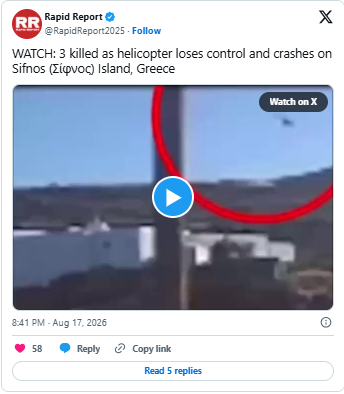
Video footage recorded from a distance captured part of the helicopter’s final descent. The aircraft can be seen rotating abnormally while losing altitude. It eventually struck the ground in an area near the island’s helipad, and a fire broke out following the impact.
Dark smoke could be seen rising from the crash location as emergency services responded. Firefighters and other personnel were sent to the scene, but the impact and fire had severely damaged the aircraft. Authorities determined that nobody aboard had survived.
Local officials described extensive destruction at the site. The wreckage was scattered around the impact area, demonstrating the force involved when the helicopter hit the ground. Despite the crash occurring near an inhabited area, reports indicated that nearby residents were not physically injured and surrounding homes were not directly struck.
Emergency crews worked to secure the area while investigators began the process of documenting evidence. Fatal aviation accidents require careful examination because damage caused during impact and fire can complicate efforts to determine whether a component failed before the crash or was destroyed afterward.
Two of the victims were reportedly located within or close to the wreckage, while another was found a short distance away. Authorities subsequently began formal identification procedures and other examinations required following a fatal accident involving foreign nationals.
Witness accounts have provided investigators with additional information about the helicopter’s final moments. Some residents living near the crash location reported hearing an unusual or unusually loud sound shortly before the aircraft descended.
Those accounts may ultimately prove relevant, but they cannot independently establish the cause of the crash. Aviation investigators generally compare witness observations with physical evidence, flight information, maintenance records, available recordings and the condition of individual aircraft components.
The helicopter’s apparent rotation before impact has generated particular interest. One possibility being examined in reporting concerns a potential problem involving the tail rotor or associated systems. The tail rotor performs an important function in counteracting torque and helping a conventional helicopter maintain directional control.
A serious problem involving that system can produce significant control difficulties. However, the appearance of rotation in a video does not by itself establish precisely which component, if any, malfunctioned.
For that reason, a tail-rotor failure should currently be described only as one possible explanation being considered, not as the established cause of the Sifnos accident.
Greek aviation authorities have taken precautionary steps involving Bell 206 helicopters while the investigation continues. Reports have described attention being directed toward inspections of tail-rotor components and related systems.
Such precautionary inspections are not equivalent to an official finding about the cause of this particular crash. Safety authorities can order or recommend additional checks while investigators are still gathering evidence.
Mechanical failure more broadly is among the possibilities receiving attention. The unusual noise described by witnesses and the helicopter’s visible movement before impact are among the details that may help investigators determine whether a technical problem developed during the final approach.
Weather conditions are also routinely considered during aviation investigations. Initial reports indicated that Sifnos was not experiencing the kind of extreme winds that would provide an obvious immediate explanation for the accident.
That does not mean environmental factors can automatically be eliminated. Investigators examine wind, visibility and other relevant conditions alongside technical and operational evidence before issuing final conclusions.
Another possibility sometimes discussed after aviation accidents involves the pilot’s health or ability to control the aircraft. There is currently no confirmed public evidence establishing that Raikos experienced a medical emergency, and such a possibility should not be presented as fact without supporting findings.
Similarly, authorities have not announced that pilot error caused the crash.
The responsible conclusion at this stage is therefore limited but clear: the helicopter lost control near Sifnos, crashed and caught fire, killing all three people aboard, while the cause remains under investigation.
The human impact of the accident extends well beyond the technical questions.
Cromie and Ebert were newly married and had traveled to Greece during what should have been a celebratory period in their lives. Their journey to Sifnos was part of their honeymoon, making the circumstances of their deaths particularly difficult for family members, friends and colleagues.
Alexander Cromie, 31, worked in London’s financial sector. He was employed by Blackstone, the U.S.-based investment firm, where he served as a vice president in its Private Wealth Solutions business.
Following reports of the crash, Blackstone issued a statement expressing shock and sadness over the deaths of Cromie and his wife.
The company remembered Cromie warmly and said he was deeply valued by the people who knew and worked with him. Blackstone also acknowledged that the couple had been celebrating their honeymoon when they died.
For colleagues who had expected Cromie to return from his trip and resume ordinary professional life, the sudden news represented an unexpected and deeply personal loss.
Marie Ebert, 30, had established her own career in London.
She worked for management consulting firm Bain & Company, where she had joined as a senior specialist in market reputation. Her professional background included experience connected with communications and reputation-related work.
Bain & Company also responded publicly after learning of reports about the accident.
The firm expressed shock at the deaths involving its colleague and her husband and conveyed support for their families and those affected.
The statements from both employers provide only a small picture of the lives Cromie and Ebert had built. Professional titles cannot capture the relationships they had with relatives and friends or the future they expected to share after their marriage.
The circumstances of their honeymoon underline how suddenly that future ended.
The couple had nearly reached their destination when the aircraft went down.
Instead of arriving on Sifnos and continuing their trip, their families received news that both had died thousands of miles from home.
Raikos’ death is equally part of the tragedy.
As the pilot, his actions and professional background will naturally receive attention during the investigation. But he was also a person with relatives, friends and colleagues who lost someone close to them.
Reports describing his extensive aviation experience have added another question to the investigation: what circumstances caused an aircraft controlled by an experienced former military pilot to enter the abnormal rotation visible before impact?
Only technical evidence can provide a reliable answer.
Investigators will examine what remains of the Bell 206 and attempt to determine the condition of important systems before the aircraft struck the ground.
The tail rotor and its associated control components are expected to receive close attention because of the nature of the helicopter’s movement captured on video.
Investigators may also examine the main rotor system, engine, transmission, flight controls and other components capable of affecting the aircraft’s behavior.
Maintenance information can be equally important.
Records may show when the helicopter was last inspected, whether components had recently been replaced or serviced, and whether any technical concerns had previously been documented.
Such records do not automatically prove that maintenance contributed to an accident. Instead, they form one part of the larger evidence investigators use to reconstruct the aircraft’s condition.
Video footage can provide another valuable source of information.
By examining the helicopter frame by frame, specialists may be able to estimate how quickly it was rotating, how rapidly it lost altitude and whether its movement changed immediately before impact.
Witness statements can then be compared with that visual evidence.
The reports of an unusual sound may help investigators determine whether something changed mechanically before the helicopter began its uncontrolled descent.
Raikos’ final communications may also become relevant.
Reports indicate that the pilot had been preparing for the landing before contact stopped.
Investigators will attempt to determine whether there was any indication of difficulty during those communications and whether the emergency developed too quickly for the pilot to issue a warning.
Until those details are officially established, it would be inappropriate to invent dialogue or claim that Raikos reported a specific technical problem.
The investigation must also distinguish between damage caused before the crash and destruction resulting from the impact and fire.
That can be one of the most challenging aspects of investigating a severely damaged aircraft.
A component discovered broken at the scene may have failed in flight, but it may also have broken when the helicopter hit the ground.
Forensic examination is designed to make that distinction whenever possible.
Greek authorities responsible for investigating aviation accidents will eventually use the available evidence to reconstruct the sequence leading to the crash.
That process can take considerable time.
Fatal aviation investigations are not intended simply to assign blame. Their broader purpose is to determine what happened and identify safety lessons that could reduce the risk of similar accidents.
If investigators establish that a mechanical component failed, those findings could lead to additional inspections, maintenance recommendations or other safety measures.
If another factor caused or contributed to the accident, the response may be different.
That is why early speculation should not be transformed into a definitive explanation before technical experts finish their work.
The videos circulating online show the final moments of the helicopter’s descent, but they cannot independently explain what caused it.
Likewise, witness reports about unusual noises provide useful information without establishing a technical diagnosis.
The available evidence therefore creates several questions rather than one confirmed explanation.
Why did the helicopter begin rotating?
Did a mechanical component fail?
Was there another technical issue?
Were multiple factors involved?
Investigators will have to answer those questions using evidence rather than assumptions.
For the families of the three victims, any eventual explanation will come after an irreversible loss.
Cromie and Ebert had begun their journey expecting to arrive safely on Sifnos and continue celebrating their marriage.
Raikos expected to complete the flight and continue his professional responsibilities.
None of them reached the planned conclusion of that journey.
Their deaths quickly attracted attention in Britain and Greece because of the unusual circumstances surrounding the accident.
However, responsible reporting does not require exaggerating those circumstances.
The established facts are already deeply tragic.
A British newlywed couple was traveling to a Greek island during their honeymoon.
An experienced Greek pilot was flying them.
The helicopter was close to its destination.
Something went wrong.
The aircraft lost control, crashed and caught fire.
All three people aboard died.
Those facts can be reported without claiming knowledge investigators do not yet have.
In particular, mechanical failure remains a possibility rather than a final conclusion.
The same applies to theories concerning the tail rotor, pilot health or human error.
Each must remain clearly identified as unconfirmed unless investigators establish otherwise.
This distinction becomes particularly important when video of a dramatic accident circulates widely on social media.
Images can create an understandable desire for immediate explanations, but aviation accidents are technically complex.
What appears obvious from a short recording may not reflect the complete sequence of events.
Professional investigators therefore rely on multiple sources of evidence.
For Cromie’s colleagues at Blackstone and Ebert’s colleagues at Bain & Company, the technical questions exist alongside personal grief.
Both organizations expressed shock following the deaths.
Their statements focused on the people they had known rather than attempting to explain the accident.
The couple’s relatives face an even more profound loss.
A honeymoon normally marks the beginning of married life.
For Cromie and Ebert, it became the setting of an unexpected tragedy.
The pilot’s family likewise waits for answers about how an ordinary professional flight ended in disaster.
On Sifnos, residents who witnessed the crash or its aftermath must also process what occurred close to their homes.
Emergency personnel who responded encountered the consequences immediately.
Their work included extinguishing the fire, securing the area and assisting with the initial investigation.
The fact that no one on the ground was reported killed prevented the tragedy from becoming even larger.
The focus now turns toward understanding the aircraft’s final moments.
Investigators have physical wreckage.
They have video.
They have witness accounts.
They can examine available operational and maintenance records.
They can analyze the pilot’s communications and the circumstances of the planned landing.
Each piece may provide part of the answer.
Only when those pieces are considered together can investigators reasonably determine why the Bell 206 lost control.
Until then, the most accurate description of the cause is that it remains under investigation.
That uncertainty should not overshadow what is already known about the victims.
Alexander Cromie and Marie Ebert were newlyweds building careers and beginning married life.
Giorgos Raikos was an experienced pilot whose professional background included military aviation.
All three died within minutes of the helicopter’s expected arrival.
Their families and colleagues are now left waiting for answers that may take time.
The investigation may eventually explain whether a mechanical malfunction, another technical problem or some combination of factors caused the crash.
Whatever conclusion investigators reach, it cannot change the human outcome.
Three people left the Athens area expecting an ordinary flight to Sifnos on August 17, 2026.
The helicopter almost completed that journey.
Instead, it crashed near its destination.
For now, accuracy requires keeping the confirmed facts separate from the unanswered questions.
The deaths are confirmed.
The investigation is continuing.
The precise cause has not yet been conclusively established.
And until authorities complete that work, the tragedy should be remembered without turning preliminary theories into facts.

