
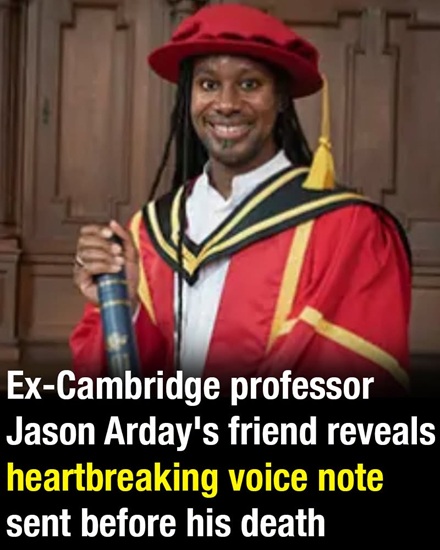
The death of former University of Cambridge professor Jason Arday at the age of 41 has led to grief and renewed discussion about the intense scrutiny he experienced during the final period of his life. Arday had recently resigned from his Cambridge position after allegations were raised concerning plagiarism and other aspects of his academic record. He disputed accusations that he had deliberately acted dishonestly while acknowledging mistakes in some of his work.
His death came only days after his resignation, but the circumstances should not be reduced to a simple cause-and-effect conclusion. Arday was found dead at his home in south London in August 2026. The Metropolitan Police described his death as unexpected but said it was not believed to be suspicious. His family was informed, and police said a file would be prepared for the coroner. That official position remains important when discussing what happened.
Until the appropriate authorities complete their work, speculation about the precise cause or circumstances of Arday’s death should not be presented as established fact. In the days following his death, Sir Simon Baron-Cohen offered a deeply personal account of conversations he had shared with Arday. Baron-Cohen, a University of Cambridge professor and director of the Autism Research Centre, said he had spoken with Arday on the morning of his death. During an appearance on BBC Radio 4’s Today programme, he also described distressing voice messages Arday had sent while facing mounting public criticism.
According to Baron-Cohen, Arday felt overwhelmed by what had happened to his career and reputation. The scrutiny had moved beyond individual questions concerning academic work and expanded into examination of many parts of his professional and personal history. Baron-Cohen recalled Arday communicating that he felt he could no longer continue under the pressure. Those comments provide important insight into what a close contact says Arday was experiencing, but they do not constitute an official finding about his death.
That distinction is essential.
A friend can accurately describe a conversation without being able to establish medically or legally what caused a person’s death. Likewise, the timing of a tragedy can raise legitimate questions without proving that one event, institution or individual was responsible for the outcome.
Arday’s professional difficulties had intensified rapidly before his death.
Questions were raised about passages in his doctoral thesis, including allegations that material had not been properly attributed. Other reporting examined elements of his academic history and public biography.
Arday challenged accusations that he had intentionally misrepresented his work.
He acknowledged errors but rejected being characterized simply as dishonest.
The University of Cambridge became involved as the controversy expanded, and scrutiny surrounding Arday’s appointment and academic record continued.
On August 5, Arday resigned from his professorship.
In announcing his departure, he said the continuing accusations, speculation and public commentary had taken a profound toll on him and on people he loved.
That statement came directly from Arday and provides important evidence about how he viewed the impact of the controversy on his own life.
His resignation represented a dramatic change in a career that had previously attracted significant attention.
In 2023, Arday’s appointment at Cambridge was widely reported as a milestone. At the time, he was described as the youngest Black person to become a professor at the university.
His path into academia had also attracted considerable interest.
Arday had spoken publicly about being autistic and about developmental and communication difficulties during childhood. He later built an academic career focused on education, inequality, race and social mobility.
Before joining Cambridge, he held positions at other British universities.
His work and personal history made him a prominent voice in discussions concerning representation and opportunity within higher education.
That visibility also meant the controversy surrounding his record quickly became about more than one academic.
Arguments about Arday became connected with broader disagreements concerning diversity initiatives, academic standards and representation in British universities.
Some observers argued that questions concerning plagiarism and research integrity needed to be investigated rigorously regardless of the identity of the academic involved.
That principle is legitimate.
Universities depend on clear standards regarding attribution, research practices and professional integrity.
Other observers argued that scrutiny of Arday went far beyond legitimate examination of his work.
They pointed to personal attacks, online ridicule and commentary they believed was influenced by racial hostility.
Following Arday’s death, those competing interpretations became even more emotionally charged.
His family issued a statement describing what they regarded as years of sustained abuse.
They said Arday had been subjected to a campaign intended to undermine him since his appointment at Cambridge and argued that the pressure had become overwhelming.
The family remembered him in personal rather than professional terms.
They had lost a father, partner, brother, uncle and son.
Their statement also requested privacy and asked that harassment directed toward the family end.
Those comments deserve to be reported accurately as the family’s perspective.
They should not automatically be transformed into a legal or medical conclusion about responsibility for Arday’s death.
The same principle applies to statements from colleagues and political figures.
London Mayor Sadiq Khan criticized what he described as public shaming directed toward Arday.
Others called for examination of the way the controversy had been handled.
Such comments form part of a legitimate public debate.
They do not replace the work of the coroner or establish who, if anyone, bears responsibility for Arday’s death.
Baron-Cohen focused particularly on Arday’s vulnerability.
He referred to Arday’s history of autism, language delay and learning differences and argued that those circumstances should have been considered when providing support and reasonable adjustments.
For Baron-Cohen, the controversy was not only about an academic under investigation.
It was also about a person he believed needed appropriate safeguarding while facing an extraordinarily stressful situation.
That argument raises important institutional questions.
Professional accountability and employee welfare do not necessarily conflict.
An institution can investigate serious allegations while also ensuring that the person involved has access to appropriate support.
Likewise, journalists can investigate matters of public interest without treating humiliation as the purpose of reporting.
Maintaining that distinction becomes more difficult once a controversy spreads across social media.
Online platforms can transform individual allegations into continuous public scrutiny.
One article can generate thousands of posts.
Old interviews can be rediscovered and analyzed.
Personal claims can be detached from their original context.
Strangers may begin making confident judgments about someone’s motives, personality or mental state.
The scale can become enormous.
For a person at the center of such attention, the experience may be very different from a conventional professional investigation conducted privately.
People close to Arday have said that the pressure affected him profoundly.
His own resignation statement similarly described a serious personal toll.
Those facts are relevant.
But responsible reporting should stop short of claiming they establish the precise cause of his death.
The Metropolitan Police have said the death is not believed to be suspicious.
The coroner process remains the appropriate mechanism for formal findings.
Until that process provides additional information, there are limits to what can responsibly be stated.
Similar care is necessary when discussing the academic allegations themselves.
Arday’s death does not automatically invalidate questions raised about his work.
Academic integrity remains important even when a controversy has tragic consequences.
At the same time, allegations do not become proven facts simply because they have been repeated extensively.
Arday disputed intentional wrongdoing.
He also acknowledged mistakes.
Both parts of that record should remain visible.
Removing either produces an incomplete picture.
Cambridge itself faced scrutiny over how Arday had been appointed and how subsequent concerns were handled.
The university had previously celebrated his achievements and the significance of his appointment.
Later, as questions accumulated, it announced inquiries concerning aspects of his academic background.
The situation therefore raised questions not only about Arday but about institutional processes.
Were appropriate checks conducted?
Were concerns investigated fairly?
Was adequate support available while investigations continued?
Those are legitimate questions that can be examined using evidence.
They do not require speculation about Arday’s death.
The broader public discussion also needs to distinguish criticism from harassment.
A researcher whose work contains potential attribution problems can reasonably face examination of that work.
Journalists can report documented discrepancies.
Other academics can discuss standards.
But personal insults, racial abuse, threats or attempts to humiliate someone are different from evidence-based criticism.
The existence of one does not justify the other.
Likewise, acknowledging possible harassment does not require dismissing every professional concern as illegitimate.
Both realities can potentially exist simultaneously.
That complexity is important in Arday’s case.
He was a prominent Black academic whose career represented a significant milestone.
He also became the subject of serious questions concerning his academic record.
He disputed deliberate dishonesty.
He experienced intense public scrutiny.
People close to him say he became increasingly distressed.
Then he died unexpectedly at 41.
Those facts form a sequence.
They should not automatically be converted into a proven explanation.
Human lives and mental states are rarely reducible to one event.
That is especially important when someone is no longer able to speak for themselves.
Arday cannot now respond to new interpretations of his actions or experiences.
That places a greater responsibility on anyone discussing the case to distinguish documentation from inference.
Baron-Cohen’s account offers a valuable example.
He can say what Arday told him.
He can describe the voice messages he received.
He can explain what he believed his friend was experiencing.
But even a close friend cannot replace an official investigation.
The same standard protects the accuracy of the story.
It also protects Arday from having his final days turned into another source of unsupported speculation.
His death has understandably caused colleagues to reconsider earlier interactions.
People may replay conversations and wonder whether something different could have been done.
That response is common after an unexpected death.
Hindsight can make earlier moments appear clearer than they felt at the time.
But reflection should not automatically become blame.
Questions about safeguarding deserve investigation.
Questions about media conduct deserve discussion.
Questions about university procedures deserve examination.
Those discussions can happen without declaring conclusions before sufficient evidence exists.
Arday’s life should also not be remembered only through the controversy that surrounded its final months.
His academic career focused heavily on inequality and education.
He became an influential figure for people who saw his path into Cambridge as evidence that unconventional educational journeys could still lead to elite academic institutions.
His appointment carried symbolic importance for many people.
That significance helps explain why the later controversy attracted such intense attention.
Supporters felt that someone who represented progress was being attacked.
Critics felt that symbolic importance should not shield anyone from academic scrutiny.
Those positions collided publicly.
After Arday’s death, the argument became even more difficult because grief entered a debate that had previously centered on professional credibility.
Perhaps the most useful response now is to separate the different questions.
The quality and originality of academic work can be evaluated through evidence and established procedures.
Cambridge’s appointment processes can be reviewed independently.
Claims of harassment or discriminatory treatment can be examined based on documented conduct.
And the circumstances of Arday’s death can be addressed by the coroner.
Combining all of those questions into one emotional conclusion risks obscuring rather than clarifying what happened.
Accuracy requires patience.
It also requires acknowledging uncertainty.
At present, authorities have said Arday’s death was unexpected and not believed suspicious.
His family says he experienced sustained abuse.
Arday himself said public accusations and commentary had taken a profound toll.
Baron-Cohen says his friend expressed severe distress in private messages.
Those statements are significant.
None should be exaggerated beyond what they establish.
The tragedy also provides a broader reminder about the human cost of public controversy.
People can be held accountable without being dehumanized.
Investigations can remain rigorous without turning into entertainment.
Criticism can focus on evidence rather than personal humiliation.
And disagreement does not require strangers to join mass ridicule.
Those principles apply regardless of whether allegations are eventually upheld or rejected.
They protect the integrity of public discussion itself.
They are particularly important in the age of social media, where thousands of people can participate in a controversy without ever meeting the person at its center.
Each individual comment may appear insignificant.
Together, the attention can become relentless.
That does not mean public figures should be immune from scrutiny.
It means scrutiny should remain connected to evidence and legitimate public interest.
Jason Arday’s final weeks demonstrate why those distinctions matter.
He had gone from holding a celebrated Cambridge professorship to resigning amid a major public controversy.
According to people close to him, he was struggling profoundly with what had happened.
Days later, he was dead.
That timeline is undeniably painful.
But responsible coverage should resist turning pain into certainty.
There is still an official process concerning his death.
There are still unresolved questions surrounding aspects of his academic career.
There are still disagreements about whether coverage of those questions was proportionate.
Those matters deserve careful examination rather than a predetermined conclusion.
For Arday’s family, however, the public debate is secondary to a far more immediate reality.
They have lost someone they loved.
Their request for privacy should be understood within that grief.
A person’s professional record can continue to be discussed without turning surviving relatives into targets.
The same applies to Arday’s friends.
Baron-Cohen’s recollection of their final communications is heartbreaking precisely because it describes a private moment that now carries significance he could not have wanted it to possess.
The voice messages show, according to his account, that Arday was in serious distress.
They do not provide every answer.
Perhaps that is the most important point to preserve.
Not every tragedy immediately produces a complete explanation.
Sometimes the responsible response is to state clearly what is known, identify what remains disputed and allow formal processes to determine what they can.
Jason Arday was 41 when he died.
He had achieved an unusually prominent academic position and had also become the subject of intense criticism.
His career contained both accomplishments and controversy.
His final weeks contained documented professional upheaval and, according to those close to him, substantial personal distress.
His death is not believed by police to be suspicious.
Beyond that, conclusions should follow evidence.
As discussions continue, Arday’s case can still prompt worthwhile reflection.
Universities can consider how they combine rigorous academic standards with appropriate support.
Journalists can consider how legitimate investigation differs from unnecessary personal intrusion.
Social-media users can consider whether participation in ridicule contributes anything useful to public understanding.
None of those conversations requires pretending that professional concerns never existed.
They require only recognizing that accountability and humanity can operate together.
That may be the most responsible way to approach Jason Arday’s story now.
Examine evidence where evidence exists.
Attribute claims to the people making them.
Avoid presenting disputed allegations as settled facts.
Avoid assigning a cause to his death before the formal process does so.
And remember that behind the professorship, headlines and controversy was a human being whose family and friends are now dealing with a loss that no public debate can reverse.

