
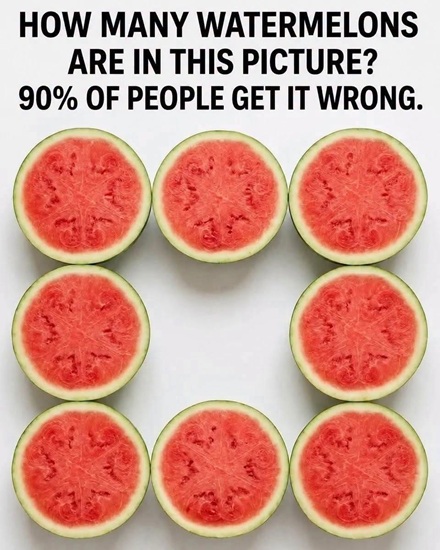
A watermelon counting puzzle may look incredibly easy when it first appears on a screen. Several familiar green fruits are arranged together, and the challenge seems to require nothing more complicated than counting them. Many viewers therefore decide on an answer within seconds. The difficulty becomes apparent only after taking a closer look, because some of the watermelon shapes may not represent complete fruits. Missing quarters, halves or other sections can completely change the final calculation.
The most common mistake is counting every recognizable circular shape as one whole watermelon. Human vision is extremely good at identifying familiar objects quickly, so the brain may register “watermelon” before examining whether the entire fruit is actually present. That shortcut is normally useful. In a visual puzzle, however, the illustrator can deliberately use it to make an incomplete object appear complete at first glance.
A better approach is to separate recognition from calculation.
Instead of immediately asking how many watermelon-shaped objects appear in the image, ask how much actual watermelon the visible pieces represent. A complete fruit counts as one. A half contributes 0.5, while a quarter contributes 0.25. If three quarters of a fruit remain, that object represents 0.75 rather than a full unit.
Once those values are identified, the arithmetic becomes straightforward.
Two halves combine to create one complete watermelon equivalent. Four quarters also produce one whole. A half combined with two quarters gives another complete unit. The challenge is therefore rarely the mathematics itself.
The real challenge is noticing the fractions correctly.
This is also why a numerical answer should not automatically be copied from another version of the puzzle. Viral images frequently pass through many websites and social-media accounts. During that process, an image may be cropped, resized, compressed or edited.
A small alteration can affect the answer.
A watermelon near the edge may lose a visible section during cropping. Another repost may contain a slightly different arrangement. Someone may even recreate the original puzzle while changing one of the pieces.
The caption, however, may remain unchanged.
That can result in two people confidently defending different answers while unknowingly examining different versions of the challenge.
For this reason, the exact image matters.
Without the specific puzzle visible, there is no responsible way to claim that one particular number is universally correct. The safest approach is to explain how the answer should be calculated from whichever version the viewer has in front of them.
Start with the complete watermelons.
Move through the image systematically, perhaps from the upper-left corner toward the lower-right. Count only fruits that are visibly whole and record that number.
Then begin a second count for incomplete pieces.
Classify each one according to how much of a complete fruit remains. Keeping the categories separate prevents the brain from switching repeatedly between counting whole objects and calculating fractions.
For example, write down the number of complete fruits first.
Then count the halves.
Next count the quarters.
Finally, identify any unusual fractions or overlapping pieces that require closer examination.
Only after every object has been classified should the totals be combined.
This method also reduces accidental double counting. In a busy visual arrangement, it is easy to return to an object that has already been included, especially when several watermelons look almost identical.
Moving consistently in one direction helps prevent that error.
Overlapping shapes deserve special attention.
Two visible pieces might initially look like separate fruits even though they represent parts of incomplete watermelons. Alternatively, a piece positioned behind another object may contain more fruit than appears obvious at first glance.
The outlines provide important clues.
Rather than relying entirely on the familiar green appearance, follow the edges of each object and determine exactly where the missing sections begin and end.
Imagine a hypothetical version containing five complete watermelons, two halves and four quarters.
The five complete fruits contribute five units.
The two halves combine into one additional whole watermelon.
The four quarters combine into another.
That hypothetical arrangement would therefore contain the equivalent of seven complete watermelons.
This is only an example of the calculation method, not the answer to every viral watermelon image.
That distinction is important.
An accurate puzzle explanation should allow another person to reproduce the result instead of simply announcing a number.
If someone says the answer is seven, eight or another total, ask how that number was calculated.
Which fruits were complete?
Which were partial?
How were the fractions combined?
Once the reasoning is visible, mistakes become much easier to identify.
Perhaps a quarter was overlooked.
Maybe someone counted a three-quarter watermelon as complete.
Another viewer may have counted a missing piece twice.
Or the disagreement may come from two genuinely different versions of the picture.
This type of puzzle works because visual perception is designed for efficiency.
The brain receives enormous amounts of visual information continuously. Analyzing every individual line, curve, color and shadow would be far too slow for everyday life.
Instead, the mind searches for familiar patterns.
When enough visual information resembles a watermelon, recognition happens rapidly.
The brain does not necessarily stop to calculate whether 25 percent of that watermelon is missing.
Normally, there would be no reason to do so.
A puzzle deliberately creates that reason.
It takes advantage of a useful mental shortcut and places the important information precisely where the viewer is least likely to examine it during the first few seconds.
That does not mean people who answer incorrectly are careless.
Their brains may simply prioritize different information.
One person notices the overall number of circular objects.
Another notices missing pieces.
Someone else focuses on the symmetry of the arrangement before thinking about either.
Attention can also be influenced by the device being used.
A large computer monitor can make small boundaries easier to see than a phone screen.
Image compression may blur the edge separating one fraction from another.
Brightness and contrast can affect visibility too.
Even fatigue can make subtle details easier to overlook.
These factors help explain why visual puzzles should be treated as entertainment rather than serious measures of intelligence.
Getting the answer quickly does not prove someone has exceptional intelligence.
Missing one quarter of a watermelon does not demonstrate poor reasoning ability.
It means only that a particular detail was or was not noticed during a particular visual task.
Claims such as “only geniuses can solve this” should therefore be treated skeptically unless supported by actual research.
The same caution applies to claims that the answer reveals someone’s personality.
A counting puzzle cannot reliably determine whether a viewer is creative, emotionally intelligent, analytical or unusually perceptive.
Human personality is far more complicated than a single visual choice.
That does not make these puzzles less enjoyable.
Their appeal comes from the moment when the interpretation suddenly changes.
At first, someone may be completely confident in an answer.
Then another person points toward one watermelon and asks a simple question:
Is that one actually complete?
Suddenly, the entire picture needs to be counted again.
Nothing in the image changed.
Only the viewer’s understanding changed.
That shift is one of the most interesting aspects of visual perception.
Once a hidden pattern has been recognized, it can become difficult not to see it.
The previously invisible missing sections suddenly appear obvious.
This effect occurs in many visual challenges.
Spot-the-difference puzzles hide small alterations inside nearly identical scenes.
Hidden-object images bury recognizable shapes within visually complicated backgrounds.
Optical illusions exploit assumptions about size, depth, direction and perspective.
Watermelon puzzles use fractions and familiar objects to produce a similar result.
The solution is therefore not to stare randomly at the picture for longer.
A structured method works better.
Divide the image into sections.
Examine each section separately.
Classify every object according to size.
Record what has already been counted.
Then combine the values.
This approach turns a visual trick into a transparent calculation.
It also makes discussion more productive.
If two people disagree, they can compare individual pieces rather than arguing about the final number.
Perhaps both calculations are correct for the images they received.
That possibility becomes especially relevant when a puzzle has circulated online for years.
Reposting can change visual information.
A crop that removes only a small portion of the image may seem insignificant, yet that missing area could contain exactly the fraction needed to alter the answer.
For that reason, the image itself should always take priority over the caption attached to it.
Do not assume a viral answer is correct simply because thousands of people have shared it.
Count what is actually visible.
The same principle applies to many online claims beyond puzzles.
Popularity does not automatically establish accuracy.
A confident caption does not replace evidence.
And a first impression can change when additional details become visible.
That broader lesson is part of what makes such a simple puzzle surprisingly useful.
It encourages people to distinguish between what they immediately recognize and what careful observation actually shows.
The first answer is not necessarily wrong.
It simply needs to be tested.
There is also no reason to rush.
Viral posts often challenge viewers to solve an image in five or ten seconds because the time pressure makes the activity more exciting.
But speed increases reliance on visual shortcuts.
Removing the time limit encourages a different type of thinking.
Instead of guessing, the viewer verifies.
That process is ultimately more valuable than producing the fastest answer.
A correct total should be something another person can independently check.
If every complete fruit and partial piece can be accounted for, the solution becomes transparent.
There is no need for a mysterious trick.
The fractions explain everything.
So the next time a watermelon counting puzzle appears in your feed, avoid counting only the number of familiar shapes.
Look at how much of each fruit actually remains.
Check the corners and edges.
Identify complete watermelons first.
Separate halves and quarters.
Combine matching fractions.
Then calculate the final total from the specific image in front of you.
If another person reaches a different answer, compare the pieces one by one.
The disagreement may reveal something one of you missed.
Or it may reveal that the two images are not identical.
Either way, the puzzle has accomplished its purpose.
It has forced the brain to move from fast recognition to careful observation.
The mathematics remains simple.
The perception is what creates the challenge.
And that is why an ordinary picture of watermelons can generate thousands of different answers online: people are not struggling to count.
They are learning to look twice.

