
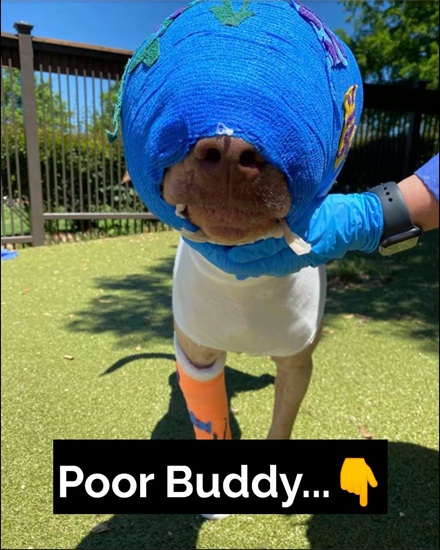
Buddy’s story became widely known in 2021 after a young dog in Mississippi survived an exceptionally serious case of animal cruelty. The Labrador retriever mix was discovered with severe burn injuries affecting much of his face and other areas of his body. An electrical extension cord was also found around his neck. What followed was not an overnight recovery but months of specialized veterinary treatment, repeated procedures and careful rehabilitation that ultimately gave Buddy an opportunity to return to a much more normal life.
According to Mississippi State University’s College of Veterinary Medicine, Buddy was intentionally burned on April 22, 2021, in Tate County, Mississippi. Neighbors discovered the injured dog and sought help, beginning an emergency response that would eventually involve several veterinary professionals and organizations. Buddy first received treatment at facilities in northern Mississippi, where efforts focused on stabilizing his condition, controlling pain and caring for his extensive wounds.
Four days after the incident, on April 26, Buddy was transferred to Mississippi State University’s College of Veterinary Medicine. His injuries were serious, particularly around his face, forehead, ears and part of his right front leg. Burn injuries can also evolve after the initial trauma, meaning veterinarians needed time to determine which tissue could recover and which areas would require additional treatment.
Despite the severity of what had happened, Buddy’s overall physical condition offered some reasons for cautious hope.
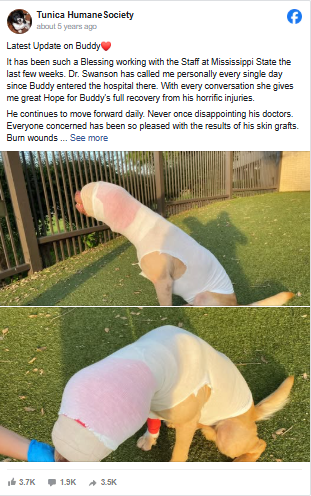
His veterinary team reported that his vital signs were stable, but they also emphasized that treating serious burns would require considerable time. Burn patients can face complications involving infection, pain, tissue damage and fluid management. Buddy therefore needed continuous monitoring rather than a single procedure followed by a quick discharge.
Dr. Elizabeth “Betsy” Swanson, an associate professor and small-animal surgeon at Mississippi State, became a central figure in Buddy’s treatment. Swanson and the wider veterinary team approached his recovery gradually, responding to problems as they developed while allowing damaged areas enough time to heal.
One of the first priorities was managing the injured tissue.
Buddy underwent debridement procedures in which veterinarians carefully removed tissue that could no longer heal properly. This process is important in severe wound treatment because damaged tissue can interfere with recovery and increase the risk of complications. According to later information released by Mississippi State, Buddy’s complete course of treatment ultimately involved more than 10 surgical procedures.
Pain management was equally important.
During the earliest stages of treatment, even routine wound care could be extremely uncomfortable. Buddy sometimes required anesthesia or significant sedation while veterinarians changed his dressings and treated the injured areas. His caregivers had to balance the need to examine and clean his wounds with the equally important goal of keeping him as comfortable as possible.
Preventing infection represented another major challenge.
Healthy skin provides an important protective barrier against bacteria and other threats. Severe burns compromise that barrier, making careful wound management essential. Buddy received extensive veterinary attention while his medical team monitored his condition and adjusted treatment as healing progressed.
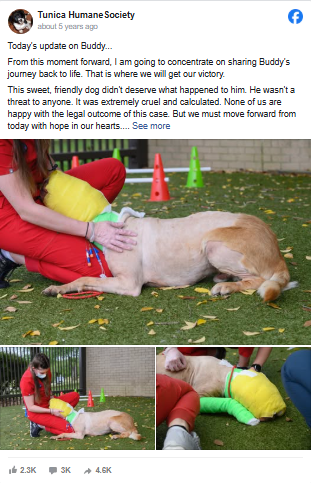
His recovery eventually included an unusual form of skin-graft treatment.
Mississippi State reported that veterinarians used a medical material derived from North Atlantic cod skin as part of Buddy’s wound care. The processed fish-skin product served as a matrix that supported the growth of Buddy’s own tissue. The company that produced the material donated grafts for his treatment.
Multiple layers were applied to injured areas of Buddy’s face.
The approach produced encouraging results. Dr. Swanson later reported that Buddy appeared to experience a significant reduction in discomfort after the first graft was applied. Over time, the treatment helped create conditions in which his own tissue could continue repairing the extensive damage.
Another major question involved Buddy’s eyesight.
His face had suffered severe burns, and swelling initially made it difficult to determine exactly how much damage had occurred around his eyes. The surrounding eyelids and tissue required substantial treatment, creating understandable concern that his vision might have been permanently affected.
Veterinarians eventually received encouraging news.
Buddy’s eyes themselves had survived. Although the tissue surrounding them was damaged and would later require reconstructive treatment, his ability to see had been preserved. That discovery became one of the most important milestones in a recovery filled with uncertainty.
For a long period, however, protective bandages covered much of Buddy’s head.
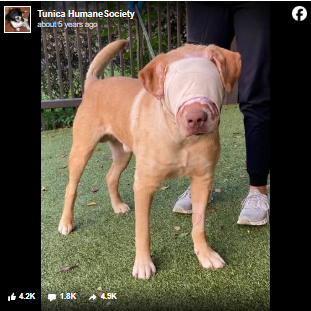
The dressings were necessary to protect healing tissue, but they also limited his ability to interact normally with his surroundings. Staff and veterinary students therefore helped Buddy navigate an environment he could not always see clearly.
He learned to rely on voices, touch and familiar routines.
Medical treatment was only one part of his recovery. Whenever Buddy’s condition allowed, caregivers also worked to keep him mentally engaged and physically active. They walked him, introduced basic training and gave him opportunities to interact with toys and people.
Those seemingly ordinary activities served an important purpose.
A dog hospitalized for months needs more than surgeries and medication. Maintaining emotional well-being and appropriate activity can become part of a broader rehabilitation plan. Buddy’s caregivers wanted him to heal physically without spending every moment of his long hospitalization focused only on medical procedures.
His personality helped.
People involved in his care repeatedly described Buddy as friendly and responsive despite everything he had endured. As his pain decreased and the amount of bandaging gradually became smaller, more of his playful behavior returned.
His progress could be measured in small changes.
Wounds that had once required extensive coverage began closing. Healthy tissue developed in treated areas. Some hair eventually started returning. Procedures that had previously required significant sedation became easier as the most painful phase of his recovery passed.
Then came one of the milestones that attracted widespread attention.
After months in which protective dressings had limited his vision, Buddy was finally able to open his eyes and clearly respond to his surroundings. The confirmation that he could see represented far more than a medical update. It allowed him to interact with the world in a way he had been unable to do for much of his hospitalization.
His behavior changed noticeably as well.
Buddy became increasingly playful and curious. Toys became an important part of his routine, and balls were among his favorites. Images and videos released during his recovery showed him carrying toys and interacting enthusiastically with the people around him.
The transformation was significant.
Only months earlier, veterinarians had been confronting extensive wounds and uncertainty about the future of his eyesight. Now Buddy could walk around the hospital, recognize his surroundings and enjoy activities associated with an ordinary young dog.
His recovery was still not complete.
The burns had damaged Buddy’s eyelids, which play an essential role in protecting and lubricating the eyes. Reconstructive procedures were therefore necessary. Mississippi State reported that his continuing treatment would include eyelid reconstruction as well as care for other medical issues.
The veterinary work required an extensive team.
Faculty members, residents, veterinary students and specialists contributed to different parts of Buddy’s treatment. Areas including surgery, anesthesia, intensive care, ophthalmology and radiology were involved during his prolonged stay.
The financial cost was substantial as well.
Mississippi State later reported that Buddy’s veterinary expenses exceeded $40,000. The Tunica Humane Society, supported by donations, helped cover the cost of the extensive treatment.
Public interest grew as Buddy’s progress continued.
Updates from the humane society and veterinary team allowed people far beyond Mississippi to follow his recovery. Each reduction in bandaging or improvement in his behavior represented another sign that the dog who had arrived with life-changing injuries was moving toward a different future.
Still, veterinarians were realistic about his long-term needs.
The new and repaired skin covering areas affected by the burns would remain sensitive. Buddy would need protection from prolonged sun exposure, including sunscreen when appropriate. His eyes could also require ongoing care, including artificial tears or similar treatment depending on his needs.
Those precautions did not prevent him from having a good quality of life.
Instead, they became part of managing the lasting effects of an injury that had once placed his future in serious doubt. Buddy could walk, play, interact with people and enjoy many ordinary activities, provided that his caregivers remained attentive to his medical needs.
By early 2022, the long hospitalization finally approached its end.
Buddy had spent roughly 10 months undergoing treatment and rehabilitation at Mississippi State. During that time, he experienced more than 10 procedures, extensive wound management, specialized grafting and reconstructive care.
Eventually, he was ready to leave the hospital.
That milestone also led to an unexpected development in his personal story.
Dr. Swanson, the veterinarian who had been closely involved in his treatment, initially brought Buddy into her home as a foster dog. She already understood his medical history and the special precautions he would continue to require.
The temporary arrangement eventually became permanent.
Swanson adopted Buddy.
After months of being surrounded by veterinarians because he required constant medical attention, Buddy now had a permanent home with one of the people who knew his recovery better than almost anyone else.
Later updates provided further evidence of how far he had come.
Mississippi State reported in 2023 that Buddy was healthy and happy. He enjoyed walking, meeting people and participating in ordinary activities with his new family. His sensitive skin still needed appropriate sun protection, but the focus of his life was no longer continuous hospital treatment.
He could simply spend time being a dog.
That outcome was especially meaningful considering how uncertain his future had appeared in April 2021.
Buddy’s case also became connected to broader discussions about animal cruelty involving juveniles. Mississippi later enacted legislation commonly referred to as “Buddy’s Law,” addressing psychological evaluation in certain juvenile animal-cruelty cases.
Reporting that part of the story requires particular care.
Public accounts connected a juvenile to what happened to Buddy, and later Mississippi State material described the person responsible as a juvenile. Because the individual involved was a child, there is no need to speculate about identity or add personal information beyond what reliable sources have publicly documented.
Buddy’s recovery itself provides more than enough of a story.
The dog required months of professional care because severe burns do not heal instantly. His progress depended on repeated medical decisions, careful wound management and the ability of his body to respond to treatment.
There was no single moment that saved him.
Instead, recovery happened through a sequence of steps.
Emergency treatment stabilized him. Debridement removed severely damaged tissue. Medication controlled pain and helped manage complications. Specialized cod-skin grafts supported wound healing. Protective bandages allowed vulnerable areas to recover.
Later came reconstruction.
His eyelids required attention so that his eyes could remain properly protected. Sensitive areas of new skin needed long-term care. Each stage addressed a different consequence of the original injuries.
Meanwhile, Buddy had to adapt emotionally.
For months, much of his life consisted of hospital rooms, medical procedures and people examining his wounds. Yet his caregivers continued giving him opportunities to play, walk and interact whenever possible.
Gradually, normal behavior returned.
The dog who had once required extensive bandaging could eventually walk through the hospital carrying a favorite toy. The patient whose vision had initially been uncertain could see the people caring for him.
Those ordinary moments became some of the clearest signs of extraordinary progress.
Buddy’s story also demonstrates what coordinated veterinary medicine can accomplish in severe trauma cases. Surgeons alone did not produce the final outcome. Successful treatment required collaboration among multiple specialties, veterinary nurses, students, humane-society workers and others involved in his care.
Public support played a role too.
The cost and duration of Buddy’s treatment would have created major challenges for almost any rescue organization. Donations helped the Tunica Humane Society continue supporting his medical needs throughout the long recovery.
The veterinary team contributed expertise.
And Buddy continued responding to treatment.
Eventually, all those pieces produced an outcome that would have been difficult to predict from the condition in which he was initially found.
Buddy’s story should not be remembered only because of the cruelty he experienced.
Focusing exclusively on the attack risks allowing one terrible event to define the rest of his life. His documented recovery tells a much larger story about veterinary medicine, long-term rehabilitation and the people who remained committed to an injured animal month after month.
The later chapters are considerably more hopeful.
Buddy survived.
His eyesight was preserved.
His wounds healed enough for him to leave the hospital.
He found a permanent home.
And the veterinarian who had helped guide him through some of his most difficult months became the person responsible for caring for him afterward.
His life still includes precautions related to his injuries.
Sensitive skin means sun exposure must be managed carefully, and his eyes may require additional attention. Those are lasting consequences of what happened, but they exist alongside a much broader recovery.
By 2023, Buddy was no longer primarily being described through medical procedures.
He was being described as healthy and happy.
For the professionals who remembered the dog arriving with extensive burns, that change represented years of effort condensed into two simple words.
Buddy’s journey demonstrates why severe veterinary trauma cases require patience.
Healing occurred over months rather than days. Progress sometimes meant a major procedure, while at other times it meant something as simple as needing less bandaging or becoming comfortable enough to play.
Each improvement mattered.
The story that began in Tate County in April 2021 could easily have ended very differently.
Instead, neighbors sought assistance, veterinary professionals responded, the Tunica Humane Society supported his treatment and specialists at Mississippi State spent months working toward his recovery.
Buddy did the rest by continuing forward through each stage of care.
More than anything, his later life provides the most meaningful conclusion.
He did not remain permanently inside a veterinary hospital. He was able to leave the environment associated with his injuries and treatment and begin a new life in a home.
He had walks to take, people to meet and toys to carry.
He also had someone beside him who understood exactly what he had survived and what he would need in the future.
The cruelty that brought Buddy to Mississippi State will always remain part of his history.
But it does not have to be the final definition of his life.
His recovery, preserved eyesight, return to playful behavior and eventual adoption became equally important parts of that history.
What began as an emergency became a nearly year-long medical journey.
What began with uncertainty eventually ended with a permanent family.
And years after Buddy was first brought into veterinary care, the most important update was also the simplest: the severely injured dog had recovered, found a home and returned to enjoying life.

