
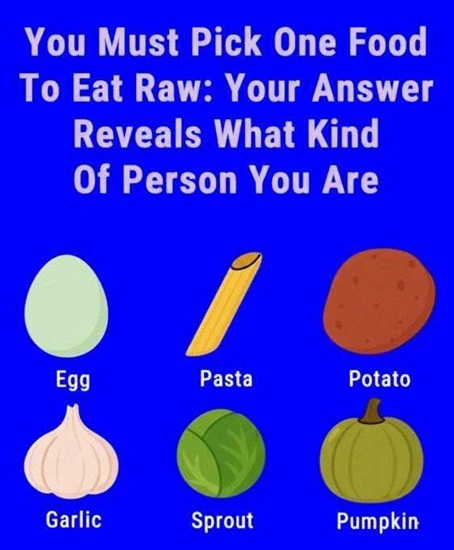
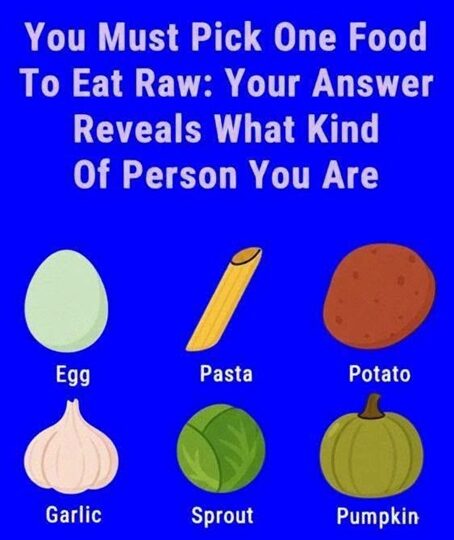
Imagine being presented with six familiar foods and being told to select only one. There is one unusual condition: whatever you choose must be eaten without cooking. No boiling, frying, roasting, baking, or other heat preparation is allowed. Your choices are an egg, dry pasta, a potato, garlic, sprouts, and pumpkin. At first, the challenge sounds simple enough to answer immediately. But once each option is considered more carefully, the decision becomes surprisingly complicated because every food brings a different combination of texture, taste, practicality, and potential safety concerns.
Most people probably begin by eliminating whatever sounds least appealing. Someone who dislikes strong flavors may immediately reject garlic. Another person may imagine trying to chew dry pasta and remove it from consideration. Someone familiar with food-safety guidance may refuse the raw egg, while another person might hesitate over sprouts. The puzzle quickly changes from “Which food do you like?” into a question about which disadvantage you are most willing to accept.
That distinction is what makes the hypothetical challenge interesting. There is no need to actually eat any of the foods in an unusual or unsafe way. The entertainment comes from comparing the options and explaining why one seems preferable to the others. Real food-safety guidance should always take priority over the rules of a viral puzzle.
The egg is often one of the first options people discuss. At a practical level, a raw egg appears quick. Unlike a hard potato or dry pasta, it would not require prolonged chewing. Someone focused on finishing the imaginary challenge as quickly as possible might therefore select it immediately.
But there is an important food-safety consideration. Raw and undercooked eggs can contain Salmonella. That is why food-safety authorities recommend proper handling and cooking of shell eggs and advise using pasteurized eggs or egg products when preparing recipes that will be served raw or undercooked.
This makes the egg a good example of how speed and risk can conflict. It may appear to offer the fastest route through the hypothetical challenge, but convenience does not eliminate the possibility of foodborne illness.
A person who rejects the egg is therefore not necessarily afraid of unusual foods. They may simply be giving more weight to a known safety concern.
Likewise, someone who initially chooses the egg is not automatically reckless. They may simply be thinking about speed before considering food safety.
Once additional information is introduced, they might change their answer.
That possibility is important because the challenge should not be treated as a genuine personality assessment.
Selecting one food cannot scientifically establish whether someone is brave, cautious, intelligent, impulsive, loyal, or adventurous.
It simply shows which factor they prioritized in one hypothetical situation.
Sprouts may initially seem like the easiest answer.
Unlike pasta or potatoes, sprouts are commonly encountered in raw preparations.
They may appear in sandwiches, salads, wraps, and other dishes without being cooked.
That familiarity can make them feel like an obvious loophole in the challenge.
Someone may think, “People already eat sprouts raw, so why would I choose anything else?”
The problem is that commonly eaten raw does not mean completely free of food-safety concerns.
Raw and lightly cooked sprouts have been associated with outbreaks involving harmful bacteria.
The conditions needed for seeds to sprout—warmth and moisture—can also support bacterial growth if contamination is present.
This is why food-safety agencies have issued specific guidance concerning raw sprouts.
Certain people face greater risks from foodborne illness and are advised to avoid raw or lightly cooked sprouts.
That includes groups who may be more vulnerable to severe complications.
So sprouts may be convenient within the imaginary challenge, but they should not simply be labeled the universally “safe” answer.
The distinction between convenience and safety matters.
A person choosing sprouts may still have perfectly understandable reasoning.
Perhaps they have eaten them raw many times.
Perhaps they prefer the texture.
Perhaps sprouts seem closest to their normal form of consumption.
That reasoning demonstrates familiarity rather than a scientifically measurable personality characteristic.
Garlic creates a completely different challenge.
Raw garlic is commonly consumed in small quantities.
It appears in sauces, dressings, spreads, and many other foods.
The problem is intensity.
A whole piece of raw garlic can have a sharp flavor and strong aroma.
Someone who chooses garlic may be deciding that a powerful but familiar taste is easier to tolerate than the texture or safety questions surrounding other options.
The strategy might be straightforward.
Accept a strong flavor for a short period and get the challenge over with.
That can sound appealing compared with chewing through a raw potato.
Yet quantity becomes important.
Does the challenge mean one garlic clove?
An entire bulb?
A small bite?
The original hypothetical question does not necessarily specify.
That ambiguity can completely change the difficulty.
One clove and one whole bulb are not equivalent challenges.
This demonstrates how incomplete rules affect decisions.
People often imagine missing details differently.
One participant pictures a single piece of garlic.
Another assumes the entire item must be eaten.
They may argue about the best answer while unknowingly answering different versions of the question.
Pumpkin introduces the same issue.
Raw pumpkin flesh can be used in some preparations, but most people are much more familiar with pumpkin after it has been cooked.
Cooking changes both its texture and how it is typically used.
Raw pumpkin is considerably firmer.
A small piece may be manageable.
An entire pumpkin would turn the hypothetical into something completely different.
A person choosing pumpkin might therefore be imagining a reasonable portion.
They may prefer a firm vegetable that can be eaten gradually.
This choice might appeal to someone who dislikes the idea of swallowing a raw egg or dealing with the strong flavor of garlic.
It becomes an exercise in patience.
But again, that does not prove the person is patient in every part of life.
It only describes the strategy behind one answer.
Dry pasta creates perhaps the clearest texture problem.
Most packaged pasta is intended to be cooked before consumption.
Cooking softens it dramatically.
Without that preparation, pasta remains hard and brittle.
Someone choosing dry pasta might initially be relying on familiarity.
Pasta is an ordinary pantry staple.
It does not look mysterious.
It does not carry the same immediate psychological reaction that some people have toward a raw egg.
The thought process may therefore be, “I know what pasta is, so I would rather choose that.”
But familiarity can influence risk perception.
A familiar food can feel more manageable even when its uncooked form is unpleasant.
Trying to chew large amounts of very hard dry pasta could be uncomfortable.
Hard foods can also be problematic for teeth, particularly for someone with existing dental issues.
The hypothetical challenge therefore changes depending on the person.
Someone with sensitive teeth would probably view dry pasta very differently from someone else.
This is another reason there cannot be one universal answer.
The potato may appear more reasonable.
It is solid, familiar, and easy to recognize.
Unlike a raw egg, there is no psychological barrier associated with consuming something liquid directly from a shell.
But raw potato has a firm, starchy texture that many people would find unpleasant.
Cooking transforms potatoes dramatically.
Boiling, baking, frying, or roasting makes them softer and changes their flavor.
Without those processes, the experience is very different.
A person who chooses the potato may be prioritizing predictability.
They can see the food.
They know its texture will be firm.
They can imagine eating it slowly.
That can feel more controllable than swallowing something quickly.
However, potatoes also require basic food-quality judgment.
Green or heavily sprouted potatoes should not simply be treated as equivalent to normal potatoes.
Naturally occurring compounds can become elevated in green or sprouting portions.
That is another reason a hypothetical puzzle should not become an actual eating contest.
The condition of food matters.
So does preparation.
The six choices therefore cannot be ranked accurately with a single rule.
The egg may seem fastest.
Sprouts may seem most normal in raw form.
Garlic may seem easiest in a small quantity.
Pumpkin may feel manageable if the portion is limited.
Dry pasta may feel familiar.
The potato may seem predictable.
Every choice has a different disadvantage.
That is why the puzzle creates discussion.
Ask six people and you may receive six different answers.
One person focuses immediately on bacteria.
Another thinks about flavor.
Someone else considers chewing.
Another searches for a loophole in the wording.
Someone simply chooses whatever they believe can be finished fastest.
None of those strategies necessarily tells us anything permanent about personality.
They reveal priorities within the specific hypothetical problem.
That is a much more modest—and accurate—interpretation.
The challenge becomes even more interesting when people are asked to explain their answer.
Suppose someone selects sprouts.
Ask why.
They may say that sprouts are already commonly eaten raw.
Another person chooses garlic because they prefer an intense taste to an uncertain food-safety concern.
Someone picks pumpkin because they can imagine eating it slowly.
Another chooses pasta because it feels familiar.
The potato chooser may value predictability.
And the egg chooser may simply want the challenge finished immediately.
Those explanations are more interesting than attaching personality labels.
They show how people define inconvenience and risk differently.
One person may view a strong taste as almost irrelevant.
Another cannot imagine tolerating raw garlic.
Someone may have no problem with a raw egg psychologically but immediately reject hard pasta because of their teeth.
Personal experience changes the ranking.
Previous food habits matter too.
Someone who regularly eats dishes containing raw garlic may barely consider it a challenge.
Another person may find even a small amount overwhelming.
A person who frequently eats sprouts may consider them completely ordinary.
Someone who has read about sprout-related foodborne illness may immediately eliminate them.
Information changes choices.
That is normal.
In fact, changing an answer after receiving better information can demonstrate sensible reasoning.
The puzzle should not require someone to defend an initial choice forever.
Suppose a participant chooses sprouts because they believe sprouts are automatically safe when raw.
After learning that raw sprouts have been linked with foodborne-illness outbreaks, they reconsider.
That is not inconsistency.
It is updating a decision.
The same applies to raw eggs.
Someone may initially think only about convenience.
After remembering Salmonella, they change their answer.
Again, the reasoning has improved because additional information became relevant.
This is why dramatic social-media claims such as “Your choice reveals your true personality” should be treated as entertainment.
There is no validated psychological basis for assigning a permanent character type based on choosing garlic instead of pumpkin.
The answer can change too easily.
Change the portion size and the answer changes.
Change the condition of the food and the answer changes.
Change the health circumstances of the person and the answer changes.
Allow pasteurized egg and the calculation changes again.
Specify that the sprouts must be eaten raw and the participant may reconsider.
Allow the pumpkin to be cut into a small piece and it becomes easier.
Require an entire pumpkin and almost everyone will view the challenge differently.
Rules matter.
The puzzle also demonstrates how assumptions fill gaps in incomplete information.
If the challenge simply says “egg,” one person imagines a raw shell egg.
Another may imagine a pasteurized egg.
Those are not identical food-safety scenarios.
If it says “pasta,” someone pictures thin spaghetti.
Another imagines thick dry rigatoni.
Chewing those could be very different.
“Potato” can mean a tiny new potato or a very large baking potato.
“Pumpkin” can mean a small piece or an entire large pumpkin.
Even “garlic” can mean a clove or a whole bulb.
Without quantity, the challenge has no objective winner.
That is perfectly acceptable for entertainment.
It simply means participants should not pretend there is one scientifically correct solution.
The most responsible version of the challenge remains hypothetical.
Nobody needs to consume unusual quantities of raw food to prove their answer.
People can discuss the choices safely.
They can debate which option sounds least unpleasant.
They can research food-safety considerations.
They can change their minds.
The conversation itself is enough.
This also prevents a harmless puzzle from turning into a risky social-media challenge.
Online trends sometimes encourage people to physically demonstrate answers.
That is unnecessary here.
Food preparation exists for good reasons.
Cooking can improve texture.
It can change flavor.
For certain foods, appropriate cooking can also reduce microbial hazards.
Removing cooking from the rules may be entertaining as a thought experiment, but it should not override real-world safety practices.
The egg illustrates this particularly clearly.
Raw shell eggs may contain harmful bacteria.
The fact that someone could physically swallow one does not mean doing so is recommended.
Sprouts provide another example.
They are widely eaten raw, but their production conditions create particular food-safety challenges.
Thorough cooking can reduce risk.
That information makes the puzzle more educational without making it frightening.
The goal is not to claim every raw food is dangerous.
The goal is to recognize that “edible raw” and “risk-free” are not identical concepts.
Food safety involves probability rather than certainty.
A particular egg may not contain harmful bacteria.
A particular batch of sprouts may not be contaminated.
But guidance is designed around reducing avoidable risk across many meals and many people.
A viral puzzle does not change that.
Garlic, pumpkin, pasta, and potatoes bring different considerations.
Texture becomes more important.
Quantity matters.
Individual health matters.
Dental condition can matter.
The food’s freshness and condition matter.
That complexity is exactly why the challenge becomes interesting once people stop answering instantly.
The first answer may be based entirely on instinct.
The second answer usually involves reasoning.
That short pause between the two is where the conversation begins.
People discover that they are not simply choosing food.
They are choosing which inconvenience worries them least.
Would you rather tolerate intense flavor?
Hard texture?
An unfamiliar form of a familiar food?
Or a food-safety concern?
Different people answer differently.
The choices can even create playful debates among friends.
One person may insist garlic is obviously easiest.
Someone else cannot believe they would willingly chew raw garlic.
Another person argues for sprouts.
Someone immediately points out the food-safety concern.
A fourth person chooses pumpkin.
Everyone starts discussing what counts as a portion.
The puzzle becomes more about interpreting the rules than eating.
That is often the mark of a good hypothetical question.
There is no immediate perfect answer.
Participants have to explain their assumptions.
The explanation exposes the reasoning.
Still, it is worth resisting the temptation to transform that reasoning into amateur psychology.
A person who chooses garlic is not necessarily brave.
Someone choosing sprouts is not automatically practical.
A potato chooser is not necessarily stubborn.
An egg chooser is not automatically impulsive.
Those descriptions may be amusing as playful commentary.
They are not validated conclusions.
Human personality cannot be measured through one imaginary food choice.
Likewise, the puzzle cannot measure intelligence.
Someone may know more about food safety than another participant.
That knowledge changes the answer.
Another person may interpret the wording more cleverly.
Someone else may notice that quantity was never specified.
Those are differences in reasoning and information, not a comprehensive measure of intelligence.
The puzzle works better without exaggerated claims.
Simply ask the question.
Let people choose.
Then ask them to explain.
That produces enough variety on its own.
It may even lead to useful conversations about food preparation.
Why do people cook potatoes?
Why are sprouts associated with particular bacterial risks?
Why are pasteurized eggs used in some uncooked preparations?
Why does dry pasta become so different after boiling?
Ordinary cooking practices begin to look more interesting when removed from the equation.
The challenge can therefore serve as a reminder that food preparation is not arbitrary.
Humans cook foods for many reasons.
Taste is one.
Texture is another.
Digestibility can matter.
Food safety can matter.
Convenience can matter.
Tradition can matter.
The six foods in this puzzle demonstrate those differences surprisingly well.
Eggs change dramatically when heated.
Pasta depends heavily on hydration and cooking for its familiar texture.
Potatoes become much softer.
Pumpkin changes in both texture and flavor.
Garlic becomes milder when cooked.
Sprouts may be eaten raw, but cooking changes the food-safety calculation.
Removing preparation exposes how much preparation normally contributes to the eating experience.
That gives the puzzle more depth than a simple personality quiz.
It becomes a conversation about how people evaluate choices under unusual constraints.
The best strategy may even be to challenge the premise.
If someone says, “I would rather not actually eat any of them raw because this is a hypothetical puzzle,” that is a perfectly sensible real-world response.
No social-media challenge requires someone to ignore ordinary food-safety guidance.
The imaginary decision can remain imaginary.
That is particularly important for people who may face higher risks from foodborne illness.
Age, pregnancy, immune status, and certain health circumstances can change the consequences of infection.
A universal recommendation would therefore be inappropriate.
There is also no need for anyone to prove courage through food.
Choosing not to participate in a risky challenge is not weakness.
Safety is not the opposite of bravery.
Similarly, taking unnecessary risk is not automatically evidence of confidence.
Those distinctions help keep the conversation grounded.
The puzzle is entertainment.
Real eating decisions should be based on actual conditions and appropriate preparation.
Within those limits, the challenge remains fun.
Picture the six options again.
An egg.
Dry pasta.
A potato.
Garlic.
Sprouts.
Pumpkin.
Which one catches your attention first?
Now ask why.
Perhaps you immediately rejected the egg.
Maybe sprouts seemed obvious.
Maybe garlic looked manageable.
Perhaps pumpkin felt safest psychologically because it resembles an ordinary vegetable.
Maybe you trusted the potato.
Or perhaps pasta seemed least alarming simply because you eat it regularly.
Now consider whether your answer changes after thinking about texture and food safety.
That second answer may be more revealing than the first—not about personality, but about reasoning.
It shows what happened when instinct encountered additional information.
That is the most useful way to interpret the challenge.
The decision can change.
The explanation can evolve.
People can disagree without one person being foolish.
The same six foods can produce different conclusions because people weigh different factors.
That is why the puzzle continues to work as a conversation starter.
It looks simple.
Then someone mentions Salmonella.
Someone else mentions sprouts.
Another asks how much pumpkin must be eaten.
Someone questions whether the garlic means one clove or the entire bulb.
Suddenly, a six-item food question becomes a debate about rules, assumptions, and risk.
There is no need for a dramatic personality result at the end.
The reasoning itself is enough.
If the challenge teaches anything, it is that apparently simple choices can become complicated when important details are missing.
The first answer may feel obvious.
A closer look can change it.
And changing your mind after learning something new is not losing the challenge.
It may be the most reasonable response of all.
So choose an answer for fun.
Compare it with someone else’s.
Explain your reasoning.
But keep the actual eating challenge hypothetical.
When food is genuinely being prepared and consumed, ordinary food-safety recommendations matter far more than winning a viral puzzle.
That keeps the question entertaining without turning it into misinformation or unnecessary risk.
And perhaps that is the most practical answer the six foods can offer: sometimes the smartest part of an uncomfortable challenge is not proving which option you can endure, but understanding why the options are different before making a choice.

