
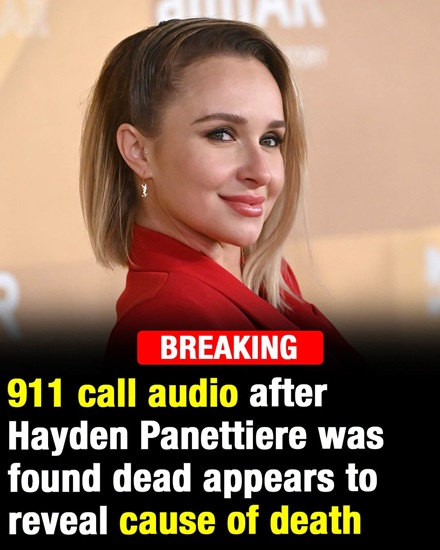
New information about the emergency response preceding Hayden Panettiere’s death has provided additional context about her final hours, but authorities have not yet announced an official cause of death. Panettiere, the 36-year-old actress known for Heroes, Nashville, Remember the Titans and the Scream franchise, was found unresponsive at a residence in Greenville, South Carolina, on Sunday, August 16, 2026. An acquaintance contacted emergency services, and police and medical personnel responded shortly afterward.
Despite extensive attempts to revive her, Panettiere was pronounced dead at the scene. Emergency-dispatch audio later reported by several outlets has attracted considerable attention because communications from the response included references to both cardiac arrest and a possible overdose. Those details provide information about what emergency personnel believed they might be dealing with at the time. They do not, however, establish a final medical explanation for Panettiere’s death.
The Greenville County Coroner’s Office has said that additional investigation is required before the cause and manner of death can be formally determined. According to the Greenville Police Department, emergency services were contacted at approximately 1:51 p.m. after Panettiere was found unresponsive. Police said an acquaintance placed the 911 call. Officers and medical personnel arrived at the residence and immediately attempted to provide assistance. Panettiere could not be revived and was subsequently pronounced dead at the scene.
Dispatch communications indicate that CPR was underway during the emergency response. Medical personnel reportedly used advanced life-support measures while attempting to restore circulation. Such procedures are standard responses when a patient is experiencing cardiac arrest and can include continuous chest compressions, medications and other emergency interventions.

The reference to cardiac arrest has sometimes been interpreted online as Panettiere’s cause of death. Medically, however, cardiac arrest describes the condition in which the heart stops effectively pumping blood. It can result from many different underlying medical events. Determining what caused the cardiac arrest requires a separate medical investigation.
The dispatch audio also reportedly included a reference to a possible overdose. That terminology has generated substantial discussion because Panettiere had publicly spoken about previous struggles with opioids and alcohol. Yet emergency dispatch information reflects preliminary circumstances and information available during an active emergency. It should not be treated as equivalent to completed toxicology testing or an official determination from a coroner.
Reports have also said that Narcan, the brand name for naloxone, was found at the residence. Naloxone is used to rapidly reverse potentially life-threatening effects of opioids. Its presence can understandably raise questions during an investigation involving a suspected overdose.
Still, finding Narcan at a location does not prove that opioids caused a person’s death. Naloxone has become increasingly available to individuals and households because it can be used during suspected opioid emergencies. Investigators must determine why it was present, whether it was administered and whether toxicology findings show that opioids or other substances played a role.
That process is one reason authorities have not announced a final conclusion based solely on what emergency responders encountered. Information from the scene must be considered alongside the autopsy, medical history, toxicology results and other investigative findings.
The Greenville County Coroner’s Office performed an autopsy following Panettiere’s death. Initial information released afterward indicated that investigators found no signs of trauma that contributed to her death. The cause and manner nevertheless remained undetermined while additional testing continued.
The Greenville Police Department similarly said its preliminary investigation had not revealed evidence of foul play or suspicious circumstances. Police have been working alongside the coroner’s office while the medical investigation proceeds.
Those findings provide several important boundaries for accurate reporting. There was no preliminary evidence that Panettiere had been physically attacked. Authorities had not identified suspicious circumstances suggesting another person was responsible. At the same time, investigators had not yet determined the precise medical event that caused her death.
The most accurate description is therefore that a possible overdose was mentioned during the emergency response but has not been officially confirmed as Panettiere’s cause of death.
That distinction matters because preliminary emergency information and final forensic findings serve different purposes. Paramedics responding to a crisis must act quickly based on whatever information is available. Their priority is saving the patient rather than determining a legally or medically definitive cause.
Coroners and medical examiners work differently. They can review autopsy findings, laboratory testing, toxicology results and other evidence before reaching a formal conclusion. That process can require additional time.
In Panettiere’s case, toxicology findings are particularly relevant because of the reference to a possible overdose. Until those results are completed and interpreted by medical authorities, identifying a specific substance or medical event as the confirmed cause would be premature.
Panettiere’s previous openness about addiction has inevitably become part of the conversation surrounding her death. She had discussed serious struggles involving alcohol and opioids and had described treatment and recovery in interviews.
Those experiences are documented parts of her life, but they cannot independently determine what happened on August 16. A person can have a history of addiction without a later death necessarily being caused by drugs.
Using Panettiere’s past as proof of her cause of death would therefore go beyond the available evidence. Her history can provide context, while the actual determination must come from the medical investigation.
Panettiere had become increasingly open about her personal struggles during the final years of her life. In 2026, she published This Is Me: A Reckoning, a memoir that explored the reality behind a public career that had begun when she was extremely young.
The book addressed childhood fame, relationships, motherhood, postpartum depression, addiction, recovery, trauma and grief. It represented one of Panettiere’s most extensive efforts to explain her life in her own words.
For much of her career, audiences primarily knew Panettiere through her characters. She had entered entertainment before she was old enough to fully understand the implications of fame and spent most of her childhood working professionally.
Her early television career included One Life to Live and Guiding Light. She also worked in commercials and other productions while still very young.
In 1998, Panettiere provided the voice of Dot in Pixar’s A Bug’s Life. Two years later, she appeared alongside Denzel Washington in Remember the Titans, one of the most recognizable films from her childhood career.
Additional roles followed as she transitioned from child performer to teenage actress. Her biggest breakthrough came in 2006 when she joined NBC’s Heroes.
Panettiere played Claire Bennet, a high-school cheerleader who discovers that she possesses extraordinary regenerative abilities. Claire quickly became one of the series’ most recognizable characters.
The phrase “Save the cheerleader, save the world” became closely associated with the show and placed Panettiere at the center of its early success.
Heroes turned her into an international television star while she was still a teenager. The role brought magazine covers, major entertainment appearances and intense public attention.
Years later, Panettiere would describe the complicated reality of growing up under that level of scrutiny. Professional success did not necessarily translate into personal stability.
Following Heroes, she continued working in both film and television. In 2011, Panettiere joined the Scream franchise as Kirby Reed in Scream 4.
Kirby developed a dedicated following among horror fans, and Panettiere eventually returned to the character in Scream VI in 2023.
Another major career chapter began in 2012 with Nashville. Panettiere played Juliette Barnes, a country singer dealing with fame, ambition, relationships and significant personal difficulties.
The role allowed Panettiere to combine dramatic acting with music and became one of the most substantial performances of her adult career. She received two Golden Globe nominations for her work on the series.
While Nashville was professionally successful, Panettiere’s private life became increasingly difficult. In December 2014, she and former fiancé Wladimir Klitschko welcomed their daughter, Kaya.
Panettiere subsequently experienced postpartum depression. She sought treatment and later spoke publicly about what she had gone through.
Her willingness to discuss postpartum depression became significant because the condition can still be misunderstood. Panettiere explained that becoming a mother did not protect her from serious emotional difficulties.
She later revealed that addiction also became a major problem. Alcohol and opioids affected different parts of her life, including relationships and her ability to maintain the stability she wanted.
Panettiere did not portray recovery as an easy or immediate transformation. She spoke about treatment, setbacks and the extensive personal work required to make changes.
Her struggles also affected the arrangements surrounding Kaya. During a particularly difficult period, Panettiere relinquished full custody to Klitschko in 2018.
She later strongly rejected claims that she had simply abandoned her daughter. Panettiere described living apart from Kaya as one of the most painful experiences of her life.
She explained that she believed her daughter needed stability at a time when she was unable to provide it consistently. Kaya consequently lived primarily with her father.
Motherhood remained central to Panettiere’s life despite the physical distance. She continued speaking about Kaya with affection and described her daughter as an extraordinary gift.
Panettiere also said she wanted Kaya to have privacy. Having grown up in the entertainment industry herself, she understood what it meant to have important parts of childhood unfold publicly.
She wanted her daughter to have more control over her own identity and future than Panettiere felt she had experienced as a child performer.
Another devastating period arrived in February 2023 when Panettiere’s younger brother, Jansen, died at only 28 years old.
His family later said his death resulted from complications involving an enlarged heart and the aortic valve.
Jansen was Panettiere’s only sibling, and she described his death as profoundly affecting her. She said losing him felt like losing part of herself.
Grief affected her emotionally and physically and became another subject she discussed openly during later interviews.
Despite that loss, Panettiere continued working and trying to rebuild different areas of her life. Her return as Kirby Reed in Scream VI represented an important professional comeback.
Her memoir in 2026 then allowed her to address experiences that had previously been understood largely through celebrity reporting.
That context is important following her death because Panettiere had deliberately chosen to be candid about addiction. Her honesty should not now be transformed into evidence for conclusions medical officials have not reached.
There is a difference between acknowledging that Panettiere previously struggled with opioids and stating that opioids caused her death.
The first is established biographical information. The second requires toxicology and an official medical determination.
Likewise, the word “overdose” appearing in emergency communications does not make overdose the confirmed cause.
Dispatchers work with preliminary information. The terminology used during an emergency can change once investigators gather additional evidence.
The presence of Narcan similarly deserves context. It may become relevant to the final investigation, but its presence alone cannot answer the central medical question.
The autopsy has already provided another piece of evidence by finding no contributing trauma. That is consistent with the police department’s preliminary conclusion that there were no apparent signs of foul play.
But the absence of trauma does not identify the cause.
That answer depends on the additional studies being completed by the coroner.
Until those findings are released, reports should avoid presenting possibilities as conclusions.
This is especially important because sudden celebrity deaths often generate speculation online. In the absence of complete information, theories can spread rapidly and become repeated as though they were established facts.
Panettiere’s documented addiction history makes her case particularly vulnerable to that process. Readers may see the word “overdose,” remember her previous interviews and assume the investigation is already complete.
It is not.
Authorities have not yet publicly confirmed an overdose as the official cause.
The known sequence of events remains much narrower.
Panettiere was found unresponsive at a residence in Greenville on August 16. An acquaintance contacted 911.
Emergency personnel responded and attempted resuscitation.
Dispatch communications referenced cardiac arrest and a possible overdose.
Advanced lifesaving measures were used, but Panettiere could not be revived.
She was pronounced dead at the scene.
Police began investigating alongside the Greenville County Coroner’s Office.
The preliminary police investigation found no evidence of foul play or suspicious circumstances.
An autopsy found no signs of trauma contributing to the death.
Additional medical testing remained necessary before the official cause and manner could be determined.
Those facts provide enough information to report what happened without adding unsupported conclusions.
The distinction also respects Panettiere’s family. Her death represents an enormous private loss occurring under intense public attention.
Her father, Alan “Skip” Panettiere, confirmed the death and remembered his daughter as someone who brought enormous love and joy to the people around her and audiences who watched her perform.
Panettiere leaves behind her 11-year-old daughter, Kaya, as well as her parents and people who were close to her.
Her colleagues have also begun reflecting publicly on her life and work. For people who acted alongside Panettiere over the years, the news represented the loss of someone they had known beyond the characters familiar to audiences.
For fans, Panettiere’s career stretched across generations.
Some first encountered her as a child actress.
Others remember Claire Bennet from Heroes.
Fans of Nashville associate her with Juliette Barnes.
Horror audiences remember Kirby Reed.
That body of work should remain part of how Panettiere is remembered rather than allowing the unanswered circumstances surrounding her death to define her entire story.
Her later openness about addiction should likewise be remembered in context. Panettiere chose to acknowledge painful experiences rather than hide them.
She spoke about recovery because those experiences had shaped her life, not because she wanted addiction to become her only identity.
The same care should apply now.
If official toxicology results ultimately determine that an overdose caused Panettiere’s death, that finding can be reported clearly once authorities announce it.
If another medical explanation emerges, reporting should reflect that evidence instead.
Until then, uncertainty should be acknowledged rather than filled with assumptions.
The dispatch audio provides important new information, but it does not answer every question.
It shows the seriousness of the emergency and the efforts made to revive Panettiere.
It indicates that responders were dealing with cardiac arrest and that a possible overdose was considered.
It does not establish the underlying cause of that cardiac arrest.
That question remains with the coroner.
For now, the most accurate conclusion is that Hayden Panettiere’s death remains under medical investigation.
A possible overdose was referenced during the emergency response, but officials have not confirmed it as the cause of death.
Police have reported no preliminary evidence of foul play, while the autopsy found no trauma contributing to her death.
Additional testing is expected to provide a clearer medical explanation.
Until those findings are available, responsible coverage should distinguish carefully between what emergency responders initially suspected and what medical authorities can ultimately prove.
Hayden Panettiere died at only 36 after spending most of her life in entertainment. Her career included childhood performances, international television fame, major dramatic roles and a later return to film.
Her private life included motherhood, postpartum depression, addiction, treatment, recovery and devastating grief following her brother’s death.
During her final years, she increasingly tried to tell that complicated story herself.
Her death should be treated with the same commitment to accuracy.
The emergency-dispatch recordings have provided another piece of the timeline, but they have not provided the final answer.
Until the Greenville County Coroner’s Office completes its investigation, claims that a specific substance or overdose definitively caused Hayden Panettiere’s death remain unconfirmed.
What can be said with confidence is that emergency personnel attempted to save her, police initially found no evidence of foul play, the autopsy found no contributing trauma, and investigators continue working to determine why a 36-year-old actress whose career had touched millions of viewers died so suddenly.

