
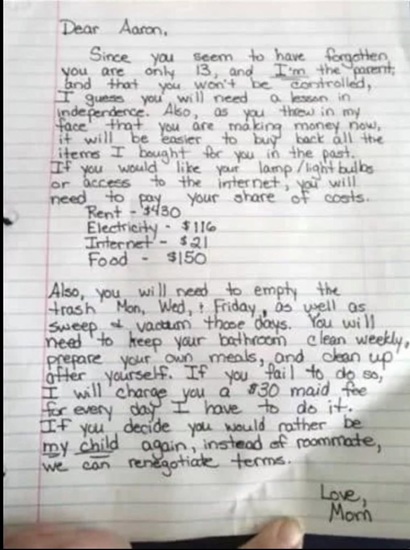
Growing up can make adulthood appear much easier than it really is. Children see a home with electricity, food in the kitchen, internet access and countless everyday comforts, but they rarely see every bill, working hour and household responsibility behind those things. For one mother, an argument with her teenage son became an opportunity to demonstrate exactly what independence requires. In 2015, Heidi Johnson wrote a memorable “roommate” letter to her 13-year-old son, Aaron, after he argued that earning his own money meant he deserved greater freedom.
What began as a private parenting lesson unexpectedly spread across social media and became the subject of a much larger discussion about teenagers, responsibility and preparing children for adulthood. At the time, Aaron was earning a small amount of money through YouTube. According to Johnson’s later explanation, he had also been resisting some of the expectations she placed on him, including completing schoolwork and household responsibilities.
Like many teenagers testing the boundaries between childhood and adulthood, Aaron wanted more control over how he spent his time. The disagreement eventually reached a point where he emphasized that he was earning money himself and suggested that his mother should have less authority over him. Johnson saw a contradiction in that argument. Aaron wanted the freedom he associated with adulthood, but he was still relying on his mother for virtually all of the necessities and comforts of daily life. His housing, electricity, meals and internet connection were being provided without him having to think about their cost.
Johnson therefore decided to demonstrate what his life might look like if their relationship operated less like parent and child and more like two independent adults sharing a home. Instead of continuing the disagreement verbally, Johnson wrote him a letter. She framed it as a kind of roommate agreement, beginning with the idea that if Aaron believed he was sufficiently independent to reject parental rules, he could also consider some of the responsibilities that accompany independence.
The tone was intentionally firm and dramatic. Johnson was not literally trying to transform her middle-school-aged son into a rent-paying tenant. She was attempting to make an abstract concept—adult responsibility—impossible for him to ignore.
The letter included an itemized monthly household bill. Johnson listed $430 for rent, $116 for electricity, $21 for internet access and $150 for food. The total came to $717 per month, an amount obviously beyond what Aaron could reasonably pay from the small amount he was making online. That financial mismatch was central to Johnson’s lesson. Earning a little spending money, she wanted him to understand, was not the same as being financially independent.
Johnson also included household responsibilities in the arrangement. If Aaron wanted to behave like an independent roommate, he would be responsible for tasks such as preparing meals, taking out the trash, cleaning his bathroom, sweeping and vacuuming. The message emphasized that maintaining a household involves much more than simply having enough money to pay a bill. Someone also has to perform the everyday work that keeps a home functioning.
The letter even included a proposed charge if Johnson had to complete tasks Aaron was supposed to handle. She jokingly treated her own household labor as something that would come with a price under their new “roommate” arrangement. Once again, the purpose was to make visible the work children can easily overlook when a parent routinely performs it.
At the end of the note, however, Johnson offered another path. Aaron could choose to return to a traditional parent-child arrangement, in which case they could discuss expectations and responsibilities again. That detail is important because Johnson later made clear that the letter was never intended as a genuine lease or threat to remove her son from the home. It was an educational exercise designed to demonstrate the difference between wanting independence and actually being prepared to support oneself.
Aaron did not immediately appreciate the lesson. According to Johnson, when he saw the letter, he became angry, crumpled it and threw it onto the floor. He then left the apartment for a while. Johnson later explained that taking some time apart during arguments was something she encouraged because continuing a confrontation while both people were angry could make matters worse.
The temporary separation gave both mother and son time to cool down. When Aaron returned, however, the disagreement was not immediately over. Johnson recalled that he questioned whether she could really take away items from his room. She asked him to leave her room until he was ready to speak respectfully, creating another period in which both could consider what had happened instead of continuing an emotional argument.
After some time had passed, Aaron’s attitude reportedly began to change. Johnson said he returned with several belongings from his room and acknowledged that he needed to earn certain privileges back. He apologized and asked what he could do to improve the situation. The conversation therefore moved away from a confrontation about control and toward a discussion about expectations.
Johnson later explained that Aaron quickly understood the financial point behind her letter as well. Even though he was making some money through YouTube, the amount was nowhere near enough to cover rent, electricity, food and internet service. The numbers demonstrated in a concrete way that having personal income was very different from being able to finance an entire lifestyle.
For Johnson, that realization was the actual objective. She said she had never expected Aaron to hand her hundreds of dollars each month. She also emphasized that she was not going to deny him food or shelter. Those necessities remained part of her responsibility as his parent. The exaggerated bill was intended to help him understand the financial value of things he had previously been receiving without needing to consider how they were provided.
The situation became much larger when Johnson shared the letter on Facebook. What was originally connected to a family disagreement quickly reached strangers far beyond her own social circle. The post spread rapidly, and people began debating whether Johnson’s strategy was an effective parenting lesson or unnecessarily harsh.
Many commenters praised her approach. Supporters argued that teenagers need to learn that independence involves responsibility and that ordinary household comforts cost money. They interpreted the letter as a creative demonstration rather than a literal attempt to collect rent from a child. Some parents said the lesson reflected conversations they had experienced with their own teenagers about chores, schoolwork and growing independence.
Other people disagreed with Johnson’s method. Critics argued that children should not be made to feel financially responsible for necessities such as housing and food. Some also questioned whether a disagreement involving a 13-year-old should have been shared publicly, especially once the post began attracting widespread attention.
Johnson responded to criticism by explaining the context behind the letter. She stressed that Aaron was never in danger of losing his home or being deprived of necessities. The arrangement was intentionally unrealistic because she wanted him to understand how far his small income was from supporting the lifestyle he already enjoyed.
She also described the ordinary household rules that existed before the dispute. Aaron was expected to make a genuine effort in school, seek assistance when he did not understand something and complete homework and chores before spending recreational time online. Johnson did not say that she expected perfect grades. Her focus was on effort and completing responsibilities before entertainment.
Aaron also had age-appropriate chores around the home. According to Johnson, those included taking out the trash, helping with dishes, keeping his bedroom reasonably organized and cleaning his bathroom. On household cleaning days, he could also be asked to help with jobs such as vacuuming, dusting, washing windows or mopping.
Those details changed the context of the viral note. The disagreement was not simply about a parent suddenly demanding rent from a child. It grew from a longer argument about whether Aaron should be expected to complete ordinary school and household responsibilities while enjoying the privileges his mother provided.
Respect was another important part of Johnson’s expectations. She wanted her son to communicate appropriately even when he disagreed with her. From her perspective, becoming more independent did not mean being able to ignore household rules or speak disrespectfully whenever he was frustrated.
This tension is familiar in many families with teenagers. Adolescence naturally brings a growing desire for autonomy. Teenagers begin forming stronger opinions, making more decisions independently and imagining lives outside their parents’ homes. At the same time, parents remain responsible for guiding them and setting limits.
The difficult question is often how quickly freedom should expand. Teenagers may focus primarily on the attractive parts of adulthood: controlling their schedules, earning money, choosing what to buy and making decisions without asking permission. Parents are usually more aware of the other side: employment, bills, deadlines, cleaning, cooking and accepting consequences.
Johnson’s roommate letter exaggerated that second side so Aaron could see it clearly. If he wanted to approach their relationship as an independent adult, then she would temporarily describe the household the way adults might experience it. Rent would become his responsibility. Electricity would have a price. Internet access would appear on a bill. Meals would require both money and preparation.
The exercise also illustrated an important difference between earning money and being financially independent. A teenager might make money from online content, a part-time job or another activity and understandably feel proud of that achievement. Earning money is valuable experience, but it does not necessarily mean someone can afford to live independently.
Adults generally have recurring expenses that consume significant portions of their income. Housing alone can be expensive, followed by utilities, groceries, transportation and communication services. Additional costs can appear unexpectedly. Johnson’s simplified bill did not even attempt to represent every expense involved in adult life.
The lesson extended beyond money because household labor has value as well. A clean bathroom does not remain clean automatically. Meals require planning, shopping, cooking and cleanup. Trash must be removed, floors must be cleaned and clothes must be washed. When parents consistently handle those jobs, children can understandably overlook how much time they require.
By adding chores to the roommate arrangement, Johnson made that labor part of the lesson. Being independent does not simply mean having nobody tell you what to do. It also means realizing that many necessary tasks will not happen unless you do them yourself.
Johnson summarized the larger principle by emphasizing that things do not simply appear without someone providing the money, time or effort behind them. Her point was not that children owe their parents repayment for being raised. Rather, she wanted Aaron to develop an appreciation for what was being provided and recognize that maintaining a household requires continual work.
The letter also became an example of how parenting decisions can look very different once they are removed from their original context. Online readers initially saw a strict note listing hundreds of dollars in expenses. Many did not immediately know what happened before or after the letter.
The later explanation provided a more complete picture. Aaron was angry initially, but the dispute did not end there. He eventually apologized, asked how he could regain privileges and began working toward restoring the normal arrangement with his mother.
Johnson also said that some belongings and comforts were returned quickly while other privileges took longer to regain. The objective was not to permanently strip his room or punish him indefinitely. She wanted consequences to be connected to behavior and then allow Aaron an opportunity to demonstrate that he could handle his responsibilities differently.
The reconciliation between mother and son is an important part of the story because viral posts often preserve only the most dramatic moment. A photograph of an unusual letter can circulate for years while the quieter conversations that followed receive much less attention.
Years later, Aaron himself indicated that the incident had not destroyed his relationship with his mother. Later reporting on the viral story noted that he and Johnson continued to have a good relationship. That perspective helps counter the assumption that one dramatic family disagreement necessarily defined everything that happened afterward.
The story also raises a separate issue about children and social media. Even when parents have positive intentions, sharing conflicts involving minors can expose those children to attention they did not request. Once a post becomes viral, controlling where it appears or who comments on it can become nearly impossible.
Johnson explained that the enormous public reaction had not been what she originally expected. Nevertheless, the episode became a parenting discussion that continued long after Aaron was no longer the 13-year-old who originally received the note.
The durability of the story may come from how familiar the underlying conflict feels. Parents and teenagers have argued about chores, homework, money and independence for generations. Technology changes, but the fundamental tension remains recognizable.
Today, teenagers may earn money through platforms that did not exist for previous generations. That can give young people real opportunities to learn entrepreneurship, creativity and financial skills. It can also create unusual situations in which a teenager earns money before understanding the expenses associated with maintaining an independent household.
Aaron’s small YouTube income therefore became an unexpectedly effective starting point for a lesson in financial literacy. Johnson did not criticize him simply for earning money. Instead, she challenged the conclusion that earning something meant he was ready to live without parental expectations.
A healthier interpretation of financial independence involves understanding both income and expenses. Someone might earn hundreds of dollars and feel wealthy until rent, utilities, groceries and other obligations arrive. Learning that difference before adulthood can help teenagers develop more realistic expectations about budgeting.
Families do not need to copy Johnson’s exact letter to teach the same lesson. Parents can involve teenagers in grocery budgeting, discuss utility costs, encourage savings or show older children how recurring bills work. Chores can similarly teach that everyone who shares a home contributes to maintaining it.
Different families will naturally choose different approaches. Some parents may find Johnson’s dramatic roommate contract useful or humorous, while others may consider it too confrontational. There is no requirement that one family’s strategy become a universal parenting model.
What matters in Johnson’s account is the intention she described and what happened afterward. She wanted her son to understand responsibility, not genuinely finance the household. Aaron initially reacted angrily but later apologized and worked toward regaining privileges.
The incident therefore became less about collecting money and more about defining independence. Aaron wanted greater control over his life. Johnson’s response was to show him that greater control is normally accompanied by greater responsibility.
That principle extends well beyond adolescence. Adults enjoy freedoms children do not have, but those freedoms come with obligations. People choose where to live but must pay for that housing. They decide what to eat but must purchase and prepare food. They can use electricity whenever they want, but somebody still receives the bill.
Children often see the benefits before they understand the costs. That is not necessarily a sign of selfishness; it is partly a consequence of having limited experience. Learning how households function is one of the gradual transitions between childhood and adulthood.
Johnson chose an unusually memorable way to accelerate that lesson. Her fictional rent bill placed a price next to comforts Aaron normally experienced without thinking about them. Whether someone agrees with the method or not, the message was difficult to misunderstand.
The story also demonstrates why context matters when discussing parenting stories online. Johnson’s letter alone could appear far harsher than the full account. Her follow-up explanation made clear that she intended to continue providing her son with basic necessities and that the financial demands were part of the lesson rather than a genuine rental agreement.
Likewise, Aaron’s angry first reaction was not the conclusion of the story. After having time to think, he returned to the conversation, acknowledged his behavior and asked how to improve the situation. The family moved forward rather than remaining trapped in the original argument.
More than a decade after Johnson originally wrote the letter, the story continues to circulate because the question behind it remains relevant: How should parents prepare children for adult responsibility while still allowing them to be children?
There is no single answer that works for every family. What Johnson’s experience demonstrates is that conversations about independence can become opportunities to discuss money, household labor, respect and accountability.
Her lesson also challenges the idea that adulthood simply means freedom from authority. Genuine independence requires people to manage their own obligations even when nobody is standing nearby reminding them what to do. Rent still has to be paid. Work still has to be completed. Homes still have to be maintained.
For teenagers, understanding that reality gradually can make the transition into adulthood less surprising. Learning to budget, clean, cook, meet deadlines and manage personal responsibilities provides skills that remain useful long after childhood ends.
Johnson’s viral letter was one mother’s unconventional attempt to communicate those ideas during a difficult moment with her son. It generated praise, criticism and years of online discussion, but she consistently maintained that the purpose was education rather than financial punishment.
Ultimately, Aaron did not become his mother’s rent-paying roommate at 13. He remained her son. What changed, according to Johnson’s account, was his understanding of the responsibilities attached to the independence he had been demanding.
The $717 bill was never really about collecting $717. It was a dramatic illustration of something easy to overlook when someone else is providing nearly everything: daily life requires money, time and effort.
That is why the story continues to resonate. Behind the viral note was a familiar family argument about a teenager wanting more freedom and a parent wanting more responsibility in return. Johnson simply turned that argument into a practical demonstration that neither her son nor millions of people who later encountered the story were likely to forget.

