

Michael J. Fox has spent decades navigating life with Parkinson’s disease while maintaining a remarkable connection with audiences around the world. After stepping away from regular acting as the physical challenges of the condition became more demanding, Fox eventually found an opportunity that encouraged him to return to television. His appearance in the third season of Shrinking carries particular meaning because Parkinson’s is also part of the storyline involving Harrison Ford’s character.
Fox was diagnosed with young-onset Parkinson’s disease in 1991 when he was only 29 years old. At the time, he was already an internationally recognized actor following the enormous success of projects including Family Ties and the Back to the Future films. He did not immediately reveal the diagnosis publicly, and for years he continued working while privately attempting to understand what the disease would mean for his future.
Receiving such a diagnosis at a young age forced Fox to confront circumstances he could never have anticipated during the rapid rise of his career. Parkinson’s is a progressive neurological disorder that can affect movement and produce symptoms including tremors, stiffness and problems with balance and coordination. The progression and severity of symptoms can vary significantly between individuals, making each person’s experience different.
Fox eventually disclosed his diagnosis publicly in 1998. Rather than withdrawing completely from public life, he increasingly used his visibility to raise awareness about Parkinson’s disease and advocate for scientific research. His willingness to discuss his experiences eventually became an important part of his public life alongside the acting career that had originally made him famous.
Throughout the years, Fox has been unusually candid about both the difficult and unexpectedly meaningful aspects of living with Parkinson’s. He has resisted being presented solely as a tragic figure and has frequently emphasized that optimism does not require pretending that difficult circumstances are easy.

During a 2023 appearance connected with Still: A Michael J. Fox Movie, the documentary about his life and career, Fox summarized that complicated philosophy in memorable terms. He acknowledged directly that Parkinson’s is difficult while also expressing gratitude for the life he has been able to experience.
“Parkinson’s sucks, but it’s a great life, so thank you for it,” Fox said. His comment captured a perspective that has appeared repeatedly in his interviews and books: recognizing the seriousness of his condition without allowing the diagnosis to become the only defining feature of his identity.
Fox has also spoken strongly about the difference between empathy and pity. He has said that feeling sorry for himself is not something on which he wants to spend his limited time. Instead, he tries to understand what difficult experiences can teach him and then continue moving forward.
That approach does not mean his physical challenges have disappeared. Fox has openly described how Parkinson’s has changed his daily routine and how he must continually adjust to new limitations. Some days present different challenges than others, meaning flexibility has become an essential part of how he approaches everyday life.
In an interview with People, Fox explained that he often begins the day by determining what his body will allow him to do. Instead of assuming every day will be the same, he adapts his plans to whatever physical circumstances he encounters.
“I wake up and get the message of what the day is gonna be like, and I try to adjust to it,” he explained. That straightforward description reflects the practical reality of living for decades with a progressive condition.
Fox has also discussed using a wheelchair more frequently. He acknowledged that adjusting to increased wheelchair use required time, just as other changes associated with Parkinson’s have required adaptation throughout the years.
Rather than hiding those realities, Fox frequently incorporates them into the way he talks about his life. Humor has become particularly important. His sense of humor, including a willingness to joke about uncomfortable situations, has helped him navigate conversations that could otherwise become overwhelmingly serious.
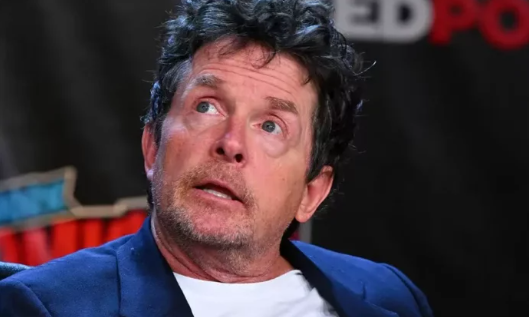
Fox has described developing what might be considered a darker comedic perspective toward some of his circumstances. For an actor whose comedic timing was central to many of his most famous performances, humor remains both a personal characteristic and a way of dealing with challenging moments.
After living with Parkinson’s for more than three decades, Fox has said that he no longer spends every day consciously thinking about the fact that he has the disease. It has become part of the reality of his life rather than something entirely separate from it.
That long experience makes his involvement with Shrinking particularly significant.
The Apple TV+ comedy-drama stars Jason Segel and Harrison Ford and explores therapists dealing with their own complicated personal lives while trying to help their patients. Ford plays Dr. Paul Rhoades, a respected therapist who is living with Parkinson’s disease.
Fox joined the series for its third season, bringing a unique personal perspective to a fictional story involving a condition he has lived with since his twenties.
Footage released for the season showed Fox’s character sitting beside Paul in a medical waiting room. The interaction quickly demonstrates the kind of humor that has long been associated with Fox’s performances.
When Fox’s character asks why Paul is at the medical facility, Ford’s character answers directly: “Parkinson’s.” Fox’s character responds with a joke that he is simply there for a haircut, creating a moment that combines the seriousness of the condition with humor.
The scene is notable because the joke is delivered by an actor who understands Parkinson’s from decades of personal experience. Rather than making the condition itself the punchline, the exchange demonstrates how humor can exist alongside difficult realities.
Fox’s appearance also reconnects him professionally with television producer Bill Lawrence, one of the co-creators of Shrinking. Their working relationship goes back many years.

Fox starred in the ABC sitcom Spin City, which Lawrence co-created. Beginning in 1996, Fox portrayed New York City Deputy Mayor Mike Flaherty, a role that earned him considerable recognition and demonstrated that his comedic television career remained strong years after Family Ties.
Fox eventually left his regular role on Spin City in 2000 as the demands associated with Parkinson’s became increasingly difficult to balance with the schedule of a weekly television series.
His departure did not permanently end his acting career.
Fox later appeared in Scrubs, another series created by Lawrence. In 2004, he played Dr. Kevin Casey in a memorable guest storyline. The role allowed him to return to Lawrence’s television world in a different capacity.
Over subsequent years, Fox continued making selected television appearances. His credits included acclaimed roles on programs such as Rescue Me, The Good Wife and Curb Your Enthusiasm. He also starred in The Michael J. Fox Show, which premiered in 2013.
Eventually, however, acting became increasingly difficult.
One major challenge involved Fox’s ability to reliably remember and deliver dialogue. Acting requires performers not only to memorize words but also to deliver them naturally while simultaneously responding to other actors, physical movements, cameras and direction.
Fox wrote about these difficulties in his 2020 memoir, No Time Like the Future: An Optimist Considers Mortality. He explained that memorizing lines had become increasingly challenging as his Parkinson’s progressed.
The problem contributed to his decision to step away from acting. Rather than forcing himself to maintain the same career he had enjoyed decades earlier, Fox accepted that his relationship with performing might need to change.
For several years, he largely remained away from acting.
During that period, however, Fox continued working extensively in another area that has become central to his legacy: Parkinson’s research and advocacy.
In 2000, he established The Michael J. Fox Foundation for Parkinson’s Research. The organization was created with the goal of accelerating scientific research and helping advance better treatments and ultimately a cure for Parkinson’s disease.
Over the years, the foundation has become a major force in Parkinson’s research. Fox’s public profile has helped bring extraordinary attention to the disease while researchers, patients, donors and advocates have contributed to the organization’s work.
His advocacy transformed what could have remained an intensely private medical diagnosis into a mission extending far beyond his own experience.
Fox has consistently emphasized that the progress of Parkinson’s research depends on scientists, patients and families working together. His celebrity gave him a platform, but the foundation’s work involves a much larger community.
While focusing on that mission, Fox did not necessarily believe that a substantial acting return was waiting for him.
Then Shrinking provided an unexpected opportunity.
Fox learned that Harrison Ford’s character was living with Parkinson’s and contacted Bill Lawrence. According to accounts from those involved with the series, Fox essentially wanted to know why Lawrence had not invited him to participate.
Lawrence welcomed the idea.
The resulting role was therefore not simply another television appearance offered to Fox. His own interest in the storyline helped create the opportunity for him to return.
That detail is important because it demonstrates that Fox’s involvement was not built solely around nostalgia. He saw something in Shrinking that connected with his own experience and wanted to participate.
The series had already approached Parkinson’s through Ford’s character, exploring how a successful professional responds to a diagnosis that gradually changes aspects of his life.
Adding Fox created another perspective.
Although both actors are portraying fictional characters, Fox brings lived experience that cannot be manufactured through performance alone. He understands the unpredictable physical challenges, adjustments and emotional complexities associated with Parkinson’s because they have been part of his life for decades.
His return also reflects how his approach toward acting has changed.
Fox no longer appears interested in measuring his career by the standards he followed when he was younger. He does not need to maintain a demanding schedule simply to prove that he can still work.
Instead, he can consider individual opportunities and determine whether his health allows him to participate.
In an interview with The Hollywood Reporter, Fox explained that returning to acting had affected him in ways he had not anticipated.
He said the experience had “really prolonged my life and made my life interesting in a way that I didn’t think it would be to this point.”
It was a powerful description of what returning to creative work meant personally.
Fox also clarified that he does not consider himself permanently retired from acting. At the same time, he recognizes that Parkinson’s ultimately determines what he can realistically do.
“I’m not retired from acting,” he explained, while making clear that if he never acted again there would be a legitimate reason for that decision.
His philosophy is essentially to allow his physical circumstances to determine what opportunities are possible rather than creating an absolute rule that he must either continue acting or stop forever.
That flexibility represents a significant evolution from the early period following his diagnosis.
When Fox first learned he had Parkinson’s at 29, he was a young actor with an established career and enormous professional momentum. The diagnosis created uncertainty about a future he had previously assumed would continue along a familiar path.
More than three decades later, the circumstances are very different.
Fox has experienced professional success, marriage, fatherhood, advocacy, health complications and changing physical abilities. Parkinson’s has remained present throughout much of that journey, but it has not been the only story.
His marriage to actress Tracy Pollan has also remained an important part of his life. The couple married in 1988, several years before Fox publicly disclosed his Parkinson’s diagnosis, and they have raised four children together.
Fox has repeatedly expressed appreciation for the support of his family throughout the challenges associated with his condition.
He has similarly expressed gratitude toward fans.
During his public appearances, Fox has acknowledged that audiences who followed his work throughout different stages of his career have provided him with extraordinary encouragement.
“My fans have basically given me my life,” he has said while describing his desire to return some of that support through his time and gratitude.
For many viewers, their connection to Fox began decades before his Parkinson’s advocacy became widely known.
Some first encountered him as Alex P. Keaton on Family Ties, the television sitcom that helped make him one of the most recognizable young actors of the 1980s.
Others remember him primarily as Marty McFly.
The Back to the Future trilogy turned Fox into an international movie star and produced one of popular cinema’s most enduring characters. Marty’s adventures with Christopher Lloyd’s eccentric scientist Doc Brown remain closely associated with Fox’s career decades after the original film was released.
Those performances established Fox as an actor with a particular combination of comedic timing, physical energy and emotional accessibility.
Parkinson’s inevitably changed some of the physical abilities that had once been central to his performances.
But it did not erase his instincts as an actor.
That becomes especially apparent in the brief Shrinking exchange with Harrison Ford. The timing of the joke, rather than elaborate physical movement, creates the comedy.
For longtime viewers, moments like that demonstrate that an actor’s identity involves more than physical ability.
Timing, personality, observation and experience remain part of the craft.
The role also avoids presenting Fox merely as an inspirational symbol. He is there to perform, interact with other characters and contribute to the story.
That distinction is meaningful.
People living with chronic illnesses can sometimes be discussed publicly only through narratives of suffering or extraordinary courage. Fox himself has repeatedly pushed against simplistic approaches to his condition.
His public comments acknowledge frustration, physical difficulty and uncertainty.
At the same time, he continues to find humor and purpose.
Those ideas are not contradictory.
A person can recognize that Parkinson’s is extremely difficult while still appreciating life. Someone can require a wheelchair while continuing to work. A person can experience increasing physical limitations while remaining creatively engaged.
Fox’s story demonstrates those realities without suggesting that everyone with Parkinson’s will experience the disease in the same way.
Parkinson’s affects individuals differently, and Fox’s personal approach should not be interpreted as a universal blueprint for living with the condition.
It is simply his experience.
After more than three decades since his diagnosis, Fox continues adjusting as circumstances change.
Sometimes that means accepting new physical limitations.
Sometimes it means focusing on scientific advocacy rather than acting.
And sometimes it means returning to a television set because a particular character and story feel worth pursuing.
Shrinking offered that opportunity.
The project brought Fox back together with Bill Lawrence, connected him professionally with Harrison Ford and allowed him to participate in a storyline that has an obvious personal connection to his life.
It also gave audiences another chance to see him perform.
For longtime fans, that return naturally carries nostalgia, but Fox’s appearance represents something more current than a celebration of his past achievements.
It reflects where he is now.
He is an actor living with the realities of Parkinson’s disease who remains willing to work when the circumstances are right.
He is also an advocate whose foundation has spent more than two decades supporting research into the condition that dramatically changed his own life.
And he remains a performer capable of finding humor in situations many people would find uncomfortable.
Fox has never suggested that optimism makes Parkinson’s easy.
His comments over the years show almost the opposite.
His optimism exists because he recognizes the difficulties and chooses to continue engaging with life despite them.
The return to acting therefore should not be interpreted as evidence that his medical challenges have disappeared or that he has somehow overcome Parkinson’s.
He continues to live with a progressive neurological condition and has openly discussed increasing physical difficulties.
His return simply means that acting became possible again under the right circumstances.
That difference keeps the story grounded in reality rather than turning it into an exaggerated narrative of triumph over illness.
Fox himself appears comfortable acknowledging both sides of his experience.
There are things Parkinson’s has taken away from him.
There are adjustments he never expected to make.
There are also experiences, relationships and opportunities he continues to value.
His role in Shrinking has become one of those opportunities.
After years away from acting, Fox found himself performing again alongside respected colleagues and reconnecting with a creative part of his identity.
According to his own account, that experience made his life more interesting and meaningful than he had expected at this stage.
For an actor whose career has repeatedly changed direction, the return feels appropriately unpredictable.
Michael J. Fox does not know exactly how much acting he will be able to do in the future.
He is not promising a full-time comeback.
He is not declaring Parkinson’s defeated.
And he is not closing the door permanently.
Instead, he is approaching acting the same way he increasingly approaches everyday life: seeing what his circumstances allow and adjusting accordingly.
That perspective may be the clearest way to understand his return.
More than three decades after receiving a diagnosis that dramatically altered his expectations for the future, Michael J. Fox remains engaged with the things that matter to him.
His work in Parkinson’s research continues.
His relationship with audiences continues.
And, at least for this chapter, his acting career continues as well.
His appearance in Shrinking is therefore significant not because it represents a miraculous reversal of Parkinson’s disease, but because it demonstrates that Fox still has room for creativity, humor and unexpected opportunities.
The disease remains part of his life, just as it has for decades.
But as Fox himself has repeatedly demonstrated, it is not the entirety of his life.
For viewers who have followed him from Family Ties and Back to the Future through Spin City and his later television appearances, seeing Fox perform again offers another chapter in a career that has already lasted decades.
For Fox, the significance appears even more personal.
Returning to acting gave him something meaningful to pursue at a stage when he did not necessarily expect another major television opportunity.
And rather than predicting exactly what comes next, he appears content to allow the future to unfold one opportunity—and one day—at a time.

