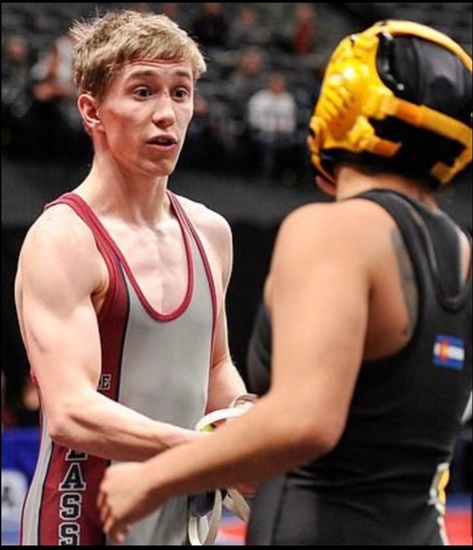
In February 2019, Colorado high school wrestler Brendan Johnston found himself facing a decision that would ultimately attract attention far beyond the wrestling mat. Johnston, an 18-year-old senior at The Classical Academy in Colorado Springs, had reached the Colorado state wrestling tournament after a successful season. Like many athletes at that level, he had spent years training for opportunities like this one. Yet when tournament competition placed him opposite female wrestlers, Johnston chose to forfeit rather than participate, explaining that wrestling women conflicted with his personal and Christian beliefs.
The decision carried significant consequences because this was Johnston’s final high school season. Every match at the state tournament represented an opportunity he would never have again as a high school athlete. He understood that forfeiting could damage his chances of finishing where he hoped in the tournament. Nevertheless, Johnston maintained a position he had already followed during previous competitions rather than changing it because the stakes were suddenly higher.
His first scheduled opponent at the 2019 state tournament was Jaslynn Gallegos of Skyview High School. Gallegos was an experienced wrestler who had participated in the sport from a young age and was accustomed to competing against boys. Johnston decided not to wrestle her and accepted a forfeit instead. Gallegos therefore advanced without the two athletes competing against each other on the mat.
Johnston continued through the tournament, but the same issue appeared again during the consolation bracket. This time, he was scheduled to face Angel Rios of Valley High School. Johnston again declined to wrestle. By accepting another forfeit, he effectively brought his high school wrestling career to an end.
The decision was not something Johnston invented at the last moment. He had previously declined matches against female competitors, including Rios, during the season. Reporting at the time also documented that he had faced a similar situation during the 2018 state tournament, when he chose not to wrestle female competitor Cayden Condit.
That earlier history is important because the story has sometimes been described online as though the widely reported Gallegos and Rios forfeits occurred in 2018. They happened at the 2019 Colorado state tournament. Johnston’s earlier 2018 decision helps explain some of the confusion surrounding the date.
When reporters asked Johnston to explain his position, he focused primarily on the physical nature of wrestling. Wrestling requires sustained close contact between competitors, along with aggressive movements intended to control or pin an opponent. Johnston said that he was uncomfortable participating in that kind of physical interaction with a young woman.
He also explained that his Christian faith influenced his decision. According to Johnston, the way he had been raised to interact with women and his personal religious convictions contributed to his discomfort. He did not frame his explanation as a claim that female athletes lacked dedication or athletic ability.
Johnston was also careful to distinguish between differences and value. He said he believed men and women were different but that this did not mean women were less valuable than men. From his perspective, declining the matches was compatible with believing that women deserved equal respect.
That explanation was important because some people interpreted his decision as an indication that he did not consider female wrestlers legitimate competitors. Johnston rejected that interpretation. He acknowledged the commitment necessary for Gallegos and Rios to qualify for a state tournament and recognized them as skilled athletes.
Still, respecting someone’s ability and agreeing to compete against that person were separate issues in Johnston’s mind. He believed he could respect the female wrestlers while maintaining a personal boundary that prevented him from wrestling them.
Gallegos understandably viewed the situation from another perspective. She had spent years training as a wrestler and wanted opponents to evaluate her according to her performance rather than her gender. Wrestling against boys was already familiar to her, so having an opponent decline specifically because she was female was frustrating.
She explained that she wanted to be regarded simply as a wrestler rather than primarily as a “girl wrestler.” For Gallegos, reaching the state tournament represented the result of years of work. She therefore wanted the same opportunity to compete that she expected when facing any other opponent.
At the same time, Gallegos did not respond to Johnston’s decision with personal hostility. She publicly acknowledged that she respected his ability to make his own decision even though she did not agree with the effect it had on her.
Those two reactions can exist together. Someone can respect another person’s right to make a personal choice while still feeling disappointed by that choice. Gallegos’s comments reflected exactly that distinction.
Angel Rios had also encountered Johnston’s position before the state tournament. Reports from the period indicated that he had forfeited previous matches rather than wrestle her. Consequently, when the same situation occurred at the state tournament, it was consistent with a boundary Johnston had maintained earlier.
This context matters when considering the sacrifice involved. Johnston was not refusing only when a particular opponent appeared. His position had already cost him matches before the state tournament, and he continued following it when the competitive consequences became much greater.
Johnston had entered his senior season with significant wrestling ambitions. The state tournament represented the culmination of years of training, practices, competitions, physical conditioning, and discipline. For many high school wrestlers, qualifying for the tournament is itself a major accomplishment.
Choosing to forfeit under those circumstances meant accepting that personal convictions could determine his final result rather than his performance on the mat. Johnston later indicated that he understood exactly what he was giving up.
His decision also highlighted the difference between possessing a belief privately and accepting consequences for acting on that belief. Johnston did not demand that Gallegos or Rios leave the tournament. He did not prevent them from competing against other athletes. Instead, he removed himself from the particular matches and accepted the forfeits that followed.
That distinction is central to understanding what actually occurred. Gallegos and Rios were eligible competitors under the tournament structure. Johnston’s personal position did not change their eligibility. His choice affected his own participation and tournament record.
For Gallegos and Rios, the 2019 tournament became historic for an entirely different reason. Both athletes ultimately reached the podium. Rios finished fourth in the Class 3A 106-pound division, while Gallegos finished fifth.
Their performances made them the first girls to place at Colorado’s state wrestling tournament. It was a significant milestone for female participation in the sport and attracted considerable attention in its own right.
Gallegos’s tournament performance involved more than advancing because of Johnston’s forfeit. She also won matches on the mat. Contemporary reporting from Colorado’s high school athletics organization documented victories she earned during the competition.
That fact is important because retellings of the story sometimes focus so heavily on Johnston’s decision that Gallegos’s actual athletic accomplishments receive less attention. Her fifth-place finish reflected her broader tournament performance, not simply one opponent declining to wrestle her.
Rios likewise earned her fourth-place result through the tournament. Together, their finishes represented a new milestone in Colorado high school wrestling.
The structure of girls’ wrestling in Colorado was also different at that time than it later became. In 2019, girls’ wrestling was developing rapidly, but female wrestlers could still compete within the established state tournament structure against boys.
That meant Gallegos and Rios were not violating tournament rules or entering a competition in which they did not belong. They had earned their positions according to the system that existed at the time.
Johnston, similarly, was not responsible for designing that system. When it created a matchup he believed conflicted with his convictions, his response was to forfeit.
This is one reason the story generated such widespread discussion. There was no need to invent a dramatic confrontation between the athletes. The real disagreement was already complex enough.
Johnston believed that participating in the matches would violate an important personal and religious boundary. Gallegos wanted to be treated like any other wrestler and felt frustrated when gender prevented the match from happening.
Both perspectives were expressed publicly.
Neither requires misrepresenting the other.
Johnston did not need to claim that Gallegos lacked ability for his personal boundary to exist. Gallegos did not need to attack Johnston’s religion to explain why his decision disappointed her.
Maintaining that distinction makes the story more accurate than turning it into a simple conflict between a hero and a villain.
The episode also occurred during a period when girls’ wrestling was expanding significantly across the United States. Increasing numbers of female athletes were joining high school wrestling programs, and more states were developing or sanctioning girls’ competitions.
As participation grew, situations involving boys and girls competing within the same divisions naturally attracted additional attention. Athletes, families, coaches, schools, and athletic organizations sometimes approached those situations from different perspectives.
The Johnston story became one prominent example because the stakes were unusually high. This was not an ordinary regular-season match. It happened at the state tournament during the final stage of Johnston’s high school career.
For Johnston, wrestling was important, but he said it was not the most important part of his identity. That perspective helped him explain why he was willing to accept a result that worked against his athletic ambitions.
Winning matters enormously to competitive athletes. State-level competitors do not normally spend years training with the intention of voluntarily accepting losses. That is precisely why Johnston’s forfeits received so much attention.
From his perspective, however, success in wrestling did not justify abandoning a conviction he considered more important.
Gallegos’s position also reflected years of commitment. She had been involved with wrestling since childhood and had repeatedly competed against male opponents. She wanted those years of training to define how people viewed her as an athlete.
Being treated differently because she was female therefore touched directly on something she had been trying to overcome throughout her wrestling experience.
Her disappointment should not be minimized simply because she respected Johnston’s right to choose. Respecting someone’s decision does not require pretending that the decision has no effect on you.
The same balanced approach applies to Johnston. Disagreeing with his decision does not require claiming that his stated motivation was something different from what he actually described.
His publicly reported explanation involved faith, personal boundaries, the physical closeness of wrestling, and the way he believed he should interact with women.
Those are the views he expressed.
Whether another person agrees with them is a separate question from accurately reporting what happened.
The tournament itself eventually continued beyond the controversy. Other wrestlers competed, brackets progressed, and champions were determined.
For Johnston, however, his second forfeit closed the final chapter of his high school wrestling career.
He had reached the state tournament but chose not to participate in two matches because the opponents were female.
The competitive cost was real.
So was the significance of the tournament for Gallegos and Rios.
Their fourth- and fifth-place finishes established a first for female wrestlers in Colorado’s state tournament history.
That accomplishment belongs to their story independently of the attention surrounding Johnston.
In the years since, the event has periodically resurfaced online. When older stories are shared without dates, readers can easily assume they describe something that happened recently.
For accuracy, the central events should therefore always be placed in their proper historical context: Johnston’s widely reported forfeits against Gallegos and Rios occurred in February 2019.
The event also should not be presented as evidence that every male wrestler, female wrestler, Christian athlete, school, or wrestling organization holds the same position.
It involved specific athletes making decisions within a particular tournament structure at a particular moment in Colorado high school wrestling history.
Johnston’s beliefs were his own.
Gallegos’s perspective was her own.
Rios continued pursuing her own competitive goals.
Treating those individuals as representatives of entire groups would oversimplify what actually happened.
The most interesting aspect of the story may therefore be that each athlete continued according to what mattered personally to them.
Johnston accepted the consequences of forfeiting rather than competing in circumstances he considered inappropriate.
Gallegos continued trying to establish herself simply as a wrestler.
Rios continued competing and eventually reached fourth place.
Nobody needed to invent a confrontation for their different perspectives to become clear.
The tournament itself created the conflict.
Johnston’s decision did not erase the accomplishments of Gallegos and Rios.
Their success did not change Johnston’s explanation for why he refused the matches.
All of those facts can be acknowledged simultaneously.
That is also why the story remains more nuanced than many social-media summaries suggest. It touches on religion, personal boundaries, equality, competitive opportunity, and the development of women’s wrestling, but the documented event itself remains relatively straightforward.
An 18-year-old senior qualified for his state tournament.
He was scheduled to wrestle female opponents.
He chose not to compete because doing so conflicted with his personal and religious beliefs.
He accepted forfeits as the consequence.
The female wrestlers continued through the tournament.
Angel Rios ultimately finished fourth.
Jaslynn Gallegos finished fifth.
Together, they became the first girls to place at Colorado’s state wrestling tournament.
For Johnston, the tournament ended with a sacrifice he said he was willing to make for his convictions.
For Gallegos, the experience reinforced her desire to be recognized according to her identity as an athlete rather than being treated differently because she was female.
Those perspectives did not perfectly align, and there is no need to pretend that they did.
The value of accurately revisiting the story comes from acknowledging the disagreement without adding claims the athletes themselves did not make.
Johnston’s final high school tournament therefore became memorable for reasons extending beyond wins and losses. His choice demonstrated how personal convictions can sometimes carry tangible consequences in competitive environments.
At the same tournament, Gallegos and Rios demonstrated the growing presence and competitive achievements of female wrestlers within Colorado high school athletics.
Those two parts of the story happened together.
Neither needs to be erased for the other to be understood.
The documented events are compelling precisely because the people involved saw the same situation differently yet continued making their own choices.
More than anything, the 2019 tournament illustrates what can happen when individual beliefs intersect with established sporting rules. Johnston chose his boundary and accepted what it cost him. Gallegos and Rios continued competing within the tournament available to them and achieved historic results.
That is the central meaning of the story without sensationalism or unnecessary speculation: different athletes entered the same competition with different experiences and convictions, and the decisions made there produced consequences none of them could completely avoid.
