
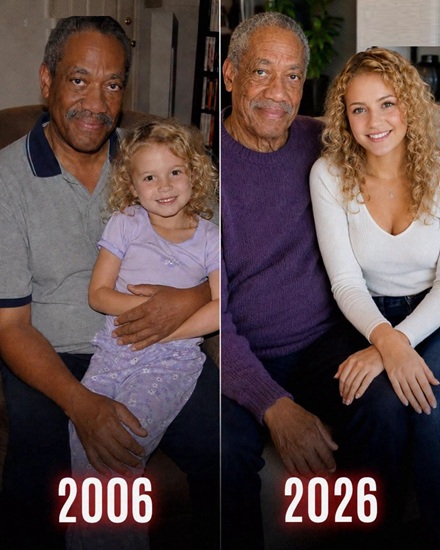
Martin was fifty years old when a winter night changed the course of his life. His son Michael, Michael’s wife Rachel, and their two children, eight-year-old Sam and five-year-old Emily, had come to his home for an early Christmas gathering. The evening had been warm and ordinary, filled with dinner, small presents, and the kind of conversation Martin had always assumed would happen again. Outside, snow had begun falling steadily, although the forecast had suggested only a light accumulation.
By seven in the evening, the family decided it was time to leave before conditions became worse. Michael carried a sleeping Emily toward the car, wrapped securely in her thick winter jacket. Martin followed them to the doorway and looked toward the road with growing concern. The snowfall seemed heavier than it had been only half an hour earlier, and the wind was beginning to push loose snow across the driveway. He suggested that they stay overnight, but Michael reassured him that the trip was short and that he would drive carefully.
Rachel helped Sam into the vehicle while Michael secured Emily in the back seat. Before closing the door, Michael smiled at his father and promised to call when they arrived home. Martin stood outside until the car’s taillights disappeared behind the falling snow.The phone call never came. As the evening grew later, Martin tried Michael’s number several times but received no answer.
He initially assumed the family had stopped somewhere or that poor weather had disrupted the phone signal. Still, an uncomfortable feeling remained with him. Shortly after ten that night, someone knocked at his front door. When Martin opened it, he found a police officer standing outside. In this fictional story, the officer is called Daniel Reynolds.
Reynolds explained that Michael’s vehicle had been found off a rural road several miles away. It had left the roadway and struck a group of trees during the storm. Michael, Rachel, and Sam had not survived. Emily, however, had been found alive in the back seat. She was transported to a hospital, where doctors treated her for a concussion, several broken ribs, and extensive bruising caused by the restraint that had helped keep her in place. For Martin, the world he had known only hours earlier suddenly seemed to disappear.
Emily’s recovery took time. The physical injuries gradually improved, but doctors were also concerned about the psychological effects of the crash. She remembered almost nothing clearly about the moments immediately before the collision. Instead, she occasionally described disconnected impressions: bright lights through snow, the sound of a horn, an adult speaking loudly, and the sensation of the vehicle suddenly changing direction. Medical professionals advised Martin not to pressure her for details. Memory following a traumatic event can be incomplete or unreliable, particularly when a person has also suffered a concussion.
Martin followed that advice. Almost overnight, he became Emily’s guardian while simultaneously grieving the deaths of his son, daughter-in-law, and grandson. He had never imagined raising another child at fifty, but his priorities changed immediately. He learned which breakfasts Emily liked before school, how to brush and arrange her hair, and how to recognize when she was frightened even when she insisted that everything was fine. He attended parent-teacher meetings, school performances, birthdays, and ordinary weekday activities. Their home slowly developed a new rhythm.
Whenever Emily asked what had happened to her family, Martin gave her the explanation he had received. There had been a terrible snowstorm, the road had become dangerous, and Michael’s vehicle had crashed. Martin emphasized that she was not responsible for what happened. He did not want a five-year-old child growing up believing that something she had said or done might have caused the tragedy. For many years, neither of them had any reason to believe there was another explanation.
Emily became increasingly curious as she grew older. She enjoyed mystery novels and puzzles and had an unusual patience for examining small details. At school, she preferred research projects that required comparing documents rather than simply memorizing information. Martin sometimes wondered whether her interest in unanswered questions was connected to the enormous unanswered question in her own childhood. He never discouraged her curiosity, although he rarely discussed the crash unless Emily brought it up herself.
After graduating from college, Emily returned to Martin’s town at twenty-five and accepted a job as a paralegal. Her work involved organizing records, reviewing case files, comparing statements, and finding inconsistencies hidden inside large amounts of paperwork. Those skills gradually changed the way she thought about the accident. As the twentieth anniversary approached, she realized that almost everything she knew about that night had come from a few conversations and an old police report.
She began asking Martin questions he had not heard in years. What exact time had Michael left the house? How heavy was the snow at that moment? Had anyone else been traveling on the same rural road? Had investigators ever returned to interview Martin after the initial report? Martin answered as accurately as he could, but two decades had blurred some details. He also admitted that he had never examined the investigation closely. At the time, grief and the responsibility of caring for Emily had consumed nearly all of his attention.
Then Emily began reviewing old records connected to the fictional case. One evening, she returned home carrying copies of documents and placed a handwritten note on Martin’s kitchen table. It contained a short sentence: “I don’t think it was only the storm.” Martin initially thought she was allowing old trauma to influence her judgment. Emily told him she had considered that possibility herself, which was why she had spent months looking for documentary evidence before discussing her suspicions with him.
Among the fictional archived materials was an old silver flip phone that appeared to have been stored incorrectly. The device had supposedly been recovered during an unrelated inquiry involving road operations in the same area. Because the fictional archive had incomplete labeling, Emily could not immediately establish why it had been preserved. She therefore treated what she found as a clue requiring further verification rather than proof by itself.
Several audio files remained on the device. Most were damaged or impossible to understand, but one recording appeared to have been made on the night of the crash. Through wind, static, and engine noise, two unidentified men could be heard speaking. One voice appeared worried and said he did not want to continue because nobody was supposed to be hurt. Another voice told him to keep moving and mentioned a missed turn.
Emily did not claim that the recording proved someone had intentionally targeted her family. In fact, the more documents she examined, the less likely that explanation appeared. Instead, she began considering whether another vehicle or commercial operation had been present on the road and whether that activity had contributed indirectly to the collision. It was a very different theory from deliberate violence, and she knew that distinction mattered.
Further fictional records revealed that Officer Reynolds had once faced an internal investigation concerning his relationship with a private trucking business. Documents suggested investigators had questioned whether he accepted improper payments in exchange for minimizing information about maintenance problems and road incidents. No single document answered everything, so Emily compared dates, maintenance logs, weather information, road records, and copies of earlier reports.
Eventually, an important detail emerged. Earlier on the same fictional day, a semi-truck had jackknifed along the rural route Michael later used. Because of the truck’s position and the worsening weather, temporary barricades were supposed to prevent ordinary traffic from entering that section of road. Yet according to the records Emily discovered, those barriers had been removed before the danger had been fully cleared.
That discovery changed the direction of her research. If the road had remained properly closed, Michael would have been forced to take another route. Instead, he had apparently entered a stretch of roadway where a disabled commercial vehicle remained difficult to see through heavy snowfall. Emily then examined diagrams from the original fictional crash report. The tire marks shown in those records seemed consistent with a sudden attempt to change direction.
Her theory was no longer that Michael had simply lost control because the road was icy. She believed he may have encountered an unexpected obstruction and reacted instinctively. With visibility reduced by snow, he might have had only seconds to make a decision. The vehicle then left the road and struck the trees. The storm remained an important factor, but it might not have been the only factor.
For Emily, that distinction was painful. Nobody appeared to have deliberately selected Michael’s family as a target. There was no evidence of a planned attack or personal dispute. Instead, the fictional evidence suggested something more ordinary but still devastating: a dangerous combination of bad decisions, improper conduct, poor road conditions, and an attempt to conceal responsibility afterward.
Emily also reconsidered why she had survived. For years, she had wondered whether there was some special reason. The more practical explanation was simpler. She had been properly restrained in the back seat and was asleep shortly before the collision. The exact mechanics of survival could never be reconstructed perfectly, but there was no need to attach a mysterious explanation to it.
There was another obstacle. Reynolds had died from natural causes three years before Emily began seriously investigating the records. Whatever responsibility he might have carried in this fictional narrative, he could no longer answer questions or face a criminal proceeding. Martin initially wondered why Emily wanted to continue. She told him that prosecution had never been her only goal. She wanted to understand what had happened to her parents and brother.
Her search eventually led to Reynolds’s widow. Emily approached her carefully and explained that she was researching a decades-old family tragedy. The widow did not immediately agree to speak with her. Several weeks later, however, she contacted Emily and said she had discovered a box of her husband’s belongings while preparing to move.
Inside were copied reports, handwritten notes, and an envelope addressed to Martin. There was also an unsigned document that appeared to describe Reynolds’s involvement in altering information related to the trucking company. Because this is a fictional story, these documents are narrative elements rather than real records or evidence concerning any actual person or company.
According to the fictional letter, Reynolds had accumulated serious personal debts. A representative associated with the trucking business had begun paying him to remove or soften details from reports that could expose the company to financial claims. At first, the changes concerned relatively minor incidents. Over time, however, Reynolds became increasingly trapped by his own decisions.
The letter described the day of Michael’s crash as the moment everything went beyond what Reynolds believed he could control. He had allegedly helped arrange for the barricades to be removed sooner than safety procedures allowed. His intention was not to harm a family. He believed the disabled truck would be moved before conditions deteriorated significantly. Then the storm intensified much faster than expected.
By the time Reynolds recognized the danger and tried to correct the situation, vehicles were already using the road. According to the fictional account, he attempted to have the barriers restored, but the sequence of events was already underway. Michael’s car entered the dangerous section before the closure could be reestablished.
The confession did not excuse the behavior. A person did not need to intend a tragedy in order for irresponsible choices to have serious consequences. At the same time, Emily refused to exaggerate what the documents showed. She did not describe Reynolds as someone who had intentionally killed her family, because that was not supported even within the fictional evidence she had assembled.
Martin struggled while reading the letter. For nearly twenty years, he had accepted the crash as a random tragedy produced by winter weather. Learning that preventable decisions may also have contributed gave him a new kind of grief. He found himself remembering small details from that Christmas evening: Michael’s gloves on the kitchen counter, Rachel laughing during dinner, Sam asking for another piece of dessert, and Emily sleeping peacefully while everyone prepared to leave.
For several days, Martin wondered whether knowing the truth had actually helped. Emily understood his reaction. She had experienced something similar during her investigation. Every new answer seemed to create another question about what might have happened if someone had made a different choice. Eventually, however, she realized that imagining alternative versions of the past could not change the one they had lived through.
The purpose of discovering the truth was not to rewrite history. It was to stop uncertainty from controlling their memories. Emily could finally separate what she remembered from what she had imagined during years of unanswered questions. Martin could understand that his son’s decision to drive home had not been an act of recklessness based on the information available to him at the time.
When Christmas arrived again, Martin and Emily continued the tradition they had followed for years. They placed three candles near the window in memory of Michael, Rachel, and Sam. In previous years, they often sat quietly afterward because speaking about the crash felt too painful. This time was different.
They talked about Michael’s terrible jokes and the way Rachel always remembered everyone’s birthdays. Martin told stories about Sam’s endless questions and his fascination with toy trains. Emily spoke openly about the nightmares she had experienced as a child and the fragments of memory she had been afraid to describe. Some memories were clear; others remained uncertain, and she had learned to accept that difference.
Martin took an old folded drawing from his wallet. Emily had made it when she was six. It showed five people standing beside a crooked green Christmas tree, all drawn with enormous smiles. The paper was worn along the folds after years of being carried everywhere.
Emily laughed when she saw it and asked why he had never replaced it with something newer. Martin told her he never wanted to. The drawing represented the first Christmas after the accident, when both of them were still learning how to live with what had happened.
The truth had not repaired everything. It could not bring Michael, Rachel, or Sam back. It could not return the years Emily had spent wondering about the incomplete images in her memory. It could not erase Martin’s regret over watching the family drive away into the snow.
What it could do was give their grief a clearer shape. The tragedy was no longer an unexplained shadow that followed them through every Christmas. They understood, within the fictional story, that a chain of preventable decisions had combined with dangerous weather to produce consequences nobody could reverse.
Emily also learned something important from her search. Finding the truth did not require turning uncertainty into sensational claims. She had started with a frightening childhood memory, but she allowed records and evidence to change her theory. When the evidence suggested that her family had not been deliberately targeted, she accepted that conclusion instead of forcing the facts to fit a more dramatic story.
Martin admired her for that. He realized that Emily had not spent years searching because she wanted someone to hate. She had searched because she wanted her family’s final night to be understood as accurately as possible.
Before going to bed that Christmas evening, Martin stood beside the window where the candles were burning. Snow had begun falling outside, lightly this time. For years, snowfall had immediately carried him back to the night he lost his family. Now the memory was still painful, but it was accompanied by something else.
Emily joined him at the window. Neither of them claimed that discovering the truth had created perfect closure. Grief rarely works that neatly. Instead, they had reached a quieter understanding: they could remember the people they loved without allowing unanswered questions to define every memory.
Martin looked at the three candles and then at the granddaughter he had raised. Twenty years earlier, he had believed that one terrible night had taken everything from him. In the years that followed, Emily had shown him that life could continue without requiring him to forget those who were gone.
The past remained part of them, but it no longer controlled the entire story. Michael, Rachel, and Sam were more than the victims of a winter crash. They were family members who had laughed around Martin’s table, exchanged Christmas gifts, told stories, made mistakes, and filled ordinary days with memories worth preserving.
For Emily, uncovering the fictional truth was ultimately less about assigning blame than understanding those final hours. For Martin, it meant finally releasing the question he had carried since watching Michael’s taillights disappear into the snow.
That night, they allowed the candles to burn a little longer than usual. Then they turned off the lights, closed the curtains, and continued forward—not because the past had disappeared, but because they no longer had to live inside an unanswered version of it.

