
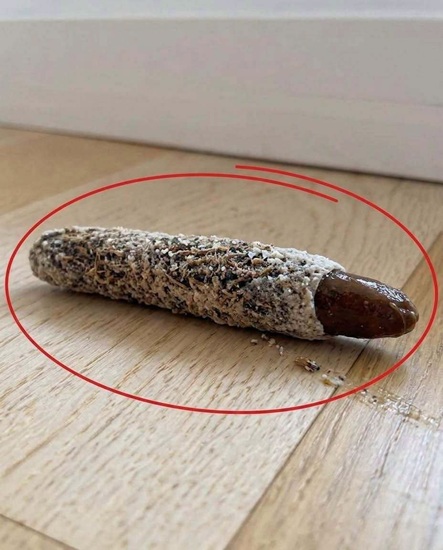
At first, the tiny object can look completely unremarkable. It may appear beside a baseboard, near a bedroom doorway, beneath furniture, or attached quietly to a wall. Its narrow grayish body resembles a piece of lint, dried debris, or dust that has somehow become compressed into a tiny tube. Because it does not immediately resemble an insect, many people simply vacuum or sweep it away. Only after looking more closely—or seeing the object move—does the discovery become considerably more interesting.
The unusual structure is often flattened and somewhat wider near the center. Its outer surface can contain tiny fibers, sand-like particles, hair, dust, and fragments gathered from its surroundings. Everything appears surprisingly organized for something that initially looked like random dirt. That is because the structure was actually constructed by an animal. In warm climates, this type of object is often the portable case produced by a household casebearer larva.
The household casebearer is a small moth whose scientific name is Phereoeca uterella. It belongs to the family Tineidae, a group that also contains several moth species associated with indoor environments and natural fibers. The insect is widely referred to as a plaster bagworm, although entomologists point out that it is not a true bagworm. True bagworms belong to another moth family.
The difference may seem unimportant to someone simply trying to identify a strange object on the wall, but accurate terminology helps explain the insect’s biology. “Household casebearer” describes one of its most distinctive behaviors extremely well. During its larval stage, the insect lives inside a case that it constructs and carries with it.
The case is not something the larva discovers already formed.
It builds the structure itself.
Silk produced by the larva creates the basic framework.
Small materials from the surrounding environment are then incorporated into the exterior.
This can include fibers, tiny grains, hair, dust-like material, and fragments of insects.
Because the construction material comes directly from the larva’s surroundings, the finished case naturally blends into the environment.
A case built in a dusty corner may appear gray.
Another made near darker material can look brown.
Cases from different locations can therefore vary slightly in appearance even though the same type of insect produced them.
This camouflage is remarkably effective.
Against a wall, baseboard, ceiling corner, or dusty storage area, the case can be difficult to distinguish from ordinary household debris.
That is one reason people sometimes discover several before realizing what they are.
The insect has been present, but its shelter helped conceal it.
The larva remains largely protected inside.
When it needs to travel, it extends its head and part of its body through an opening in the case.
It grips the surface and pulls the shelter along behind itself.
The movement can be slow enough that someone initially thinks they imagined it.
Then the entire tiny case shifts position again.
Suddenly, what looked like an inanimate piece of lint is clearly alive.
The mature case typically has openings at both ends.
This allows the larva to turn around inside and use either opening.
Rather than dragging the structure backward over a long distance, it can change direction while remaining protected.
For such a small animal, the system is surprisingly efficient.
When disturbed, the larva can retreat deeper inside the shelter.
The case therefore performs several jobs at once.
It provides camouflage.
It offers physical protection.
It travels with the larva.
And later, it also plays a role as the insect develops toward adulthood.
The structure is one of the main reasons the species attracts attention when people finally notice it.
The adult insect looks quite different.
After completing the larval and pupal stages, a small moth eventually emerges.
Someone who has only noticed the moving cases may never connect them with the tiny moths occasionally seen indoors.
Yet both appearances represent different stages of the same life cycle.
The larval stage is the one responsible for creating the characteristic portable shelter.
Household casebearers are particularly common in warm regions.
They are associated with tropical and subtropical conditions and are frequently noticed in buildings where temperatures and food sources allow them to survive.
Warmth alone, however, does not explain their presence.
The larvae also need suitable material to eat.
This is where ordinary household corners become important.
Household casebearer larvae are commonly associated with spiderwebs.
They can consume spider silk as well as dried insects and other material trapped in abandoned webs.
A dusty web behind a cabinet may therefore represent much more than clutter to the larva.
It can provide food.
This explains why cleaning spiderwebs is frequently recommended when these insects appear repeatedly.
Removing a web removes the silk itself.
It also removes the dead flies, mosquitoes, and other tiny arthropods that may have become trapped there.
A single cleaning action can therefore eliminate several potential resources.
Hair and other animal-derived materials may also be consumed.
This includes shed human hair and certain natural fibers.
Household casebearers can potentially damage wool and other animal-based textile materials when suitable conditions exist.
That makes closets and storage spaces worth checking if multiple cases are appearing.
However, the discovery of one larva does not mean every item of clothing is under attack.
That conclusion would be an unnecessary exaggeration.
The practical response should depend on the amount of activity actually observed.
If one case appears on an otherwise clean wall, it can simply be removed.
The nearby area can then be vacuumed and inspected.
If dozens of cases repeatedly appear around closets or stored natural-fiber items, the situation deserves more attention.
This distinction between an occasional insect and an established pest problem is important.
Homes are not biologically sterile environments.
Small insects occasionally enter through doors, windows, vents, packages, plants, or other routes.
Finding one does not automatically indicate poor housekeeping or a major infestation.
Repeated activity provides more useful information.
Vacuuming is one of the simplest management tools.
A vacuum can physically remove larvae and their cases while simultaneously eliminating hair, lint, insect remains, and other potential food sources.
Corners deserve particular attention.
So do baseboards.
Areas behind furniture should be cleaned periodically.
Closets and storage spaces can also accumulate exactly the material these larvae exploit.
Removing abandoned spiderwebs is particularly useful.
People sometimes clean the center of a room thoroughly while leaving ceiling corners or spaces behind furniture untouched for months.
Those protected areas can provide small indoor organisms with stable environments.
A vacuum attachment makes reaching them much easier.
Natural-fiber clothing deserves separate consideration.
Wool sweaters, rugs, blankets, felt items, feathers, fur, and similar materials can be attractive to several indoor textile pests.
If household casebearers are appearing near such items, the fabrics should be inspected for actual damage.
Do not assume damage exists without checking.
If valuable natural-fiber clothing is being stored for long periods, cleaning it before storage and using appropriate sealed containers can reduce pest opportunities.
This is useful preventive practice even when household casebearers are not currently visible.
Synthetic fabrics generally do not provide the same type of animal-derived nutrition as wool.
That does not mean a larva can never crawl across synthetic clothing.
It simply means location does not necessarily indicate feeding.
Identifying actual damage remains more useful than assuming every nearby material is being eaten.
Indoor moisture can also influence pest conditions.
Household casebearers are frequently associated with warm, humid environments.
Reducing excessive indoor humidity can therefore form part of general pest management.
Ventilation, air conditioning, or dehumidification may help where moisture is persistently high.
Water leaks and damp areas should also be corrected for broader building-health reasons.
Still, humidity should not be treated as the only explanation.
A case found indoors does not automatically prove the home is excessively damp.
Likewise, reducing humidity does not guarantee that every larva will disappear immediately.
Food sources, shelter, climate, and access all interact.
Effective prevention usually involves addressing several conditions rather than searching for one magical solution.
This is also why immediately spraying pesticides throughout a room is rarely a sensible response to one unidentified case.
First determine what the object actually is.
Then inspect the area.
Physical removal and sanitation may be enough when numbers are low.
If repeated cases continue appearing despite cleaning, professional identification can help determine whether additional treatment is appropriate.
Correct identification matters because several indoor insects can produce cases, cocoons, or structures that look somewhat similar.
A photograph on social media cannot always provide enough information for certainty.
The characteristic household casebearer case is usually flattened, spindle-like, and open at both ends.
Watching a larva extend itself and move the case provides another useful clue.
If uncertainty remains and the problem is persistent, an extension entomologist or qualified pest-management professional may be able to identify a specimen.
That is preferable to treating the home for the wrong pest.
The nickname “plaster bagworm” has created another common misunderstanding.
Some people assume the insect emerges from plaster or eats the walls.
That is not what the name means.
The larvae are often noticed crawling on walls and building surfaces, but the wall itself is not necessarily their food.
They are searching for or moving between suitable organic materials.
The case can become attached to walls while the insect rests or develops.
Its dusty appearance makes it look almost like a tiny fragment of the building.
That visual illusion probably contributed to the common name.
The shelter itself is held together by silk rather than simply being a compressed ball of dust.
Without the silk structure, loose particles would fall apart.
The larva’s ability to incorporate debris into silk is what gives the case its recognizable form.
As the insect grows, the case must accommodate its increasing size.
The larva maintains and expands its shelter during development.
Eventually, it pupates within the protective structure.
An adult moth later emerges.
An apparently abandoned case may therefore be empty after the adult has departed.
Another case may still contain an active larva.
A third might contain a developing pupa.
From the outside, those stages are not always immediately obvious.
That is another reason physical removal is easier than trying to determine the status of every individual case.
The larvae themselves are not considered a biting threat to people.
They do not hunt humans.
They do not crawl into skin.
They are not large dangerous parasites.
Their primary significance indoors comes from nuisance activity and their potential to feed on certain natural materials.
Understanding this can dramatically reduce the anxiety caused by discovering one near a bedroom.
Location alone often makes unfamiliar insects seem more threatening.
A tiny case found outside might generate curiosity.
The same object beside a bed can immediately feel alarming.
But the biological identity of the insect does not change because it appeared in a bedroom.
Careful identification is more useful than fear.
Bedrooms can actually contain several resources household casebearers may exploit.
Hair accumulates under furniture.
Lint collects along baseboards.
Small insects become trapped in spiderwebs near windows or ceilings.
Closets may contain natural fibers.
These ordinary materials can support a tiny scavenging larva without anyone realizing it.
This does not mean the room is unusually dirty.
Even regularly cleaned homes accumulate small amounts of organic debris in inaccessible places.
Moving furniture occasionally and vacuuming underneath can simply reduce those resources further.
The insect’s relationship with spiderwebs is particularly fascinating from an ecological perspective.
A spider builds a web to catch prey.
Small insects become trapped and die.
Later, a household casebearer larva can consume parts of the abandoned web and the dried remains.
One organism’s hunting structure becomes another organism’s food source.
All of this can occur unnoticed inside a house.
What humans describe as “dust” can therefore contain the remains of a miniature ecosystem.
Hair, fibers, dead insects, web silk, and microscopic organic material accumulate together.
The household casebearer is adapted to exploit that environment.
Its case then incorporates some of the same material.
The shelter literally reflects the environment in which the animal lives.
That is what makes the construction so remarkable.
A creature small enough to be mistaken for dirt gathers available particles and combines them with silk into a functioning portable structure.
No two cases need to look perfectly identical.
The local environment supplies the exterior materials.
The larva supplies the silk and behavior.
Together, they produce effective camouflage.
Evolution has created many examples of animals using environmental material for protection.
Some insects cover themselves with debris.
Certain aquatic larvae build shelters from sand or plant fragments.
Case-bearing moth larvae provide an indoor example of a similar strategy.
Their architecture happens on such a small scale that most people never notice it.
That is why seeing one move can be so surprising.
The brain initially categorizes the object as debris.
Debris should not crawl.
When it does, the original assumption has to be reconsidered.
A mundane household discovery suddenly becomes a biology lesson.
There is still no reason to leave unwanted larvae in the house simply because their behavior is interesting.
Curiosity and pest management can coexist.
You can appreciate the adaptation and still vacuum the case away.
Understanding the insect simply makes the response more targeted.
Instead of spraying everything in sight, remove what the larva needs.
Clean corners.
Vacuum hair and lint.
Remove spiderwebs.
Inspect susceptible fabrics.
Manage persistent moisture.
Monitor for additional cases.
If none return, the issue may already be resolved.
If new cases continue appearing, broaden the inspection.
Check rooms that receive less frequent cleaning.
Look behind heavy furniture.
Examine closet edges and stored natural fibers.
Pay attention to locations with persistent spider activity.
Repeated cases can help indicate where larvae are finding resources.
A professional assessment may become useful if numbers remain high or fabric damage is discovered.
Professional help is especially reasonable when identification is uncertain.
Different moth larvae may require different management approaches.
A trained person can evaluate specimens rather than relying on a generic internet photograph.
That reduces unnecessary treatment.
For ordinary isolated discoveries, however, the response can remain simple.
Remove the case.
Clean the surrounding area.
Observe.
There is no need to assume a dangerous infestation is hiding inside the walls.
The broader lesson is useful beyond this particular insect.
Unfamiliar household objects often generate dramatic explanations online.
A strange egg becomes a “deadly parasite.”
An ordinary insect case becomes evidence of something dangerous.
Sensational descriptions spread quickly because fear attracts attention.
Accurate identification usually produces a much calmer explanation.
In this case, the explanation is genuinely interesting without exaggeration.
The object may be alive.
A larva may indeed be hiding inside.
It may have constructed the entire case itself.
But that does not make it a serious threat to the people living nearby.
It is a small moth larva using an unusual survival strategy.
The discovery can therefore move through several stages.
First comes confusion.
Then surprise.
Then identification.
Finally, understanding.
What looked like a random dusty tube turns out to be a portable shelter.
The fibers were not arranged accidentally.
The movement was not imaginary.
A tiny animal was carrying its home across the wall.
Once that is understood, practical action becomes straightforward.
The case can be vacuumed.
The room can be cleaned.
Potential feeding sites can be removed.
Natural-fiber materials can be checked when appropriate.
Then the area can simply be monitored.
The experience also offers a reminder that human homes contain more biological activity than we normally notice.
We share buildings with tiny organisms that occupy spaces we barely think about.
Some live near windows.
Others hide behind appliances.
Some feed on stored food.
Others survive on dead insects and discarded organic material.
Most remain invisible until chance places them directly in our path.
The household casebearer is especially good at remaining unnoticed because concealment is built directly into its lifestyle.
Its shelter resembles the environment.
It moves slowly.
It prefers protected areas.
Its entire strategy depends partly on not attracting attention.
Only when it crosses an exposed wall or floor does that strategy temporarily fail.
For the homeowner, that failure provides an opportunity.
It reveals where a little additional cleaning or inspection may be useful.
For someone interested in nature, it also reveals something unexpectedly sophisticated.
Silk and debris have been transformed into protection.
The case is simultaneously camouflage, armor, shelter, and eventually a place for transformation.
All of it can fit into a structure roughly the size of a small seed or piece of lint.
That scale makes the biology easy to overlook.
Yet complexity does not require a large animal.
Some of nature’s most impressive adaptations occur in creatures most people would never notice without looking closely.
So if a strange narrow case appears near a doorway or slowly travels across a wall, there is no need to immediately imagine the worst.
Look carefully.
Avoid unsupported conclusions.
If the shape matches a household casebearer and a tiny larva emerges to pull it forward, the mystery has a likely explanation.
The object is not simply dust.
It is not evidence of a large creature hiding somewhere nearby.
And despite the familiar nickname, it is not a worm emerging from plaster.
It may be the portable case of Phereoeca uterella, the household casebearer commonly called a plaster bagworm.
Remove it if you do not want it indoors.
Clean the surrounding area.
Check for repeated activity.
Protect vulnerable natural fibers when necessary.
And perhaps take one moment before the vacuum cleaner arrives to appreciate what you discovered.
A tiny moth larva gathered fragments most people would consider worthless.
It combined them with silk.
It built a shelter.
Then it carried that shelter wherever it went.
What initially looked like household trash was actually a small example of adaptation taking place almost unnoticed inside an ordinary home.

