
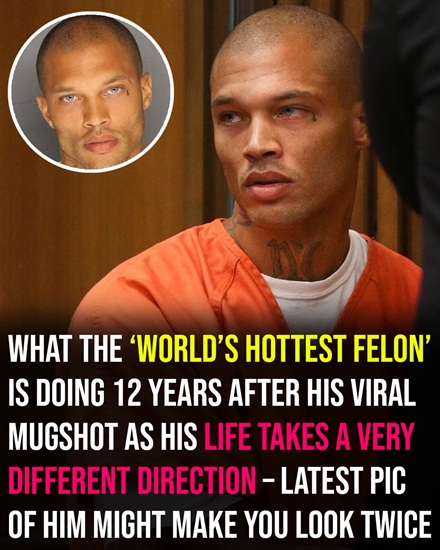
In June 2014, Jeremy Meeks could hardly have predicted that a routine booking photograph would become the image that changed the direction of his public life. Meeks was 30 when the Stockton Police Department in California published his mugshot following his arrest on June 18. The photograph rapidly spread across Facebook and other parts of the internet, where thousands of users commented on his blue eyes, facial features, and appearance.
Before long, headlines and social-media users were referring to him by nicknames including the “Hot Felon,” transforming an ordinary police image into an international viral phenomenon. The enormous online reaction, however, did not erase the legal circumstances surrounding the photograph. Meeks was facing serious criminal proceedings, and his case eventually moved into federal court. In February 2015, he received a 27-month federal prison sentence after being convicted of possessing a firearm as a felon.
The judge also ordered his participation in a substance-abuse treatment program while incarcerated. Whatever attention his appearance generated online, Meeks still had to deal with the legal consequences of the conduct that had resulted in his arrest. His criminal history had begun long before the famous photograph. Meeks had previous encounters with law enforcement and had already spent substantial time incarcerated.
He has subsequently spoken openly about that period of his life rather than pretending the viral arrest represented his first serious difficulty. His biography therefore cannot accurately be reduced to the popular idea that an unknown model was suddenly discovered through an unusual photograph.
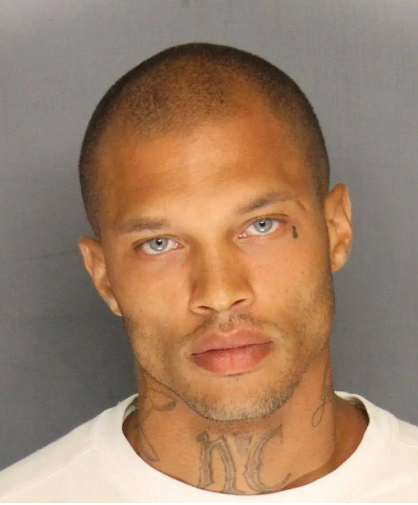
Something extraordinary was nevertheless happening while Meeks remained incarcerated. The booking image had reached people working within the entertainment and fashion industries. Modeling representatives began expressing interest in him, creating a situation few prisoners experience: professional opportunities were potentially waiting outside before he had completed his sentence.
Meeks eventually signed with White Cross Management. The agreement generated considerable media attention because it suggested that the internet fascination surrounding his mugshot could become something more substantial than a temporary meme. Still, nothing was guaranteed. Viral attention disappears quickly, and being widely recognized online does not automatically produce a lasting professional career.
Meeks was released from federal custody in March 2016 after serving approximately 13 months. He emerged into circumstances completely different from those surrounding his incarceration. Cameras were waiting. Fashion opportunities were being discussed. People who had never met him already recognized his face.
He publicly expressed hope that the opportunities would allow him to support his family and permanently change the direction of his life.
The transition from prison to fashion quickly became real.
After his release, Meeks began working professionally as a model and attending fashion events. His striking appearance, which had originally generated attention through the police photograph, now became part of commercial campaigns and runway presentations.
One of his most widely reported early runway appearances came with designer Philipp Plein.
Meeks walked in Plein’s New York Fashion Week show in 2017, appearing alongside established models and celebrities.
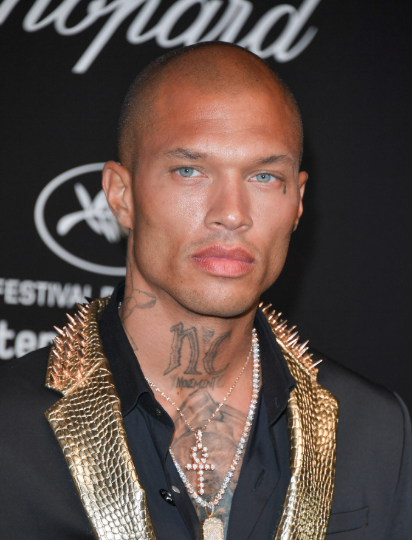
The moment attracted extensive coverage because the contrast was difficult to ignore.
Only a few years earlier, millions had first seen his face on a police department’s Facebook page.
Now photographers were capturing him on a fashion runway.
Additional opportunities followed.
Meeks participated in other fashion events and became associated with internationally recognized names in the industry. His work eventually included a Tommy Hilfiger fashion presentation in Milan.
By that point, describing him only as an internet curiosity had become increasingly inaccurate.
He was doing professional modeling work.
That distinction mattered because many people initially assumed his fame would disappear almost immediately.
Internet trends often last only days or weeks.
Meeks’ visibility instead continued after his release, giving him opportunities to establish relationships within fashion rather than depending entirely on the original mugshot.
The modeling career also brought international travel.
He attended fashion events in major cities and appeared in campaigns and photographs that presented an image dramatically different from the booking picture that introduced him to the public.
The contrast became a central part of his media identity.
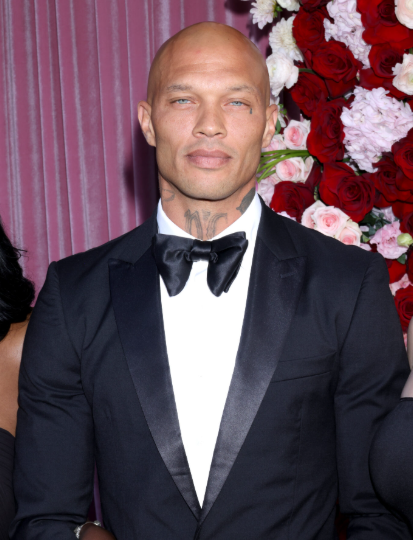
But Meeks eventually wanted to participate in fashion beyond modeling other people’s clothing.
In 2019, fashion-industry reporting announced a major collaboration involving Meeks and Fashion Concept GmbH.
The reported agreement was valued at approximately $15 million and involved developing a clothing line under his name.
That represented another significant shift.
The man once known almost exclusively for a photograph was attempting to become involved in fashion as a business participant and designer.
His collection subsequently debuted for the fall/winter 2020 season.
Years later, Meeks continued pursuing fashion projects.
In 2024, he collaborated with Canon Mitchell on another collection.
The work demonstrated that his relationship with the fashion industry had lasted considerably longer than the original wave of viral attention.
Acting became another professional direction.
Meeks began appearing in films, adding screen credits to his modeling résumé.
His acting work has included productions such as Secret Society, Dance for Me, Love After Holidays, Beach Chain, and films connected to the Dutch series.
The projects did not eliminate his association with fashion, but they expanded the range of professional work attached to his name.
Behind those public achievements was a considerably more complicated personal history.
Meeks has spoken in interviews about growing up in extremely difficult circumstances.
According to his own autobiographical accounts, both of his parents struggled with heroin addiction.
He has described himself as having been born dependent on the drug.
Meeks has also said that his father was sentenced to life imprisonment after committing a murder when Jeremy was still an infant.
Those claims form part of Meeks’ description of his own childhood and help explain how he understands the environment in which he grew up.
He has described his early years as dark and unstable.
His mother’s addiction created additional difficulties, while his father’s incarceration meant that a stable two-parent household was not part of his childhood experience.
Meeks has connected those circumstances with some of the decisions he later made.
That explanation does not remove personal responsibility for criminal conduct.
Difficult childhood circumstances can provide context without automatically excusing later choices.
Meeks himself has increasingly framed his story in terms of understanding how he reached prison and what he needed to change afterward.
His encounters with the criminal justice system began when he was young.
He spent time in juvenile facilities and later experienced adult incarceration.
Years before the 2014 arrest, he had already served prison time.
That history makes his later transformation more complicated than the simplified “mugshot to model” narrative frequently repeated online.
The 2014 photograph was not the beginning of his difficulties.
It was the moment those difficulties became visible to millions of strangers.
Ironically, the same image documenting another arrest became the source of opportunities that eventually helped him enter an entirely different professional environment.
Meeks has also described how bizarre the viral attention became while he was still incarcerated.
In a 2026 podcast appearance, he recalled receiving enormous amounts of mail from strangers.
People who had never met him wanted to communicate with him because they recognized the photograph.
Some strangers reportedly attempted to visit him in custody.
According to Meeks, those attempted visits could occupy limited visitor availability that might otherwise have gone to members of his family.
From outside prison, the attention looked glamorous.
From inside, it could also become intrusive.
That experience illustrates an important part of sudden internet fame.
Public fascination can create opportunity while simultaneously removing privacy.
Millions of people knew what Meeks looked like before they knew almost anything about his life.
Many formed opinions based entirely on a single photograph.
Some romanticized him.
Others criticized the attention because they believed his appearance was distracting people from the seriousness of his criminal record.
Both reactions became part of the public conversation.
After his release, Meeks had to determine what to do with attention he had never intentionally created.
He chose to pursue the legitimate professional opportunities available to him.
But professional success did not eliminate personal difficulties.
In later interviews, Meeks has spoken candidly about struggling with substance use even after becoming successful in fashion.
One account he shared publicly described an especially frightening incident during his relationship with Chloe Green.
According to Meeks, his drug use had reached a dangerous level.
He recalled that Green recorded him while he was asleep because his breathing had become unusually slow and his lips were changing color.
Meeks has characterized the incident as an overdose or near-overdose.
Green was pregnant with their son at the time.
According to his account, she realized that the situation required intervention and sought assistance.
Meeks later received treatment.
His description of that episode adds an important dimension to the glamorous images associated with his modeling years.
From the outside, he had achieved something extraordinary.
He was traveling internationally.
He was attending fashion shows.
He was being photographed at high-profile events.
Yet privately, he has said he was struggling with addiction severe enough to endanger his life.
The contrast demonstrates why professional success and personal recovery should not be treated as the same thing.
Money, recognition, and career opportunities do not automatically resolve addiction or emotional difficulties.
Meeks has described treatment and sobriety as separate challenges requiring deliberate effort.
His personal relationships also attracted considerable media attention.
Meeks had been married to Melissa Meeks before his modeling career took off.
They share a son, Jeremy Jr.
Their marriage eventually ended, with the divorce finalized in 2018.
Meeks later entered a highly publicized relationship with Chloe Green.
Green is the daughter of businessman Philip Green, whose family became widely associated with the Topshop retail empire.
The relationship generated extensive tabloid coverage because Meeks’ background contrasted sharply with the wealthy social world associated with Green’s family.
The couple welcomed their son, Jayden Meeks-Green, in May 2018.
Their relationship later ended.
Meeks has subsequently spoken about focusing more deliberately on himself.
In a 2024 interview, he described himself as single and said he was concentrating on his own development.
Later, he publicly stated that he had intentionally avoided romantic relationships for an extended period.
According to Meeks, removing those distractions allowed him to focus on other parts of his life.
Those comments describe his mindset during particular interviews rather than establishing a permanent status.
Personal circumstances can change.
What they demonstrate more reliably is that Meeks was publicly discussing self-discipline and personal priorities differently from how he had described earlier periods of his life.
Fatherhood has remained an important part of that discussion.
Meeks is the father of two sons.
His older son, Jeremy Jr., is from his marriage to Melissa.
His younger son, Jayden, is from his relationship with Green.
In interviews over the years, Meeks has repeatedly spoken about wanting to provide for his family.
That desire was already present immediately after his release from prison.
The unexpected modeling career offered him a lawful way to build financial stability that had not previously existed in the same form.
As his career continued, Meeks began telling more of his own story instead of allowing headlines to summarize it.
That process eventually led to his autobiography, Model Citizen: The Autobiography of Jeremy Meeks.
The memoir provided a format for discussing experiences that a viral mugshot could never communicate.
Meeks wrote about his childhood.
He addressed crime and incarceration.
He discussed sudden internet fame.
He described the transition into modeling.
And he addressed struggles that continued after success arrived.
Ahead of the book’s publication, Meeks said he wanted to approach his story with vulnerability.
He expressed hope that readers would better understand how he became the person he was and how he reached his current stage of life.
That does not mean an autobiography should automatically be treated as independent verification of every memory.
Memoirs necessarily present events from the author’s perspective.
But the book provides something the original viral moment did not:
Meeks’ own extended account of his life.
That difference is significant.
In 2014, the public encountered Jeremy Meeks almost entirely without context.
There was a photograph.
There were criminal allegations.
There were thousands of comments about his appearance.
Then came the nickname.
The person behind the photograph was largely absent from the conversation.
More than a decade later, the available picture is considerably broader.
His convictions remain part of his documented history.
So do his years of incarceration.
But his subsequent modeling work is equally documented.
So are his fashion collaborations.
His acting roles exist.
His memoir exists.
And his public discussions of addiction and recovery have added another layer to the story.
None of those later developments requires pretending the criminal history never happened.
Likewise, acknowledging his criminal record does not require pretending that people cannot pursue lawful careers after completing their sentences.
Both realities can exist simultaneously.
That balance is particularly important when discussing Meeks because his appearance originally generated such an unusual public response.
The attention sometimes risked glamorizing the circumstances surrounding his arrest.
A booking photograph is not a fashion campaign.
It documents someone entering the criminal justice system.
Meeks later transformed the attention surrounding that image into fashion opportunities, but the distinction between the arrest and the career that followed should remain clear.
His federal firearm conviction carried real consequences.
He spent time incarcerated.
Only afterward did he begin building the career for which he is now known.
That sequence makes his story unusual without requiring exaggeration.
It also illustrates the unpredictable nature of social-media virality.
Police departments routinely publish booking photographs.
Almost none become global internet phenomena.
Almost none lead to modeling contracts.
Almost none eventually result in international runway appearances.
Meeks happened to become one of the extraordinary exceptions.
The public reaction was driven largely by his physical appearance.
Professional representatives then recognized potential commercial value in the attention.
But turning viral curiosity into a career required more than simply being photographed once.
Meeks continued modeling for years.
He developed fashion projects.
He pursued acting.
He wrote a book.
Those later activities are what transformed a temporary viral moment into a longer public career.
At the same time, Meeks’ own accounts show that transformation was not a straight line from trouble to perfect success.
There were difficult periods after prison.
There were relationship changes.
There were addiction struggles.
There was treatment.
There were attempts to reconsider priorities.
A more accurate biography includes those setbacks rather than presenting his life as an effortless success story.
The phrase “from prison to runway” makes an effective headline.
Reality is more complicated.
Meeks came from a childhood he has described as unstable.
He developed a criminal history.
He was incarcerated.
His mugshot unexpectedly went viral.
He received professional opportunities.
He completed his federal sentence.
He became a model.
Then he faced additional personal struggles while expanding into fashion, acting, and writing.
Each stage matters.
Removing the difficult parts creates an incomplete story.
Removing the later accomplishments does the same.
Today, Meeks’ public identity is broader than the nickname created in 2014.
He is still frequently introduced through the mugshot because that is how millions of people first encountered him.
But he has now spent years working in other fields.
The photograph remains the beginning of his fame rather than the complete definition of his career.
That may ultimately be the most interesting aspect of his story.
A photograph intended only to document an arrest became one of the most recognizable booking images of the internet era.
It opened professional doors nobody involved could have reasonably predicted.
Yet those opportunities did not magically erase the life that came before or solve every problem afterward.
Meeks still had to complete his sentence.
He still had to confront addiction.
He still experienced failed relationships and personal difficulties.
And he still had to determine what kind of life he wanted once the initial wave of viral attention faded.
His memoir represents one attempt to answer that question publicly.
Rather than allowing strangers to interpret his entire life through one image, Meeks has chosen to describe the experiences surrounding it.
Readers can decide for themselves what they think of those choices.
The documented timeline does not require anyone to either glorify or condemn him.
It simply demonstrates substantial change.
In June 2014, Jeremy Meeks was arrested and photographed by police.
In 2015, he received a 27-month federal prison sentence.
In March 2016, he was released.
Professional modeling followed.
International fashion appearances followed.
Fashion collaborations followed.
Acting roles followed.
Eventually, an autobiography followed.
Along the way, Meeks has publicly discussed difficult aspects of his childhood, addiction, relationships, fatherhood, and recovery.
Those subjects are considerably more complicated than the comments originally posted beneath his mugshot.
The internet initially saw a face.
More than a decade of events eventually supplied the context.
His life does not prove that every difficult circumstance will produce an extraordinary second opportunity.
Most people leaving prison will never receive the unusual level of attention Meeks received.
His path was exceptional and heavily influenced by viral fame.
It therefore should not be presented as a typical experience.
What it does demonstrate is something narrower and more factual.
A person’s circumstances can change dramatically over time.
A criminal record remains part of someone’s history, but it does not automatically describe every lawful choice that person will make afterward.
For Meeks, the opportunity happened to arrive through one of the strangest possible routes.
A police photograph became viral.
The viral attention produced modeling interest.
That interest became professional work.
The work expanded into other industries.
And the man who was once known almost exclusively by a nickname attached to his arrest eventually gained additional titles:
Model.
Actor.
Fashion designer.
Author.
Father.
Those later roles do not erase what came first.
They simply show that the story continued.
More than twelve years after the photograph first spread online, Jeremy Meeks’ life remains connected to that extraordinary moment.
It probably always will.
But the mugshot is now one image in a much longer timeline.
The legal history is real.
The fashion career is real.
The later personal struggles he has described are part of his own public account.
And the professional reinvention that followed his release is documented.
That is what makes the full story more interesting than the viral headline.
One photograph brought Jeremy Meeks worldwide attention.
What happened afterward required years.
And whatever anyone thought when they first saw that mugshot in 2014, it ultimately became the opening image of a public life that developed in directions almost nobody could have predicted.

