
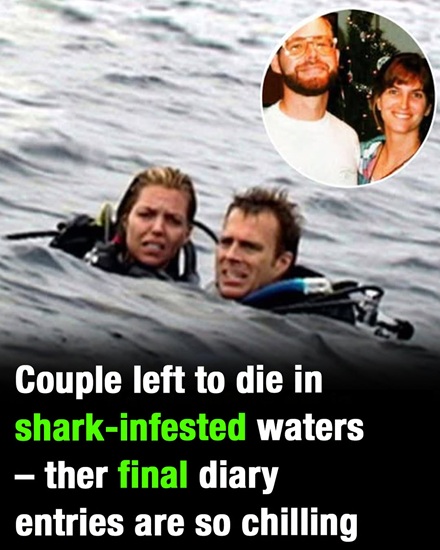
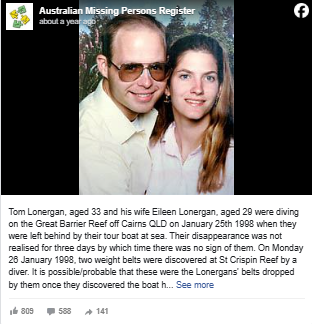
On January 25, 1998, American couple Tom and Eileen Lonergan joined what should have been another memorable scuba-diving excursion on Australia’s Great Barrier Reef. They traveled aboard the MV Outer Edge to St. Crispin’s Reef, off Queensland, entered the water with other recreational divers, and expected to return to the vessel afterward. Instead, the boat departed the area without them. The error was not discovered until roughly two days later, triggering a major search and creating one of the best-known tragedies in recreational diving history.
Tom was 33 years old and Eileen was 28. The Louisiana couple were experienced travelers who had spent significant time overseas before arriving in Australia. They had recently completed Peace Corps service in the Pacific and were traveling through the region before returning to the United States. They were also experienced recreational divers, making the circumstances different from an accident involving beginners unfamiliar with basic scuba procedures.
The Great Barrier Reef offered exactly the kind of experience they were looking for. Stretching along Australia’s northeastern coast, the reef system is famous for coral formations and extraordinary marine biodiversity. Thousands of visitors travel to Queensland each year specifically to experience it from beneath the surface. For Tom and Eileen, the January excursion was supposed to be another adventure during a long period of international travel.
They boarded the Outer Edge with other passengers for the trip to St. Crispin’s Reef. Divers entered and exited the water during the day’s activities, while the crew was responsible for ensuring that everyone who went into the ocean was accounted for before the vessel departed. In an offshore environment, that apparently routine procedure is one of the most important safeguards a dive operator has.
Something went catastrophically wrong.
At the end of the diving session, the boat left St. Crispin’s Reef.
Tom and Eileen were not aboard.
The precise details surrounding the failed count have been examined and debated in accounts of the case, but the essential fact is undisputed: two customers remained behind after the vessel departed.
The mistake was not immediately recognized.
That delay would become one of the most consequential elements of the tragedy.
Had the absence of two divers been identified immediately, a search could have begun around the known dive site while the couple were potentially still nearby.
Instead, hours passed.
Then the night passed.
Still, nobody realized that Tom and Eileen had never returned from the water.
When the Outer Edge returned to shore, personal belongings associated with the couple remained aboard. Their absence also affected transportation arrangements after the excursion. Yet those clues did not immediately trigger recognition that two divers might still be at sea.
The vessel subsequently continued operating.
Approximately two days after the dive, the unclaimed belongings finally received closer attention.
A bag left aboard contained personal items identifying its owners.
At that point, the horrifying possibility became clear.
Tom and Eileen had not simply forgotten their belongings.
They themselves were missing.
Authorities were contacted, and an extensive search began.
Aircraft, boats, police, rescue personnel, and others searched waters off Queensland in the hope that the couple might still be alive.
The challenge was enormous.
Ocean currents can carry people and floating objects significant distances, and after approximately two days, searchers were no longer dealing with a small area immediately surrounding St. Crispin’s Reef.
They were attempting to locate two people somewhere in an enormous marine environment.
No rescuers found Tom or Eileen.
As the search continued without success, hope diminished.
Eventually, the active operation ended without recovering either diver.
But the ocean later began returning pieces of evidence.
Items associated with the Lonergans were found in the weeks and months after their disappearance.
Among the recovered objects were pieces of diving equipment and clothing.
Those discoveries supported the conclusion that something had happened to them after the Outer Edge departed.
However, the location where an object was recovered could not automatically reveal where the couple themselves had been at a particular time.
Currents can transport floating equipment over long distances.
An item found many miles from the original dive location might have traveled there independently.
That made reconstruction extremely difficult.
The most haunting piece of evidence was a diver’s slate recovered months after the disappearance.
A slate is a surface on which divers can write messages.
The writing attributed to the Lonergans indicated that they had been abandoned by the Outer Edge and asked whoever found the message to rescue them before they died.
That discovery was extraordinarily important.
It indicated that the couple understood they had been left behind and attempted to communicate their situation.
It also strongly supported the conclusion that the abandonment was an emergency rather than part of a planned disappearance.
The message transformed the case from a disappearance containing many theoretical possibilities into something much more concrete.
Tom and Eileen had apparently surfaced expecting to find their dive boat.
At some point, they realized it was gone.
They knew they were stranded.
And they attempted to summon help.
Exactly what happened after that remains unknown.
Their bodies were never recovered.
No witness observed their final hours.
There was therefore no autopsy capable of establishing a precise cause of death.
Several possibilities were considered during the investigation, including drowning, exposure, dehydration, and shark attack.
None could be conclusively identified as the single cause.
That distinction matters because popular retellings sometimes describe the couple as having definitely been killed by sharks.
The evidence does not establish that.
Sharks inhabit the Great Barrier Reef, and witnesses later discussed shark activity in the broader area.
An attack was therefore considered possible.
But possible is not the same as proven.
Some recovered clothing also became part of the shark speculation.
Damage to material was initially interpreted by some observers as potentially consistent with an animal encounter.
Other analysis suggested alternative explanations, including contact with coral.
Without bodies or conclusive forensic evidence, investigators could not establish that a shark killed either diver.
The responsible conclusion is therefore that shark attack remained one possible explanation among several.
Prolonged exposure at sea provides another plausible scenario.
Being able to float does not mean someone can survive indefinitely in open water.
Sun exposure, dehydration, waves, currents, fatigue, stress, and declining physical strength can become increasingly dangerous.
Even experienced divers equipped with buoyancy devices face severe limitations when stranded for an extended period without fresh water, food, shelter, or a reliable way to signal rescuers.
The delayed alarm made those dangers significantly worse.
The search did not begin when the boat initially left.
By the time authorities knew Tom and Eileen were missing, they had already faced a prolonged period at sea.
Investigators therefore had to examine not only what might have happened after the abandonment but also how the vessel could leave without two passengers.
Passenger-accounting procedures became a central issue.
Dive operators must know who enters the water and verify that those people have returned.
An informal assumption is not enough when the consequence of an incorrect count can be catastrophic.
Evidence surrounding the Outer Edge indicated that the accounting system failed on January 25.
The couple’s belongings provided another missed opportunity.
Their bags remained behind.
Other equipment discrepancies were also reported in accounts of the case.
Individually, one forgotten object might not immediately signal an emergency.
Taken together, however, the missing passengers and unclaimed belongings became evidence of a much larger failure.
The tragedy demonstrated how multiple small oversights can reinforce one another.
One incorrect assumption may still be corrected by another safety check.
When several checks fail, however, the original mistake can continue unnoticed.
In this case, the delay lasted approximately two days.
By then, an immediate recovery near the dive site was no longer possible.
The investigation later expanded beyond operational failures because authorities discovered the couple’s personal diaries.
Selected passages attracted intense media attention.
Some writings suggested that Tom had experienced deeply pessimistic thoughts about life and death.
An entry attributed to Eileen expressed concern about what she described as her husband’s “death wish.”
Those words sounded alarming when published after the disappearance.
They also produced an entirely new theory.
Perhaps, some speculated, Tom and Eileen had not died because they were accidentally abandoned.
Maybe they had planned to disappear.
Others wondered whether their deaths could have involved suicide.
The diaries suddenly became central to sensational accounts of the case.
But investigators could not responsibly interpret a few disturbing sentences without considering the rest of the evidence.
The Lonergans’ families strongly objected to the way selected passages were portrayed.
They argued that private writings had been taken out of context and that the couple had not been planning to die.
The official investigation ultimately did not conclude that Tom and Eileen had entered the water as part of a suicide plan.
This distinction remains important today.
People sometimes write about despair, fear, mortality, or frustration without having a specific intention to harm themselves.
A private diary can provide information about someone’s emotional state.
It cannot automatically prove what that person intended to do weeks or months later.
Investigators therefore had to compare the diary material with physical evidence and the circumstances of the disappearance.
The recovered rescue slate was especially significant.
A desperate written request asking to be rescued is difficult to reconcile with the simple theory that the couple intentionally entered the ocean intending to die.
The later recovery of their equipment also supported an emergency at sea.
Another theory suggested that the couple might have staged the entire disappearance.
Perhaps they had deliberately remained behind, secretly reached another location, and started new lives.
Such ideas can flourish whenever bodies are never recovered.
But investigators found no convincing evidence supporting that scenario.
There was no verified trail demonstrating that Tom or Eileen survived.
No confirmed sightings established that they had escaped Australia.
Their financial activity did not provide evidence of a carefully prepared new life.
The recovered diving equipment and distress message pointed in a different direction.
The Queensland coroner ultimately concluded that Tom and Eileen had died at sea after being left behind.
Possible mechanisms included drowning, exposure, or shark attack.
The coroner rejected the theory that the pair had deliberately disappeared or participated in a planned suicide.
That official finding provides the strongest framework for understanding the case.
It does not answer every question.
It cannot tell us precisely when Tom and Eileen died.
It cannot tell us what they said to one another during their final hours.
It cannot establish whether they remained together until the end.
And it cannot identify one exact physical cause of death.
But uncertainty about those final details does not make every alternative theory equally credible.
The evidence strongly supports accidental abandonment followed by death at sea.
The investigation also placed intense scrutiny on Geoffrey Ian “Jack” Nairn, the skipper of the Outer Edge.
Questions centered on responsibility for ensuring that every passenger had returned before the vessel left the reef.
Nairn eventually faced criminal proceedings connected with the deaths.
He was ultimately acquitted.
That fact is essential in an accurate account.
Whatever criticism surrounded the procedures aboard the vessel, Nairn was not criminally convicted over the couple’s deaths.
The dive company itself faced separate consequences and pleaded guilty to negligence-related charges.
The tragedy also affected the broader Queensland recreational diving industry.
A tourist industry built around taking people into remote ocean environments depends heavily on trust.
Customers need confidence that operators will know when they enter the water and will confirm that they have safely returned.
The Lonergan disappearance demonstrated what could happen when that basic safeguard failed.
The case consequently became an important reference point in discussions about diver-accounting procedures.
More systematic approaches were emphasized so operators could reliably match people entering the water with people returning to the vessel.
The principle is simple.
Count people before they enter.
Record who is diving.
Confirm each person’s return.
Do not depart until every individual has been positively accounted for.
The simplicity of those steps makes the Lonergan tragedy particularly disturbing.
The catastrophe did not require an extraordinary mechanical failure.
The boat itself did not sink.
A major storm was not responsible for initially separating the couple from the vessel.
Two people were simply not aboard when the boat departed.
The ocean then transformed that administrative error into a survival emergency.
This is one reason the story remained in public memory.
Another was the 2003 independent film Open Water, released more widely in 2004.
Writer-director Chris Kentis drew inspiration from the real-life disappearance when developing the film’s basic premise.
The movie follows a fictional couple accidentally abandoned during a scuba excursion.
But Open Water is not a documentary.
Its characters are fictional.
Its dialogue is fictional.
Many of the events depicted after the abandonment were created for dramatic purposes.
Most importantly, the movie’s ending should not be treated as evidence of what happened to Tom and Eileen Lonergan.
Nobody witnessed their final hours.
The film had to invent events that history could not provide.
That distinction has sometimes been blurred because the movie’s premise closely resembles the real accident.
A viewer may finish Open Water and assume the film recreated the Lonergans’ deaths.
It did not.
The real case remains less complete and, in some ways, more haunting precisely because the ending is unknown.
We know where the emergency began.
We know why they were stranded.
We know they attempted to seek rescue.
We do not know exactly how their lives ended.
The recovered slate provides perhaps the closest thing to the couple’s own account of what happened after the boat departed.
Its message indicated abandonment and an urgent desire for rescue.
There is no need to invent dramatic final conversations beyond that.
Doing so would turn two real people into fictional characters.
The known evidence is powerful enough.
Imagine the basic sequence without adding anything unsupported.
Two experienced divers surface.
Their boat is gone.
They wait, initially perhaps expecting it to return.
Eventually, they recognize that something has gone terribly wrong.
They attempt to leave a message requesting help.
That much alone explains why the case has remained so disturbing.
The ocean around the Great Barrier Reef is vast.
A person floating at the surface can be extremely difficult to see from a distant vessel or aircraft.
Waves can hide someone from view.
Currents continuously change position.
As time passes, the potential search area grows.
A rescue operation that begins quickly therefore has a major advantage over one beginning approximately two days later.
The Lonergan case tragically lacked that advantage.
By the time authorities began searching, the couple’s position could have changed dramatically.
Searchers were effectively trying to reconstruct movements created by currents, weather, and time.
The later locations of floating equipment provided clues but not precise answers.
The bodies themselves never appeared.
That absence has fueled speculation for decades.
Yet a missing body does not automatically transform a well-supported accident into an unsolved conspiracy.
Ocean environments can make recovery extremely difficult.
Currents, depth, marine conditions, and time can all prevent remains from being found.
The coroner therefore did not require recovered bodies to conclude that the couple had died.
The disappearance theory also faced practical problems.
If Tom and Eileen wanted to secretly begin new lives, they would have needed a method of escaping the reef without being detected.
They would have needed resources afterward.
They would have had to avoid leaving a financial or identification trail.
And they would somehow have needed to explain why their diving equipment and apparent rescue message later appeared.
Investigators found no persuasive evidence demonstrating such a plan.
The diaries remained the most frequently cited support for intentional-death theories.
But even those writings were ambiguous when viewed in the broader context.
Private thoughts about mortality cannot retroactively transform an accidental abandonment into deliberate action without additional evidence.
The official investigation rejected that interpretation.
This is why modern retellings should clearly distinguish between documented facts and speculation.
It is accurate to say that troubling diary entries existed.
It is accurate to say that they generated questions.
It is not accurate to claim that those entries proved the couple planned their deaths.
Likewise, it is accurate to say sharks were present in the broader marine environment.
It is accurate to say shark attack was considered possible.
It is not accurate to say investigators proved the couple were killed by sharks.
The same standard applies to every dramatic element.
Possibility should remain possibility.
Evidence should remain evidence.
And official conclusions should not be replaced by theories simply because the theories make a more sensational story.
The central facts are already extraordinary.
Tom and Eileen Lonergan went scuba diving at St. Crispin’s Reef on January 25, 1998.
Their vessel left without them.
Their absence was not discovered until roughly two days later.
An extensive search failed to find them.
Their bodies were never recovered.
Pieces of their diving equipment later appeared.
A recovered slate contained an apparent request for rescue after they had been abandoned.
The coroner concluded that they died at sea.
Those facts tell the essential story.
Everything beyond them requires appropriate caution.
The accident also demonstrates why safety procedures often exist because previous failures revealed vulnerabilities.
A checklist may feel repetitive when nothing goes wrong.
A passenger roll may seem like routine paperwork.
A second verification may appear unnecessary after someone has already counted once.
But redundancy is precisely what can prevent one human mistake from becoming irreversible.
If one count is wrong, another check can catch it.
If one crew member makes an incorrect assumption, a documented system can expose the discrepancy.
Safety procedures are strongest when they do not depend entirely on memory.
The Lonergan case became a painful example of that principle.
The consequences extended beyond the couple and their families.
Dive operators faced increased scrutiny.
Tourists questioned safety procedures.
Authorities examined how passengers were tracked.
The industry had to confront a simple but devastating question:
How could two customers disappear without anyone noticing before the boat left?
That question mattered more than sensational theories about sharks or secret escapes.
The preventable failure occurred before the mystery began.
Tom and Eileen were left behind.
Everything that followed originated from that mistake.
Their families then endured not only loss but uncertainty.
Without recovered bodies, there was no conventional funeral following identification of remains.
Without witnesses to the final hours, there was no complete explanation.
Instead, relatives received fragments.
Equipment.
A written message.
Investigative findings.
Diary entries that became public.
And years of speculation from strangers.
The success of Open Water introduced the basic story to millions of people who might never otherwise have heard the Lonergans’ names.
That attention preserved awareness of the accident but also created confusion between reality and fiction.
Movies need endings.
Real unresolved tragedies do not always provide them.
The film could decide exactly what happened to its characters.
History cannot do the same for Tom and Eileen.
The most responsible account therefore ends where the evidence ends.
They were accidentally abandoned.
They apparently remained alive long enough to recognize what had happened and attempt to summon help.
A rescue operation began too late to locate them.
They died at sea.
Exactly how remains unknown.
That uncertainty does not diminish the tragedy.
If anything, it makes the documented portion more powerful.
The case does not require a hidden conspiracy to remain memorable.
It does not require a confirmed shark attack.
It does not require a secret suicide pact.
It does not require an escape to another country.
It requires only one terrible mistake.
A boat left.
Two people remained behind.
Nobody realized soon enough.
More than a quarter-century later, that sequence remains the reason the disappearance of Tom and Eileen Lonergan continues to be remembered.
Their story influenced popular culture, changed conversations about recreational diving safety, and demonstrated how an apparently routine procedure can become critically important when people are operating far from land.
The film inspired by their disappearance gave audiences an imagined version of the nightmare.
The real case left something more difficult:
an ending that can never be reconstructed with

