
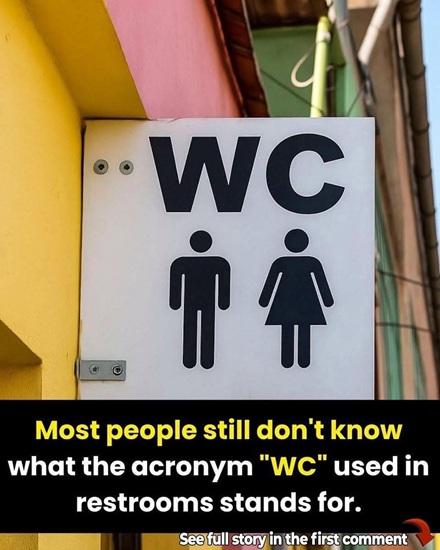
Most people have walked past a door marked “WC” without giving the letters much thought. The sign appears in airports, hotels, restaurants, train stations, shopping centers, cafés, and countless other public places. Even people who do not know what the letters stand for usually understand immediately that the sign points toward a toilet or restroom. The explanation is simple and well established: WC is an abbreviation for “water closet.” The term traditionally refers to a toilet or to a small room containing one.
The phrase may sound unusual to modern ears because “water closet” is no longer the most common expression in everyday English. In the United States, people are far more likely to say “restroom” or “bathroom.” In Britain, “toilet” and “loo” are common, while “WC” remains recognizable. In many parts of Europe and elsewhere, the two-letter abbreviation is still widely used on signs even when English is not the main language spoken locally.
The word “closet” is one reason the expression can seem confusing today. Many modern speakers immediately think of a storage area for clothes when they hear the word. Historically, however, “closet” could also describe a small private room or enclosed space. A “water closet” therefore referred to a private compartment containing a toilet that used water to remove waste.
As indoor plumbing became more common, the term helped distinguish water-flushing toilets from older sanitation arrangements. Earlier systems did not always use the type of plumbing people now take for granted. The development of reliable water supplies, sewer systems, traps, pipes, and flushing mechanisms gradually changed everyday sanitation. The phrase “water closet” became associated with this newer type of private toilet facility.
Over time, people naturally shortened the phrase.
“Water closet” became “WC.”
The abbreviation was convenient because it was compact and easy to place on doors and directional signs. It did not require a long explanation, and once people became familiar with it, the two letters were enough to communicate the intended meaning.
That is one reason the abbreviation has survived even though the full phrase sounds somewhat old-fashioned today.
Language often works this way.
A complete expression gradually disappears from everyday conversation while its shortened form remains familiar.
People may know exactly what an abbreviation means in practice without ever thinking about the words that originally created it.
WC is an excellent example.
Someone may have recognized WC signs for twenty or thirty years without once asking what the W and C represent.
The sign still performs its job perfectly.
It points people toward the toilet facilities.
Only when someone finally asks about the letters does the historical phrase become noticeable again.
The meaning is supported by major English dictionaries.
“WC” is defined as an abbreviation for “water closet,” referring to a toilet or a room containing one.
That definition is straightforward and does not require a mysterious hidden explanation.
It is simply an older term that remained visible because the abbreviation became internationally familiar.
One reason WC signs can be especially useful is that they are short enough to work in places used by international travelers.
Airports and railway stations often need signage that can be understood quickly.
Long sentences would be impractical.
Short labels and standardized symbols are therefore extremely valuable.
WC became one of those familiar labels.
Even someone with limited English may recognize it from previous travel experience.
The same principle applies to the familiar restroom pictograms showing male, female, or accessible facilities.
Simple visual symbols can communicate meaning across language barriers.
WC often appears beside those symbols as an additional cue.
This combination makes it easy for travelers to understand where they need to go.
Interestingly, the terminology used for toilets varies widely even within the English-speaking world.
An American might ask where the “restroom” is.
A Canadian may say “washroom.”
A British speaker might ask for the “toilet” or “loo.”
Someone in another country may simply say “WC.”
All of these expressions can refer to roughly the same type of facility, although regional habits and context influence which term sounds most natural.
“Bathroom” is another interesting example.
In American English, people frequently use the word to refer to a room containing a toilet even when there is no bathtub or shower anywhere nearby.
Someone in a restaurant may ask, “Where is the bathroom?”
Nobody expects the restaurant to provide an actual bath.
The context makes the intended meaning clear.
“Restroom” works in a similar way.
People generally do not enter a public restroom because they intend to rest.
The word became a polite or indirect way of referring to toilet facilities.
“Washroom” emphasizes washing.
“Lavatory” is another older or more formal term.
“Loo” is a familiar informal British expression.
These variations demonstrate how languages often develop several ways to refer to the same private bodily function.
“Water closet” belongs to that same history.
The phrase was especially meaningful when indoor plumbing was still developing.
Today, flushing a toilet seems completely ordinary.
People press a button or move a handle and rarely think about what happens afterward.
Yet reliable indoor sanitation depends on enormous infrastructure.
Clean water has to reach the building.
Wastewater has to be removed.
Pipes, traps, sewer networks, treatment systems, and maintenance all work together.
Earlier generations did not always have access to those systems.
A private toilet connected to water and drainage therefore represented a significant technological improvement.
That historical context helps explain why “water” became an important part of the name.
The term distinguished the fixture from sanitation systems that did not operate in the same way.
The word “closet” emphasized the private enclosed space.
Together, the two words created a practical description.
As the technology became normal, the terminology became less important.
People stopped needing to emphasize that the toilet used water.
New expressions became more common.
But WC had already become a familiar abbreviation.
Signs tend to preserve old language particularly well.
Once businesses, transportation systems, hotels, architects, and public institutions adopt a short label, replacing it is not always necessary.
If everyone understands what WC means in practice, the sign continues to work.
The abbreviation therefore survived changes in everyday vocabulary.
This is also why people sometimes describe WC as almost an international symbol rather than simply an English abbreviation.
Its origin is English, but its use spread far beyond places where people regularly say “water closet.”
In some countries, WC may actually be more common on public signs than it is in modern American public spaces.
A traveler might therefore see the letters repeatedly while never hearing anyone use the full expression aloud.
That combination can make the discovery feel surprising.
The sign is familiar.
The words behind it are not.
This kind of linguistic survival is common.
Modern life is filled with abbreviations and expressions whose original meanings are rarely considered.
People use them automatically because convention has made them understandable.
Only later do they sometimes discover the older phrase or technology behind them.
WC is simply one of the clearest everyday examples.
The history of the toilet itself is also more complicated than many internet stories suggest.
The modern flushing toilet was not invented in one single moment by one single person.
Different inventors and engineers contributed improvements over long periods.
Plumbing systems, sewer design, flushing mechanisms, sanitation practices, and manufacturing all developed gradually.
One early flushing toilet design is associated with Sir John Harington in England during the late sixteenth century.
Later inventors improved the technology further.
However, a modern toilet depends on far more than one individual invention.
It requires a functioning network of water and waste infrastructure.
This broader history is worth remembering because viral trivia sometimes reduces complex developments to one dramatic claim.
A simple accurate explanation is usually more reliable.
In the case of WC, no exaggerated story is necessary.
The letters come directly from “water closet.”
There are also a few incorrect explanations that occasionally circulate online.
Some people guess that WC means “wash center.”
Others jokingly suggest different combinations of words.
Those interpretations may sound plausible to someone unfamiliar with the history, but standard dictionary definitions identify the accepted origin as “water closet.”
That is the meaning people can safely rely on.
The phrase remains useful in architecture and interior design too.
In some modern houses, especially larger bathrooms, a toilet may be installed inside its own small enclosed room.
That separate compartment is sometimes specifically called a water closet.
The rest of the bathroom might contain sinks, a shower, or a bathtub.
The enclosed WC provides privacy and allows more than one person to use different parts of the bathroom at the same time.
In that context, “water closet” can describe something slightly more specific than a general public restroom.
Architects and builders may use the term precisely.
On a public sign, however, WC normally communicates a simpler message.
It means the toilet facilities are located there.
No architectural knowledge is required.
That flexibility has probably helped the term survive.
It can function as both a technical expression and an ordinary sign.
There is also an interesting difference between understanding a word and understanding its origin.
Millions of people understand WC perfectly well.
They see the letters and know where to go.
That practical knowledge is enough for daily life.
Knowing that the abbreviation comes from “water closet” is an additional piece of historical knowledge rather than something necessary for using the facility.
This is why discovering the meaning can produce a small “I never knew that” moment.
Nothing about the sign changes.
But suddenly the two letters are no longer arbitrary.
They represent words with a clear historical explanation.
Once someone learns the meaning, it becomes difficult not to notice it again.
The W clearly stands for “water.”
The C stands for “closet.”
The abbreviation suddenly seems obvious.
Before learning it, however, the connection may never have occurred to them.
That is part of what makes ordinary language trivia enjoyable.
The information is often hiding in plain sight.
People may encounter the same sign hundreds of times without asking the question.
Then one small explanation gives a familiar object an unexpectedly interesting history.
The term also shows how technology can influence vocabulary.
When water-flushing sanitation was relatively new and noteworthy, describing the toilet as a “water closet” made practical sense.
As the technology became standard, speakers moved toward shorter or more indirect expressions.
The infrastructure changed the language.
Then the language continued evolving even after the technology became ordinary.
Something similar happens with many technological terms.
Words survive even when the original reason for their existence is no longer obvious.
People continue using them because everyone already knows what they mean.
WC belongs to that category.
It is a linguistic leftover from an earlier era of sanitation that remains useful in modern public spaces.
Another interesting feature is how cultural preferences influence which toilet-related words people choose.
Some societies use direct language.
Others prefer euphemisms.
Even within the same language, people may consider one expression more polite than another.
“Restroom,” for example, often sounds more polite in American public conversation than simply saying “toilet.”
In other regions, saying “toilet” is completely normal.
Neither style is inherently more correct.
They reflect different linguistic conventions.
WC avoids much of that regional variation because it functions primarily as a sign.
People do not necessarily need to pronounce it.
They just recognize it.
This makes the abbreviation especially useful in multilingual places.
Tourist destinations often depend on communication that works quickly and with minimal language.
A person urgently looking for a toilet does not want to translate a long sentence.
Two familiar letters can solve the problem immediately.
That practicality probably matters more today than the historical phrase itself.
Most modern travelers are not thinking about water closets.
They are thinking about finding the restroom.
The sign succeeds because it delivers that information with almost no effort.
There is also no need to attach a dramatic mystery to the explanation.
The meaning is interesting precisely because it is ordinary.
It shows how a phrase from an earlier period can remain part of everyday life long after most people stop using the full expression.
The surprise comes from familiarity, not secrecy.
A person may see WC signs constantly and still never know the origin.
That is perfectly normal.
Language contains countless examples of people using expressions correctly without knowing their history.
Etymology is an extra layer of understanding.
It explains how words arrived where they are today.
In the case of WC, the path is easy to follow.
Indoor water-based sanitation became increasingly important.
A private compartment containing the fixture was called a water closet.
The phrase was shortened.
The abbreviation spread.
The full phrase declined in everyday conversation.
The abbreviation remained visible.
That sequence explains why modern people still see WC today.
It also helps explain why the term can feel both familiar and old-fashioned at the same time.
The letters are modern enough to appear on airport signs.
The full phrase sounds like something from another generation.
Both impressions are correct.
The abbreviation survived while the spoken vocabulary changed around it.
If someone asks what WC means today, the safest and clearest answer is therefore very simple:
WC stands for “water closet.”
Historically, it refers to a toilet or a private room containing one.
In modern public signage, it usually just means restroom or toilet facilities.
No secret code is involved.
No unusual modern acronym is hidden behind it.
It is simply an old expression that became a very durable abbreviation.
The next time you notice WC on a door, you may see those letters a little differently.
They are not random symbols.
They carry a small piece of sanitation history.
They reflect the development of indoor plumbing.
They show how words can outlive the circumstances that originally made them important.
And they demonstrate how ordinary public signs can preserve surprisingly old language.
That may be the most interesting part of the entire story.
Something as simple as looking for a restroom can connect modern life with centuries of changing technology and vocabulary.
Most people will still walk through the door without thinking about any of that.
But once you know the meaning, the sign has a story.
Two letters.
One old phrase.
A very practical purpose.
And a piece of everyday history hiding in plain sight.
So when someone asks, “What does WC actually stand for?” the answer does not need exaggeration or speculation.
It stands for water closet.
The phrase traditionally describes a toilet or a small room containing one.
The abbreviation became widely recognized and continues to appear on public signs around the world.
Sometimes the most interesting facts are the ones we have been looking at for years without ever stopping to ask what they mean.

