
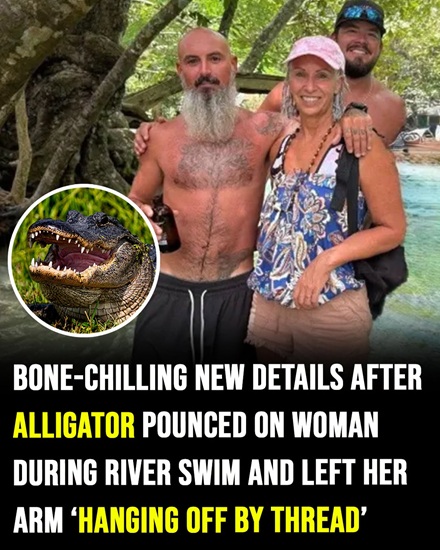
A family outing on Florida’s Silver River became a life-threatening emergency on August 8, 2026, when 58-year-old Dina Spann was seriously injured in an alligator attack. Spann had been spending time in the water with relatives in Marion County when the encounter suddenly unfolded. According to accounts later provided by her son, Zach Guerrina, and people who witnessed or assisted during the incident, an alligator approached the group before attacking Spann. The encounter caused devastating injuries to her right arm as well as damage to her left hand.
Despite the severity of what happened, Spann survived after nearby people responded quickly and helped move her to safety and emergency medical care. Guerrina later described the events leading up to the attack in interviews with news outlets. He said he had stepped away only a short time earlier while his mother remained in the water with other members of the family. According to his account, Spann noticed the alligator approaching and attempted to discourage it from coming closer. Guerrina said she used a stick in an effort to push or shoo the animal away. The situation then escalated rapidly, with the alligator attacking and pulling Spann into a struggle in the water. What had begun as a quiet recreational outing changed within moments into a desperate effort to survive.
According to Guerrina, his mother actively fought against the animal instead of remaining motionless during the encounter. He said Spann tried to control the alligator’s mouth with her hands while repeatedly working her way toward the surface so she could breathe. Her son also said she tried to prevent the animal from getting access to her legs. During the struggle, however, the alligator severely injured Spann’s right arm. Her left hand was injured as well, and reports state that she lost part of her ring finger on that hand. The injuries to her right arm were ultimately serious enough that doctors could not save the damaged portion.
Several people nearby realized that something was wrong and began moving toward the swimmers. John Gamache and his father had reportedly been eating lunch on their boat when they heard people calling for help farther upriver. Gamache later said that when he looked in that direction, he could see an alligator moving quickly through the water toward the group. The spring-fed water in the area was clear enough for him to identify what was happening from a distance. Understanding that the swimmers were in immediate danger, he moved the boat toward them as quickly as possible.
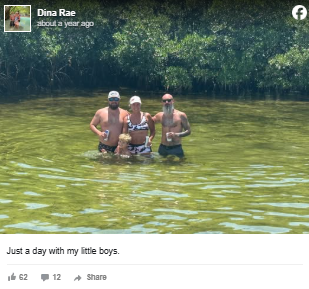
Reports later identified the alligator removed from the area as measuring approximately 9 feet, 8 inches. Gamache described the animal moving rapidly toward the swimmers before the attack occurred. As his boat approached, the increased movement and noise apparently helped drive the animal away from the immediate area. By the time the boat reached Spann, the alligator had released her. The threat from the animal had temporarily passed, but the severity of Spann’s injuries meant the situation remained extremely dangerous. The people helping her immediately turned their attention toward controlling her bleeding and getting everyone out of the water.
Another person in the area, paddleboarder Mike Head, was also reported to have responded during the incident. Head later described seeing the alligator heading toward the swimmers and moving closer despite recognizing that doing so created a danger for him as well. Reports indicate that he used his paddle while attempting to help discourage the animal. The rescue therefore involved several people responding from different positions and making decisions within a very short period. Their accounts provide slightly different perspectives on the same emergency because each person witnessed a different part of the unfolding incident.
Once Spann was brought onto a boat, the extent of her injury became clearer. Witnesses described extremely serious damage to her right arm and significant blood loss. Without immediate access to professional medical equipment, the people assisting her used materials that were available at the scene. Reports state that clothing and an anchor rope were used in an effort to control the bleeding until professional emergency personnel could take over. In an injury involving major blood loss, the period before first responders arrive can be critical, making the actions taken by people at the scene especially important.
Guerrina later said one of the details that stayed with him was how calm his mother appeared despite everything happening around her. He described Spann as unusually composed while other people were working to help her and dealing with the shock of what they had just witnessed. His comments about her reaction became an important part of the family’s public account of the incident. Rather than focusing only on the physical injuries, Guerrina emphasized his mother’s determination and attitude in the immediate aftermath. He said he was proud of the way she handled an extraordinarily frightening situation.
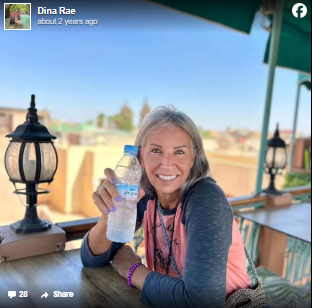
The rescue effort also involved helping the other people who remained in or near the water. Spann had not been swimming alone, and getting everyone safely away from the area became another priority once the immediate attack ended. Gamache and his father helped bring the remaining members of the group onto the boat before heading toward a location where first responders could reach them. This meant the rescuers were simultaneously dealing with a severely injured patient and ensuring that no one else remained exposed to the animal. Reports indicate that the other swimmers escaped without suffering injuries comparable to Spann’s.
Emergency personnel eventually took responsibility for Spann’s care and transported her for hospital treatment. Doctors determined that the damage to her right arm was too extensive to repair fully, and the arm was amputated below the elbow. She also lost part of the ring finger on her left hand as a result of injuries sustained while fighting the alligator. Those are permanent and life-changing injuries that will require significant adjustment. Nevertheless, Spann survived the attack, and reports published shortly afterward said she was discharged from the hospital and able to continue recovering at home.
Guerrina later discussed why he believed his mother was attacked rather than one of the younger swimmers nearby. His explanation was that she happened to be positioned in front of the others when the animal approached. There is no publicly verified evidence establishing that the alligator deliberately selected Spann because of her age or any other characteristic. Wildlife behavior should not be given unsupported human motives. The documented circumstances instead indicate that Spann was in the animal’s path and became the person directly involved in the encounter while the others were fortunate enough to escape without similar injuries.
The fact that the younger family members were not seriously hurt has strongly influenced the way Spann’s family has spoken about what happened. Guerrina said his mother appeared grateful that other people in the group were safe. He also described her as approaching the loss of part of her arm with an unexpectedly positive attitude. According to her son, Spann has focused on the extraordinary fact that she survived rather than allowing the injury alone to define the experience. Those comments represent the family’s description of her outlook and should not be interpreted as minimizing the serious physical and emotional challenges that can accompany an amputation.
Recovery following an amputation can involve several stages, including healing from the original injury, rehabilitation and learning new ways to perform everyday activities. Spann’s specific long-term medical plan has not been publicly detailed, so it would be inappropriate to make assumptions about the precise treatment she will receive. What has been publicly reported is that she survived the initial emergency and was able to leave the hospital relatively quickly. Her family’s statements have focused largely on her resilience, while recognizing that the incident permanently changed her life.
Wildlife officials also responded after the attack. The Florida Fish and Wildlife Conservation Commission and a contracted nuisance-alligator trapper became involved in locating and removing the animal. Officials later confirmed that a 9-foot, 8-inch alligator was removed from the area on August 9, one day after Spann was injured. Removing the animal was part of the state’s established procedure for responding to alligators considered a potential threat to people. The action also allowed officials to address safety concerns in an area used by residents and visitors for outdoor recreation.
Florida operates a Statewide Nuisance Alligator Program through the Florida Fish and Wildlife Conservation Commission. Under that system, contracted trappers respond when qualifying alligators are reported as possible threats to people, pets or property. The program reflects the reality that alligators are native wildlife throughout much of Florida and frequently share environments with people. Most sightings do not result in attacks, but animals displaying threatening behavior or repeatedly approaching populated areas may require intervention. Officials encourage people to contact wildlife authorities rather than attempt to capture or confront an alligator themselves.
The Silver River incident also drew attention because serious alligator attacks remain relatively uncommon even in a state with a large alligator population. Florida contains extensive freshwater habitat, including rivers, lakes, ponds, marshes and wetlands where alligators naturally live. Millions of residents and visitors use many of those same environments for recreation. That overlap makes encounters possible, but the presence of an alligator does not automatically mean an attack will occur. Wildlife officials nevertheless advise people to remain cautious and respect the distance between humans and wild animals.
Florida wildlife officials have longstanding recommendations intended to reduce the risk of dangerous encounters. Among their most important messages is that people should never feed alligators. Feeding wildlife can cause animals to lose their normal wariness of humans and begin associating people with a source of food. Feeding alligators is also illegal in Florida. Officials advise people to keep a safe distance whenever an alligator is observed and to avoid approaching the animal for photographs or other unnecessary reasons.
Officials also recommend using designated swimming areas and paying attention to local signs or restrictions. Alligators are generally more active between dusk and dawn, which is one reason wildlife authorities recommend swimming during daylight hours in designated locations. Pets should also be kept away from the water’s edge because their size and movements can attract the attention of predators. These recommendations are general safety guidance and do not establish exactly why the alligator involved in Spann’s attack behaved as it did.
Guerrina has discussed concerns about interactions between visitors and alligators following his mother’s experience. His statements reflect the perspective of a family member responding to a traumatic event. They should therefore be distinguished from an official wildlife investigation into the specific cause of the attack. At the same time, his concerns overlap with established FWC guidance warning against feeding or becoming unnecessarily close to alligators. There is no need to speculate that a particular human action caused this animal’s behavior unless wildlife authorities publicly establish such a connection.
Gamache has said he was a longtime visitor to the Silver Springs area and had not previously witnessed an alligator attack there. That experience made the incident particularly shocking for him. Afterward, Spann’s family contacted him, giving the people involved in the rescue an opportunity to speak about what had happened. Gamache described the conversation as meaningful and expressed relief that Spann had survived. Although her injuries were devastating, he acknowledged that an incident involving a large alligator and several people in the water could have resulted in additional serious injuries or loss of life.
The intervention by Gamache, his father, Head and others nearby has become an important part of the story. Their actions unfolded before professional emergency responders could reach the scene. One person moved closer from a paddleboard, another rapidly brought a boat toward the swimmers, and others helped control bleeding and bring people aboard. No single action should be presented as definitively responsible for Spann’s survival because complex emergencies can involve numerous factors. What the witness accounts do establish is that several people responded quickly rather than ignoring the calls for help.
Spann’s own actions during the attack are similarly important without needing to exaggerate what can be proven. According to her son, she resisted while being pulled underwater and repeatedly tried to return to the surface. She attempted to keep the alligator from reaching her legs and continued fighting until the animal released her. Those actions demonstrate that she remained engaged in trying to survive throughout the encounter. It is impossible to determine exactly which movement changed the outcome, but her family understandably views her response as evidence of remarkable determination under extreme pressure.
Accounts of wildlife attacks can sometimes become distorted as dramatic details are repeated online. In this case, the confirmed facts already describe an exceptionally serious event without adding unsupported claims. Spann was attacked while swimming with family members, suffered severe injuries to both arms, underwent a below-the-elbow amputation and survived. Nearby people responded rapidly, helped remove the group from the water and worked to reduce the bleeding. Wildlife officials subsequently removed a large alligator from the area. Keeping the account centered on those verified details helps avoid unnecessary misinformation.
It is also important not to treat a single attack as evidence that every encounter with an alligator will end violently. Alligators are an established part of Florida’s natural ecosystems, and most interactions with people do not involve attacks. Wildlife management agencies aim to protect public safety while recognizing the ecological role of the species. Following official safety recommendations is a more useful response than portraying all alligators as actively seeking human targets. Respecting wildlife and maintaining appropriate distance remain fundamental principles for recreation in areas where large animals are present.
The attack occurred during a period when other serious alligator incidents in Florida had also received media attention. Those cases have contributed to renewed public discussion about water safety and wildlife awareness. However, separate incidents should not be combined in a way that implies a single cause or unusual statewide pattern unless official data support such a conclusion. Each event has its own circumstances. Wildlife authorities maintain long-term records specifically so trends can be evaluated through evidence rather than impressions created by a series of widely reported stories.
Florida has monitored human-alligator interactions for decades. The state’s wildlife agency collects information about bites and uses historical data to better understand the conditions associated with serious incidents. Such research is useful for developing safety recommendations and managing nuisance animals. It also provides context: Florida has both a substantial alligator population and a very large human population, including millions of visitors each year. Serious attacks receive understandable attention because of their severity, but wildlife experts continue to describe them as relatively uncommon.
For people recreating on Florida waterways, official guidance remains straightforward. Wildlife should be observed from a safe distance rather than approached. Alligators should never be fed or intentionally attracted. Swimming should take place in appropriate areas and, when possible, during daylight hours. Children and pets require particular supervision around shorelines. Anyone who believes an alligator is behaving aggressively or creating a threat should contact the appropriate wildlife authorities rather than trying to handle the situation personally.
These recommendations do not mean people should panic whenever an alligator is seen. They are intended to encourage reasonable caution around powerful wild animals. An alligator resting on a bank or moving through distant water may simply be displaying normal behavior. Problems can develop when people become too comfortable around wildlife or when animals become accustomed to receiving food from humans. Maintaining boundaries protects people and helps keep wild animals from developing behavior that can ultimately result in their removal.
Spann’s case provides a particularly vivid example of how quickly an ordinary outdoor activity can become an emergency. According to the timeline described by her family, only minutes separated Guerrina leaving the immediate area and the attack beginning. There was little opportunity for anyone involved to prepare. The response therefore depended on people recognizing the danger quickly and working with whatever resources were available. That combination of immediate action and eventual professional medical treatment allowed Spann to survive despite the severity of her wounds.
The use of improvised materials to control the bleeding has received significant attention because of the seriousness of Spann’s arm injury. Witness accounts indicate that rescuers used what was available rather than waiting for specialized equipment. In a major trauma situation, emergency medical professionals are best equipped to provide treatment, but bystanders may sometimes find themselves acting before professionals can arrive. This story should not be interpreted as universal medical instruction because appropriate first-aid decisions depend on the circumstances and professional guidance.
Once first responders arrived, Spann’s treatment became a medical matter. Doctors ultimately performed a below-the-elbow amputation on her right arm. The decision to amputate is a clinical judgment based on the condition of injured tissue, blood supply and other medical factors that have not been publicly detailed in her case. Reports about her treatment have focused on the outcome rather than releasing comprehensive medical records. Respecting that boundary avoids speculation about private information while still accurately reporting the seriousness of the injuries.
Her left hand also sustained lasting damage. According to reports and statements from her family, Spann lost part of her ring finger while fighting the alligator. That detail reinforces the extent to which she used both hands during the encounter. It also means her recovery involves injuries to more than one limb. Nevertheless, public comments from her family indicate that Spann has approached the situation with optimism and humor where possible, a response that has impressed those close to her.
Guerrina’s pride in his mother has been one of the recurring themes in his interviews. He described her as someone who had already lived a full and productive life before this event and suggested that she was determined not to allow the attack to become the only thing defining her future. His remarks are a personal family perspective rather than an assessment of how anyone else should react to a traumatic injury. Different survivors can experience recovery in very different ways, and there is no single correct emotional response to a life-changing event.
The involvement of the younger swimmers is another reason the family has expressed gratitude. Although Spann sustained catastrophic injuries, the teenagers and other family members nearby were able to escape. Guerrina has suggested that this fact matters greatly to his mother. From the family’s point of view, the situation might have been even more devastating if multiple people had been injured. That does not make Spann’s injuries less serious, but it helps explain why relatives have spoken simultaneously about trauma and gratitude.
The rescue also created an unexpected relationship between Spann’s family and the strangers who came to help. Gamache later spoke about receiving contact from the family after the incident. For rescuers, learning that Spann had survived provided some emotional closure after witnessing such an intense emergency. For the family, being able to speak with the people who intervened offered an opportunity to express gratitude directly. Those interactions are a reminder that emergency situations often bring together people who had never met before the event.
No one involved could have predicted that an ordinary afternoon on the river would unfold this way. Gamache had reportedly been eating lunch. Spann had been swimming with family. Other people were simply enjoying the water nearby. Within moments, those unrelated activities converged into a rescue operation. That sudden transition is part of what makes the account so striking, but it also underscores the importance of avoiding sensational additions when describing the event. The documented sequence itself already demonstrates the seriousness of what happened.
Wildlife officials eventually returned the focus to managing the alligator involved. The animal was removed the following day by a contracted nuisance-alligator trapper working with the Florida Fish and Wildlife Conservation Commission. This response reflects a system Florida has developed specifically because alligators and people sometimes come into conflict. Removing a nuisance animal after a serious incident is different from suggesting that the broader species represents an abnormal threat. Wildlife management involves evaluating particular animals and circumstances.
Alligators play an important ecological role in Florida’s wetland environments. Their activities can influence habitats used by numerous other species, and they are a natural component of ecosystems that existed long before modern residential and recreational development. Responsible wildlife management therefore involves balancing conservation with public safety. Programs operated by FWC are intended to manage individual conflicts while maintaining healthy populations across the state.
Visitors unfamiliar with Florida wildlife may benefit from learning basic safety guidance before entering rivers, lakes or wetlands. Signs at recreational areas can provide information about local conditions, and state wildlife agencies publish guidance online. People should treat wild animals as wild even when the animals appear calm or are commonly seen around populated areas. Familiarity should not be mistaken for domestication. Maintaining distance is safer for both humans and animals.
The Silver River is known for clear water and outdoor recreation, making it understandable that families visit the area to enjoy nature. At the same time, clear water does not remove the presence of wildlife. Alligators, fish, turtles and many other species inhabit Florida waterways. Recreational use and wildlife habitat therefore overlap. Recognizing that reality allows people to appreciate natural areas while taking reasonable precautions.
Spann’s experience does not erase the recreational value of the region, nor should it be used to present the area as universally unsafe. It does, however, provide a powerful reminder that natural environments cannot be controlled in the same way as swimming pools or other managed recreational facilities. Conditions can change, and wildlife behavior is not always predictable. Following established rules and remaining observant are practical ways to reduce risk.
The emotional aftermath may continue long after the physical emergency has ended. Spann’s family witnessed an extremely violent encounter involving someone they love, and the rescuers also saw injuries that were difficult to process. Public interviews can reveal some aspects of their reactions, but they cannot fully describe the private experience of everyone involved. Reporting the event responsibly means recognizing that the people at the center of the story are individuals dealing with the consequences of a traumatic incident.
Spann herself now faces the task of adjusting to significant physical changes. Modern rehabilitation and assistive technology can provide options for people with limb loss, but her own choices and medical circumstances remain private unless she decides to discuss them publicly. The most accurate description at this stage is simply that she survived, returned home according to published reports and began recovering. Predictions about how quickly she will adapt or what treatments she will pursue would be speculative.
Her family’s comments provide a hopeful picture of her attitude without guaranteeing that every day of recovery will be easy. Humor and optimism can coexist with difficult physical and emotional challenges. Guerrina’s description of his mother suggests that she has been trying to focus on survival and the safety of the people who were with her. That perspective has become central to the way relatives have publicly discussed the attack.
Meanwhile, the rescuers have emphasized relief rather than portraying themselves as heroes. Their accounts focus on seeing a person in danger and responding because help was urgently needed. The actions they took deserve recognition, but the available reports also show that they were part of a larger chain of assistance that included other bystanders, first responders and medical professionals. Spann’s survival was followed by emergency transport, surgery and hospital care, all of which were essential parts of the response.
The incident is therefore best understood not as a simple story involving one rescuer or one moment, but as a sequence of actions. Spann fought to survive the attack. People nearby moved toward her. Bystanders helped control severe bleeding. The other swimmers were brought out of danger. Emergency personnel transported her for treatment. Doctors addressed the catastrophic injuries. Wildlife officials then removed the alligator. Each stage contributed to the eventual outcome.
Accuracy matters especially in stories involving wildlife because dramatic accounts can easily lead to misunderstandings about animal behavior. There is no verified basis for claiming that the alligator intentionally targeted Spann to protect territory, obtain food or attack a particular member of the family unless investigators have established such a motive. Wildlife behavior is complex, and assigning a specific reason without evidence would turn a factual report into speculation. The confirmed details are sufficient to explain what occurred.
It is equally important not to exaggerate Spann’s actions by claiming that she single-handedly defeated the animal. Her son has described a determined struggle in which she tried to control its mouth, reach the surface and protect her legs. She also benefited from rapid assistance by people nearby. Recognizing both her resistance and the rescuers’ intervention provides a more accurate account than reducing the event to a sensational slogan.
The same principle applies to descriptions of her injuries. They were extremely severe and resulted in amputation, but graphic details are not necessary to understand their seriousness. Responsible reporting can describe the medical consequences without turning the story into graphic entertainment. That approach is also more appropriate for broad audiences and advertising-supported platforms, where unnecessarily explicit descriptions can distract from the factual importance of the event.
For the people involved, the most meaningful fact is that Spann survived. Her injuries will continue to affect her life, but she returned home to her family rather than becoming another fatality. The younger swimmers were also safe. The strangers who rushed toward the emergency were able to assist rather than becoming additional victims. Those outcomes explain why family members and rescuers have spoken with gratitude despite acknowledging the severity of what happened.
Spann’s story can also serve as a reminder to take official wildlife guidance seriously without encouraging unnecessary fear. Natural areas provide opportunities for recreation precisely because they remain functioning ecosystems. Visitors share those places with animals that should be respected and observed from a safe distance. Understanding the environment, following local rules and avoiding actions such as feeding wildlife can reduce unnecessary risks.
Anyone encountering an alligator that appears threatening should use official reporting channels when possible. Florida’s nuisance-alligator program exists so trained personnel can evaluate and respond to situations involving potentially dangerous animals. Attempting to approach, capture or provoke an alligator can create additional risk. In Spann’s case, the direct confrontation occurred during an immediate attack, which is very different from voluntarily approaching an animal that can safely be avoided.
The events of August 8 will likely remain a defining memory for everyone who was present. For Spann, it marks the beginning of an unexpected recovery process. For her family, it was a moment in which an ordinary day nearly became a fatal tragedy. For the boaters and other people who responded, it was an emergency that required decisions with almost no time to prepare. For wildlife officials, it became another situation requiring a formal response to a nuisance animal.
The attack also demonstrates why eyewitness accounts should be compared carefully rather than treated as interchangeable. Gamache, Head, Guerrina and other people involved were positioned differently and experienced different portions of the event. Small differences in their recollections do not necessarily mean anyone is inaccurate; stressful incidents unfold rapidly and can be observed from multiple angles. Combining the consistent portions of those accounts provides the clearest picture while avoiding claims that cannot be independently verified.
What remains consistent is the central sequence. Spann was attacked by an alligator during a family outing on the Silver River. She resisted while the animal caused serious injuries. Nearby people responded and helped bring her and the other swimmers to safety. She received emergency medical treatment and underwent amputation below her right elbow. Wildlife authorities subsequently removed a large alligator from the area. Those facts form the foundation of the story.
The family has chosen to emphasize Spann’s resilience within that difficult reality. Guerrina has repeatedly expressed pride in his mother and relief that she survived. His description suggests that she is trying to view the encounter as an extraordinary experience she lived through rather than only as the moment she lost part of her arm. That outlook belongs to Spann and her family and should be presented in their terms without using it to diminish the seriousness of the injury.
Similarly, the actions of the rescuers can be recognized without overstating what any one individual accomplished. Their willingness to respond quickly clearly mattered. They moved toward a dangerous situation, helped remove people from the water and assisted a severely injured woman until professionals could intervene. That collective response is one of the strongest elements of the documented account and does not need additional dramatic embellishment.
In the days after the attack, the immediate crisis shifted toward recovery and reflection. Spann was home, the other members of the swimming group were safe, and the alligator involved had been removed from the area. Questions about rehabilitation and long-term adjustment remained ahead. Those parts of the story will depend on Spann and her family deciding what they want to make public rather than reporters filling gaps with assumptions.
For readers, the incident offers both a remarkable survival account and practical context about sharing recreational environments with wildlife. It shows the potential seriousness of a rare alligator attack while also illustrating how bystanders can become crucial during an unexpected emergency. At the same time, it should not be used to portray Florida waterways or wildlife through unsupported generalizations. Accurate reporting requires separating the extraordinary circumstances of one event from broader conclusions that the available evidence does not support.
Dina Spann’s experience ultimately involves several interconnected stories: a woman fighting through a terrifying encounter, relatives suddenly confronting a medical crisis, strangers moving toward danger to assist someone they did not know, medical professionals treating catastrophic injuries and wildlife authorities responding afterward. None of those elements needs exaggeration to be compelling. Together, they describe an extraordinary incident in which a family outing changed within minutes but ended with Spann alive and beginning the difficult process of recovery.
As Spann continues healing, the people involved have reason to reflect on how differently the day might have ended. Her family has expressed gratitude that she survived and that the younger swimmers were unharmed. The people who came to her aid have expressed relief that their efforts were able to help. The attack permanently changed Spann’s life, but it also produced an account of resilience, rapid intervention and cooperation during an emergency when every moment mattered.

