
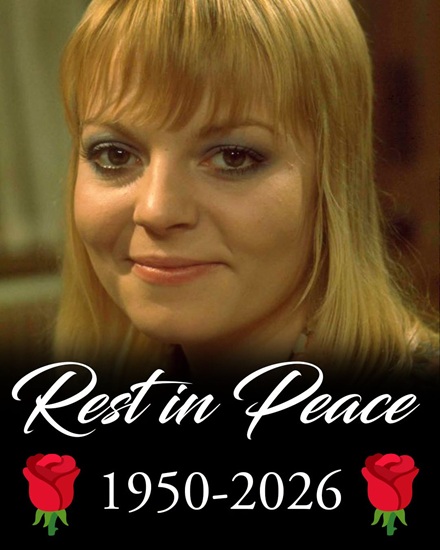
British actress Cheryl Hall, whose television career included memorable appearances in Citizen Smith and Doctor Who, has died at the age of 76. Her death brings renewed attention to a varied career that stretched across several decades of British television, film and public life. Hall became a familiar face to audiences through comedy, science fiction, crime drama and soap opera, appearing in productions that reached different generations of viewers.
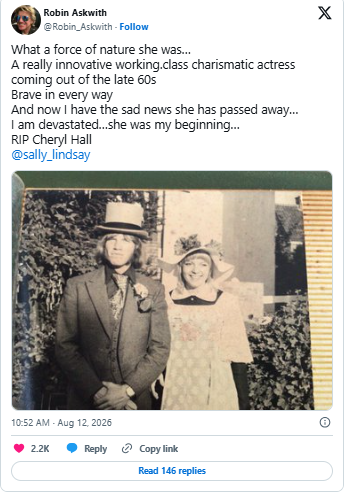
Although certain roles became particularly closely associated with her name, her professional history was far broader than any single television character. Her work reflected the versatility of an actress who was able to move comfortably between very different genres throughout her career. Actor Robin Askwith, who was romantically involved with Hall for several years during the early 1970s, shared a personal tribute after learning of her death.
He remembered her as a charismatic and courageous performer who emerged from the changing cultural landscape of the late 1960s. His message emphasized both her working-class background and the strong personality that distinguished her as a young actress. Askwith also made clear that Hall had played an important role in his own early life, describing her as someone he had never forgotten. His tribute offered audiences a personal perspective on the woman behind the television performances for which she later became known.
Hall began establishing herself professionally around the end of the 1960s and soon found regular opportunities on British television. One of her early television credits came in 1971 when she appeared as Eileen, a bus conductress, in an episode of the popular sitcom On the Buses. The appearance came during an era when British television comedy was attracting enormous audiences and creating characters that would remain recognizable for decades. Hall continued building her résumé rather than becoming associated exclusively with one programme. Her ability to take on comedy as well as more dramatic material eventually allowed her career to develop across numerous productions and television formats.
An especially significant moment arrived when Hall became part of the world of Doctor Who. She appeared as Shirna in the 1973 serial Carnival of Monsters, alongside Jon Pertwee as the Third Doctor and Katy Manning as Jo Grant. The four-part adventure was written by Robert Holmes and originally broadcast between January and February 1973.
Shirna accompanies the travelling entertainer Vorg, played by Leslie Dwyer, and the pair become connected to the unusual events surrounding a device known as the Miniscope. Hall’s appearance in the serial gave her a lasting connection with one of Britain’s longest-running science-fiction programmes and ensured that her performance would continue to be discovered by later generations of Doctor Who viewers. Interestingly, Hall’s association with the programme might have become considerably larger. Before Katy Manning was selected to portray Jo Grant,
Hall was among the actresses considered for the companion role. Although she ultimately did not receive the part, producer Barry Letts later found another opportunity for her in Carnival of Monsters. Actress Jenny McCracken, who had also been considered during the casting process, appeared in the same serial as Claire Daly. Hall’s involvement therefore represents an interesting piece of Doctor Who casting history. She came relatively close to becoming a regular companion before instead joining the programme for one memorable adventure.
For many comedy viewers, however, Hall became most closely associated with Shirley Johnson in Citizen Smith. Created by John Sullivan, the BBC sitcom starred Robert Lindsay as Wolfie Smith, an enthusiastic but frequently unsuccessful revolutionary with ambitious ideas about changing society. Hall played Shirley, Wolfie’s girlfriend, and became an important presence in the programme during its early years. Her performance helped provide a grounded counterpoint to Wolfie’s exaggerated plans and political enthusiasm. The sitcom became one of the notable British comedies of its period and later remained familiar through repeats and retrospectives devoted to classic television.
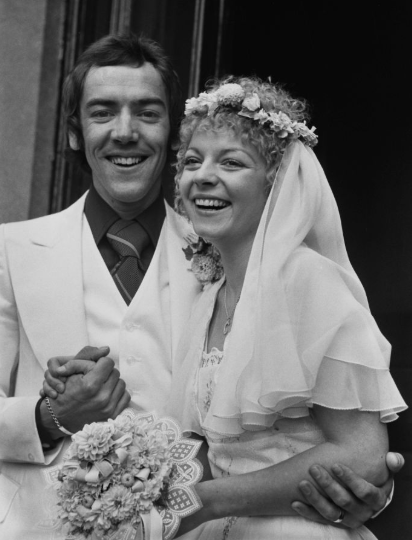
Hall and Lindsay’s relationship was not limited to their work together on television. They were also married in real life during the 1970s before eventually separating and divorcing. Their personal relationship is frequently mentioned when discussing Citizen Smith because audiences were watching two performers whose connection existed both on and off screen. Hall nevertheless established an identity and career independent of the programme. Rather than allowing one successful sitcom to define her professional life permanently, she continued accepting a broad range of acting assignments over the following years.
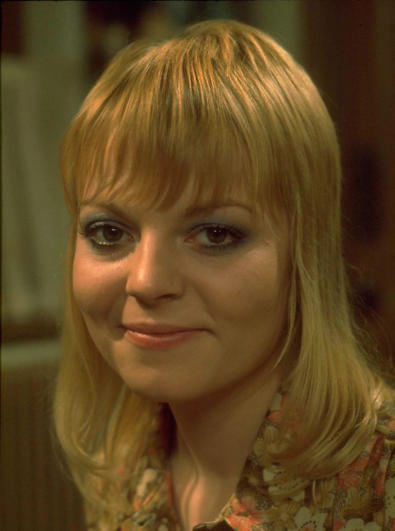
Her television résumé eventually included appearances in numerous recognizable British productions. Hall worked in programmes including The Bill, Poirot, Silent Witness, EastEnders and As Time Goes By, among other credits. She also appeared alongside David Jason in the 1976 comedy Lucky Feller. These roles demonstrate how frequently Hall moved between different areas of television. Comedy might have brought some of her most recognizable early work, but drama and guest roles remained important parts of her career. Her continued presence on television also meant that audiences who had never seen Citizen Smith could encounter her through entirely different programmes.
Hall also accumulated film work alongside her television appearances. Her screen credits included productions such as Deep End, Villain, To Catch a Spy and The Magnificent Seven Deadly Sins. While television ultimately provided many of the performances most strongly associated with her public image, these film roles added another dimension to her professional record. Like many working British actors of her generation, Hall did not follow a career confined to one medium or one recognizable character. Instead, she moved between opportunities as they appeared, building a substantial body of work across different stages of her life.
Another interesting part of Hall’s television legacy concerns her connection with writer John Sullivan. Accounts of their professional relationship have noted that Hall challenged Sullivan over the way women were represented in some of his writing. That conversation has been linked to Sullivan’s later creation of Just Good Friends, the successful BBC sitcom starring Jan Francis and Paul Nicholas. The story provides an insight into Hall’s willingness to speak openly about the roles available to female performers. It also suggests that her contribution to television extended beyond what viewers saw directly on screen, as conversations between actors and writers could sometimes influence later creative decisions.
Hall’s life eventually expanded beyond acting into politics and public service. In the 1997 UK general election, she stood as the Labour candidate in Canterbury. Official election results show that she received 16,949 votes, representing approximately 31.3 percent of votes cast in the constituency, while Conservative candidate Julian Brazier retained the seat. Hall later became involved in local government in Kent and served as a councillor. This political activity represented another chapter of her life rather than an extension of her acting roles, and historical accounts also record her interest in improving the representation of women in public life.
Her political involvement can be understood as part of Hall’s wider biography without requiring audiences to share any particular political position. She spoke publicly about the importance of women having opportunities to participate in decision-making and representation. At the same time, she continued to be remembered primarily by entertainment audiences for the performances she had delivered throughout her acting career. Her transition between television and public service demonstrated a willingness to pursue different interests rather than remaining exclusively within the entertainment industry.
News of Hall’s death has encouraged viewers to revisit the wide range of programmes connected with her career. For Doctor Who enthusiasts, she remains Shirna from Carnival of Monsters and an intriguing part of the programme’s companion-casting history. For fans of classic comedy, she is closely remembered as Shirley Johnson in Citizen Smith. Other audiences may recognize her from crime dramas, soaps, films or guest appearances made later in her career. These different associations illustrate how a performer can become part of several generations of popular culture without relying on a single defining role.
The personal tributes shared after her death provide another perspective on Hall’s legacy. Robin Askwith’s recollections focused not simply on professional achievements but on her character, courage and distinctive personality. His words suggested that the young actress he knew during the 1970s had made a lasting impression on him long after their relationship ended. Such memories add a human dimension to a career that audiences otherwise know primarily through archived performances, photographs and television credits. They also demonstrate how differently someone may be remembered by colleagues, friends, family members and viewers.
Cheryl Hall leaves behind a career that crossed several areas of British cultural life. From her early television work to Doctor Who and Citizen Smith, and from later dramatic appearances to her involvement in public service, she repeatedly entered new professional territory. Her television performances remain available for audiences who want to revisit an important period in British entertainment history. Rather than being remembered solely for one programme, Hall’s legacy includes comedy, drama, science fiction, film and a later chapter in public life.
Her death at 76 marks the loss of a performer whose work stretched across decades of changing television. The programmes themselves remain part of the historical record, allowing longtime viewers to remember her work while giving younger audiences an opportunity to discover it. Hall’s career demonstrates the breadth that can exist behind a familiar television face: numerous characters, different genres and experiences extending well beyond the screen. For those who followed her work, Cheryl Hall will be remembered as a distinctive actress whose performances formed part of several memorable chapters in British television history.

