
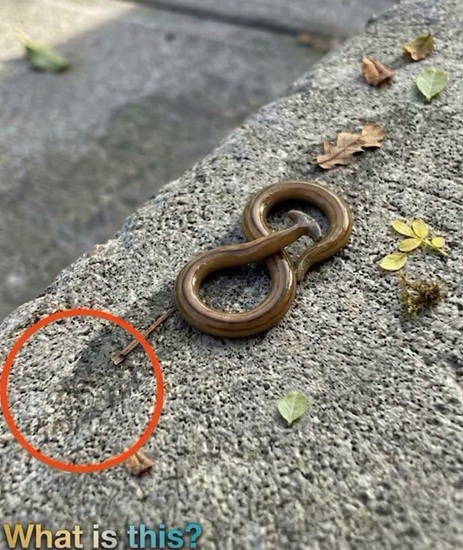
One quiet morning outdoors became unexpectedly memorable after an unusual creature appeared on damp ground. At first, it looked similar to an earthworm, long and dark with a soft body moving slowly across the surface. But after a closer look, several features stood out. Its movement was unusually smooth, its body appeared somewhat glossy, and the front of the animal was broad and flattened rather than rounded. Those characteristics are consistent with a type of terrestrial flatworm commonly known as a hammerhead worm, although an exact species cannot be confirmed without a clear image or expert identification.
The confusion with an earthworm would be completely understandable. Both animals can appear on moist soil, in gardens, or around shaded outdoor areas, especially after rain or during humid weather. But biologically they are very different. Earthworms belong to a group of segmented worms, while hammerhead worms are flatworms. Their bodies are not segmented in the same way, and their movement often looks more like gliding than wriggling.
The shape of the head is one of the most recognizable clues. Some hammerhead flatworms have a front end that spreads outward into a shape resembling a shovel, crescent, fan, or small hammer. This feature immediately distinguishes them from most ordinary earthworms. When seen for the first time, the head can make the creature look strange or even artificial.
The body can also provide useful clues. Many hammerhead worms are smooth, moist-looking, and somewhat flattened. Some species have dark stripes running along the length of the body. Others may appear more uniformly colored. Because several different species exist, color and size can vary, so those features alone are not enough for exact identification.
Movement is another useful difference. Earthworms usually move through muscular contractions involving their segmented bodies. Hammerhead flatworms travel using a thin layer of mucus and tiny hair-like structures on the underside of the body. To an observer, this can make them appear to slide gently across the ground rather than crawl in the familiar way an earthworm does.
Moisture is important to these animals because their bodies can dry out easily. They are often found under logs, flowerpots, stones, mulch, leaf litter, or other sheltered areas where humidity remains high. Seeing one on damp ground early in the morning would therefore fit with the conditions they typically prefer.
Some hammerhead flatworms found in North America are introduced species rather than native wildlife. Certain species originally came from parts of Asia and became established elsewhere through the movement of plants, soil, and landscaping materials. That means they can sometimes appear in gardens or yards far from their original natural range.
This does not mean every unusual flatworm outdoors is invasive. Several different land planarians exist, and not all of them have the same origin or ecological significance. The safest description from a visual account alone is that the animal appears consistent with a hammerhead-type land flatworm.
These creatures are predators. Depending on the species, they may feed on earthworms, slugs, snails, or other small invertebrates. That feeding behavior is one reason some agricultural and environmental agencies pay attention to them. Introduced predators can sometimes affect local ecosystems, although the impact can vary by species and location.
The unusual side-to-side movement of the head can also have a biological explanation. Land flatworms use sensory structures in the head region to explore their surroundings and help locate potential prey. To someone watching from a distance, this can look almost like the animal is sweeping the soil with its head.
It is important not to interpret that behavior as aggression toward people. Hammerhead worms do not hunt humans. Their prey is made up of much smaller soil-dwelling animals. Their strange appearance can make them seem threatening, but appearance alone does not indicate that they are actively dangerous to someone standing nearby.
That said, unnecessary bare-handed contact is best avoided. Some hammerhead flatworms are known to contain compounds such as tetrodotoxin. This does not mean they behave like venomous snakes or inject toxins into people. They do not have a specialized system for delivering venom into humans, but caution is still sensible when handling unfamiliar wildlife.
If someone accidentally touches one, washing the skin with soap and water is a reasonable precaution. Anyone who experiences an unusual reaction after contact with any unidentified organism should seek appropriate professional medical advice. In most situations, simply observing the animal without touching it is enough.
Taking a clear photograph is often the most useful next step. A good image showing the entire body, head shape, markings, and approximate size can help with identification. A photograph also makes it possible to consult nature guides, university extension services, or local invasive-species programs without having to handle the animal.
Exact identification can be difficult because the term “hammerhead worm” refers to multiple species. Some are lighter brown, some darker, and some have several distinct stripes. Others can be shorter or longer. This means a general description may be enough to identify the group but not the exact species.
One commonly discussed species is Bipalium kewense, a long terrestrial flatworm with a broad head and longitudinal stripes. It has been recorded in the United States for many years and is not a newly discovered organism. This is worth mentioning because social-media posts sometimes describe hammerhead worms as though they suddenly appeared recently.
In reality, some introduced land flatworms have been documented in North America for well over a century. Their occasional appearance in viral photographs can make them seem new simply because many people have never noticed them before.
The internet can easily make unusual wildlife sound more alarming than it is. A dramatic photo may be labeled as a “mutant worm,” “dangerous parasite,” or “mysterious creature,” even when the organism has been known to science for decades. These descriptions may attract attention, but they are not always accurate.
A better approach is to focus on observable features. Does the animal have a broad, flattened head? Does it move smoothly over a mucus layer? Is the body flattened rather than cylindrical? Are there longitudinal stripes? These details provide far more useful information than a frightening headline.
Another reason caution is helpful is that hammerhead flatworms can regenerate after injury. For that reason, cutting one into pieces is not generally recommended as a control method. Some fragments may survive and regrow.
If someone is concerned about an introduced flatworm on their property, the most appropriate response depends on the local area. State agricultural agencies, university extension programs, or invasive-species specialists may provide guidance. Reporting requirements can vary, so there is no single instruction that applies everywhere.
It is also worth remembering that not every strange wormlike organism is harmful. Some native flatworms play normal roles in local ecosystems. Correct identification should come before any attempt to remove or destroy an animal.
This is one reason the decision to observe from a distance was sensible. Picking up an unfamiliar creature immediately is rarely necessary. A few minutes of careful observation can reveal much more than an impulsive reaction.
The setting also matters. Damp soil, shaded gardens, mulch, and areas beneath debris are common environments for land flatworms. Finding one in one of these locations is far less mysterious than discovering it in a completely dry or exposed environment.
The broad head is usually the detail that makes people stop. It can look almost too unusual to belong to a worm. Yet that unusual body plan is simply part of the biology of terrestrial planarians. These flatworms are generally soft-bodied and lack the hard external skeleton seen in insects. Their bodies can stretch, contract, and change shape slightly as they move. This flexibility can make them look different from one moment to the next.
Because of that, photographs taken at different angles may create very different impressions. One image may make the head look extremely wide, while another may make it seem only slightly expanded. Lighting can also affect the apparent color and glossiness of the body. This is another reason exact identification from a single low-quality photograph can be unreliable. A careful observer should combine several clues rather than rely on one feature.
The creature’s apparent calm movement is also normal for many flatworms. They do not usually rush across the ground. Their movement can be slow and deliberate, giving the impression that they are carefully exploring the surface. To someone unfamiliar with them, this can make the animal appear almost snake-like. But the biological mechanisms behind its movement are completely different from those of a snake.
The encounter also illustrates how human expectations affect perception. Most people know what an earthworm looks like. When something similar appears but has one very unusual feature, the brain notices the difference immediately. That can create curiosity and sometimes fear. An unfamiliar shape is often interpreted as potentially dangerous before enough information is available to make that judgment.
The best response is usually observation rather than panic. Improved lighting, a photograph, and reliable identification resources can turn a strange encounter into an interesting natural-history lesson. If the animal is indeed a hammerhead flatworm, its presence does not automatically mean a property is “infested.” A single sighting simply means one individual was present at that location at that time.
Repeated sightings might justify closer attention, particularly in places where invasive species are being monitored. Again, local guidance is more useful than generalized advice from social-media comments. Gardeners may be especially interested because some hammerhead flatworms prey on earthworms. Earthworms can influence soil structure and decomposition, so the presence of predators that feed on them may be relevant in certain environments.
Still, claims that one flatworm will destroy an entire garden are exaggerated. Ecological effects depend on population size, species, local conditions, and many other factors. The same caution should be applied to claims about human health. The fact that certain species contain a toxin does not mean every encounter represents an emergency. Risk depends on exposure and other circumstances.
Avoiding direct contact is a simple precaution that removes most unnecessary concern. There is no benefit in touching a strange flatworm just to confirm what it is. Pets should also be prevented from intentionally eating unfamiliar wildlife when possible. This is a general safety principle and not something unique to hammerhead worms. If a pet has ingested an unknown organism and begins behaving unusually, contacting a veterinarian is more appropriate than relying on internet speculation.
For most people, the main value of an encounter like this is educational. It reveals just how many unusual organisms can exist in ordinary yards and gardens without being noticed. A creature can look exotic and still be part of a well-documented biological group. The unusual appearance simply reflects a different evolutionary body plan. The hammer-shaped head is not a deformity. It is a normal feature of certain land planarians. What looks strange to a human observer is simply ordinary anatomy for the animal.
The glossy surface is normal as well. Land flatworms produce mucus that helps them move and protects their soft bodies from drying. This mucus can contribute to the smooth, gliding movement that makes them look so different from earthworms. The contrast between the expected and the unfamiliar is what makes the encounter memorable. An ordinary patch of soil suddenly contains something that looks unlike anything the observer has previously noticed.
That sense of discovery can be valuable if it leads to curiosity rather than fear. Taking a photo and checking reliable nature guides is therefore a much better response than immediately posting dramatic claims. Online identification groups can sometimes help, but expert sources are preferable when the species matters.
University extension services are particularly useful because they often provide regional information and practical advice about introduced organisms. State agriculture departments may also have current information about species being monitored locally. The important point is not to assume that every region handles sightings the same way. Reporting procedures differ.
The animal’s presence should also not be used to make unsupported claims about local environmental conditions. A single sighting cannot establish a larger ecological problem. Likewise, the exact path by which one individual reached a property usually cannot be determined. It may have arrived through soil, nursery plants, landscaping materials, or another route. Without evidence, assigning a specific source would be speculation.
This kind of uncertainty is normal in wildlife observation. Identifying the organism is often possible even when explaining how it arrived is not. The original encounter therefore becomes much easier to understand once the biological clues are considered together. The creature was long, smooth, dark, and moving over moist ground. Its head was wider and flatter than the rest of its body. Its movement appeared more like gliding than wriggling.
Those features strongly point toward a terrestrial flatworm in the hammerhead group. The safest wording remains “likely” rather than absolute certainty because exact identification requires better evidence. That distinction is important in any nature story. Accuracy is more valuable than sounding certain. When a photograph or specimen is available, an expert may be able to determine the species from markings and morphology. Without that, a broader identification is still useful.
The encounter is also a reminder that not everything unfamiliar needs to become a frightening story. Sometimes something strange simply means something unfamiliar has been noticed for the first time. The natural world contains many organisms that look unusual from a human perspective. Flatworms are a good example because their body structure differs dramatically from the animals most people encounter every day. Their appearance may seem almost alien, but their biology is well studied.
The same principle applies to countless insects, fungi, spiders, and other small organisms. Initial surprise is normal. Immediate sensational conclusions are unnecessary. A few minutes of careful observation can often replace fear with understanding. That makes the experience more useful and more accurate. In this case, the best explanation is that the animal was probably a hammerhead-type land flatworm rather than an unusually shaped earthworm.
Its broad head, flattened body, smooth movement, and preference for damp conditions all support that interpretation. If one appears again, there is no need to approach closely. A clear photograph from a safe distance can provide enough information for further identification. Anyone who wants to know whether the species is considered invasive locally can contact an appropriate regional authority. This avoids both unnecessary alarm and unnecessary harm to native wildlife.
The most important lesson is simple: observe first, identify second, and react only after enough information is available. An unfamiliar animal may look disturbing for a few seconds, but its appearance alone does not tell you whether it is dangerous. Once the biology is understood, the mysterious creature becomes something far less frightening. Instead of a strange unknown worm, it becomes an example of the surprising diversity that can exist in an ordinary garden. And that can turn a confusing early-morning discovery into something genuinely interesting rather than something to fear.

