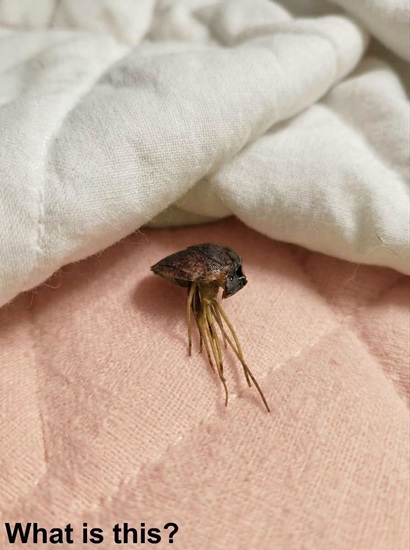
Finding something unfamiliar in a place where you expect to feel safe can trigger an immediate reaction. Imagine pulling back a blanket before going to sleep and noticing a pale object with several thin projections resting on the bedding. In dim light, those tiny extensions might resemble legs, making the object look more like an insect than a piece of plant material. Before assuming the worst, however, a closer look can sometimes reveal a much simpler explanation.
The first few seconds after an unexpected discovery are often guided more by instinct than by careful observation. The brain tries to identify unfamiliar shapes as quickly as possible, especially when something appears where it does not belong. A rounded center with multiple thin extensions may instantly be categorized as a bug, spider, or other small creature even before enough detail is visible to support that conclusion.
Lighting can make the effect even stronger. Shadows stretch delicate structures, soft edges become more dramatic, and ordinary objects can take on a completely different appearance. A tired person seeing something unusual late at night may therefore interpret a harmless object as something far more alarming simply because the available visual information is incomplete.
A better approach is to slow down and inspect the object carefully. Turning on brighter lights, keeping a reasonable distance, and using a phone camera to magnify the object can reveal useful details. This can help determine whether the apparent legs are actually jointed limbs or whether they are roots, fibers, or dried plant structures.
If closer inspection shows that the object is plant material, one possible explanation is a germinating seed. Seeds can look surprisingly strange during the earliest stages of growth. Before a recognizable stem and leaves appear, the first visible structures may be thin, pale roots extending from a small central seed.
The beginning of plant growth is known as germination. A viable seed generally requires suitable environmental conditions before this process can begin. Water is usually essential because the seed absorbs moisture and resumes internal biological activity. Oxygen and an appropriate temperature are also important, although the exact requirements vary between species.
In many plants, the first structure to emerge is called the radicle. This develops into the plant’s primary root. As growth continues, additional fine root structures may begin forming around it. When viewed outside soil, those roots can look remarkably like tiny legs, especially if the observer is not expecting to see a sprouting plant.
Young roots are often pale because underground plant structures normally contain little chlorophyll compared with leaves. If a seed germinates in a dark environment, the emerging tissue may appear even lighter. On a blanket or mattress, this unfamiliar shape can look unsettling because it appears in a setting where people usually expect only fabric, pillows, and bedding.
That does not mean every strange object found on a bed is necessarily a seed. Many possibilities exist, including dried plant fragments, burrs, fibers, insect remains, actual arthropods, or debris accidentally brought indoors. Reliable identification requires examining the specific object rather than automatically applying one explanation to every similar photograph.
Plant material can reach bedrooms in very ordinary ways. Seeds may cling to clothing, shoes, bags, pets, or blankets after time outdoors. Lightweight material can also enter through open windows or doors. Houseplants, dried flowers, fruit, vegetables, and gardening activities are other possible sources.
For a seed to actually begin germinating, it generally needs access to enough moisture and suitable temperatures. Dry bedding would not normally provide ideal growing conditions. However, if a fabric area remained damp for some reason, a viable seed caught there might begin the early stages of development under the right circumstances.
If a plant-like object is found on bedding, there is usually no reason for panic. It can be removed carefully, and the surrounding area can be checked for additional debris. If the bedding is damp, washing or thoroughly drying it according to the manufacturer’s instructions is a sensible step.
The room can also be examined for a possible source. An open window, nearby houseplant, recently used outdoor clothing, a backpack, or a pet may explain how the object arrived. Finding a reasonable source can often resolve the mystery without the need for dramatic theories.
If the object moves independently, however, the situation should be approached differently. Genuine insects and other arthropods often have visible body segmentation, jointed legs, antennae, or repeated movement. A clear photograph can help with identification, and a qualified pest-control professional can assist if the object appears to be a household pest.
It is especially important not to rely exclusively on viral photographs or social-media comments for identification. Images can distort scale, color, and shape. Shadows and camera angles can make a harmless piece of plant matter appear much more threatening than it is.
A close-up photograph should therefore be treated as one piece of evidence rather than definitive proof. Useful questions include whether the object moves, whether the projections have joints, whether there is a recognizable seed coat, and whether the structures branch like roots rather than behaving like animal limbs.
When the object is confirmed to be a germinating seed, the entire situation becomes easier to understand. The structures that initially looked like legs are simply the plant’s developing root system. Nothing about the object itself has changed; only the interpretation has become more accurate.
This shift from fear to understanding is a good example of how perception works. Human beings are very good at recognizing familiar patterns quickly, but that same ability can occasionally lead to mistakes. When visual information is incomplete, the brain tends to choose the most familiar explanation available.
In a bedroom, the thought of a bug naturally comes to mind more quickly than the thought of a sprouting seed. The environment shapes expectations. Seeing roots in a flowerpot would seem completely normal, but finding the same roots on a pillow could trigger a very different reaction.
Fatigue can also influence how people interpret ambiguous details. After a long day, the mind may be more likely to accept an immediate explanation rather than pause for careful inspection. That does not mean tired people cannot see accurately, only that surprise and reduced attention can make an unusual object seem more threatening at first.
Using a phone camera can help because magnification allows the observer to inspect details without remaining extremely close. The photograph can also be compared with reliable identification resources. If the object cannot be identified confidently, saying “uncertain” is better than guessing.
This is particularly relevant to viral posts asking, “What is this?” Such images often attract hundreds of conflicting answers. Some commenters may confidently call an object a dangerous parasite, while others insist it is completely harmless. Confidence in a comment does not make the identification correct.
Accurate identification depends on distinctive physical features. Insects may require examination of body shape, leg arrangement, antennae, wings, or mouthparts. Seeds and seedlings may be identified through the seed coat, root pattern, emerging shoot, and eventually leaves.
If there is not enough detail to confirm the species, the most responsible conclusion is to acknowledge uncertainty. Saying that something appears to be a germinating seed is different from claiming to know exactly which species it is. Similarly, an unidentified object should not be described as dangerous unless there is evidence supporting that assessment.
Household cleanliness can be maintained with simple precautions. Bedding should be washed regularly and kept dry. Damp fabrics should be addressed because prolonged moisture can create conditions favorable to mold and other unwanted biological growth, whether or not a seed happens to be present.
If actual insects are repeatedly discovered, further inspection may be appropriate. Mattress seams, bed frames, furniture, and nearby cracks may need to be checked depending on the suspected pest. Professional identification is often preferable to randomly applying pesticides without knowing what organism is present.
The broader lesson is that nature can appear very strange when removed from its usual environment. Seeds, roots, plant fragments, and insect remains can all look unfamiliar when seen at close range. Something completely ordinary outdoors may seem disturbing indoors simply because the context is unexpected.
Context strongly influences interpretation. A pale sprout in soil looks normal because it matches expectations. The same sprout beneath a blanket seems out of place, causing the brain to search for a different explanation.
Many popular mystery images work for exactly this reason. They show ordinary objects from unusual angles or in unexpected settings. Viewers quickly build explanations around the first impression, sometimes without enough evidence to support them.
A more reliable approach is simple: improve the lighting, avoid touching unknown organisms directly, examine the shape carefully, take clear photographs, and consult trustworthy identification sources if necessary. These steps help replace fear with evidence.
If the mysterious object ultimately proves to be a sprouting seed, the discovery can become interesting rather than frightening. The thin roots that first resembled insect legs are part of an ordinary biological process that happens whenever suitable conditions allow a viable seed to begin growing.
A seed is not intentionally choosing a bed or blanket. It is merely responding to moisture, temperature, oxygen, and other environmental conditions. Once germination begins, the root emerges and starts the plant’s early development.
If the seed remains healthy and can be identified, someone may choose to place it in suitable soil and observe whether it continues growing. There is no guarantee it will survive, since different species have different needs, but the situation can become a small biology experiment rather than a reason for alarm.
The most important lesson is not that every strange object is harmless. It is that unusual appearances should be investigated before conclusions are made. Something may genuinely require attention, but fear should not replace identification.
Sometimes the object under the blanket may indeed be an insect. Other times, it may be nothing more than plant material that accidentally found its way indoors. The responsible response is the same in either case: observe carefully, gather enough information, and avoid presenting guesses as facts.
A frightening first impression can change completely once the object is properly understood. What seemed like a tiny many-legged creature may turn out to be a seed beginning to grow. A few minutes of careful inspection can turn an unsettling mystery into a simple and surprisingly interesting explanation.
