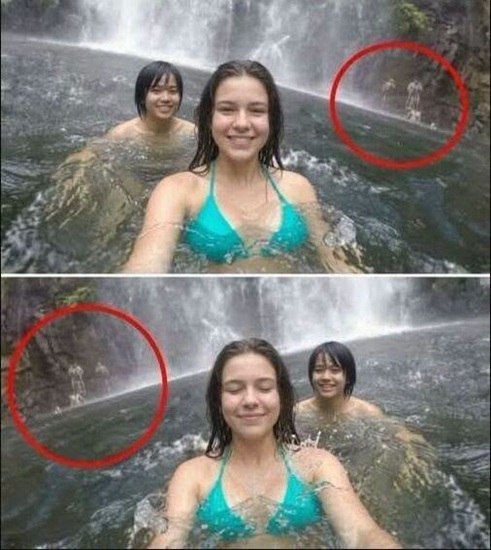
An ordinary photograph can appear completely straightforward when we first look at it. Within seconds, we recognize the main subject, understand the general setting, and form an impression of what is happening. Yet closer examination can reveal something that was visible from the beginning: a person in the distance, an unexpected reflection, an unusual object, or a shape hidden among other visual elements. Once that detail has been pointed out, it can become remarkably difficult not to see it.
The photograph itself has remained unchanged; what has changed is where our attention is directed. Human vision does not function exactly like a camera that records every part of a scene with equal importance. Our eyes receive an enormous amount of visual information, but conscious attention is limited. The brain therefore has to prioritize what appears relevant while giving less attention to other information. This selective process is essential for everyday life because examining every color, edge, object, movement, and shadow with equal concentration would be inefficient. Most of the time, the system works extremely well, but it can also allow noticeable details to escape conscious awareness.
One phenomenon associated with this limitation is known as inattentional blindness. It occurs when someone fails to consciously notice an unexpected but visible stimulus because their attention is concentrated elsewhere. This does not necessarily mean the person has poor eyesight or was behaving carelessly. Instead, attention was occupied by another task or object that the brain considered more important at that moment. Psychological research has repeatedly demonstrated that concentrating intensely on one part of a visual scene can make unexpected information surprisingly easy to overlook.
A famous demonstration of this phenomenon was conducted by researchers Daniel Simons and Christopher Chabris. Participants were shown a video of people passing basketballs and asked to count certain passes. During the activity, an unexpected person wearing a gorilla costume walked through the scene. Many participants concentrating on the counting task did not report noticing the unexpected figure. Once people know about the gorilla, however, it appears extremely obvious. The experiment became an influential illustration of the difference between having something within view and consciously paying attention to it.
Expectations can further influence what attracts our attention. Consider a photograph taken near a waterfall. A viewer is likely to focus first on the people, rushing water, rocks, vegetation, and other prominent elements. Those objects fit the expected interpretation of the scene. Meanwhile, a small figure near the edge, an unusual reflection, or an unexpected shape in a shadow may receive little attention. The overlooked element is not necessarily physically concealed; it may simply fall outside the viewer’s immediate priorities.
Previous experience helps make this rapid interpretation possible. People develop knowledge about what kitchens, streets, forests, beaches, bedrooms, offices, and other familiar environments normally contain. When we recognize one of these places, the brain can quickly organize the visual information using expectations developed through experience. This saves considerable effort and allows us to understand our surroundings rapidly. However, expectations can sometimes make unusual details less noticeable because the brain is already working with a familiar interpretation of the environment.
Familiar surroundings provide everyday examples. Someone might use the same room for days before realizing that a small object has been moved. A person can travel along the same road repeatedly and suddenly notice a building or sign that has apparently been there for years. In such situations, the environment was visible all along. The difference is that the previously overlooked feature finally received enough attention to become part of conscious awareness.
A related phenomenon called change blindness occurs when people fail to detect changes between different views of a scene. Research has shown that changes can sometimes go unnoticed when they happen during interruptions or when attention is directed elsewhere. These findings challenge the intuitive belief that we maintain a perfectly detailed mental representation of everything around us. Our experience feels visually rich, but attention plays an important role in determining which specific details are carefully processed and remembered.
Still photographs make these effects particularly interesting because the scene remains available for repeated inspection. Nothing disappears simply because the viewer looked somewhere else for a moment. Nevertheless, people usually examine photographs selectively. Faces often attract attention quickly, while bright colors, high contrast, central subjects, and unusual objects can also dominate visual attention. Consequently, backgrounds, corners, shadows, reflections, and less visually prominent areas may receive only limited inspection during the first viewing.
Photography itself frequently takes advantage of this characteristic of perception. Focus, lighting, contrast, framing, color, and composition can all guide the viewer toward particular parts of an image. A sharply focused face against a blurred background naturally attracts more attention than the surrounding environment. A bright object in a dark photograph may become the immediate focal point. Photographers and filmmakers use these techniques intentionally because controlling visual emphasis helps shape how an audience interprets a scene.
The experience changes considerably once someone identifies an overlooked detail. Instead of searching the entire photograph, the viewer now knows approximately where and what to examine. Attention moves toward that area, and the previously unnoticed object suddenly becomes obvious. This explains why hidden-object photographs can seem almost effortless after the answer is revealed. The relevant information existed beforehand, but it had not received the same degree of conscious attention.
This also demonstrates an important distinction between something being visible and something being noticed. Visual information can be present without becoming a prominent part of conscious experience. Human perception involves complex interactions among sensory processing, attention, memory, expectations, and prior knowledge. Scientists continue investigating precisely how these processes interact, but research clearly shows that people do not consciously process every available visual detail equally.
Optical illusions provide another demonstration of the brain’s role in interpreting visual information. Some ambiguous images can reasonably support more than one interpretation. A person might initially see one object and then suddenly recognize a completely different form after receiving a hint. In certain illusions, perception can alternate between two possibilities even though the physical image never changes. The experience illustrates how the brain actively organizes visual information rather than simply displaying an untouched copy of what reaches the eyes.
Context can also determine what different observers notice. Someone experienced in photography may quickly examine lighting, perspective, and reflections. A mechanic viewing a vehicle may pay attention to mechanical components that most people ignore. Someone trained in wildlife observation may notice subtle shapes or patterns in vegetation. Expertise does not make anyone immune to perceptual limitations, but training can change which visual features receive priority and how systematically a scene is examined.
This helps explain why two people can look at exactly the same photograph and notice different things. Their eyes may receive similar information, but their goals, expectations, knowledge, and previous experiences are different. One person may immediately concentrate on a face while another examines the background. Neither observation alone necessarily represents everything contained within the photograph. Comparing perspectives can therefore reveal information that a single viewer initially missed.
Anyone trying to inspect a photograph carefully can use a more systematic approach. Instead of accepting the first impression immediately, begin at one corner and slowly scan across the entire frame. Examine the foreground, middle distance, and background separately. Pay attention to windows, mirrors, reflective surfaces, shadows, spaces between objects, and areas where several shapes overlap. Deliberately looking away from the obvious central subject can reveal details that initially received little attention.
Changing viewing distance may also help. Zooming in can expose textures, small objects, and subtle visual features, while stepping back can make larger patterns easier to recognize. Temporarily covering the main subject may force attention toward neglected parts of the photograph. Returning to an image after a short break can sometimes produce a fresh impression because attention is no longer following exactly the same path it followed during the first inspection.
Describing an image carefully can be useful as well. Instead of simply saying that a photograph shows people near a waterfall, an observer can identify how many people are visible, where each person is positioned, what appears behind them, and what occupies the corners of the image. This encourages deliberate observation rather than dependence on a general impression. It does not guarantee that every detail will be discovered, but it can make the inspection more systematic.
At the same time, unusual-looking details should be interpreted cautiously. Perspective, shadows, reflections, motion blur, image compression, overlapping objects, and unusual lighting can produce shapes that appear mysterious or misleading. A form that resembles a person may simply be several unrelated objects aligned from a particular camera angle. Modern images may also have been digitally edited or generated using artificial intelligence. A surprising visual appearance by itself is therefore not sufficient evidence for an extraordinary conclusion.
This principle becomes especially important when photographs are presented as evidence of real events. Before making factual claims, it is useful to consider the original source, image quality, surrounding context, and whether independent information supports the interpretation. A dramatic explanation may attract attention, but accuracy requires distinguishing between what the image clearly demonstrates and what someone is merely guessing it might show. When evidence is ambiguous, acknowledging uncertainty is more reliable than presenting speculation as established fact.
The limits of visual attention are relevant far beyond entertaining image puzzles. Driving requires people to monitor vehicles, pedestrians, road signs, traffic signals, and changing conditions simultaneously. Workplace safety can involve tracking equipment and environmental hazards while completing another task. Similar challenges exist in security observation and many professional settings. Distraction, fatigue, divided attention, and strong expectations can all influence which information receives adequate attention.
This is one reason important procedures sometimes rely on checklists, repeated inspections, multiple observers, or independent verification. Such systems recognize that human attention is powerful but not unlimited. Asking another person to examine a situation can reveal something the first observer overlooked because the second person begins with different expectations. The goal is not to eliminate human perception but to account for its known limitations when accuracy matters.
Eyewitness observations require similar caution. A person can sincerely remember an event while still having overlooked some details or interpreted others incorrectly. Memory is not a perfect video recording, just as perception does not capture every element of a scene with equal precision. Confidence in a recollection does not automatically establish complete accuracy. Where important conclusions are involved, additional evidence and independent verification can provide a more reliable picture.
These characteristics should not be interpreted as defects that make human vision unreliable in general. Selective attention is essential because it helps people concentrate on relevant information while filtering enormous amounts of competing stimulation. Without this ability, everyday activities could become far more difficult. The same system that occasionally allows an unexpected detail to go unnoticed also enables us to focus on conversations, read text, navigate environments, recognize faces, and complete complex tasks.
Hidden details in photographs therefore provide a simple but fascinating demonstration of a much broader feature of human cognition. What people consciously notice depends not only on what is physically present but also on where attention is directed, what they expect to find, what they already know, and what appears important at that moment. Two observers can receive much of the same visual information and still walk away with different impressions of the scene.
Perhaps the most interesting moment occurs after the hidden detail has finally been discovered. Suddenly, it seems impossible to understand how it could ever have been overlooked. The object appears prominent, obvious, and permanently connected to the photograph. Yet before attention was directed toward it, the same element may have remained outside conscious awareness. Nothing about the photograph changed during that transition.
What changed was the observer’s interpretation.
That simple experience offers a useful lesson about perception. Human beings do not consciously examine every available detail before understanding a scene. Instead, the brain rapidly constructs a practical interpretation based on attention, context, expectations, and previous experience. Most of the time, this allows us to understand the world efficiently. Occasionally, however, it means the most surprising part of a photograph can remain directly in front of us until someone finally tells us where to look.
