
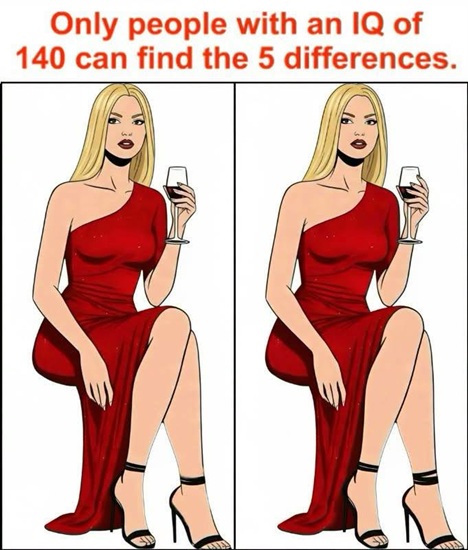
Spot-the-difference puzzles have entertained people for generations, appearing in activity books, newspapers, magazines, websites, and more recently across social media. The idea could hardly be simpler: two images appear almost identical, but several small details have been changed. Your task is to carefully compare them and identify every alteration. In this particular challenge, there are five differences waiting to be discovered. Some may stand out immediately, while others can remain surprisingly difficult to notice even after several careful inspections.
Online versions of these puzzles are frequently accompanied by dramatic statements claiming that only people with an exceptionally high IQ can solve them. You may encounter headlines suggesting that finding all five differences requires an IQ of 140 or that only a tiny percentage of people can succeed. Those statements can make a challenge more exciting, but they should not be interpreted literally. A recreational picture puzzle is not a scientifically validated IQ test, and completing one cannot establish someone’s intelligence quotient.
Formal intelligence testing is much more complicated. Standardized assessments are developed using specific procedures and typically evaluate multiple aspects of cognitive performance. A single visual comparison exercise does not provide enough evidence to assign someone an IQ score. Therefore, if you quickly discover all five changes, you can certainly enjoy the accomplishment, but it does not scientifically demonstrate an IQ of 140. Likewise, struggling with one difference does not mean someone has lower intelligence.
What these puzzles can genuinely challenge is visual attention. When people first look at two similar pictures, they usually notice the overall scene before examining individual details. If the characters, colors, objects, and composition appear broadly similar, the brain can quickly recognize both images as representing the same scene. Spot-the-difference puzzles deliberately take advantage of that tendency by placing alterations inside otherwise familiar visual information.
The challenge becomes more interesting when the differences are subtle. Instead of removing an enormous object or completely changing the background, a puzzle designer might alter a small accessory, change the shape of an item, remove a line, adjust a color, or slightly modify part of someone’s clothing. Because the rest of the scene remains unchanged, the altered detail can blend naturally into its surroundings. That is often why something appears completely obvious only after another person points it out.
Visual-attention research has demonstrated that people do not necessarily notice every change occurring within a scene. One relevant phenomenon is known as change blindness, in which observers can overlook alterations when their attention is directed elsewhere or when visual information is interrupted. This does not mean the human brain is poor at processing images. Instead, attention is selective, allowing people to prioritize some information rather than consciously processing every detail with equal intensity.
A useful strategy for solving the puzzle is therefore to avoid looking at both complete images randomly. Instead, mentally divide them into smaller sections. Begin with the upper-left portion of each picture and compare only that area. Then move toward the center, upper-right corner, lower sections, and finally the edges. A structured search reduces the likelihood that your eyes will repeatedly return to the same obvious features while completely overlooking another area.
You can also compare specific categories of details. Start with the main person’s face and hair before examining clothing, hands, jewelry, shoes, and accessories. After that, inspect nearby objects and finally the background. Shapes and outlines deserve particular attention because small changes can be difficult to notice when the surrounding colors remain identical. Buttons, straps, glasses, patterns, folds, furniture details, and small decorative objects are all worth checking.
Another technique is to alternate your attention between corresponding points in both pictures rather than scanning one entire image before examining the other. Look at one object in the first picture and immediately compare the same object in the second. Doing this repeatedly reduces the amount of visual information that needs to be remembered at once. It can be especially helpful when the images contain many similar colors or complicated details.
Many players discover the first two or three differences relatively quickly before becoming stuck. This is normal for puzzles intentionally designed with varying levels of difficulty. The obvious changes attract attention first, leaving only the carefully concealed details behind. At that stage, repeatedly scanning the entire picture may become frustrating. Returning to a systematic section-by-section comparison can often be more productive.
If you have been staring at the images for several minutes without success, looking away briefly may also help. Prolonged concentration on nearly identical visual information can make the scene feel increasingly familiar. After a short break, returning with fresh attention may help you notice an area that had previously been overlooked. There is no requirement to solve the challenge immediately unless you personally enjoy adding a time limit.
Timers are another common feature of online visual puzzles. A challenge might ask whether you can identify every difference in ten, fifteen, or thirty seconds. This can make the activity more competitive and entertaining, particularly when playing with friends. However, an arbitrary countdown does not turn the activity into a standardized psychological assessment. Someone taking longer to complete the puzzle has not demonstrated anything definitive about their overall cognitive ability.
Several practical factors can influence performance as well. A person viewing the puzzle on a large monitor may notice small differences more easily than someone using a small phone screen. Image compression, brightness, display resolution, eyesight, distractions, fatigue, and previous experience with similar puzzles can all affect how quickly a change becomes noticeable. Even the order in which someone’s eyes move across the picture can influence whether a hidden detail is discovered immediately or much later.
This is one reason comparisons between players should remain lighthearted. One friend might identify a missing accessory instantly while overlooking an obvious color change. Another might find exactly the opposite. People naturally direct their attention toward different visual features, and spot-the-difference puzzles provide an entertaining demonstration of those differences without needing to turn the results into judgments about intelligence.
The social aspect is also part of what makes these challenges enjoyable. A puzzle that takes only seconds to understand can easily be shared among friends or family members. Everyone begins with exactly the same information, yet each person may notice different details first. Comparing answers afterward can produce the amusing experience of discovering that something one person considered obvious was almost invisible to everyone else.
There is also a satisfying moment when a difficult difference finally becomes visible. After searching the same image repeatedly, suddenly noticing a missing line, changed accessory, or altered shape can make it difficult to understand how it escaped attention earlier. Once detected, the difference becomes much easier to see again. That small moment of discovery is one of the reasons these simple puzzles remain engaging.
The most important thing is not to treat failure to locate a difference as evidence about someone’s intelligence. The popular “140 IQ” label is an attention-grabbing way of presenting the challenge, not a scientifically supported diagnosis. Intelligence cannot responsibly be reduced to whether someone spots five edited details in a pair of illustrations. The puzzle is better understood as a recreational exercise in observation, concentration, and visual comparison.
So, if five differences are hidden in front of you, approach the challenge methodically. Compare the pictures section by section, examine small accessories and outlines, and pay attention to details that initially seem unimportant. If you become stuck, move to another part of the image or return after a short break rather than repeatedly examining the same location.
Whether you find all five differences immediately or need several attempts, the purpose remains the same: enjoying a simple visual challenge. Discovering every alteration can certainly provide a satisfying sense of accomplishment, but there is no need to attach an unsupported IQ score to the result. Sometimes the smallest detail is simply difficult to see—and finding it is precisely what makes the puzzle fun.

